Rediscovered: The Hammett Tour Books!

Jeez. You hang around long enough, cycles pass, and if you’re lucky your once new stuff is ready for rediscovery.

Anyway, that’s my thinking after Evan Lewis selected my series of Hammett tour books for a Forgotten Books Friday post. Apparently, Evan picked up the 1982 edition during the Bouchercon I chaired that year, but even then didn’t know about the true first edition in red side-stapled wraps from 1979. I usually describe that one as “little” and “ratty,” as in “the ratty little first edition,” but what the hell, it was the first edition, and for collectors who go for that angle, you’ve got to have it.

Evan is correct that it doesn’t come on the market very often, at least not to my knowledge. Most recent one that I recall is the copy inscribed to my buddy Steve Eng, which wasn’t selling for a lot of loot, but on the other hand was among the many other books in Steve’s library which got drowned in a flood, and may not have been in primo condition.

If you want it, keep an eye out and you may get lucky — like the guy I met years ago who found an inscribed first edition copy of Hammett’s Red Harvest for a dollar at a garage sale. Patience. Vigilance. Luck.

Evan was just in Frisco for a visit, and has been rereading Hammett — see his posts about the Bette Davis Maltese Falcon and the Thin Man TV show, he’s getting back into action on that hard-boiled groove.

Plus he’s finally getting around to reading Charles Willeford. Looks like he’s going to go book-by-book, in order. A major aesthetic experience for anyone who enjoys the hard-boiled and the absurd. And for first edition collectors, Willeford really provides some fun.

Posted in Dash, Film, Frisco, Lit, Willeford | Tagged , , , , |

Hammett: An American Master

Just noticed that the documentary on Hammett done for the American Masters series in 1999 has shown up in the Edward R. Hamilton remainder catalog for $5.95 a copy — of course, there’s a $3.50 shipping fee (on one or as many copies as you order from the print catalog), and if you order from the online service maybe another $3.50 plus 40 cents per item. Still, more than half off (or you can grab one in that same range used off Amazon).

This DVD was the last documentary done on Hammett, and includes the only other brief film clip of the author of The Maltese Falcon found so far (but not as interesting as the clip of Hammett I featured for his birthday this year — that bit needs to show up in the next documentary). And still no audio — you’d think someone as active in film and radio as Hammett was would have left some sort of studio recording. In some archive somewhere. . . .

I haven’t watched this one since it first aired, but it’s pretty good, worth having if you assemble this sort of thing. Pay attention and you’ll spot me and Bill Arney, then the Inhabitant of the Sam Spade Apartment, drinking in a background shot, pulling cameos.

Posted in Dash, Film | Tagged , |

Tour: Nothing Shaking for November

No extra tours set for this month, where you can just show up with a tenspot and walk the walk.

Your next shot at that will be Sunday December 18, rain or shine. If it is raining, a hat and trenchcoat come in real handy.

Posted in Tour | Tagged |

Two-Gun Bob: “The Bright Barbarian”

And what better way to celebrate Halloween and close out October, than with something kind of creepy. . . .

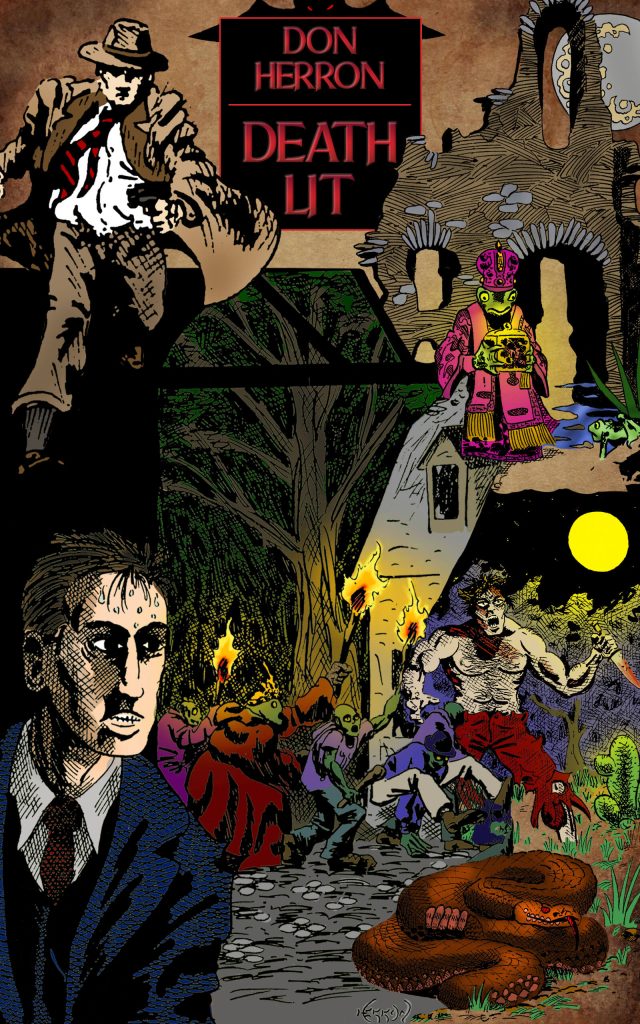
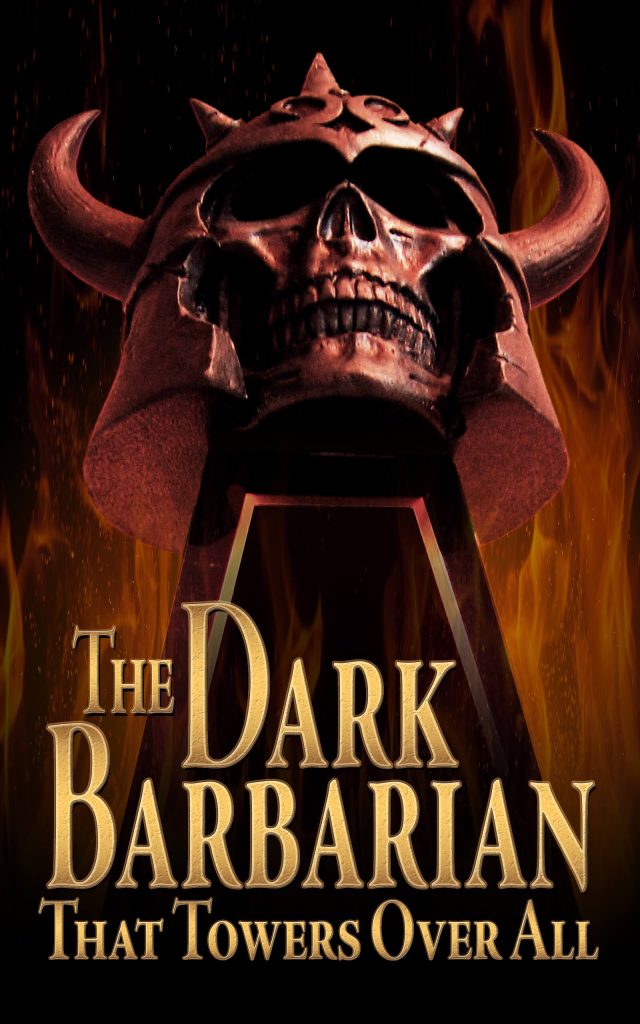
It probably won’t amount to much, but I’ve noticed a possible new trend in the way some people want Robert E. Howard and his work to be perceived. A trend, if it gains ground, which would be in diametrical opposition to my position as set forth in “The Dark Barbarian” (and in “Hard-Boiled Heroic Fantasist” from the same book), kicking it back toward the air-headed approach of L. Sprague de Camp and Lin Carter, which I rebutted in 1976 in the essay “Conan vs. Conantics.”

I touched on it briefly toward the end of a recent post, where I quote Professor Frank Coffman as asking, “Did they suggest that Conan isn’t quite the ‘Dark’ barbarian that Herron maintains?”

Apparently Frank is toying around with the idea of “The Bright Barbarian” — if he can articulate the concept in an essay, maybe he thinks he can dethrone my idea as the dominant theory in Howard Studies of the last twenty years. I don’t know if Frank is up to writing an essay that would have to be That Good, but he’s definitely monkeying with the concept. I first noticed it mentioned in his review of the Jason Momoa Conan movie — if you want to look into it, feel free, but I warn you that Frank is one of the least readable figures in Howard Studies. You’ll have to plow through a lot of verbiage about how only elite intellectuals have the technical stylistic tools to do real criticism, and you’ll be blindsided by a comparison of Conan the Barbarian with Battleship Potemkin. Jeez.

But for what it’s worth, that’s the first place I noticed the term “The Bright Barbarian,” and now I await the onslaught in my impregnable redoubt. (I think I’ll have time to take a nap.)

Meanwhile, Lightin’ Al Harron has done another post on his blog about our back and forth — Al seems to be enjoying the exchange, but his readership is getting kind of frantic:

“No, Al, no! — he’s just toying with you, man!”

“Watch it, Al, he’s got a knife!”

“Behind you, Al, he’s behind you!!!”

Al goes on and on and on and on trying to explain his positions, constantly changing the argument. If you look at the whole shebang, at first he’s wondering where I am, why I haven’t been doing anything in Howard Studies — then he realizes I’ve never been gone, that I do Howardian material steadily — then he admits he’s not really doing criticism — but then he defends what he does do, which has nothing to do with the topic of criticism. If I may borrow the technique from Frank, I have a technical word for this kind of writing, Al: dithering.

During one of our regular phone calls, I told Leo Grin, former honcho of The Cimmerian, about the Al posts, and he surfed over to check them out. First thing he noticed at the top of the page that day was a bit in which a woman who is a new editor on the Conan comic books has decided that they’re going to make Conan “sexier” and also “prettier” — with the intent of getting “more female fans into the fold.” Leo groaned, but after all, it’s only a comic book, it doesn’t matter what they do to the character — have Justin Bieber play him in a movie, the comic book dinks will justify it in their own minds for their own pleasure.  The real fiction is different — as Howard stated prophetically in the poem “A Word from the Outer Dark:”

“I am the Dark Barbarian that towers over all.”

Yeah. Dark. Barbarian. Towering over all the inferior imitations.

Yet, I do hope old Professor Frank manages to knock out a few essays on his side of the argument, such as:

“The Bright Barbarian.”

“The Delicate Barbarian.”

“The Pretty Barbarian.”

“The Girl-Friendly Barbarian.”

Creepy. . . .

Posted in Film, Lit, REH | Tagged , , , , , , , , , , |

Hammett: More Tad’s Blind Man

Once he’s on the trail, Terry Zobeck sticks like a bloodhound — and the Tad’s blind man bit from the Op story “It” has caught his attention. He put out a general inquiry on the Fiction Mags list, and credits fellow FictionMagateer Steve Rowe for steering him toward cartoonist Thomas A. Dorgan. Here’s Terry:

Although Hammett is not specific as to who Tad is, I now suspect he may be the cartoonist Thomas A. Dorgan (1877-1929), who signed his work “Tad.” He was born in San Francisco and was quite well-known in his day (he is credited with coining the word hot-dog).

Tad may well have used this saying about a blind man in a black room in a cartoon with which Hammett was familiar — and which he liked enough to use twice in his fiction.

I guess the next step will be to track a specific cartoon, or series of cartoons (if Tad used the motif more than once). It’ll probably be a matter of dumb luck, finding it, but there are a lot of comic art collectors out there, so who knows? Looking quickly into the matter, I was interested to see that Tad was inducted into the International Boxing Hall of Fame, for his many drawings of the ring — a hard-boiled cartoonist, no less.

Posted in Dash, Frisco, Lit | Tagged , , , , |

Hammett: “The Black Hat That Wasn’t There”

And Terry Zobeck is back, with more info on the Op yarn “It” — here’s Terry:

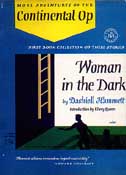
Frederic Dannay reprinted “It” — which first appeared in the November 1, 1923 issue of Black Mask — in his 1951 collection Woman in the Dark.Among the other changes he made, the most obvious was dropping the story’s original title and replacing “It” with “The Black Hat That Wasn’t There.”

At first, as I reread this story, I thought the pulp title was rather poor
and didn’t blame Dannay for changing it (no pun intended here or throughout
this piece). But, as I was reading the climactic scene — the Op’s struggle with
his killer client, Zumwalt, in a darkened basement and subsequent discovery of
the gruesome “it” — I realized, once again, that Hammett got it right.

Dannay took his title from this same scene. When the Op is caught by
Zumwalt in the basement he raises his hands, giving him the opportunity to
break the overhead light bulb and plunge the room into total darkness. As the
Op lies waiting silently on the floor he thinks of “Tad’s ‘blind man in a dark
room hunting for the black hat that wasn’t there.’”

This is a curious quote. In trying to document its source I could not
find an attribution to anyone named Tad. It appears to be a somewhat common
metaphor that has been misattributed to Charles Darwin — who supposedly applied
it to mathematicians (changing the hat to a cat). According to Wikipedia, the
earliest source is Baron Charles Bowen, a late 19th century English judge who is reported to have said: “When I hear of an ‘equity’ in a case like this, I am reminded of a blind man in a dark room — looking for a black hat — which isn’t there” (as quoted in Pie Powder, Being Dust from the Law Courts: Collected and Recollected on the Western Circuit, by a Circuit Tramp [1911] by John Alderson Foote).

Hammett liked the metaphor so much that he used it again in The Dain Curse. Chapter IX is titled “Tad’s Blind Man”. On page 91-92 of the first edition, Hammett has the Op
thinking the exact same words, this time though, as he sits at night in a
darkened car. In Robert Gale’s A Dashiell Hammett Companion he mistakenly identifies Tad as a character in The Dain Curse, giving him this entry:

“Tad. In The Dain Curse he is mentioned by the Op as a blind man frustrated in a dark room.”

Hammett, however, is obviously quoting someone named Tad, as is evident from the quote marks enclosing the words as they appear in “It” — they are absent in The Dain Curse —and the chapter title: it isn’t “Tad the Blind Man.”

Posted in Dash, Lit | Tagged , , , , , , , , , |

Hammett: “It”

Terry Zobeck springs back into action with a new posting, detailing the changes made to yet another Op adventure. Take it, Terry:

This time around we look into the edits made to the obscure Continental Op story “It.” Obscure because it is one of only two Op stories that have never been reprinted since Frederic Dannay collected them in paperback — the other, you will recall, is “Death and Company.” If you’ve yet to read “It,” beware of spoilers.

Dannay used “It” in the 1951 collection Woman in the Dark, where the story’s title was changed to “The Black Hat That Wasn’t There” — “It” originally appeared in the November 1, 1923 issue of Black Mask — the fourth Op story and Hammett’s sixth appearance in Black Mask.

“It” is not among the best of the Op stories, which perhaps accounts for — but does not excuse — its unavailability today. One of its most distinguishing characteristics is that it may be the first use of that hoariest of private eye plot devices: the killer hiring the sleuth to throw off suspicion. It may have been a fresh turn in 1923, but after many imitators, it is rather obvious. Most of the story is somewhat pedestrian, with the Op telling us what he did in his investigation rather than showing us. But the fight between the Op and Zumwalt is exciting and suspenseful:

. . . I found that I was wet and dripping with perspiration. Then I could hear his breathing, but couldn’t determine whether he was nearer or was breathing more heavily.

A soft, sliding, dragging across the dirt floor! I pictured him crawling awkwardly on his knees and one hand, the other hand holding the pistol out ahead of him — the pistol that would spit fire as soon as its muzzle touched something soft. And I became uneasily aware of my bulk. I am thick through the waist; and there in the dark it seemed to me that my paunch must extend almost to the ceiling — a target no bullet could miss.

As we’ll see in a moment, several edits were made to this scene that
diminishes its impact.

As usual, the following list provides the page number, the line number
and whether it is from the top or bottom of the page, and the affected
text — Hammett’s original wording is underlined. The page numbers refer to the
story as it appears in Woman in the Dark.

Page    Line     Top/Bottom    Text

44        2          top                   If
I’m going to work on this case for you I’ve got to have the whole
story.

44        17        bottom           over
to par during his absence,

45        3          top                 You
weren’t on the best of terms at the time,

45        4          top                 days
before that over a shady deal

46        3          bottom           he
probably has as many as any man in San Francisco. He was a wonderful mixer.

47        4          top                   who
lives in the 1100 block of Bush Street.  There
were probably others too, but I know of only those two.

47        17        bottom           The
girl—Mildred Narbett was her name—said that Rathbone [the em-dashes should be
replaced with commas

48        3          top                 that
he was out of town and wouldn’t be back for a week or two.”

49        10        top                 with
a haughty air and a nervous trick of chewing her lower lip.

50        6          top                 husband
had arrived in New Orleans and, apparently not knowing that there was
another man in the deal,
had persuaded her to return home.

50        9          top                 so
she hadn’t tried to get in touch with him, or to learn what had kept him
from joining her
.

50        17        bottom           and
what I thought of it.

50        3          bottom           “But
that means jail for Dan, with no chance to quietly straighten the matter up!”
he protested.

50        2          bottom           “It
does,! [replace the comma with an exclamation point] bBut it
can’t be helped.

51        5          top                 published
to the newspapers, who luckily had photographs of Rathbone, taken a year
before when he had been named as co-respondent in a divorce suit
.

51        15        top                 clues
clews [gotta love them “clews”]

52        15        top                 Blast
it
Damned if I can dope it out!

52        16        top                 “Here’s
something else for you to dope out,”

52        14        bottom           notepaper
note paper

53        15        bottom           bowed
myself out of the office, but not out of the job.

53        12        bottom           After:
the letter was a plant, should be this separate paragraph:

And
then again: maybe Zumwalt had given me the air because he was dissatisfied with
the work I had done and peeved at my question about the girl—and maybe not.

53        7          bottom           fit
that theory well enough.

53        4          bottom           private
dick sleuth

54        10        bottom           hour
traveling each day. . . . Thanks!” [delete the ellipsis]

56        18        bottom           head
hand

56        16        bottom           for
the a black hat that wasn’t there,”

56        13        bottom           moving
out from his the hiding place wherein he had awaited my
arrival
.

56        9          bottom           somewhere
above my feet. I wasn’t the only one feeling the strain.

56        7          bottom           Then
I could hear his breathing [this should be a separate paragraph]

56        5          bottom           Then
aA soft, sliding, dragging across the dirt floor . . .!
[delete the ellipsis]

57        13        top                 You
may know that
I put everything I had in that smack when I tell you that
not until later, when I found that one of my cheeks was scorched, did I know
that his gun had gone off
.

57        7          bottom           him
and clenched my fist, he gave in.

57        1          bottom           of
lying in the wet ground. . . [replace the ellipsis with a period]

58        1          top                 Note:
In court

58        9          top                 Zumwalt
Aat that time Zumwalt

This exhausts my holdings of Hammett’s original stories edited by Dannay for which I can identify the pure texts — for the moment anyway. I have hopes of acquiring more of the missing eight stories.

If and when I do, I’ll be sharing what I learn with you all. In the meantime I have a few more ideas for guest blogging on other aspects of Hammett’s work.
Posted in Dash, Lit | Tagged , , , , , , |

Two-Gun Bob: Lightin’ Al Strikes Again, Like Lightin’

Meanwhile, over in the World of Robert E. Howard Studies (or at least one encampment where skin-clad knuckle-draggers sit around and devour the latest issue of the Conan comic book in cannabalistic fashion — yum-yum, eat-em-up):

I see that Al Harron has tossed together a response to my previous Lightin’ Al post — if you follow this sort of thing, hop over to this bit and make sure to read the comments, too, they’re priceless. Got to love the commentator who suggests I lurked in egomaniacal fashion on Al’s site for month after month waiting for him to reply to an even earlier post — now there is someone who has no idea how this new-fangled Internet works. Al does explain about contraptions like Google Alert, and even reveals that he has his name programmed into Google Alert so he knows instantly every time his name pops up anywhere. Wow. Does that make Al an egomaniac — or is that just what almost everyone does these days?

I bet he’s an egomaniac. Come on, Al, really — you have to know every time your name graces some website?

But again, two points of clarification: I don’t actually read Al’s blog, because it’s about stuff like the Conan comic books that I don’t care about one way or the other (during Howard Days one year they were giving away comp copies when you checked in, and I didn’t take any — honest, I don’t need to read that stuff). I’m not on Google Alert, and only heard about the Al posts because Damon Sasser told me about the first one and Brian Leno spotted the next one. They’re more dedicated to patrolling the Howardian Web than I’ll ever be.

And Al is correct that I don’t think he’ll ever become a major critic, certainly not with his laid-back If I Inspire Even One New Fan style (Golly Gee, I helped a new guy discover REH, and now he’s reading the comic books!). Yeah, one new guy every now and then, that’ll really set Howard on the road to literary acclaim — if you live longggggggg enough.

Al is confusing being a general REH fan booster with being a critic. You want to review new Conan comic books for the people who read them, knock yourself out. Have fun. Keep up with movies and video games.

You want to lift Howard higher in critical regard in the wider world, you’ve got to do more than that to have any impact.

What else?

Someone tipped me off to a mini-rebuttal Professor Frank Coffman made to my dismissal of Conan Meets the Academy — a book Frank is set to appear in — as a throwback to the kinds of books L. Sprague de Camp used to assemble from material that had appeared previously in the fanzine Amra, edited by George Scithers. The Conan Reader (1968). The Conan Swordbook (1969). The Conan Grimoire (1972). Complete reliance on the name Conan to attract fanboy buyers — which may have worked for de Camp back when, but I don’t think will sell many copies of the new academic-oriented tome. They’ve made a big mistake commercially by putting “Academy” in the title — they should have titled it Conan the Supercilious or something.

Frank’s rebuttal notes, “The stuff in those LSdC’s was from Amra wasn’t it?”

He adds, “Those books contained stuff about stylometric analysis and archeological connections for Conan? Did they suggest that Conan isn’t quite the ‘Dark’ barbarian that Herron maintains?”

In answer, yes, the stuff was from Amra. In those days critics did consider “style,” but the mathematical stylometric analysis hadn’t kicked in yet — you talk about boring, try reading a stylometric piece. A sub-sub-specialty of a niche group of academics. And while I don’t recall if archaeology popped up in those de Camp edits (de Camp himself wrote whole books on ancient civilizations and traveled the world to archaelogical sites), they did include surveys of word origins in Howard and so on — basically, you take a topic and apply it to the Conan stories. What’s the difference?

As for the de Camp books suggesting that “Conan isn’t quite the ‘Dark’ barbarian that Herron maintains,” I guess Prof Frank isn’t really ready for razor-point debate. No, none of them suggested that idea, because my book The Dark Barbarian didn’t see print until 1984 — twelve years after The Conan Grimoire. The fanzine Amra itself released its last issue in 1982. It would have been very hard for them to suggest I was wrong, given that whole linear time concept I keep hearing about. . . .

But what Frank is saying unwittingly is that, yes, the ideas put forth in The Dark Barbarian have come to be the standard accepted critical concepts in Howard Studies over the last couple of decades. In the previous de Camp/Amra period, the idea was that Conan was great and that Howard was a crazy guy who killed himself at age 30 (but thank god he created Conan first!!!). The concepts I set forth were that Howard, at his best, was a great writer, and that any critical work ought to consider the whole of what he wrote, not just Conan.

Posted in News, REH | Tagged , , , , , , , , , |

Hammett: More Rhea and Wilmer

Bill Arney has been busy knocking out a new series of Cheese Theatre episodes, but after holding down the Sam Spade apartment in 891 Post Street for years he keeps his hand in on Hammett stuff — and just popped these notes in as a response to the article Mike Humbert found floating around on the web. Here’s Bill:

At least it attempts to explain the Rhea character. She’s very enigmatic in the story. However, I tend cynical on the theory. For a detective like Spade to not recognize Wilmer out of disguise is asking a lot. Ear lobes, eyebrows, chin. And we know how homophobic Hammett was. No way he doesn’t have Spade throw that in Gutman’s face.

But I will admit that I always wondered why Rhea is even in the story. What was Hammett thinking? He could have used any number of other devices to keep Spade from effectively pursuing the bad guys at that point in the story. But it’s not the only unexplained aspect of Falcon. The ship being set afire is completely unnecessary, for example. Spade could just as easily gone down there and simply found the ship empty, spent some time searching it.

But maybe it all goes back to Flitcraft. Life is full of unexpected turns. Success in life is a matter of being able to adjust to falling beams.

As far as Falcon epiphanies go, mine is that Spade knows who killed Archer the very morning after the killing, when Archer’s widow accuses Spade of the murder. Spade knows he didn’t kill Archer, and now he knows the widow didn’t do it, either.

There’s only one other character who could have got that close to Archer in a blind alley.

Well, if you don’t count Effie, that is.

Posted in Dash, Lit | Tagged , , , , , |

Hammett: Rhea, Wilmer, or. . . ?

Mike Humbert refreshes his name in my Tag Cloud by sending in a link to a bit about The Maltese Falcon he’s found hanging out in the web — as he notes, it is an “Off-the-wall theory, but interesting. . . .”

The basic idea put forth by Marissa Skudlarek is that Gutman’s daughter Rhea in the novel (a character dropped by John Huston from the film version) and the young gunsel Wilmer Cook are the same person. 

If you’re interested in this sort of speculative litcrit, hop over and have a look, then come back and I’ll toss my two-bits into the aether. As Mike says, it is interesting, and it’ll get you thinking.

Back? Ready for more? Okay.

My favorite interpretation of the role of Rhea Gutman comes from the late, great Stan Old, who first suggested to me the idea that, like Wilmer, Rhea is another sex toy Gutman hauls around with him. Not his daughter, necessarily, but traveling under that cover. Overall in the plot of the novel, that makes more sense, and explains the dramatic scene where Wilmer blushes when Spade mentions the cuts on Rhea’s body — I’ve long thought that Hammett was referring to some sexual practise Wilmer and Rhea (perhaps under the tutelage of Gutman) were engaged in. One involving pins. No doubt someone out there is an expert on the subject, but the closest thing I have encountered to the idea for the time is Albert Fish, who inspired the legend that when they tried to fry him in the electric chair he shorted it out because of the large number of pins deeply embedded in his flesh and testicles. I think I can safely call Fish demented without offending anyone — child rapist and murderer, cannibal, the works.

The suggestion is that Gutman and crew are sick puppies, if you pick up on it — if not, the crime novel just rolls on and you wait to see whodunit.

Marissa is correct that Rhea only appears onstage for the one scene, where she is drugged in the hotel room. But she is first mentioned in Chapter XIV La Paloma — where Spade “went to the Alexandria. Gutman was not in. None of the other occupants of Gutman’s suite was in. Spade learned that these other occupants were the fat man’s secretary, Wilmer Cook, and his daughter Rhea, a brown-eyed fair-haired smallish girl of seventeen whom the hotel-staff said was beautiful. Spade was told that the Gutman party had arrived at the hotel, from New York, ten days before, and had not checked out.”

The way detective novels are written, it doesn’t sound as if Gutman checked in with Rhea one day and brought her in disguise as Wilmer to check in later — they checked in as a party and the staff saw a female, and apparently more than just one fleeting glimpse.

In Chapter XVII Saturday Night Spade asks the desk clerk, “‘These Gutmans — up in twelve C — are they in?'” Then we get the bit about how the Emergency Hospital crew Spade had called for Rhea had showed up and found no one. The clerk says, “‘. . .there was nobody up there. They went out earlier in the evening.'”

In Chapter XX If They Hang You Spade phones the cops and says, “‘They’ve just left here and they’re blowing town, so you’ll have to move fast, but I don’t think they’re expecting a pinch. . . . There’s a girl in it too — Gutman’s daughter.’ He described Rhea Gutman. ‘Watch yourself when you go up against the kid. He’s supposed to be pretty good with the gun. . . .'” Again, unless a very, very clever cross-dresser has pulled the wool over Spade’s eyes, at the end of the novel he believes Rhea and Wilmer are distinct individuals.

And if you dig around in the novel you’ll find more details, which could be made to go either way — in the one Rhea scene she has “dulled golden-brown eyes” and while they’re waiting for Effie to bring in the black bird in Chapter XVII The Fall-Guy we learn that the “boy’s eyes were cold hazel gleams.” Hazel and golden-brown are close enough, but the other details just don’t flow — in particular, I think it is a giant stretch to think it means anything that Spade first carries Rhea into a room with masculine items laying around, then crosses a hall and finds a room with female items and leaves her there.

But I did enjoy the idea of “doubling” — and you can contemplate it in various other ways, not just Rhea-is-Wilmer. If Rhea and Wilmer are both used to sate the sexual appetites of Gutman, then their similar physical appearance make them his type, and Janus figures.

And I don’t recall thinking much about it before, but Rhea is something of a shadow-figure for Brigid, an echo of sorts — both female, criminals traveling the world on a treasure hunt, skilled in lying. . . a reflection further down in a hall of mirrors.

And even better, Rhea is a thematic halfway point toward the character Floyd Thursby, famous because he never appears onstage in the novel — we only hear about Thursby at secondhand, but we have no doubt that he exists. Rhea appears onstage in the one scene, and like Thursby is mentioned on other occasions, but I see no textual reason to think she doesn’t exist (or is running around disguised as Wilmer most of the time).

I do like the idea that Hammett is playing with the tonality, the richly detailed onstage characters, the almost non-existent daughter, the fully offstage gunman. . . . Yeah, that hall of mirrors effect.

And of course, if you want to explore some real cross-dressing in Hammett, don’t miss the 1925 Op tale “Mike, Alec or Rufus” which Frederic Dannay reprinted under the title “Tom, Dick or Harry” in The Creeping Siamese. Rhea, Wilmer or. . . ?

Posted in Dash, Film, Lit, News | Tagged , , , , , , , , , , , , |