Hammett: “Angel,” Resurrected

Our now regular Guest Blogger Terry Zobeck returns for another installment — following “This King Business” and “Death and Company” — detailing the various changes made by Frederic Dannay when he was editing Hammett for paperback. I couldn’t help but look into my copy of A Man Named Thin, which assures us on the front cover that this is the “First book collection of these stories” — no problem there — and that it is “COMPLETE AND UNABRIDGED” — whoa!!! There we must disagree. Here’s Terry with a list of abridgments for:


“The Second Story Angel” was published in the November 15, 1923 issue of Black Mask.  Dannay reprinted it in his final selection of Hammett’s short stories, A Man Named Thin.  It’s a tale about a struggling writer — hmm, wonder what the inspiration for this was? — searching for a plot for his next story when he is visited by a lovely lady burglar in the night. Rather than turn her over to the police, he pays a bribe to the detective on the scene. In return, he hopes she will tell him her life story, which he will then use for his fiction. The story resolves with an amusing twist; I suspect Hammett meant to be a little more risqué, but had to settle for a simple kiss. It is set in New York City rather than San Francisco; however, Hammett provides no details of the city that would give the story a sense of place, unlike what he often did with his stories set in San Francisco.

Like many of Hammett’s stories that Dannay included in Ellery Queen Mystery Magazine and/or collected in the digest volumes, he took the blue pencil to “The Second Story Angel.” In providing the original text, I’ve used the same format as my earlier posts — page number, line number, whether it is from the top or bottom of the page, and the text corrections. The page numbers refer to the digest first edition A Man Named Thin (1962):

Page no.    Line #     Top/bottom     Text

73                 2                top

         of various divers popular magazines

74                 17              bottom

         to a position outside without the next room

74                 15              bottom

         on the intruders part

75                 8                top

           Should be a new paragraph: Then he drove a fist

75                 13              bottom

            lay a tool, a very small pinch bar

76                 2 & 3         top

            of the former to her temples and face and of the latter between her the lips

76                 5                bottom

            Should be a separate paragraph: She laughed briefly

77                 4                top

             Should be a separate paragraph: “Suppose you tell me about it.”

78                 8                top

              whether you make lay charges

80                 10              top

               Carter found himself saying, speaking:  The dialogue that follows should be a separate paragraph

80                 12              top

               Cassidy shook his head briskly bruskly [yes, that’s how it’s spelled in the original]

80                 15              bottom

               Dialogue should be a separate paragraph: “I’m makin’ a sap o’ myself

80                 14              bottom

                give me the th’ dough

80                 6                bottom

                 girl’s hunger;:

81                 13              bottom

                 a lawyer

81                 7                bottom

                Before: it’s just that it’s a rotten way, should be: but it amounted to the same thing, and I didn’t want any of it.  It’s not the morals of it—

81                 5                bottom

                 a job somewherein a store

82                 7                top

                wrong place by mistake; original has: wrong place my mistake; the original appears to be a typo

82                 3                bottom

                and that brings my the tale up-to-date [there should be no hyphens in “up to date”]

83                 3                top               

                 After: potentialities, should be: —already trying to frame the opening paragraph that would come from his typewriter.

83                 9                top

                Should be a separate paragraph: Carter laughed.

83                 18              top

                All of the stories noted here should be in single quotes; all of the magazine titles should be in italics.

83                 5                bottom

                The dialogue should be a separate paragraph: “But I suppose

84                 6                bottom

                 Should be a separate paragraph: They were afraid

85                 3                top

                After: express her gratitude, should be a new paragraph of the following dialogue: “You’re one white ––”

85                 13              top

                Mrs. H. J. H.

85                 16              bottom

                 the city, then, or for the newspaper.

85                 14              bottom

                  in his New York rooms,

85                 12              bottom

                  mail frantically feverishly

85                 12              bottom

                   the messenger-boy

85                 10              bottom

                    town,—futile telegrams [the comma is added and the em-dash is deleted]

86                 3                top

                    drawn from the life

86                 8                top

                    serial, dramatic and moving picture rights of this story

86                 9                top

                    she was a crook [“was” should be italicized]

86                 13              top

                   Finally the manuscript tale was completed, found satisfactory, and sent out

86                 15              bottom

                   Gerald GFulton and Harry Mack Mays [subsequently, Dannay reverted to Fulton]

86                 10              bottom

                   When the group four visitors

86                 5                bottom

                    Should be a separate paragraph: He turned to Carter.

86                 4                bottom

                    of the idea for your story, The Second Story Angel [the title of the story should be italicized rather than enclosed in single quotes]

87                 6                top

                    Mack Mays

87                 10              top

                     It was Mack’s Mays voice [there is no apostrophe after Mays—this is an error]

87                 16              top

                     and the his four professional writers guests

87                 13              bottom

                     Mack Mays

87                 7                bottom

                     bought one,; but five –”

97                 4                bottom

                     Mack Mays

So, there you have it, “The Second Story Angel” resurrected to its original text. Next up, we’ll see “Who Killed Dan Odams” and what, if anything, Dannay did to further the homicide.

Posted in Dash, Frisco | Tagged , , , , , , |

Rediscovered: Haefele Roaming Around the Arkham Hills

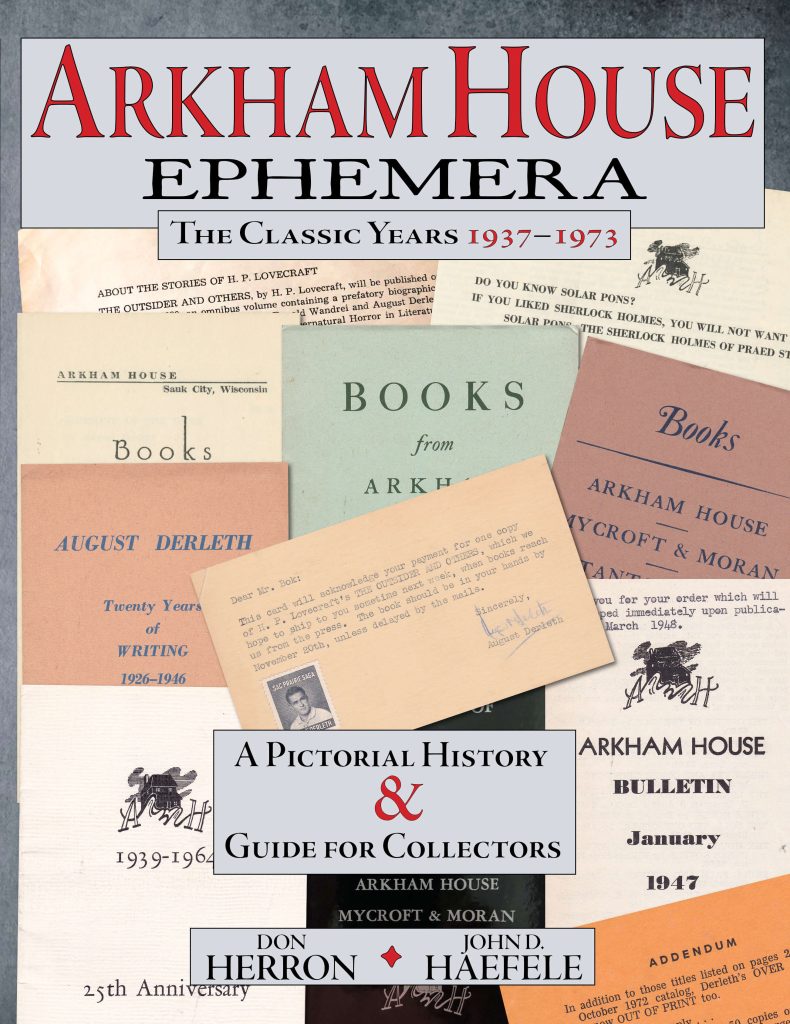
My Arkham House ephemera collecting pal John D. Haefele returns to print with “Far from Time: Clark Ashton Smith, August Derleth, and Arkham House” in the premiere issue of Weird Fiction Review from Centipede Press. John last got a blurb on this site when his booklet August Derleth Redux: The Weird Tale 1930-1971 came out — that title just caught a review in Europe. And weird fiction fans may also remember him for his research essay on how Derleth brought out the first major anthology of Robert E. Howard’s fiction, “Skull-Face and Others at Sixty,” in the September 2006 issue of The Cimmerian.

I picked this one up just for John’s coverage of how Derleth chose Clark Ashton Smith as the next major writer he’d promote for the Arkham lineup, after H.P. Lovecraft. But Scott Connors also appears with an impressive statistic-filled article on how it was Lovecraft, not Seabury Quinn, who was the most popular writer for Weird Tales, based on the ongoing Readers Polls. And the short story by Jason Eckhardt was good — the rest of the contents I sampled the openings of, didn’t continue.

I’ve found in thirty or more years of buying fanzines, that most you get only for one or two pieces, worth keeping around for reference. Very few are great in total, like The Cimmerian was in its heyday.

The price on this issue is very competitive with current magazines, such as the new issue of Two-Gun Raconteur. Some of the Centipede price tags for their books are kind of unbelieveable, but this one is more or less current market value. And overall, very sharp looking, marred only by more typos than you’d like to see slip past the proofreaders.

But if you’re like me you’d only want it for Haefele and Connors, and their articles are pretty clean, something you can consult for years down the road.

Posted in Lit, News, REH | Tagged , , , , , , , , , , , |

Tour: Urbane and SFist


This shot of me and Charlie Morfin of the Black Dahlia Tours gumshoeing up Elwood alley reminds me of a shot used in the recent article for The SFist, which you can check out here.

Posted in Tour | Tagged , , |

Two-Gun Bob: Poetry on Parade

As Donald Sidney-Fryer and I were trooping down Enchanted Rock outside Fredericksburg, Texas, a stop on our way to Robert E. Howard Days in Cross Plains in June 2009, I did not suspect that I was going to be drafted to sit in on a poetry panel that DSF was chalked in on. The idea was that Don and the Texas Poet Laureate Larry D. Thomas would be the stars, with Howard fan Professor Frank Coffman doing the moderating.

But about a minute before the panel began, Howard fan Indy Cavalier (yeah, I know, I’ve thought his name was made up for many, many years now) told me that Frank wasn’t going to be able to attend and asked if I’d sub for him.

Sure, why not? How hard could it be, running a poetry panel with zero prep time?

If you’ve got any interest at all, yet another Howard fan, Ben Friberg, did video on DSF’s main spiel and has a basic cut of it up on YouTube. You like poetry, you like Robert E. Howard, there you go.

More pieces of the panel were up for awhile, which unfortunately left off my introductory remarks, where I recall telling the audience that I was going to be much more entertaining than Frank would have been — I’m not a professor, I’m fun. Also, if memory serves, I used the opportunity to demote Indy. Some years ago I anointed him Black Indy, but at that time he’d just let Joe Lansdale kick his butt in some online discussion of some comic books — pathetic, really. So I demoted him to Brown Indy, and if he doesn’t watch himself, he may be reduced to Yellow Indy before it’s all done. . . .

Looks like I’m not going to make the scene for Howard Days this year, but I have done a couple of things for books that will premiere there. And I see that Indy recently did a post about another item where I contributed a quick but heart-felt tribute to Glenn Lord, the major Howard scholar of the last six decades.

Got to love Howard fandom. I know almost all those guys, and enjoy watching the debate that continues to rage over the poetry readings the fans have had at Howard Days in recent years. It’s not that people don’t like Howard’s poetry, it’s that people don’t like BAD READINGS of Howard’s poetry.

Just before the poetry readings began in 2009, DSF and I — wised-up with age — made a break for it. If I can help it, I’m never getting stuck at another bad poetry reading again in my life.

A good reading, though, that would be okay.

Posted in Film, Lit, News, REH | Tagged , , , , , , , , |

Hammett: Have Pen, Will Edit

Terry Zobeck returns for another Guest Blog spot, to kick off the month of June. He plans on more posts on pure texts to follow his detailed surveys of “This King Business” and “Death and Company.”  This time he looks into a little known facet of Hammett’s life as a pulp writer in San Francisco: 

By the end of 1922, Hammett was through as a detective. His health had deteriorated so much he could no longer do such strenuous work. To supplement his disability income, he began writing fiction. By the beginning of 1924, Hammett had published 18 stories in a variety of magazines, including The Smart Set, Brief Stories, 10 Story Book, The New Pearsons, Saucy Stories, Action Stories, and Black Mask. While this magazine work served Hammett well during his period of apprenticeship as a writer, it did not pay well. He needed to further supplement his income with work that was not physically demanding.

It is only within the past five years that we’ve learned about one of Hammett’s attempts to earn a few more dollars — he offered his services as a professional editor to other aspiring writers. Starting in January 1924, Hammett placed a monthly classified ad in Writers Digest — the magazine for authors that had begun publication four years earlier. 

Three variations of the ad ran through July of that year — these are pictured above and below.

A few years ago, a seller on eBay offered the July 1924 issue of Writers Digest, noting it had a classified ad by Hammett offering his editorial services to writers of prose fiction. This was news to me. It sent me scrambling to the book shelf for the June 1924 issue, which contains Hammett’s article “In Defense of the Sex Story”, a response to H. Bedford-Jones’ “Sex Deftly Handled” from the October 1923 Writers Digest that was critical of the gratuitous use of sex in fiction. Sure enough, there on page 37, was another classified ad from Hammett. A few weeks later I searched microfilm copies of Writers Digest at the Library of Congress and discovered the third variation, and that the ads ran for seven months.

These ads had escaped the attention of Hammett scholars, bibliographers, and collectors all these years. Admittedly, they are the most minor of Hammett, yet they provide a further glimpse into his life at this time. He obviously believed himself to be sufficiently skilled at writing fiction — after only a little more than a year at practicing it — that he could charge other writers for his editorial services. He was after all a fiction writer who had “found a consistent market” for his “marketable fiction”, and he didn’t believe his “experience too slight.”

And, even this early in his career, he knew breaking the rules could make for more effective writing.

Given that the ads only ran for seven months, it is unlikely they were successful in attracting clients. In addition, as Don notes in the Dashiell Hammett Tour, writing about the first ad, it is hard to imagine Hammett working on his own stories while editing the work of others.

But it is an intriguing thought that there may be some long forgotten short story or even a novel or two waiting to be discovered that benefitted from Hammett’s blue pencil.

Posted in Dash, Frisco, Lit | Tagged , , , , , , |

Death Lit: Ace Atkins Returns!

Ace Atkins is returning to “M” is for Mystery in San Mateo for a signing of his latest novel, The Ranger, on Tuesday June 14, 7 p.m. Unless I’m jumped and blackjacked into some noir limbo, I plan to be there. I’m a few novels behind on Ace’s backlist, but I’ve read close to half and he’s one of the best crime writers going today — I figure I’ll grab a couple more I’m missing, plus this new one.

Ace is getting a lot of press after signing on to continue the Spenser series created by Robert B. Parker — I’ll have to tell him what Parker said about writing a Philip Marlowe novel when he came into the burg to be Guest of Honor for that Bouchercon I was chairman of in 1982.  

The photos this time date from Thursday April 2, 2009, shot on location in “M” is for Mystery, when Ace and I did a joint signing for his novel Devil’s Garden and the then newly released Dashiell Hammett Tour book. Top grainy image, we’re working the audience from the stage area. Bottom, in sharper focus, the formalities are over and people are milling around — in the foreground signing a book, leg propped on a chair, you’ll spot Vince Emery, with Ace toward the back.

And Ace, like pretty much everyone else, loved the film clip of Hammett I put up for his birthday — he did a bit on his blog about it, even speculating on exactly what kind of cigar Hammett was about to lip. A Cohiba? Maybe.

Posted in Lit, News | Tagged , , , , , , , |

Hammett: More on “Death”

Prompted by Terry Zobeck’s post on “Death and Company,” I pulled out my Dell Mapback edition of The Return of the Continental Op and checked through all his corrections. Took a little bit of work, since Terry’s page and line numbers refer to the first edition, the Lawrence Spivak digest-sized paperback — but once I got into the flow of the story, it wasn’t that hard to figure out where the missing stuff belonged.

I prefer the look of the Mapbacks over that of the first edition digests myself, but my ragtag collection of the Dannay edits is split about half-and-half between digests and Mapbacks, since I only have them to read the stories. Bottom line, a Hammett fan just wants to read the stories.

Terry’s corrections have forced me to rethink an idea I’ve entertained for years, which I touched on specifically on page 108 of the newest Hammett tour book, using some backup data previously dropped on page 70. To sum up, I have thought that Hammett intended the aptly titled “The Farewell Murder” to be his personal good-bye to the Continental Op series, and in effect to Black Mask, not “Death and Company.”   

“Farewell” appeared in the February 1930 issue of the Mask. That same month Knopf released The Maltese Falcon in hardback, following Red Harvest and The Dain Curse in 1929. Hammett’s Hollywood work, the really big money, had begun.

For all practical purposes, Hammett’s pulp era was over. Yes, his next novel, The Glass Key, would appear in Black Mask in four parts in the March, April, May and June 1930 issues, but that was already in the pipeline. You say adios to the short fat Op, turn in the new novel you’ve written with Knopf in mind, set your sights on the future, and don’t look back.

But then “Death and Company” saw print in the November 1930 Black Mask — after that, no more Hammett in the magazine where he made his name.

My idea was that Hammett pulled “Death and Company” out of a reject stack from circa 1924 or 1925, to give editor Cap Shaw one more chance to toss his byline onto the contents page. “Death” reads to me like something from this same period, when Hammett goes offstride from time to time — as in “Women, Politics and Murder” or “Mike, Alec or Rufus” or “The Creeping Siamese.”

My reasoning was purely based on texts — “Death and Company” doesn’t read like an Op story from the end of his Black Mask run, while “The Farewell Murder” doesn’t really read like a classic Op story at all — it is smoother, cleaner, and consequently less interesting in its way. As in other of his last few stories, the technique is fine, but a certain fire is gone.

And then Terry had to complicate the scenario with more information!

The big clews came as I discovered that Dannay had changed some of the San Francisco street names, for no apparent reason — I know that some people with an interest in Hammett don’t grasp the great symbiotic relationship between the author and The City, but trust me, you don’t change out local details, you don’t omit any information that reflects on Hammett’s time in San Francisco. (I still can’t believe that Hammett’s October 2, 1944 letter to Pru Whitfield — see page 113 in the tour book — was left out of the Selected Letters — come on!)

The line per Dannay, “At first they were making the George-and-Larkin-Street brickpile a midnight target for half the police force,” we now know originally said Turk and Larkin, an actual intersection — who knows from what bizarre impulse Dannay subbed in “George,” which isn’t a street name in San Francisco, then or now. Without doing any research at all, my guess is that the “brickpile” would have been some large structure on the southwest corner, where the massive Federal Building stands today.

And in terms of what we know about Hammett’s life in San Francisco, the intersection of Turk and Larkin is one block west of where he is said to have rented a room in 408 Turk, on the corner at Hyde, and one block south of where the pulp fictioneer and his family lived longest in 620 Eddy Street between Larkin and Polk.

The big piece of info, though, is that “Park Street” is supposed to read “Post Street” as in “Take your police to Apt. 313 at 895 Park St. and you will find the corpse we promised you. . . .”

891 Post Street was Hammett’s last address in San Francisco, before he left late in 1929 to make his assault on New York and Hollywood. As most Hammett fans know, he began a story called “The Thin Man,” set partly in San Francisco and featuring detective John Guild (not Nick and Nora Charles), around the time he left town. He never finished that version, but in the fragment he drops the address 1157 Leavenworth — he had his wife and daughters installed for a year or so in rooms in 1155 Leavenworth. There is no 1157 Leavenworth, no 895 Post Street — but clearly Hammett would offset real street numbers slightly if he decided to play around and use a building he was familiar with in a story.

We are confident he lived in room 401 in 891 Post, and used that room as the apartment for Sam Spade in The Maltese Falcon — various pieces of paper back that up, plus when he lived in that apartment Bill Arney used clews in the novel to match details of 401 exactly. But who can say that Hammett didn’t live in another unit in the building at some point, maybe moved from that one to 401, or from 401 to another unit?

A quick check through the various editions of the Hammett tour book failed to turn up any printed mention I may have made about an incident on the tour — the tour, a living thing, almost — which occurred circa 1979 or 1980. On the walk itself, I drop the reference on occasion, but what happened was that as the group stood outside the doors of 891 Post an old lady emerged from the building, recognised what we were up to, and told us, “I remember that guy. He lived in room 312.”

Room 312. Versus room 313 in “Death and Company.” I tell you so that I’m not the only person on the planet being gnawed on by this information.

And coolest of all, I noticed this bit which leaped out full force once I understood that the story featured 891 Post: “The manager of the house told us the apartment had been occupied by a man named Harrison M. Rockfield. She described him: about 35 years old, six feet tall, blond hair, gray or blue eyes, slender, perhaps a hundred and sixty pounds, very agreeable personality, dressed well.” What you have there is Hammett describing himself as the occupant of the apartment!

I’m not yet willing to give over my idea that “Death and Company” doesn’t date from an earlier period, and that Hammett didn’t take that typescript and add 891 Post Street into the action in 1930. And I freely concede, thanks to Terry going after the original text, that if Hammett did write “Death and Company” as his farewell gesture to the Op and Black Mask, then it’s a lot better than I had thought, because he casts himself as the suspect — and that’s fun, fitting, an appropriate note to go out on.

As of today, I’m a much bigger fan of “Death and Company” than I ever have been before. How about you?

Posted in Dash, Frisco, Lit, News, Tour | Tagged , , , , , , , , , , , , , , , , , , , , , |

Hammett: Give that Man a Cigar

How about a surprise for Hammett’s 117th birthday?

As you may or may not know, researchers have managed to turn up almost zero footage of Hammett on film, and so far not a single audio recording. Doesn’t mean there’s nothing out there, waiting for discovery — we can hope that one day Hammett’s testimony before McCarthy will surface, kind of the Holy Grail of something we know was filmed but no one has been able to find in an archive.

When American Masters located some brief grainy footage of Hammett for their segment about his life, it was considered a real coup. Practically a miracle. (And if I remember right, in some of the scenes with talking heads in that documentary you can spot me and Bill Arney drinking in the background, pulling our cameos, tossing back shots of Jack Daniels.)

But a year ago I popped down to L.A. for a quick visit, and my pal Leo Grin told me that he thought he had spotted Hammett in a brief clip in the documentary Somewhere Over the Rainbow: Harold Arlen (1999), on the life and times of the Great American Songbook composer best known for tunes like “Get Happy,” “That Old Black Magic,” “Ac-Cent-Tchu-Ate the Positive,” “Stormy Weather,” and (of course) “Over the Rainbow.” We fast forwarded until we got to the moment, so I could check on it.

Yep, right there at the 27:37 mark. Hammett. No question. Alive. Well. About to massacre a cigar.

Hammett is standing with Anya Taranda, Arlen’s model-turned-wife, and director Vincente Minnelli. As I say in the tour book, during his Hollywood years Hammett knew everyone, and this footage only backs that idea up. Personally, I have much more interest in the era when Hammett worked as an operative for Pinkerton’s National Detective Agency and pounded the typewriter keys as a pulp writer in San Francisco, but who wouldn’t admit that hobnobbing with Minnelli and Judy Garland and that crew has its own deep fascination?

So, enjoy this quick glance into yesteryear — and whoever does the next Hammett documentary can track down the rest of the footage so we can see the author of The Big Knockover mugging for that camera.

And if you happen to meet up with the eagle-eyed Leo Grin, buy him a drink, or offer him a cigar. Hammett, as you can see, approved of cigars:

Posted in Dash, Film, News | Tagged , , , , |

Hammett: The Original “Death”

As announced, Terry Zobeck is on board to let Hammett fans know exactly which words and sentences Frederic Dannay cut from the original magazine texts as he collected Hammett’s short stories into digest-sized paperbacks — in effect, Terry is reconstructing the closest thing we have for a “pure text” on stories many readers thought they knew well, and encouraging the next publisher who releases a Hammett collection to do it right. Here’s Terry:

“Death and Company” was the last Continental Op story to see print and was Hammett’s final appearance in Black Mask (November 1930). Collected in The Return of the Continental Op in 1945, it has not been reprinted since — making it one of only two Op stories not readily available to readers today (the other is “It”).  Perhaps that makes it all the more unfortunate that Dannay edited the story heavily.

While not among the best of the Op stories, “Death and Company” is far from the worst — and Dannay’s edits don’t help it any. In fact he cut some nice dialogue and description, particularly at the end of the story. I’ve detailed the edits, restoring Hammett’s original text, following the same format for presenting the restored text as with my earlier piece on “This King Business” — page number, line number, whether it is from the top or bottom of the page, and the affected text. In this case, the page number refers to the page in The Return of the Continental Op


Page no.    Line #     Top/bottom     Text

79              1             top

                   Dannay inserted “meaning the head of the Continental Detective Agency,” after “The Old Man”.

79              3             top

                   Following line 3 should be: I sat down.

79              4             top

                   Chappell was a man of forty-five

79              5             top

                   I noticed hHis eyes

79              6             top

                   and their lower lids

79              13           top

                   and that is to go to the lot of George on Turk and Larkin St. [in the original the letters from Death & Company are in all capitals].

79              3             bottom

            I telephoned all of them — everybody I could think of —and none of them had seen her.

80              1             top

                   Before the first line the following text was deleted: 

                  “Any enemies? Anybody with a grudge against you, or against her? Think, even if it’s an old grudge or seems pretty slight. There’s something like that behind most kidnappings”

                  “I know of none,” he said wearily.

80              4             top

                   “I’ve an manufacturers advertising agency.”

80              6             top

                   “No, the only one I’ve ever discharged was John Hacker and he has a better

80              8             top

                   Before this line the following text was deleted: 

                  I looked at the Old Man. He was listening attentively, but in his usual aloof manner, as if he had no personal interest in the job.

80              9             top

                   but they’re necessary.  Right?

80              10           top

                  He winced and took a deep breath as if he knew what was coming, but nodded and said: Right.

                  Has Mrs. Chappell ever stayed away over night before?

                  No, not without my knowing where she was. His lips jerked a little. I think I know what you are going to ask. Id like — Id rather not hear. I mean I know its necessary, but, if I can, I think Id rather try to tell you without your asking.

                  Id like that better to, I agreed. I hope you dont think Im getting any fun out of this.

                 I know, he said. He took a deep breath and spoke rapidly, hurrying to get it over:

80              16           top

                  I replied, and then complained: Its a damned shame thats the only way to handle a kidnapping. These Death and Co. birds are pretty dumb, picking that spot for the pay-off. It would be duck soup to nab them there. I stopped complaining and

80              9             bottom

                 off till then.” I asked the Old Man: “Don’t you think so?”

80              8             bottom

                 The Old Man He nodded and reached for his telephone. I think so. Ill have Lieutenant Fielding and perhaps someone from the District Attorneys office come up here and well lay the whole thing before them.

80              7             bottom

                 Fielding and an aAssistant District crown aAttorney

80              6             bottom

                 making the George Turk-and-Larkin-Street-brick-pile

80              5             bottom

                 for half the San Francisco police force

80              4             bottom

                 We waved dug up the history of kidnapping from the days of Charlie Ross to the present Parker and waved it in their faces and showed

81              1             top

                   At 11:30 half past eleven oclock that night [This should be the start of a new paragraph]

81              2             top

                   $5,000 five thousand dollars wrapped

81              2             top

                   At 12:20 twenty minutes past twelve he returned.

81              4             top

                   he said with difficulty. I didnt see anybody.

81              6             top

                   I dozed on in a sofa.

81              after 9    top

                   She did not come home [This is a separate paragraph]

81              14           top

                   “You had the place watched?” he cried.

81              15           bottom

                 Inside was another of the crudely printed letters.

81              4             bottom

                 Before: I asked Campbell, should be: I looked at the postmark on the envelope. It was earlier that morning.

81              1             bottom

                 At 11:30 half past eleven oclock that night Chappell left his house with another $5,000 five thousand dollars.

82              2             top

                   like the previous one except that he had less hopes of seeing Mrs. Chappell in the morning.

82              3             top

                   expected another letter in the morning asking for still another $5,000 five thousand dollars.

82              8             top

                   895 Park Post St.

82              11           top

                   jumped for the telephone on a nearby table.

82              15           top

                   “Stow Hell with that,”

82              16           top

                   The Park Post Street address

82              17           top

                   It took a couple of more minutes more to find

82              18           top

                   apartment house and to take the her keys away from him herThen we went up and entered apartment 313.

82              16           bottom

                  on the living room floor in 313.

82              15           bottom

                 Before: She had been dead, should be: There was no question of her being dead

82              5             bottom

                 He She described him:

82              4             bottom

                 160 a hundred and sixty pounds

82              3             bottom

                 He She said Rockfield he

83              3             top

                   Before: The police department experts, should be: We found a plentiful supply of clothing in the apartment, some of which the manager positively identified as Rockfields.

83              10           top

                   Before: A detective came in, should be: But why? Chappell demanded dumbfoundedly.

                    Playing safe. You wouldnt know till after youd come across. She wasnt feeble. It would be hard to keep her quiet in a place like this.

83              15           top

                   After: without being seen by them, should be: Callahans answer to that was a bellowed The Hell they couldnt—they did!

83              13           bottom

                After: “wait for me.” Should be a new paragraph:

                I told Callahan and the others what Chappell had told me.

                Callahan growled. —-,he said, I guess were up against another of those — damned nuts!

83              11           bottom

                 he tried to explain. “I’m I am

83              10           bottom

                  I’m not that afraidbut-but with Louise

83              6             bottom

                  The paragraph starting on this line should be broken into two paragraphs; the first sentence is a separate paragraph in the original.

84              3             top

                   find him, because you know how tough that —- is.

84              4             top

                   “I know,” he I said.

84              8             top

                   cursing Moley, in a choked husky voice.

84              9             top

                   After: I said, should be: Stop that.  Thats no good.

84              12           top

                   After: had dropped from him, should be:  Get your hat,I said, and well go.


                   He ran upstairs for his hat and down with it.

84              13           top

                   He had asked

84              15           top

                   Before: “I can’t,” should be:

                   But in the car he went suddenly limp and slid down in his seat.

                   Whats the matter? I asked.

84              17           top

                   brought had a maid bring him water.

84              4             bottom

                   but I found the latch and worked it.

84              1             bottom

                  and fired once straight ahead at random.

85              7             top

                   Before: I picked up his gun, should be:

                   That damned fool maid got scared and locked this door, he complained, or Idve made it out back.

85              7             top

                   I went nearer and picked up his gun.

85              8             top

                   I hadn’t dropped the gun when the leg it upset me.

85              14           top

                   “That was — damned dumb of you.”

85              17           top

                   his to pinch him for killing his wife?”

85              16           bottom

                  I hope to —- they hang you for it.

85              9             bottom

                  I came pretty near giving the rat — — — —– what he deserved.”

86              1             top

                   or you wouldn’t have pulled this one. Anyhow we had enough to figure he was wrong, and if youd let him alone wed have pulled him, put it in the papers, and waited for you to come forth and give us what we needed to clear you and swing him.

86              8             top

                   I had to go downtown, but I wasn’t gone an hour.

86              8             top

                   cold when I came back.” He frowned. I dont think shedve answered the doorbell, though maybe—or maybe hed had a duplicate made of the key she had.


                  Some policemen came in: the frightened maid had had sense enough to use the telephone.

86              last line

                          Death and Company Co. business.

So, there you have it, the restored “Death and Company”.

Posted in Dash, Frisco, Lit | Tagged , , , , , , |

Hammett: The Dannay Edits


Terry Zobeck returns for another Guest Blog post, an overview of Things to Come. Inspired by his research into restoring the pure text on “This King Business,” Terry has decided to dig into his collection and show us what Hammett wrote before Fred Dannay put the blue pencil to it. Here’s Terry: 

All fans of Dashiell Hammett’s stories owe Frederic Dannay — one half of the Ellery Queen team — a great debt of gratitude. Starting in 1943 and continuing over the next two decades, Dannay, with Hammett’s permission, collected the majority of his short stories in a series of 10 digest-sized paperback volumes.

It is unfortunate, however, that he chose to edit many of the stories in often inexplicable and seemingly capricious ways. Until recently, these were the only versions of the stories that most of us could readily access, because Dannay’s editions — while long out of print, if available on the collectors market — formed the basis of the texts used for The Big Knockover (1966), The Continental Op (1974), and Nightmare Town (1999) — all of which are still in print. Only the two most recent collections of Hammett’s short fiction — Crime Stories & Other Writings (2001) and Lost Stories (2005) — based their texts on the rare original pulp and slick magazine appearances.

For the record, Hammett published 65 stories in his lifetime; one of these, “The Man Who Loved Ugly Women” has not been located. A 66th, “A Man Named Thin,” was published in Ellery Queen’s Mystery Magazine (EQMM) a little more than a month after Hammett’s death in 1961. Dannay ultimately collected 54 of these 66 stories in his 10 volumes.

Two additional stories have been published more recently: “Faith” in Otto Penzler’s Pulp Fiction: The Villains (2008) and “So I Shot Him” in the Strand Magazine (2011—volume XXXIII). 

In an earlier post I documented the edits Dannay made to the Op story, “This King Business,” when he reprinted it. In discussing this story via emails with Don, I noted that I’ve always thought Dannay edited Hammett’s stories for the digest volumes. Don suggested instead that if he edited them largely for reasons of space, then he probably edited them as he reprinted them first in the pages of EQMM. With the aid of the FictionMags Index, I checked the contents of all of the issues of EQMM from the 1940s through the early 1960s. It turned out we were both right. Of the 54 stories Dannay collected, 34 were used first in EQMM before Dannay collected them in one of the digest volumes.

The two most recent story collections reprint a total of 42 stories from their original texts.  Of the remaining 23 stories, 21 were reprinted by Dannay; currently, we don’t know the extent to which they were edited. I have a dozen of these stories in their original magazine appearances. (Two of Hammett’s stories — “The Diamond Wager” and “On the Way” — have never been reprinted.)

Over the next few months, Don has offered to post my assessments of the extent of the changes made to the texts by Dannay for:

  • The Second Story Angel
  • The Man Who Killed Dan Odams
  • The New Racket (reprint title: The Judge Laughed Last)
  • One Hour
  • Ruffian’s Wife
  • Death and Company
  • A Man Called Spade
  • Too Many Have Lived
  • They Can Only Hang You Once
  • Albert Pastor at Home
  • His Brother’s Keeper

 The remaining stories for which I don’t have copies of the original appearances are:

  • The Vicious Circle (reprint title: The Man Who Stood in the Way)
  • It (reprint title: The Black Hat that Wasn’t There)
  • Bodies Piled Up (reprint title: House Dick)
  • Night Shots
  • Afraid of a Gun
  • Who Killed Bob Teal?
  • Mike, Alec or Rufus (reprint title: Tom, Dick or Harry)
  • Corkscrew
  • The Nails in Mr. Cayterer

If someone has any of these stories, please consider reviewing them for those of us who want pure texts.

Next up from me: “Death and Company.”

Posted in Dash, Lit | Tagged , , , , , |