Hammett: Prowling Burritt Alley

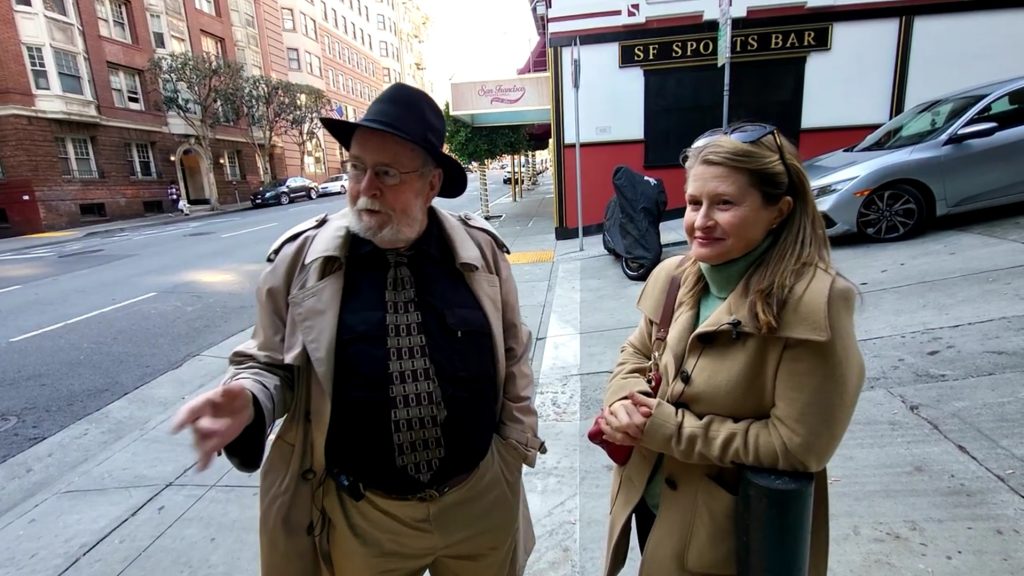
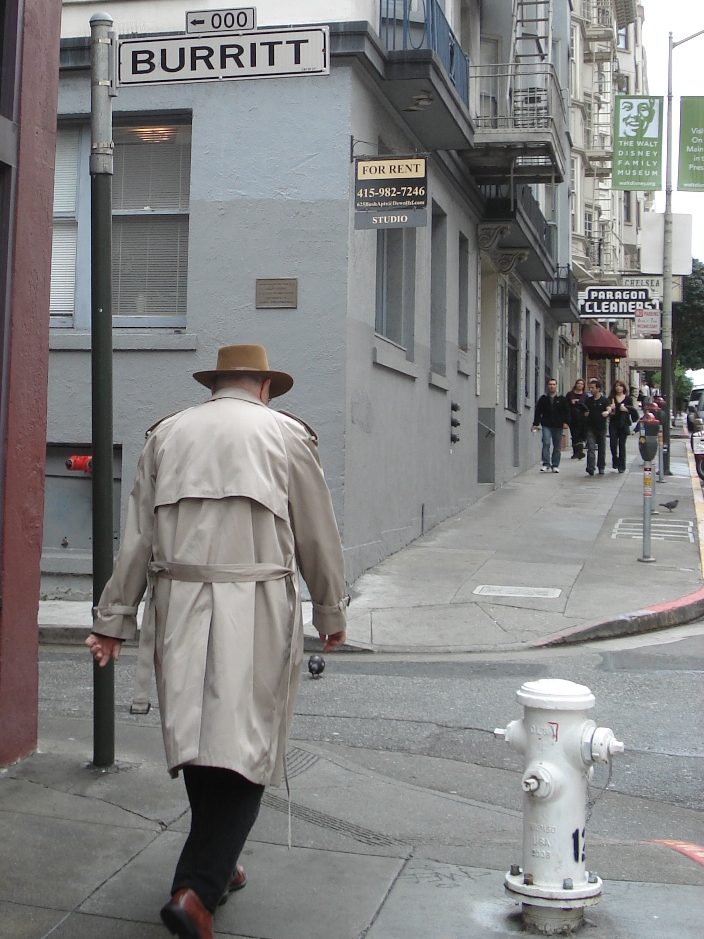
I guess it was in 2021 when I shot some footage with Duane and Rachel Anderson of Travel by the Book TV. Took them awhile, but they’ve got about 20 minutes now up on YouTube, touring Hammett sites in San Francisco.

I show off Burritt alley, and they have a nice sequence where I’m telling about how Beat poet Lawrence Ferlinghetti wanted to rename Burritt.

He wanted to name it Dashiell Hammett Street.

As you’ll see in the video, my response was “NOOOOOOOOOO!!!”

Posted in Dash, Frisco, News, Tour | Tagged , , , , |

Rediscovered: A Look Behind the Ed Price Biblio

Version 1.0.0

Doing some email with noted book and pulp collector Kevin Cook, the topic of Ed Price’s collection of pulp era memoirs came up — in particular the bibliography of Price’s own pulp fictioneering that appears in the book.

Since I just plugged a biblio John D. Haefele recently compiled on August Derleth, how about another post on the world of bibliography? Trust me, it ain’t easy.

Here’s Kevin with his memoir of the moment:

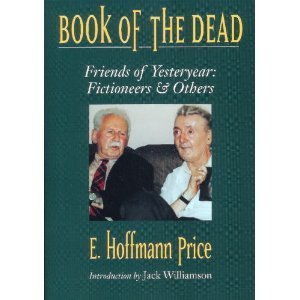
I have something of a special affinity for Book of the Dead because it printed the E. Hoffmann Price bibliography that I compiled, together with Virgil Utter and Glenn Lord.

Actually, the story behind it shows just how much Glenn was respected in pulp fandom.

Virgil put together a series of bibliographies for Galactic Central Publications. I asked him about a Price bibliography and he honestly told me that he lacked the information — especially from the Spicy pulps — to even attempt it.

I told him I would help and we put out notice of the book and the pulp information we needed. We got little feedback.

At the same time, I contacted Glenn Lord who as a member of the pulp amateur press association PEAPS had been running indexes of the Spicy pulps. Glenn was going through the magazines trying to identify all the reprints published under various house pseudonyms.

I asked him if he had separate records by author. Instead of just answering me, Glenn said that Price deserved a published bibliography and that he would like to join Virgil and myself in compiling one.

Obviously we immediately welcomed his help. Word soon got around that Glenn Lord wanted bibliographical information regarding E. Hoffmann Price.

The next year at Pulpcon people were coming up to us right and left with all sorts of books and magazines with Price stories in them. Glenn’s name worked magic. I had a notebook where I was writing down every new bit of data we were given, and was amazed at the people crawling out of the woodwork with offers to help. Glenn would say to them, “Ask Kevin if we need that information,” and when we did I wrote it down. Even today I remember some of the specific items that were shown to us.

Don’t discredit Virgil, though, as he searched through tons of reference books to track down information, and then asked individuals who had the magazines to check and insure that the printed information was accurate.

A more innocent time period in many ways, to put the bibliography together the way we did, in total collaboration.

The completed bibliography was published in PEAPS. The editor of Arkham House at the time, Peter Ruber (who I never really got along with well) from there just took it and used it in Book of the Dead without giving Glenn or me any credit for compiling it. At least Ruber put Virgil’s name on it.

I guess that must have felt par for the course for Glenn, who was screwed over by so many others regarding Robert E. Howard and Conan.

But I was certainly pissed off.

Obviously, I suppose, the important thing is that the information got out there for whomever may be interested.

Posted in Lit | Tagged , , , , , , , , |

Rediscovered: A Couple of Walla Walla Footnotes for The Memoli Thread

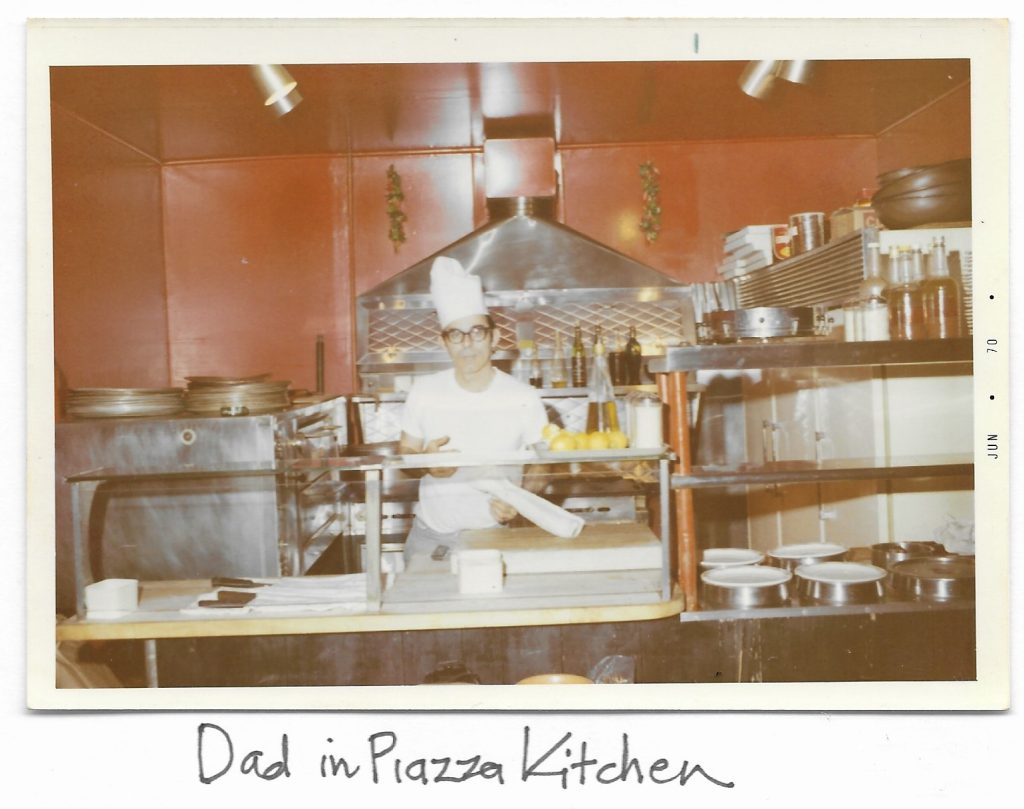
Iris Odonata sent me a few additional tidbits on her Dad, Joe Memoli, Made Man — and longtime figure in Oakland, with his restaurants and extracurricular activities.

Memoli’s incarceration in Walla Walla inspired me to send Iris a link to the post where the notorious Midget Bandit died in a gundown with the bulls during a breakout in Walla Walla. She liked it. If you haven’t seen it, you will too.

And in with following dope on Walla Walla, Iris tossed in a link to the sale of her Dad’s Frank Sinatra collection. The auction occurred in Peoria for some reason, and you may recall that the late great Bill Arney hailed from Peoria.

Here’s Iris:

walla walla was also where dad did time with charles manson, who stopped by dad’s first restaurant back after the counterfeit bust. 

manson, after being released, was on his way to los angeles to become a music star. my sister met him then, as she was waitressing for dad at time. when the tate-labianca news broke, etc, my sister screamed at the tv, “oh my god i met him. he had the craziest eyes.”

walla walla was also where dad served time with joe conforte, owner/operator of the famous, “mustang ranch.”  i served him several times whenever he’d come into the restaurant in the late 60’s-early 70’s.

Posted in News | Tagged , , , , , |

Rediscovered: The Return of Joe Memoli

If you’ve got a long memory, you may recall that Iris Odonata — daughter of Joe Memoli, Made Man — once asked for a few points about him I once wrote be corrected. No sweat. Happy to do it.

She made the ask in 2014. I got around to it the next year. In 2020 Larry Belling came across the post on Memoli and sent in his own memoirs of the man.

And Iris just noticed those, and sends in the following info for the unfolding saga:

greetings don:

was just made aware that in 2020 you rediscovered info on my father from larry belling.

this delighted me.

there is one small correction i’d like to offer, if you decide it’s warranted.

my father was never in san quentin. when he was busted for the counterfeiting ring in 1963, he reported to southern california’s san pedro correctional institution on the day after lee harvey oswald was shot by jack ruby. i know this because i was sitting on the floor next to him while we watched events unfold live on tv.

after an altercation at san pedro, dad was transferred to the federal prison in walla walla, washington.

he returned to oakland in 1967.

as for the SFO Heliport attempted robbery in November 1970, which occurred on thanksgiving, dad, smitty and the others were acquitted. they proved entrapment by police. i was in the courtroom with my sister when the verdict came in.

also, when john delorean was on trial, his attys consulted with my father’s attys, and as you know the rest is history.

i imagine you can research this if you are so inclined.

and by the by, i think my dad would have liked you.

if anyone else comes forward with stories, please let me know, and i’ll confirm what i can or kabash errors.

Posted in Boxing, News | Tagged , , , |

Rediscovered: More Derleth Bibliography

Check out the latest book from John D. Haefele, if you have an interest in August Derleth or Lovecraft or the general Arkham House landscape. Or if you’re simply one of those people who enjoy plunging into a meaty bibliography.

The new book is an extensive expansion and revamp of previous chapbooks, first the early checklist of Derleth’s essays and reviews done as an entry in the short-lived The Cimmerian Press series — the four titles in the main series were limited to 100 copies. Haefele’s entry has been listed as “Currently Unavailable” on Amazon for the last few years, and might present some difficulties tracking down. Addendum 1 later appeared in a 100 copy run from The Cimmerian redoubt, and much more recently Haefele did Addendum 2 in his private press Cat Butt series. The Cat Butt was limited to 10 — ten — copies, so add that one to your list of items you’ll never see.

Juggled around, the entries in those early chapbooks all appear in the new book — and in a nicer format and larger font than the tiny typeface squeezed into the Ur offerings. Sized to match Haefele’s A Look Behind the Derleth Mythos and Lovecraft: The Great Tales (tho the biblio is considerably slimmer than the Cyclopean bulk of Great Tales).

And of course Haefele includes citations he’s found — a few hundred — not featured in Cat Butt and company.

Posted in Lit, News | Tagged , , , , , |

Rediscovered: The Return of Arthur O. Friel

We haven’t had an Autograph Hound Super-Sunday rollout in awhile, and I wasn’t expecting Arthur O. Friel to be the guy scribbling the old John Hancock.

From everything I’ve heard, Friel signatures — much less Friel inscriptions — are rare. Not quite non-existent, but your average hen probably has more teeth.

Back in 2019 the Autograph Hound Brian Leno covered the Friel scene for us and mentioned the one inscribed Friel he’d heard of at that time, The River of Seven Stars.

I just got a note from David Balfour, who may well be the collector who has that particular inscribed Friel.

David says, “I enjoyed your article, Rediscovered: Arthur O. Friel, to which I was referred recently. A few years back, I posted the attached images on another site — so this may be the inscription that Brian Leno is referring to. 

“In any case, I purchased this copy of River online. The seller didn’t mention anything about an inscription, but I was happy enough to find a good copy of the book at a reasonable price. 

“Needless to say, I was thrilled to find the inscription when I opened it.”

So, for all you fans of Friel and the pulp mag Adventure — and to stoke the unquenchable flames of envy deep in Brian Leno’s soul — David offers a fresh look at the loot.

Howl, you Autograph Hounds, howl!

Posted in Lit, News | Tagged , , , , |

Hammett: Some Thoughts on M. Spade from Kent Harrington

That prolific writer in the Posse McMillan crew, Kent Harrington, asked if I’d seen Monsieur Spade yet. Not yet, but give me a day or two free and I’ll binge my way through. (Meanwhile, I have binged the two seasons of The Tourist, and the French Furies, and The Gentlemen.)

Since Kent seemed interested, I told him if he had some commentary to toss online, These Mean Streets stood ready.

(Keep in mind that Kent is big into France. A few of his first editions appeared in French — and still may be only available in translation. You may remember that awhile back I kicked around San Francisco with Kent and his translator.)

Here’s Kent:

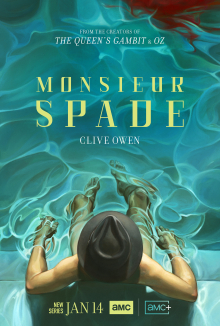
There is no doubt that Clive Owen is a great actor and many fans of his will tune into Monsieur Spade because of Owen. And they should. He doesn’t disappoint as expat Sam Spade, the famous San Francisco detective, now living in Southern France in the late 50s early 60s.

But for crime fiction aficionados — especially hard-boiled fans — is it worth hours out of your life?

Short answer: Yes.

I think so and for this reason:

For a long time now crime fiction has been a watered-down version of what the great crime writers, including Dashiell Hammett, produced. Hardboiled crime fiction in books and movies became, like much of American entertainment, painfully derivative. Or if you are more plain speaking, embarrassingly simple minded. (Clancy v. Le Carre).

Most crime fiction/movies today are careful-not-to be provocative or important. If the Superman comic book character (written by two Jewish teenagers) was, in the 1930s, an anti-fascist, protecting us against the very real Nazi threat, today he would be simply treated as a studio executive’s ticket to prime Malibu real estate. Not important.

Great crime fiction, and Noir literature, its parent, got its power from muscular commentaries on society. Gustave Flaubert’s noir novel, Madame Bovary, wasn’t simple minded to say the least. It was this commentary that made the works powerful. They were usually progressive — but not always — in as much as they sought to portray modernity, especially the power of money and the reality of class conflict, from the working stiff’s point of view.

But they also could, and did, deal with Capitalism’s need for Colonial power and possession. “East of Suez” is after all more than a Ska song. I was pleased to see that Monsieur Spade deals with the French colonial war in Algeria, starting in 1954, head on. (It may have been De Gaul’s undoing.)

The show’s writers also deal with the way national intelligence agencies, in this case French, were becoming very important players and unseen movers after the Second World War.

And we know these same intelligence services could go rogue and be very nasty.

Here is a quote from the famous French novel, The Centurions, about the infamous French paratroopers,1st Foreign Parachute Regiment, who fought in Algeria — and before that, in Vietnam. Many were recruited from French prisons and were former French SS types, who had fought for Germany during the war and offered a choice: rot in jail or go to Vietnam and fight. (Read: The Captive Dreamer by Christian De La Maziere. A firsthand account of a French SS officer who was given that choice.)

The Centurions:

“I’d like to have two armies: one for display, with lovely guns, tanks, little soldiers, fanfares, staffs, distinguished and doddering generals, and dear little regimental officers . . . an army that would be shown for a modest fee on every fairground in the country. The other would be the real one, composed entirely of young enthusiasts in camouflage battledress, who would not be put on display but . . . to whom all sorts of tricks would be taught. That’s the army in which I should like to fight.”

The Espiocracy, and their colonial wars, are what Le Carre and others have tried to warn us about. The brutality displayed by both sides in the Algerian struggle for independence is the series’ backstory and gives it a powerful theme and makes it interesting and the narrative believable. (Ukraine anyone?) The series is much more than about bodies dropping, or cool fedoras. Yes, Sam Spade parachutes into southern France, so to speak, but we believe it.

Is there anything I didn’t like about the show? Yes. The pilot is weak at first, unable to deal with Sam in France — they tried too hard. I think the show runners, who brought us the wonderful Queen’s Gambit, talented as they are, dropped the ball there.

The ending doesn’t match up to the interior of the series either. But the parts in between these mal pasos are at times perfect and always entertaining.

Spade is the wise-cracking hard guy that we expect. The customary Spadian bon mots serve to juxtapose him to the French, who just don’t care or get him. The actors, many are French, are wonderful and pull you in. By the way, French TV series, like Spiral and The French Village, are truly great TV series.

If you are any kind of Francophile, as I admit I am, you will enjoy Monsieur Spade’s location which makes you want to jump on a plane and lose yourself in the South of France.

And like Spade, dive into an elegant swimming pool, butt naked, and forget where you came from.
Posted in Dash, Film, Frisco | Tagged , , , |

Sinister Cinema: The Oscars

Brian Wallace popped me another tidbit from the historic archives of Noir & Mean Streeting, from which I deduced he must have watched the recent Oscars ceremonies:

“Wonderful what Hollywood will do to a nobody. It will make a radiant glamour queen out of a drab little wench who ought to be ironing a truck driver’s shirts, a he-man hero with shining eyes and brilliant smile reeking of sexual charm out of some overgrown kid who was meant to go to work with a lunch-box. Out of a Texas car hop with the literacy of a character in a comic strip it will make an international courtesan, married six times to six millionaires and so blasé and decadent at the end of it that her idea of a thrill is to seduce a furniture-mover in a sweaty undershirt.”

So opined Raymond Chandler in the 1949 Philip Marlowe novel The Little Sister.

No one could lay out the snide like Chandler.

Posted in Film | Tagged , , , |

Hammett: M. Spade — Episodes 4, 5 & 6

When last seen reviewing Episode 3, Terry Zobeck was getting into Monsieur Spade as a mystery. Sure, he had to ignore the baffling presence of a guy named Spade in France for some reason, but he was making the best of it.

The concluding episode dropped last weekend, and Terry’s forgiving and quite generous nature dropped with it. He is a die hard hard-boiled fan, after all. Tougher than he looks.

Here Terry knocks off some commentary on the final three episodes and sweeps our expat detective off his decks and into the dustbin of history:

We are given three significant plot developments in Episode 4; however, only one of them has any direct bearing on the mystery at the heart of the story.

A flashback explains the fate of Gabriella’s first husband and the connection to many of the leading lights of the town.

In one of the best scenes of the entire series Gabriella visits her father-in-law, who is near death. We gain a good deal of sympathy for her husband and Spade’s foe, Jean-Pierre, as Gabriella spits wonderful vitriol at the old man. She cuts him no slack for his impending death.

The one development that has some bearing on the central plot involves a murderous attack on Spade in his own home, ending the episode with a cliff-hanger.

In Episode 5, the writers suddenly seem to remember that their Spade character has some vague relationship to a San Francisco private detective of that name from 30 years ago. They toss in a couple of inconsequential references to that Spade.

Sam continues to tell anyone who may be interested that he wants nothing to do with the current intrigue, but no one is listening. The story begins to wander into Dan Brown territory, delving into the historical past, with a plot slightly reminiscent of the Falcon’s.

Most importantly, an obvious secret is suggested — one that experienced viewers will have guessed long ago.

The final episode demolishes whatever Good Will the program garnered from those like me, who managed to ignore the Sam Spade connection and simply enjoy a stylish and well-produced thriller.

More hidden relationships are revealed. A reference to Sgt. Dundee from the Falcon reminds us of the original. Plus a double-cross or two. All fine, but the ending — truly awful.

We get a denouement straight out of a Golden Age mystery with all the suspects gathered at the country estate, in this case Spade’s home.

Rather than having Spade explain who the murderer is, a deus ex machina in the form of Alfre Woodard appears from nowhere to explicate the role of each person in the hunt for the MacGuffin.

I was so frustrated with this clichéd ending I wanted to throw my laptop across the room. The sort of nonsense Hammett regularly railed against in his book reviews.

To have his name associated with such a mess is blasphemy.

Not until the credits roll do you realize that Spade had absolutely nothing to do with the resolution of the central mystery — the murder of the six nuns at the convent in which Teressa was raised — or really any aspect of the story other than shooting one of the villains.

And even then he is only one of the shooters. (The Spade in Falcon doesn’t carry a gun. “I don’t like guns,” quoth the gumshoe.)

If you can’t tell, I really didn’t like it. I do hope there is not a Season 2 of this crap.

Posted in Dash, Film | Tagged , |

Hammett: M. Spade Episode 3

I believe tonight is the formal drop for the sixth and last episode of Monsieur Spade, which reminds me I have further ongoing commentary on hand by Terry Zobeck to nudge out onto The Mean Streets. I don’t believe there’s any cause for cliffhanger excitement.

If Terry squeaks more in so it is “live,” or if shows up a few days after the fact, all good enough.

For the third episode Terry finds that “I’m beginning to enjoy this series — not so much as a Spade story (actually, not at all) — but as an engaging thriller/mystery.” Halfway through and he kind of likes it.

Here’s Terry:

With this episode, the story is beginning to pull me in. I’ve followed my own advice and ignored the conceit that this is an authentic Sam Spade tale. Standing on its own as an engaging mystery, it works well.

The opening scene, a flashback to 1955 shortly after Spade’s arrival in Bozouls, has some of the snappiest tough-guy dialogue so far in the series. Spade has been hired by the widow Gabrielle (soon to be his wife) to persuade Phillipe — Teresa’s alleged father — to leave town.

At one point, Phillipe asks where he would go. “I hear Norway needs more assholes,” replies Sam.

This dialog is fine, but Clive Owen delivers the lines with none of the style or steel of Bogart, the model that Owen has admitted was his inspiration. Think of Rick sparring with Major Strasser.

Owen delivers them in the same unmodulated monotone with which he orders breakfast.

In this third outing, the filmmakers toss in a few attempts to remind viewers that this character is supposed to be the Spade of The Maltese Falcon. In a flashback with Gabrielle and Spade sitting poolside, we come in as Spade finishes telling her the Flitcraft parable.

I guess Sam tells all his girlfriends the story.

This time he explains its meaning — it’s possible he’ll leave her one day.

Later, Teresa wants to know where the money came from in the trust fund that her mother left her. Sam tells her that “she had nose for antiques.” They also have a sharp exchange where it is clear that Teresa is an apple that didn’t fall far from the tree when it comes to telling Sam the truth.

And, perhaps most importantly, we learn there is a MacGuffin, in the form of a young Algerian boy, wanted by an international cast of character actors.

More duplicity lies ahead for Sam before the case is solved.

Posted in Dash, Film | Tagged , , |