Hammett: Edwin “Midget” Ware

quentin-mug2

Yesterday I told you we were going to give you an ID on The Midget Bandit — and here it is. As direct as a fist in the face.

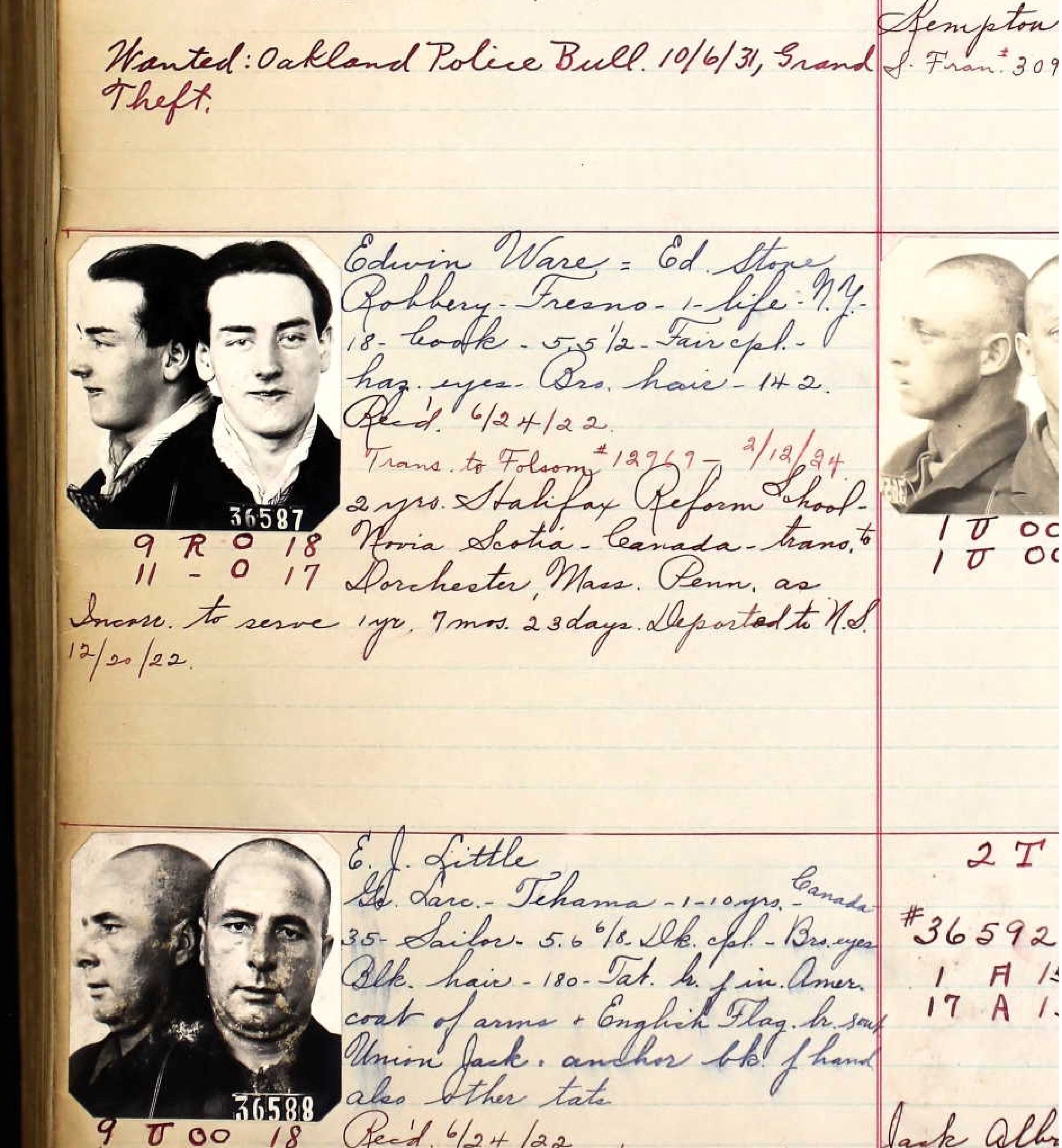
If you ever had the slightest curiosity about The Midget Bandit, here are the facts, culled by Warren Harris from the news articles of the day, prison records, and other archives. The images at top and bottom of the post — my favorites of the mug shots — come from the San Quentin booking circa June 24 1922. The clip from the Fresno Morning Republican in the text is dated November 21 1921 — at this point, the earliest mug shot of the criminal who inspired Hammett to create Wilmer Cook.

And without further ado, here is Warren Harris, latest — and instantly one of the greatest — Guest Bloggers on this site. Take it, Warren:

For decades Dashiell Hammett scholars have searched in vain for the “The Midget Bandit,” the colorful youth said to be the basis for boy gun-man Wilmer Cook in The Maltese Falcon.

Ladies and Gentlemen, meet Edwin Ware.

In his introduction to the 1934 Modern Library edition of the novel, Hammett wrote that most of the characters were based on people he met while working as an operative for Pinkerton’s National Detective Agency — most of those people are untraceable at this late date as there are simply too few details to identify them.

The original for Wilmer Cook, however, should have been easy to find as Hammett said that the exploits of The Midget Bandit were covered by local newspapers. Stockton, California papers. But Hammett’s only statement on Wilmer’s inspiration gets several key details wrong, leading researchers to look in the wrong place.

The tale of Edwin Ware, the 17-year-old holdup man known to local newspapers as The Midget Bandit matches almost exactly to Hammett’s story, save that he was arrested in Fresno rather than in Stockton, California. Both burgs are in California’s Central Valley, only about 127 miles distance from each other.

In 1995, columnist Michael Fitzgerald of the Stockton Record spent weeks trying to track down the history of the Midget Bandit.

I called Pinkerton. I also called area historians, retired cops, old filling-station owners … every day for weeks, I tried another angle. Finally I recruited a couple of volunteers who slogged through years and years of old newspapers. Joe Schmid found the Miner Bandit, the Gentleman Bandit, the Hermit Bandit, the Boy Bandit, the Argonaut Bandit and the Minstrel Bandit … but no Midget Bandit.

Fitzgerald had to give up his quest without finding the trail of The Midget Bandit. Other Hammett scholars have tried and failed to find the bandit in Stockton back issues.

The Fresno newspapers in 1921 tell the story of a bandit that matched Hammett’s details almost exactly, with headlines following a hold up at the city’s Central Garage on August 19, 1921 — followed by the robbery of a Standard Oil Company service station on September 1.

In the latter robbery —  the most important to the legend — Ware followed L. J. Perry home from his job at a Standard Oil station and held him up for day’s receipts, although he gave the man back his own money.

Perry called the man who held him up a “little fellow” in newspaper interviews and said he’d like to meet him again.

The saga begins on August 19, 1921 — and the legend of Fresno’s Midget Bandit is born.

Masked by a black bandana Edwin Ware slipped into the Central garage in Fresno at 3 am. that day, holding up garage man Roy Reid and private patrolman C. A. Murphy, who were talking. Murphy started to go for his gun.

“Stick ’em up,” Ware said. “I’ve a good mind to shoot you. I don’t like cops anyway.”

Ware took the patrolman’s pistol, grabbed a straw hat and handed it to the men, then pointed to the cash register.

“Who knows how to play the piano?” the two-gun man said. “Hurry up, get busy and wind it up.”

With this holdup, a reporter for the Fresno Herald dubs the robber “The Midget Bandit” based on his size. While not a midget, Ware is slight of build and just 5′ 5″ tall.

A few days after this incident, police and the press in Fresno connected him to a brutal holdup at the end of August at the Subway Saloon where the proprietor was slugged over the head, but Ware later claimed he was innocent, and he was never prosecuted for the crime.

On September 1, 1921, Ware followed L. J. Perry home from his job at a Standard Oil station. Ware had seen the man take the day’s proceeds from the station and held him up at his front door.

In contrast to the brash bravado he displayed in the Central Garage holdup, he was described as polite this time. He kept his voice so low that the victim’s mother inside the house thought her son was talking to a friend.

Perry told a newspaper that he felt bad that he was held up by a man half as big as he. Ware read the comments and dashed off a reply while waiting for his train to Los Angeles the day after the robbery.

“You may tell that big stiff that I may be small but without a gun I can lick any man twice my size,” Ware said. The newspaper was happy to print a facsimile of the robber’s note.

While in Los Angeles, he robbed a Standard Oil Station and handed the man a note to give police — identifying himself as the Midget Bandit from Fresno.

Later press reports claim he’s a suspect in a series of mail robberies that struck the area in the fall of 1921, including one for more than a half million dollars, but he was never charged over those crimes. He’s reportedly responsible for some 50 gas station hold ups, again without much proof.

Ware was also a suspect in the unsolved murder of a gas station manager in Turlock, California. But then, the police claimed a number of people were suspects in that case and the timing makes it doubtful that he would have been involved.

A second crime he was responsible for in Los Angeles was the holdup he committed at the Bimini Baths where he supposedly stole $2,000 and engaged in a struggle where he fired three shots. Ware was arrested and sentenced to probation and released without taking credit for the crimes of The Midget Bandit.

While in the Los Angeles jail, he met fellow 17-year-old John Noble, a Canadian who had done time in his native country.

The pair teamed up and committed several crimes. First they robbed a pawnshop on Main Street, obtaining a number of guns. Perhaps feeling that Los Angeles was getting too hot for him, Ware decided to steal a car and return to Fresno and hold up Perry again. Noble went with him.

They stopped at the tiny town of Tipton where they burglarized a hardware store and stole silk shirts, pocket knives and a rifle before continuing on to Fresno.

Nobel was arrested first on November 20, 1921 when the proprietor of the rooming house where he was staying became suspicious of him. Inspector Tom O’Brien, who had investigated the original Central Garage holdup, confronted Noble, who shoved a gun into the officer’s stomach.

O’Brien knocked the gun aside and told Noble that he had him covered with a pistol he had in his coat pocket. Once at police headquarters, Noble confessed that he’s the confederate of The Midget Bandit and that the man they have been looking for was back in Fresno. He told the officers that they shouldn’t try to take The Midget Bandit because he was well armed with several revolvers and thousands of rounds of ammunition.

Leading a squad of police officers, Captain B. A. Wickstrom started a hunt of hotels and rooming houses in the city, finding that Ware was in a room at the Hotel Adanis.

Ware had intended to hold up Perry again that night, but had fallen asleep instead.

At 2:30 Sunday morning, an officer knocked on Ware’s door and called out that Ware had a phone call. The ruse worked and Ware was taken into custody without trouble.

Ware then made statements to police and reporters that ends up being much of the evidence against him at his trial, as well as being the origin for the newspaper stories about his life.

The brief crime spree of the infamous Midget Bandit, whose exploits were carried by newspapers as far away as New York City, was over.

In November of 1921, then, while Hammett was still working for the Pinkerton’s Agency, members of the Fresno City police force arrested 17-year-old Edwin Ware — who confessed to being the man the newspapers dubbed “The Midget Bandit” — along with his  confederate,  John  Noble.

fresno paper

As Hammett says, Ware did claim — and really was — just 17-years-old. His father, Harvey Ware, really was a lieutenant with the New York City police department.

In a jail-house interview with the Fresno Morning Republican, following his November 20,1921 arrest, Ware confirmed the last part of Hammett’s story:

“At this time I met Noble and we wanted to get away from Los Angeles and come back to Fresno where we … could holdup the Standard Oil station and Perry, who wanted to meet me again, so we took a car.”

Unfortunately, Hammett did not have anything to do with Ware’s arrest, although some Hammett biographers have interpreted Hammett’s statement about a “fair pick-up” otherwise. Hammett certainly could have talked to Ware — but he also could have gotten all of the details he relates just from reading newspaper coverage.

With police across California trying to pin every unsolved crime in the state onto Ware, it’s possible that the Pinkerton’s Agency, faced with investigating a smash-and-grab jewelry store heist in San Jose, would think it worthwhile to send the then-ailing Hammett to Stockton to interview the jailed Ware to see if they could glue that crime on him as well. But it turns out that Ware wasn’t involved in the San Jose case and all Hammett got for his time was the inspiration for Wilmer.

Hammett carefully words his language so that The Midget Bandit was a fair pick-up — he doesn’t say he personally arrested him. He says he went to Stockton (really Fresno, Hammett either got the name of the city wrong when reminiscing fifteen years later — or changed it enough to not credit Edwin Ware directly for inspiration) looking for the criminal who smashed a window at a San Jose jewelry store robbery. He admits that The Midget Bandit wasn’t responsible.

Some have read that statement to say that Hammett claimed to have arrested The Midget Bandit while looking for the other criminal. But what Hammett is really saying is that he traveled to Fresno after Edwin Ware was arrested and interviewed him in jail.

It was a logical task for a Pinkerton’s agent. Police across the state were trying to tie Ware to every unsolved crime they could. A smash-and-grab at a jewelry store is exactly the sort of crime Ware committed. He’d burglarized a hardware store and robbed a pawn shop in L.A. and he was known to have spent at least some time in the San Francisco Bay Area before moving on to Fresno.

Hammett apparently made the trip, met the cocky youth and returned to San Francisco without the lead he’d hoped for — but with the inspiration for Wilmer Cook, the boy gunsel.

Now that we know the story of the real Midget Bandit, we can say for certain that Hammett, while he might have met the youth, did not have any part in his arrest by Fresno city police officers.

Ware was arrested in late 1921 and by early 1922 Hammett was out as a Pinkerton, unable to continue because of ill-health. The trip to interview Ware would be one of Hammett’s last — and now confirmed — cases.

Tomorrow: Before the Crime Spree.
quentin2


Posted in Dash, Frisco, News | Tagged , , , , , , , , |

Hammett: Midget Bandit Week!

Midget

If you’re any kind of serious fan of the writings of Dashiell Hammett, you know that Hammett modeled the gunsel Wilmer Cook in The Maltese Falcon, published in first edition hardcovers by Knopf in 1930, on a crook known as The Midget Bandit.

Wilmer. Without argument the most famous gunsel of all time. Immortalized onscreen by Elisha Cook Jr. in the 1941 film version of the novel, directed by John Huston, starring Humphrey Bogart as detective Sam Spade. A classic role for a classic actor in a classic movie. From a classic novel.

Hammett told us about The Midget Bandit in a two-page intro he did for a 1934 reprint of the novel by the Modern Library. He mentions that he remembers “where I got most of my characters” and does quick thumbnails: “Dundy’s prototype I worked with in a North Carolina railroad yard; Cairo’s I picked up on a forgery charge in Pasco, Washington, in 1920; Polhaus’s was a former captain of detectives,” and so on — he shadowed the original of Caspar Gutman in the early days of World War I “and I never remember shadowing a man who bored me as much.”

But Hammett begins his catalog with Wilmer and The Midget Bandit, the longest paragraph in his intro — twice as long as his paragraph about Sam Spade:

Wilmer, the boy gun-man, was picked up in Stockton, California, where I had gone hunting a window-smasher who had robbed a San Jose jewelry store. Wilmer’s original was not my window-smasher, unfortunately, but he was a fair pick-up. He was a neat small smooth-faced quiet boy of perhaps twenty-one. He said he was only seventeen, but that was probably an attempt to draw a reform school instead of a penitentiary sentence. He also said his father was a lieutenant of police in New York, which may or may not have been true, and he was serenely proud of the name the local newspapers had given him — The Midget Bandit. He had robbed a Stockton filling station the previous week. In Los Angeles a day or two later, reading a Stockton newspaper — there must be criminals who subscribe to subscription services — he had been annoyed by the description the filling station owner had given of him and by the proprietor’s statement of what he would do to that little runt if he ever laid eyes on him again. So The Midget Bandit had stolen an automobile and returned to Stockton to, in his words, stick that guy up again and see what he wanted to do about it.

Needless to say, Hammett fans, Hammett scholars, maybe even some Hammett biographers, have tried to track down The Midget Bandit. I’ve met a few guys who’ve prowled fruitlessly through archives of the Stockton papers, almost in tears — no Midget Bandit.

On the trail of The Midget Bandit for decades. . . .

No luck.

Until now.

And I don’t think luck had much of a role in the tracking down and capture of the identity of The Midget Bandit — what cracked the case was the involvement of a tireless Continental Op-style archive-prowling man-hunter named Warren Harris.

I believe I first met Warren when he came out on the tour a decade or more back, and I bump into him on rare occasion. He does a zine titled Back Numbers Can Be Easily Procured for an amateur press association devoted to pulps — The Pulp Era Amateur Press Society, or PEAPS for short. Warren’s been a member on and off since about 2002, with his current stint his third go-round.

Point is Warren appreciates Hammett and knows the pulp scene, and The Mystery of The Midget Bandit grabbed his attention.

Avoiding misdirection, he followed each new lead until he nailed down the name, birthplace, criminal career, and several mug shots of the man who inspired Hammett to create Wilmer Cook. Everything from his California crime spree to his violent death.

And Warren has selected Up and Down These Mean Streets as the vehicle to present this research to the wider world — though he’s unearthed so much info I think the only way for him to do full justice to the subject is a book. Since I consider this find to be the coolest piece of info on Hammett’s career as a detective to be uncovered in decades, I’m honored that Warren lays out the facts here.

(Wow. Someone found The Midget Bandit! Personally, I am floored.)

So fasten your seatbelts and come back tomorrow to find out if Hammett was right or wrong about Midget’s age, whether or not his father was a New York cop — if even the moniker The Midget Bandit was real.

I’ll tell you this much now: The Midget Bandit was real. And on These Mean Streets it is now, officially, Midget Bandit Week!

Posted in Dash, Film, Lit, News | Tagged , , , , , , , , |

Rediscovered: HPL at 124

I was well aware that yesterday was birthday 124 for H.P. Lovecraft — been doing a lot of rereading of The Old Gent in the past year or so, even grabbed a moment in memoriam to decipher some of his squiggly holograph off a photocopy of a 1932 letter. Noticed a nice tidbit that was left out of the Arkham House Selected Letters set, where Lovecraft mentions:

Oh, yes — about my 46 titles, only 31 have been professionally published. The two long novelettes — “Kadath” & “Charles Dexter Ward” — have never been even typed (god, how I hate that damned machine!), & besides myself no living soul but Donald Wandrei (while on a visit here in 1927) has even read them.

Think about that. As late as November 1932 — Lovecraft would die early in 1937 — Don Wandrei was the only reader for “The Dream-Quest of Unknown Kadath” and “The Case of Charles Dexter Ward.” Might not mean anything to the General Public, but for any Lovecraftians in the audience I think a little awe is in order. Makes me appreciate my days hanging out with Wandrei all the more — never met HPL, but knowing Wandrei had to be close to the same experience.

And if you want to read a nice article on Lovecraft, John J. Miller’s piece from the Claremont Review of Books earlier this year is worth checking out. It became available just in time for the birthday festivities. “Wake me when the stars are wrong again” — great line.

Posted in Lit, News | Tagged , , , , , , |

Hollywood Beat: Becoming an Instant Icon

bacall first film

Just got a note from Nathan Ward, who is in LA doing more on-the-ground research for his biography of Dashiell Hammett — needless to say, as soon as that one is available I’ll alert everyone who surfs Up and Down These Mean Streets.

Nathan noted, “Well said on Bacall. Was there ever a greater film debut than a 19-year-old saying a line co-written by Faulkner from a book by Hemingway?”

Yeah, To Have and Have Not by itself probably would have done it for her, made her a legend.

Image at top: Bacall lights herself up in To Have and Have Not.

Posted in Film, Lit | Tagged , , , , |

Hollywood Beat: An Icon Among Icons

Bacall

Image above — of course — Lauren Bacall being lit up by Bogie in that classic of San Francisco film noir, Dark Passage.

As everyone from The Hollywood Reporter on down has been saying, when Bacall died on Tuesday August 12, an era passed. The last icon of that age of Hollywood, gone. When you think that Bogart himself died in 1957, it is quite amazing.

But I think it is safe to say that the legends will live on.

If you refer to your copy of the latest tour book, page 180 and 181, you see the report on how The Dashiell Hammett Tour once crossed paths with Bacall — as I wrote, “there are icons and then there are icons,” and Bacall was an Icon.

Posted in Film, Frisco, News | Tagged , , |

Tour: Sundays, August 10 and August 31

don16

On Sunday August 10 and again on Sunday August 31, anyone who wants to show up with $20 and four hours to invest can hike the Hammett trails that thread through the jungle of mean streets that is San Francisco.

Show up by noon — yes, high noon, not noon-thirty, not 1p.m. — near the landmark revolving “L” sculpture.

No reservations. Sure, you can promise on your complete collection of the pulp Black Mask that you’ll be there, but if in fact you aren’t there, what can I do about it?

A few weeks back someone popped me an email solicitation to get The Dashiell Hammett Tour signed on for Groupon, so that I could “fill up” the walks. Please. This walk is for Hammett and pulp and noir fans — and more casual folk who sense that even without extensive background knowledge, it’s simply a great tour. If only one or two people show up, then I take only one or two people. If no one shows, I return to my lair and go back to sleep. No hard feelings.

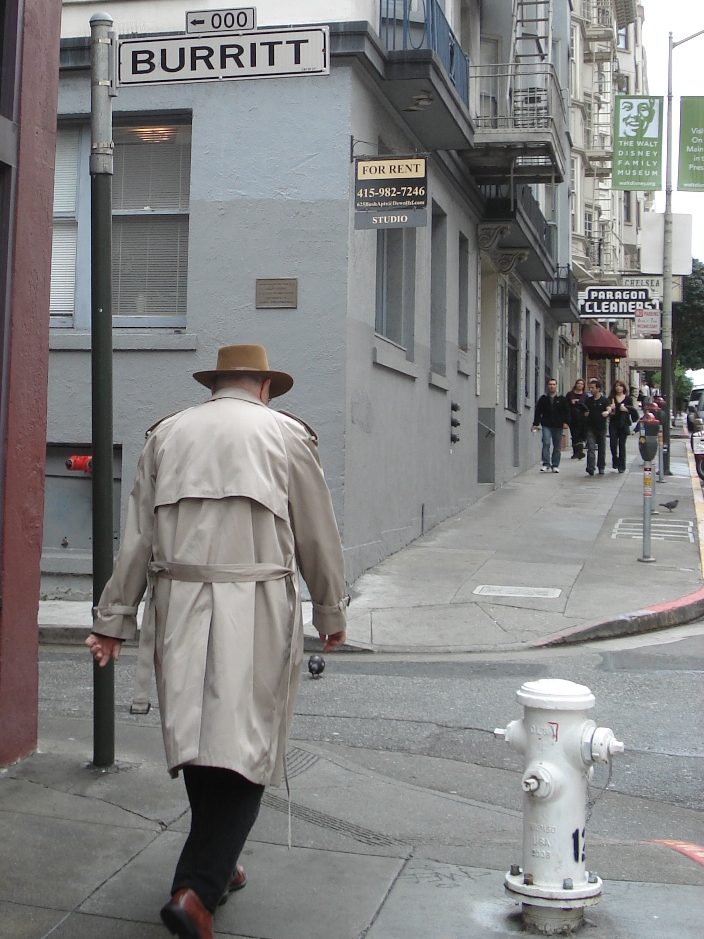
(Photo at top — tour halfway back Burritt alley, where Miles Archer got the lead pill drilled through his pump.)

Posted in Tour | Tagged |

Rediscovered: Another Manchette Down

mad and badWhile I wasn’t paying close attention, New York Review Books has slipped another novel by Jean-Patrick Manchette into English translation — excellent. Only took them three years, but that is much better than the previous gap of nine years between novels for those of us who don’t read the French language.

Now we have four of the ten Manchettes available and only six more to go. Guess I’m going to have to work on living for a few more years, because I really like these books. As I said when bemoaning the nine year gap, Manchette probably isn’t for every crime reader, but ought to suit the taste of Up and Down These Mean Streets regulars. If you surf in searching for Willeford and Kakonis, Red Harvest and noir, you have a target on your forehead and these novels are the bullets in the clip.

Found this blurb for The Mad and the Bad surfing around — as you can see, everyone is jumping on the bandwagon, and they should.

Posted in Lit, News | Tagged , , |

Blog: Say “Cheese”

Bill Arney

In the shot above — used previously for a post of yesteryear — Bill Arney stands against the frame of the Murphy bed in Sam Spade’s apartment in 891 Post Street and regales a tour group with some anecdotage.

Bill is famed as the greatest (and alas, former) inhabitant of those rooms, and also has some renown for acting as the Voice of Noir City when it does its annual run in the Castro Theatre. And lately he’s been hosting his own theatre on cable — Cheese Theatre.

Bill and Cheese finally have entered the blogosphere if you want to surf over and check out his bio, see which flicks are coming up. Not a lot of content yet — you can get lots more Bill images by clicking on his name in my Tag Cloud — but I’m betting he’ll get in the swing of things. It’s like going into a new bar — at first you don’t want to say much, scoping out the terrain, but pretty soon everyone knows you’ve got opinions.

Posted in Film, Frisco, News | Tagged , , , |

Rediscovered: Tom Kakonis

Criss_CrossOn the tour Sunday various people asked me at various times as we hiked along whether or not Pinkerton’s was still around — couldn’t say for sure, but something easy to Google up and resolve. Not that any of us bothered at the time.

But it reminded me that it seems that I haven’t noticed a Pinkerton’s armored car in a year, two years, which at the end got a few of us talking about armored cars.

Which led to me doing a plug for the movie Palookaville, one of my favorites — it’s got an armored car caper in it. Plus there’s the classic Armored Car Robbery (sampled in Palookaville), and the more recent Armored — a whole little sub-genre.

And of course I mentioned the Tom Kakonis novel Criss Cross, a novel no fan of armored car capers should miss. As I said in a tour brochure back in 1992, Criss Cross is more or less the Kakonis version of The Maltese Falcon, a modern hardboiled masterpiece.

That micro-essay on Kakonis and the ultra-hardboiled just got reprinted on July 18 on the Brash Books website, part of the promo effort to bring the Kakonis backlist into print. Hey, anything I can do to help out.

I’m digging into an advance copy of the new Kakonis novel now — release date September 2 — and unless he screws the pooch with the ending, he’s still got it.

As always, he’s especially good with the scenes of lowlife thugs. Very, very funny.

Posted in Lit, News, Tour | Tagged , , , , , |

Sinister Cinema: In Hilly Alabam

AlabamWhen last seen here on Up and Down These Mean Streets, Hollywood tour guide Charlie Morfin supplied us with a shot of the Dashiell Hammett Street sign when they got the spelling wrong — white hot news back in 2011, kicked off a little series of posts.

Plus he did some mugging in Burritt alley — not that kind of mugging, this kind of mugging.

And I always liked that shot of me and Charlie hoofing up Elwood alley.

Now it turns out he’s writing books, too. I glanced at the title Location Filming in the Alabama Hills and my first thought was, why the hell would some guy like Charlie — with a toehold in Hollywood — head off to Alabama?

A bit of attention paid to the blurb, though, tipped off that that’s the name of some hills outside LA where tons of movies have been shot. Looking at the rocks on the cover, I’m betting that the 1957 Randolph Scott/Budd Boetticher oater The Tall T was shot there — great little movie, with Richard Boone, and Henry Silva chewing up the Alabama Hills scenery as a creepy psycho killer owlhoot. If they shot that one someplace else, Silva chewed up that scenery, too — came close to stealing the film with his performance.

For all you film fans — especially the ones who like to track down the shooting locales.

Posted in Film, Frisco, News | Tagged , , , , , , , , , |