Rediscovered: Further “Fungus” Fisher

Yet another Autograph Hound Super-Sunday! Jeez, what have I got lying around in all the stacks of stuff?

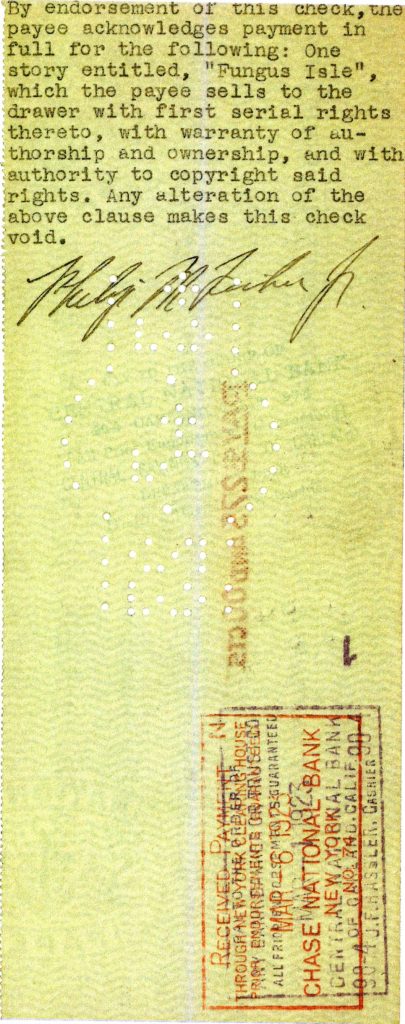
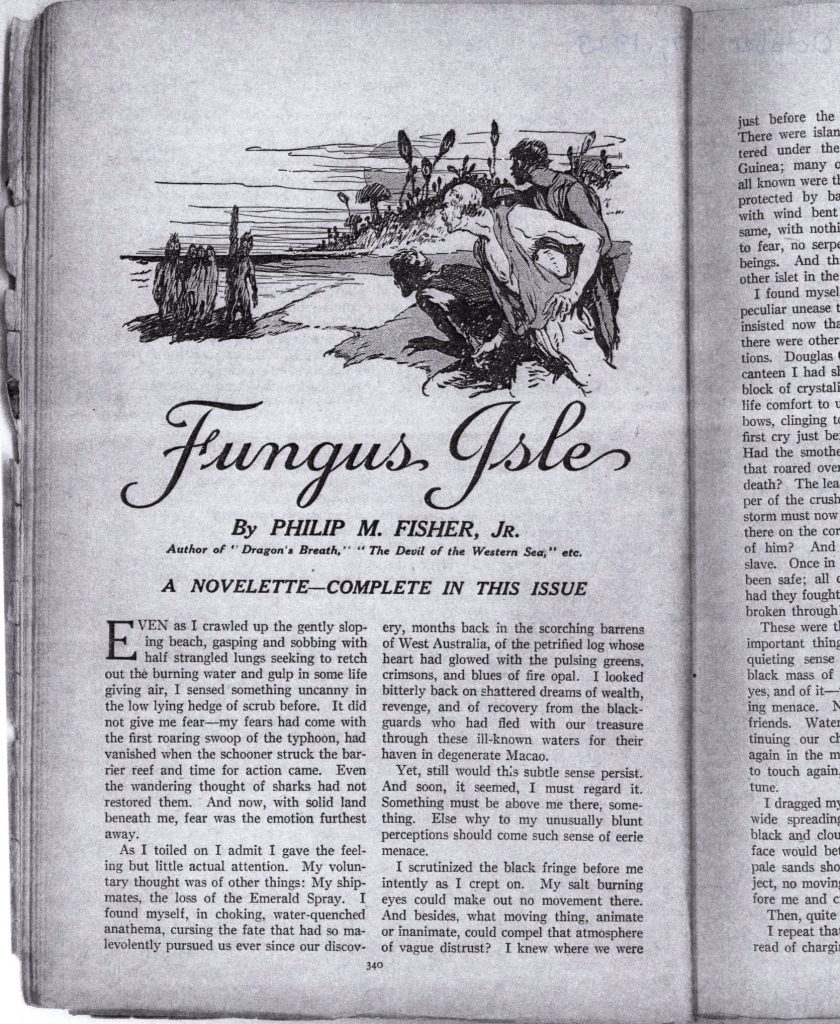
Remember when Brian Leno provided a John Hancock for Philip M. Fisher Jr, probably best known today for his short story “Fungus Isle,” which appeared in Argosy All-Story Weekly October 27, 1923?

That story carries its fame because it seems to be heavily influenced by the William Hope Hodgson masterpiece “A Voice in the Night” — and it’s good. Maybe not as good as Hodgson at his peak, but what is?

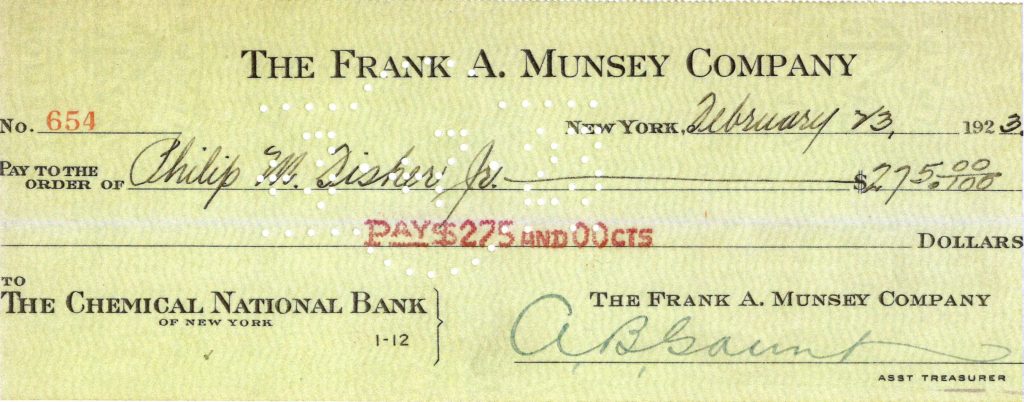
Brian didn’t have a signed cheque for “Fungus Isle” in his collection, so he used the one he does have, noting “Fisher is a rare autograph and, to me, desirable, for his Hodgson connection. It’s the only example I’ve ever seen — and I’ve looked.”

And then what happens but that the noted pulp and book collector Kevin Cook sends in a copy of the original cheque for “Fungus Isle” from his collection!

I’m thinking that between them Brian and Kevin must have every autograph ever scribbled.

Kevin says, “Dave Saunders tells me that the Argosy All-Story Weekly illustration for ‘Fungus Isle’ was by John R. Neill.

“An idea I had regarding Fisher was to point out that his service as a Naval Officer could have brought him into contact with the same stories and legends that William Hope Hodgson used as the basis for his own stories, and that ‘Fungus Isle’ and ‘The Ship of Silent Men’ were not necessarily inspired by or ‘stolen’ from Hodgson.

“Of course, the reverse argument is that his travels at sea might have brought him in contact with British magazines containing Hodgson stories. It should be asked, though, was there any circulation of books and/or magazines between the US and UK during the first World War? We would need more information including Fisher’s exact years of service and where the vessels he traveled on went to — probably more work than required for a small blog post.”

Yeah. Someone get on that.
Posted in Lit | Tagged , , , , , , |

Hammett: That Sneaky Jeopardy!

Yesterday — 10/23/2020 — the Jeopardy! clew crew spun yet another variant on their long years of Hammett-related questions. First time I recall Sam Spade’s papa invading scrambled words turf. What next??? — math and science?

In the first round.

Category: Anagrams, How Novel!

The $400 clew:

Hard-boiled favorite about a pilfered avian: “Heels of Cattleman”

Jamelle, a Crime Scene Analyst, jumped on it and asked:

“What is The Maltese Falcon?”

Precisely.

Posted in Dash | Tagged |

Mort: Dick Lupoff

Just got a note from Tom Krabacher linking to the Locus obit on Dick Lupoff, who died today at age 85.

If you recall, Krabacher and Lupoff and I were all hanging out at an Edgar Rice Burroughs mini-convention not so long ago — the last time I would see Lupoff, as it turned out. Before that I attended the book release party for his autobio in Borderlands Books. Before that — who can say? I would see Lupoff fairly often for awhile, then a few years would pass. A few times I saw him at some convention, but then I don’t hit many conventions. I encountered him more often socially, usually at his house. He got a mention in the obit I did on Stan Sargent from one of those just-hanging-out sessions.

In the intro to the Robert E. Howard collection Tales of Weird Menace in 2010 I gave Lupoff credit for being a cornerstone figure in the sort of thing I ended up doing.

In memoriam, here is the excerpt:

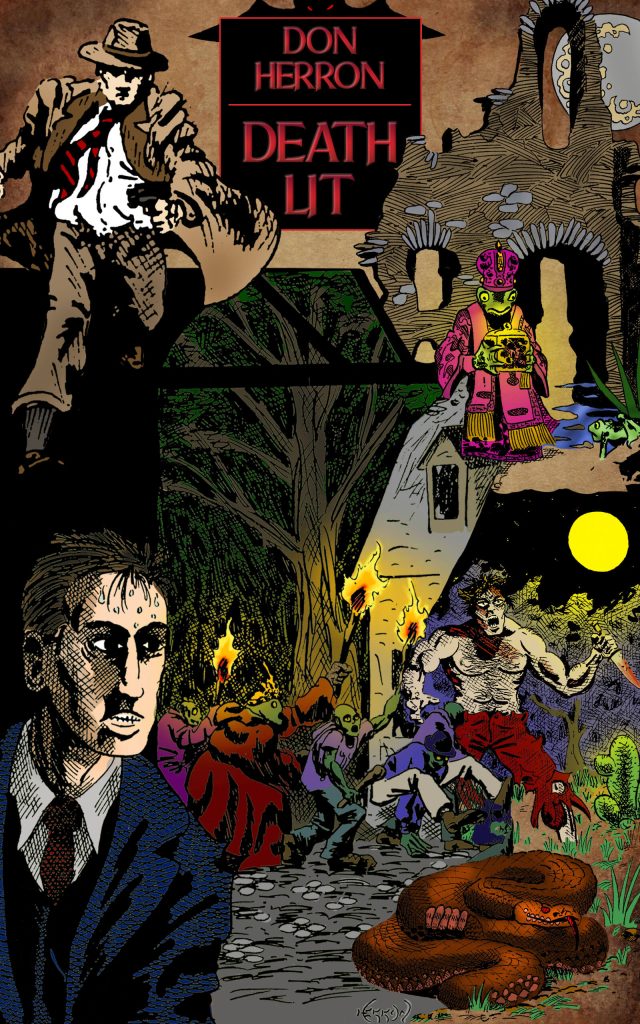
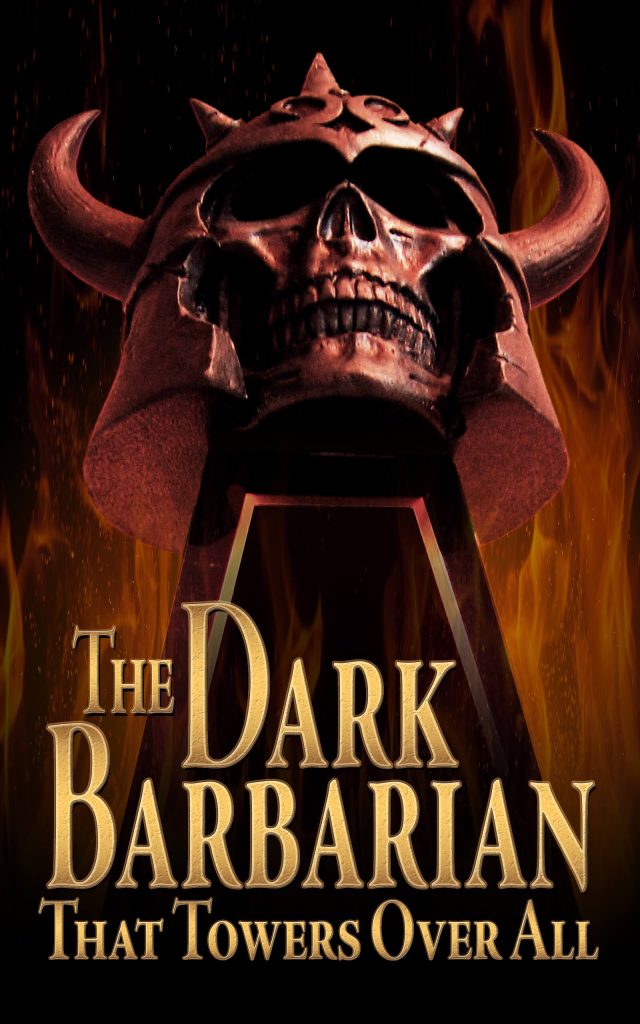
By the time I edited The Dark Barbarian in 1984 I had plenty of models to work from, Starrett among them. But where as a kid in Tennessee could I have gotten even the glimmer of the concept that that you could do a whole book about a favorite author, especially a writer like Howard? I must have known that books had been written about someone like Ernest Hemingway, but I didn’t want to do books about Hemingway— I had something to say about the prolific pulp fictioneer from Cross Plains, Texas.

I realized that the answer to this mystery was right under my nose as soon as I saw that Howard’s short novel Skull-Face anchors this collection.

Oh, yeah. . . Lupoff. . . .

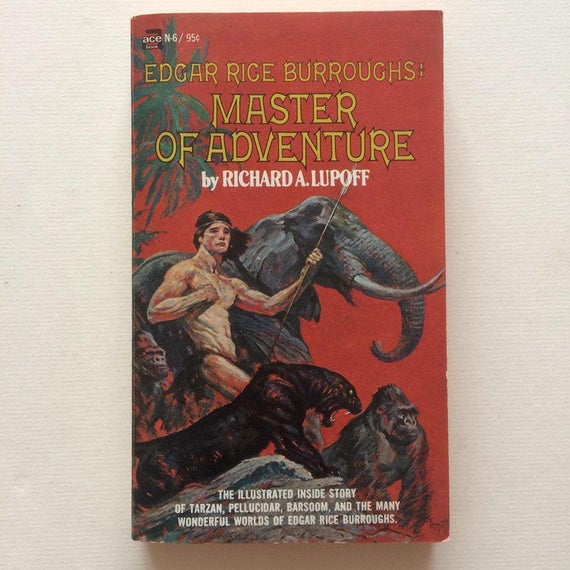
I cannot imagine that a Howard fan of my generation could hear the title Skull-Face and not think instantly of Richard A. Lupoff’s Edgar Rice Burroughs: Master of Adventure and his surprising assessment of that work — how the young Texan managed to out-Fu Fu-Manchu! The first edition of that book-length study of the creator of Tarzan and John Carter of Mars appeared in hardcover in 1965 from Canaveral Press, but it would be several more years before I began adding hardbacks to my own collection. The edition I read, along with everyone else, blazed into print in paperback from Ace Books in 1968, that bright red cover by Frank Frazetta recycled from an earlier Ace paperback of Burroughs’ The Beasts of Tarzan. And of course it was a Frazetta painting that had drawn my eye to Conan the Warrior the year before — Frazetta, a cornerstone figure for that era.  

In addition to profiling the many series launched by the prolific Burroughs, Lupoff looked at the extent of his influence and the many imitations that sprang up using Tarzan as a model. “These illegitimate descendants of Tarzan do raise a serious question concerning the matter of successor authors,” he wrote. “After having read a number of stories of various sorts by successor authors, over a period of years, I had prior to the past few months concluded that their products were universally inferior to the original. To the extent that a successor author maintained fidelity to the original his work was superfluous. To the extent that it varied from the original, it tended to fracture the structure of imagination created by the original author. Either way, the successor’s work would suffer.” Then Lupoff got to Robert E. Howard:

     I have come across one exception to this principle. It is Skull-Face, the title of the 1946 collection of Howard stories. Skull-Face was serialized in Weird Tales in 1929. . . a pastiche of the Fu Manchu stories of Sax Rohmer. Skull-Face is Dr. Fu just as clearly as he can be, portrayed as well as Rohmer ever portrayed him. Howard’s hero, the American Stephen Costigan, is far superior in conception and presentation to any of the men Rohmer ever put up against Fu. To the extent that Howard maintains fidelity to the original, his work is superior.

     To the extent that Howard does not rely upon Rohmer, he goes beyond Rohmer, extending rather than destroying the structure of the original author’s work. Rohmer had never fully explained the origin of Fu, although he often hinted an Egyptian identity of incredible antiquity. Howard carries back beyond Egypt, makes Skull-Face a survivor of sunken Atlantis, and brings the whole audacious thing off perfectly!

Yes. You could do literary criticism on Howard. You could do entire books on writers very much like Howard. That moment in Master of Adventure was exactly what I needed to see as a teenager to spur on dreams of doing criticism of the Texan of my own. And as a statement from 1965, it ranks in the forefront of modern reappraisals — recognizing that Howard was far more talented a writer than the mere pulp hack many commentators had dismissively portrayed him as being, if they mentioned his name at all.

Posted in Lit, News, REH | Tagged , , , , , |

Hammett: More “Silver Eyes”

And today Evan Lewis tosses up yet another newsprint appearance for the Op yarn “The Girl with the Silver Eyes,” Pittsburgh, December 1936.

Plus some ads from Allentown blurbing an October 1938 reprint for this primo Op adventure in that paper.

I recall some guys making a point of how Carroll John Daly with his Race Williams PI stories kept turning them out through the 30s while Hammett — off to Hollywood, books coming out — had disappeared from the pulp detective scene — and by extension, the public mind. (Of course, as soon as the Bogie The Maltese Falcon came out in 1941, Hammett became the most influential hardboiled detective writer of all time, if there was still any question about it.)

But you know how these guys think. It’s story for story with them. One story in a pulp, then another and another, more important than bestselling books and a few classic movies.

Yet if it’s story for story, I’m wondering if with all these newspaper reprints whether Hammett may not have grabbed more eyes than someone like Daly. At this moment, we still don’t know how many of the Op series got reprinted (again, and again), but it’s beginning to seem like a floodtide.

Posted in Dash, Film | Tagged , , , , |

Hammett: Zobeck Fact Checks The Morgman

A note rolled in just now from longtime guest blogger Terry Zobeck, always trying to keep the Hammett facts straight. He spotted a wrong detail in the Morgan Holmes bit about what kind of .32s the Op carried in “Corkscrew” — and I thought, yeah, that one nagged at my memory even as I quickly threw the link up. But I forged ahead anyway.

So, to clarify, here’s Terry:

I went to the link on the Op’s armament. Interesting article, except for the mistake about only one Op story appearing outside of Black Mask. As you know, there are two: “Who Killed Bob Teal” in True Detective Stories and my personal favorite “This King Business” in Mystery Stories

Posted in Dash, News | Tagged , |

Hammett: Roscoes Barking

Woke up to a note from Morgan “The Morgman” Holmes, who says, “I have my own Hammett gun post up at Castalia. Did not realize you had the Webley one up until this morning. Guess we are all thinking about guns.”

As always, These Mean Streets leads the parade.

Morgan delves into the possible automatic .32s of the era which might have served as the Op’s pocket arsenal in “Corkscrew.” With photos.

Just recently Morgan did a heavy-on-guns zine for the Robert E. Howard United Press Association which panicked one of the academics sucking around the fringes of Howard Studies. The guy was seized by the vapours, clutched his pearls, and huffed out of REHupa. Will anyone notice he’s gone?

Always amazing to me, the current crop of would-be readers, gripped by “woke” sensibilities, who insist on reading the major pulpsters, timidly covering their eyes at the politically incorrect spots. Robert E. Howard, famous as one of the most violent fictioneers of all time. Hammett, author of a symphony of bullets in the Op saga.

I don’t know what it would be, but surely these bozos could find something more current, bland enough to not offend them.

Posted in Dash, News, REH | Tagged , , |

Hammett: “Silver Eyes”

Evan Lewis pulled another reprint Hammett yarn from the newsprint of yesteryear today — “The Girl with the Silver Eyes” (a stone-cold classic) from the Vancouver Sun, 1936.

Check it out. Profusely illustrated.

Posted in Dash | Tagged , , |

Rediscovered: The Poet Jack

It’s been mentioned before on These Mean Streets, but among the numerous hobbies and preoccupations — Autograph Hound, Two-Gun Bob fan — of Brian Leno, he’s got an interest in Ripperology, and herewith marks a grim anniverary:

On September 30, 1888,  one hundred thirty-two years ago, Jack the Ripper killed two women, Elizabeth Stride and Catherine Eddowes. The ladies were not murdered at the same time. 

Stride went first, with the Ripper, perhaps through fear of discovery, being forced to leave her body before he could work his usual mutilation upon it. Eddowes, found about 45 minutes after Stride, was not so lucky. 

The Ripper was not too kind with her body and had time to work his trademark hideous transformations on the corpse.

This double murder has become known, to Ripperologists, as the “double event.”

Of course no one knows who the Ripper was, although many candidates have been brought forth, and one of these names is Francis Thompson, poet, author of “The Hound of Heaven.”

Around the time that Jack was roaming the streets of Whitechapel, Thompson was suffering an addiction to opium and was pretty down and out. He was rescued by an unnamed prostitute, with the proverbial heart of gold.

According to the story she let Thompson share her rooms, and provided him with food. When she realized he had the makings of a great poet she left him, not wanting to stand in the way of his chance at happiness.

She disappeared and Thompson never told anyone her name.

Some other stories, a bit more sinister, postulate that she vanished, but it was under the knife of the Ripper–perhaps one of Thompson’s first kills.

Of course this is hogwash, but it makes for an interesting story. Jack’s true identity, hopefully, will always remain unknown.

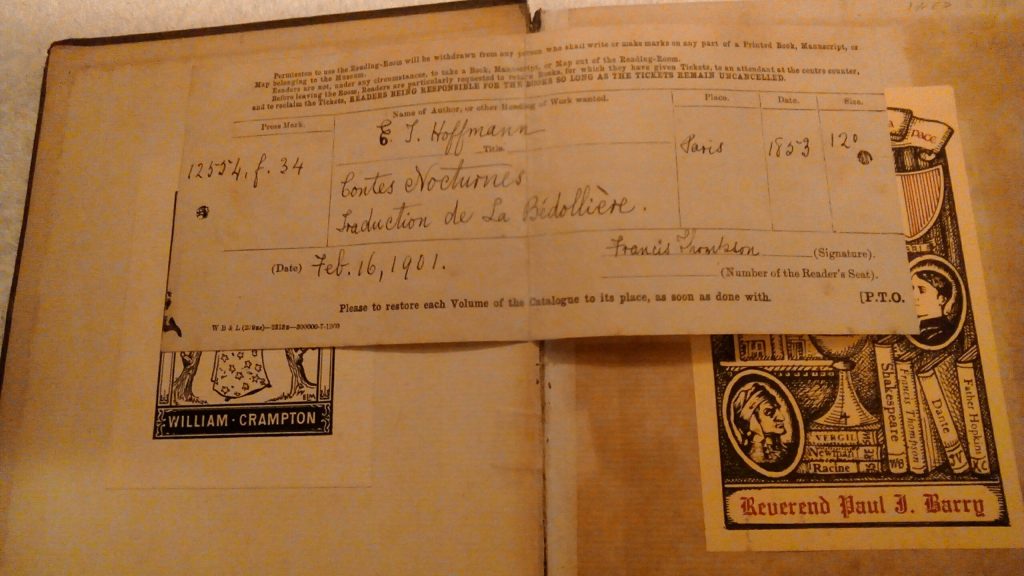
The book pictured is the first edition of Thompson’s Poems, from 1893. It has a Slipcase and two bookplates, Reverend Paul J. Barry and William Crampton.

But the most interesting thing is what one of these gentlemen affixed to the book with a little glue. It’s a library ticket from February 16, 1901 with Francis Thompson asking to look at a copy of a book by E. T. Hoffmann.

As you can see it bears Thompson’s signature, and I think that’s great. Only example of his autograph I’ve come across, but I would guess he’s signed a few things — all authors of books have signed copies floating around but this is the first I’ve seen of Thompson’s.

So there you go, Jack the Ripper’s signature. Or maybe not.

Posted in Lit, News | Tagged , , , , , |

Hammett: The Roscoe Barked

In Chapter II of The Maltese Falcon Death in the Fog — Sam Spade describes the gun used to bump off his partner Miles Archer: “Webley-Fosbery automatic revolver. That’s it. Thirty-eight, eight shot. They don’t make them any more.”  

With some time to kill during COVID our longtime pal Bill Arney decided to look up some info on the gat in question:

A bit of trivia I found while doodling around the interwebs:

Webley’s surviving production and sales records show that only 107 of these revolvers in this caliber [.38] were sold, the remainder of the total of 417 originally produced in the period 1902-1903 being converted to .455 caliber or scrapped for parts before 1914: only 39 examples are currently known to have survived. Of these, few survive today with high original condition and very few are found in the United States.  

It occurs to me that, in order to “convert” an eight shot .38 into a six shot .455, the entire cylinder would have to be scrapped and replaced. The barrel could simply be bored out. I found an auction ad for the .38 version on sale for $31,625, but the more numerous .455 I found on auction for $8,500 – $13,000 — one comes with the original holster, so that would definitely be the way to go.

I always wondered why W-F bothered to make the thing in the first place, since a double action revolver also fires as fast as you can pull the trigger, just like automatics. The story is that double action revolvers were kind of a new thing (W-F started making these in 1902), and a lot of extra pull was required to work the double action, as opposed to the lighter triggers on single action revolvers.

That extra pull threw the aim off. Still does, I suppose.

One more detail — in order to make the recoil work properly, you had to keep your wrist and elbow very stiff when firing. Any movement would throw off the recoil mechanism. Basically, that would cause the recoil rack to not make it all the way back, and  the damn thing would jam. The whole reason for using a revolver instead of an automatic is BECAUSE AUTOMATICS JAM AND REVOLVERS DON’T.

Geez, what a hair-brained scheme.

I spoke to a guy has the largest Webley collection in the world — or so he says — with his dad. Dad died 15 years ago and the son has finally decided to sell off the collection. The .455 version that he has is yours for $12,500. He’ll do lay-away!

He reminded me that it is an investment that will NEVER devalue.

If you want the authentic Hammett .38 for over $30,000, start saving your pennies. They may also do lay-away.

Good hunting!


Posted in Dash | Tagged , |

Rediscovered: Before Re-Upping in the Heretics

It’s probably lucky that Tom Krabacher made his run up to Auburn to check on the old Gaylord homestead a couple of weeks ago, because he just got called up for Haefele’s Heretics and their latest assignment — proofing the 800 pages of John D. Haefele’s upcoming book, Lovecraft: The Great Tales.

800 pages, that is, if done in the same font size as Haefele’s previous book, A Look Behind the Derleth Mythos.

Brutal. But fun.

If you’ve noticed me missing in action over the last few months, slaving over the edits as Haefele and I finished off his text surely was the reason. We got it wrapped and polished.

Now the Heretics take over.

Posted in Lit, News | Tagged , , |