Two-Gun Bob: Men, Women, Jungles and Chain Mail Bikinis

In Round One of his review of Conan Meets the Academy, Brian Leno padded into the ring, finding that editor Jonas Prida has a highly breakable glass jaw in the arena of Howard Studies, because he can’t seem to tell much difference between Robert E. Howard and L. Sprague de Camp. Or Howard and Robert Jordan, or Howard and an Ah-nold flick.

But now he’s going into the meat of the book to see if that material is more effective.

Here’s Brian, gloves up:

The first part of Conan Meets the Academy deals with the literary Conan and starts with Jeffrey Shanks’ “Hyborian Age Archaeology: Unearthing Historical and Anthropological Foundations.” Shanks is well-respected among Howard fans — placing his essay as the first in the book was an intelligent decision for editor Prida. It’s a good start and helps to erase a little of the bad taste left in my mouth after the introduction.

Shanks nicely displays his knowledge, showing readers how books such as H. G. Wells’ The Outline of History: Being a Plain History of Life and Mankind and W. Scott-Eliot’s The Story of Atlantis may have influenced the Texan when he got down to his task of imaginary world creating. Informative and respectfully done, Shanks’ article compares favorably to other essays he has written.

Frank Coffman’s “Barbarian Ascendant: The Poetic and Epistolary Origins of the Character and His World” begins with promise but then strays as Coffman furthers his arguments. His main point is to demonstrate that when Howard states in a letter that there was no “conscious process” on his part to create Conan, REH “leaves his statement open to the contradiction by the truth of the matter—there were unconscious processes at work.”

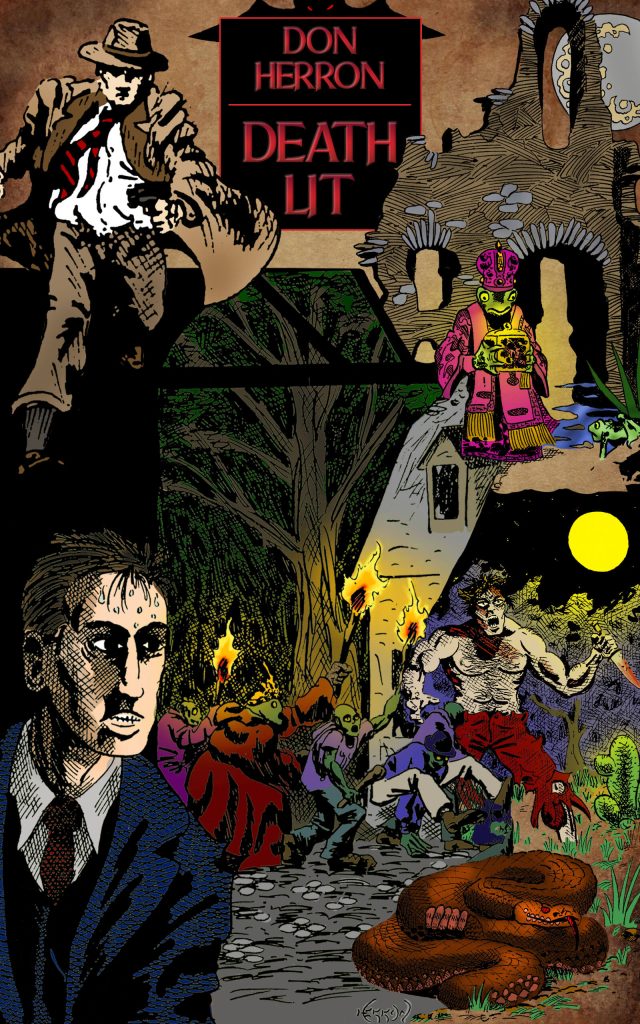
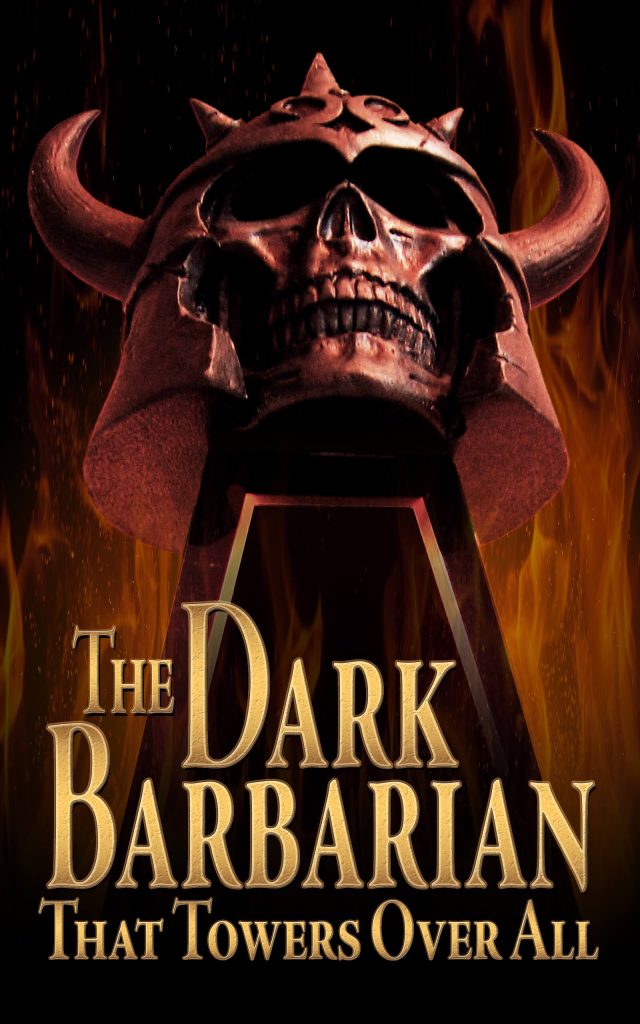
Nothing really new here, but Coffman muddies the water when he attempts to prove that Howard’s view of barbarism wasn’t really as “dark” as the title of Don Herron’s groundbreaking The Dark Barbarian might indicate. This is apparently a pet project, as a recent essay of his titled “Conan as Bright Barbarian:  Or—Barbarism is Relative” has appeared on his website. Mildly interesting, but I think he’d be better served to argue on more feasible topics.

Still, this essay is better than Coffman’s “Texas Talespinner: Robert E. Howard’s Ways with Words” which appeared in the Szumskyj volume Two-Gun Bob.

The third essay, “Life, Liberty and the Pursuit of Women: Gender Dynamics in the Hyborian World” is by Winter Elliot and is the worst essay in the first half. On the very first page she cites Darrell Schweitzer’s Conan’s World and Robert E. Howard not once, but three times.

I really had thought Howard studies had moved beyond this ineffective little booklet from 1978, which is not very highly thought of by scholars or fans alike. She writes that Howard’s “bewitching population of female characters sometimes helped to land [him] the cover art of Weird Tales”, and then she cites Schweitzer’s book as her source — did she really need to read Schweitzer to discover that?

She adds “such lovely ladies could also lead to some pointed speculation about the contributors to Don Herron’s The Dark Barbarian…to a man these contributors are…well men.” I gather this is some sort of tongue-in-cheek comment; I really can’t imagine she is grouping Fritz Leiber, Glenn Lord and Steve Eng (well-respected writers all) as being from the Land of Misfit Boys because they may have enjoyed looking at the Margaret Brundage covers. Leiber is an internationally known writer and has appeared in the Library of America. Glenn Lord (forget de Camp) did more than anyone else to keep the memory of Robert E. Howard alive. And Steve Eng wrote the definitive essay on Howard as a poet. Their contributions to Howard studies stand head and shoulders above most.

To be fair, Elliot does cite the Leiber and Lord articles from The Dark Barbarian — but she does seem to rely mostly upon Schweitzer.

Later in her essay she writes that Howard’s character of Valeria had “wonder of wonders, more or less appropriate clothing” and then adds, in another touch of misplaced humor, that “apparently all of the chain mail bikinis were sold out.” First off, of course, Howard never wrote any of his women into a chain mail bikini and I could only come to the realization that Elliot isn’t really taking Howard and his writing seriously.

She adds to the misfortunes of her essay when she brings up the famous episode in “Red Nails” when Valeria strips an adversary naked and starts to whip her, attempting to gain valuable information. “Now,” Elliot writes, “as even the American CIA recognizes, there are many and varied ways to torture someone, and the methods’ effectiveness at producing information varies widely.” If you’re going to talk about politics let’s talk about politics in REH’s time, and how that relates to his stories. Why any modern writer would feel Howard fans are anxious to know his or her own political preferences is beyond my understanding.

Thankfully, the next essay, “Robert E. Howard’s Barbarian and the Western: A Study of Conan Through the West and the Western Hero” by Daniel Weiss is decent. Weiss quickly gets to the point and tells how, in his essay, he “will examine the structure and efficacy of the western through an exploration of several western novels and how they relate to Conan and the Conan stories.” He handles this intelligently, bringing up authors that Howard had, in all likelihood, read. Zane Grey’s Riders of the Purple Sage, and Owen Wister’s The Virginian, and the novels of James Fenimore Cooper are only a few that fall under his literary microscope.

To his credit Weiss notes that for continued reading one should turn to Ben Indick’s “The Western Fiction of Robert E. Howard” which appeared in The Dark Barbarian. However he does himself a disservice when he cites from de Camp’s Dark Valley Destiny, a book that hardly anyone holds in high esteem anymore.

The next essay, “Canaan Lies Beyond the Black River: Howard’s Dark Rhetoric of the Contact Zone,” is by Paul Shovlin, a former contributor to The Cimmerian. His offering in Leo Grin’s superb journal was “Raising Kane: Transcendence through Subversion,” and it was a good one. One of the best articles ever on Solomon Kane, Shovlin won me over when he mentioned that in a story like “Wings in the Night” Howard’s Puritan adventurer “might as well be named [Joseph Conrad’s] Kurtz, as he evades cannibals seeking to literally eat him alive even while we realize with horror that Africa itself long ago swallowed him whole.” I’m a fan of “Heart of Darkness” and anyone who doesn’t see similarities between the Africa of Conrad and the Africa Kane journeys through isn’t reading very closely — even though Howard had probably not read Conrad by the time he was creating Solomon Kane.

Shovlin in this latest essay states that “it is a good time to revisit and reconfigure explanations of the role and race in [Howard’s] work,” because of the purer texts available. Shovlin goes on to write that he is “less interested in defending Howard’s reputation by how racist he was or what kind of racist he was, and more interested in figuring how racial representations work in his stories and how race relates to a particular set of philosophies or a worldview his literature supports.” He does this by an examination of “Black Canaan” and “Beyond the Black River” and it’s refreshing to read a writer who can go beyond the racist label that has been applied to Howard and give us a thoughtful, reasoned approach to a complex issue.

Shovlin gets high points for this article, but to my view the Kane essay from The Cimmerian is the better of the two.

Ding-ding!

End Round Two.

Brian goes to his corner to get ready for the final round — and keep in mind he hasn’t crossed gloves with stylometrics or the Really Boring Stuff in this book yet! Jeez. Poor Brian.

And due out at any moment is the 17th issue of Two-Gun Raconteur, where I toss in a quick 2000-plus worder on Howard Studies and academics — and address briefly the suggestive statement by Winter Elliot that The Dark Barbarian featured essays all by men.

To quote from that upcoming article:

“Men. Ick.”

Posted in REH | Tagged , , , , , , , , , , , , , , , , |

Two-Gun Bob: Could The Academics Refurb de Camp? and Other Concerns of a REH Purist

A little over a year ago our occasional Guest Blogger Brian Leno managed to slug his way through the collection of litcrit on Robert E. Howard, all by academics: Conan Meets the Academy, edited by Jonas Prida. And not too long after that he jabbed his way through a review. . . .

I’ve had the review keeping cool in the icehouse for a few months, but with the anniversary of Howard’s suicide coming up on June 11th, it’s no doubt time for it to clamber out on the mat. I’m presenting it in three rounds, each with some ringside commentary by me. Brian could have gone more savage on this book than he did (as when he muttered “My god. You’d have to be one dusty son-of-a-bitch sitting in a study somewhere to want to read something like this. . . .”), but Brian’s such a nice guy, he just couldn’t take off the gloves and go bare knuck.

It takes something truly rancid, such as the Joshi “novel” The Assaults of Chaos, to get Brian really swinging from the ropes.

And now, in this corner, Brian Leno:


I’ve been labeled a Howard completist, and while I think I no longer qualify for that appellation, at one time I couldn’t help myself. I bought — excepting the comics and the paperback pastiches — damn near everything. 

Because of this compulsion I’ve made a few bad purchases in my time — volumes such as the Darrell Schweitzer edited The Robert E. Howard Reader and Two-Gun Bob:  A Centennial Study of Robert E. Howard, compiled by Benjamin Szumskyj. These two books of “literary criticism” only serve to remind me that not all tomes on Howard are good, something other fans of the Texan and his writing also should have discovered by now.

I don’t even know where my copies are of these two anthologies — tools for use in future research they most certainly are not.

So when my copy of Conan Meets the Academy: Multidisciplinary Essays on the Enduring Barbarian arrived I wondered how this book would fare. Would it end up as just another bad Howardian purchase or could it possibly merit being stacked next to Don Herron’s The Dark Barbarian or Leo Grin’s literary journal The Cimmerian? — publications which are undoubted highlights of Robert E. Howard studies.

The first couple paragraphs of Jonas Prida’s introduction gave me some slight hope; it seemed that he and I shared a few similarities. Prida writes he first met Conan through “Arnold Schwarzenegger’s well-oiled, muscle bound version in Conan the Barbarian” and he adds that to see it his father drove him to the nearest theater, which was an hour and a half away. He was eleven at that time. I quickly realized that we had something in common; I had also discovered Conan when I was about eleven, except my first meeting came via the Lancer paperbacks. Added to this somewhat coincidental start was the fact that my parents had also driven many miles to take me to a Howard destination — Cross Plains, Texas, where I was able to see the home of my literary idol.

While Prida and I came to Conan at about the same time in our lives there’s a world of difference when he starts discussing Robert E. Howard. I discovered Conan through the art of Howard — I just tossed the de Camp and Carter rubbish aside — so when I saw the Schwarzenegger movie I realized it was a pale imitation of Howard’s barbarian; Prida didn’t have the reading base to understand that. Perhaps that is why to his “adolescent mind” Robert Jordan’s Conan the Invincible was as good as “Red Nails” because, as he phrases it, “it was all Conan.” Prida states in the preface that “as editor he took it upon [himself] to read every Conan story, rewrite, pastiche, and novel available, leaving out only the comics.”

While I suppose I should give him credit for perseverance, I still wonder how he could possibly have so much time to waste.

Before we get much more into this review it should be noted that I am a Conan purist — if it wasn’t written by Howard it’s not really Conan. So when Prida stresses that his book is about Conan “as a cultural product” I have reservations about how the writers might handle the legacy of Robert E. Howard.

And reading a sentence where Prida states he “paid little attention” to the de Camp introductions (where de Camp comes off as jealous of Howard and just downright insensitive) and then adds that there “is certainly a difference in the flavor of Howard’s writing that is not found in the slightly tamer [emphasis mine] versions of de Camp” not only makes me angry but also a bit uneasy.

If the writers in this book have as much trouble as Prida in recognizing the superiority of Howard’s Conan to the dilution of the character as brought about by his appearances in popular culture, I knew I was going to be in for a long haul. The realization that I, by doing a little math, have been reading Howard for more years than Prida has been alive didn’t put my fears safely to bed either.

I know the title tells me it’s going to be Conan meeting the academy — but what’s wrong with Howard meeting the academy?

If I was having this many problems, and questions, with just the introduction what would the rest of the book be like?


Ding-ding!

First Round down.

Time for Brian to take breather and for me to do some commentary, get some weigh-in statistics and so forth into the mix:


Brian was telling me on the side that he was really nervous about Prida’s seeming fondness for de Camp. You’ve got a younger fighter coming into the ring. Could an academic have a longer reach? Is it possible that someone like Prida could punch de Camp back into the good graces of Howard fandom, if he keeps at it — and doesn’t even understand that there’s a problem?

My answer to Brian: Don’t worry about it. Prida could make it his life’s goal to boost de Camp in Howardian circles and get nowhere. De Camp is no longer a contender.

Sure, if you search out info on de Camp related to his role as one of the writers in the Campbellian Golden Age of Science Fiction, he looks good on paper. All buddy-buddy with Heinlein, Asimov, and company. The sf critical crowd doesn’t even seem to understand that by the end of his career he was making most of his money off Conan, all the while knocking REH as some crazy, primitive pulp writer — a stance that most in Howard fandom dislike intensely.

No Howard to create the barbarian icon, de Camp’s career would have trickled off into nothing much by the end.

When REH’s reputation becomes the focus, de Camp doesn’t look good at all. (And we won’t even begin the discussion of how de Camp’s biography of H.P. Lovecraft made him the target of Lovecraftians, as passionate about it to this day as are Howardians. Ah, I remember those early years, when the assembled Lovecraft scholars, led by Dirk Mosig, began their charge — and I was on an adjacent field with a Pure Robert E. Howard banner flying high, sword drawn. . . .)

I told Brian: Look at it this way. Yes, de Camp was a mover behind the Lancer paperbacks which catapulted REH into worldwide awareness. But by adding his own crappy material into the mix, he undid the good he did — to the point that when Lifetime Achievement Awards began in REH circles de Camp couldn’t even get a toehold.

The first awards were handed out in 2001 — the Cleos — that one year only. Check the people who made the cut. De Camp’s name doesn’t appear for either Lifetime Achievement or Biography. He had died as recently as November 6, 2000, but already was a non-entity in Howard Studies.

Then Leo Grin started up The Cimmerian Awards in 2005. First Lifetime Achievement — the Black Circle Award — went to Glenn Lord. Of course. In 2006 Rusty Burke and I duked it out, with neither getting a clear majority. In 2007 Rusty and I were both given the Black Circle, since otherwise it appeared our respective voting blocks would just go toe-to-toe forever. In 2008 Novalyne Price Ellis was the first posthumous winner, so you didn’t have to be alive to nab the glory.

All that time de Camp’s name was in the hopper, but he couldn’t muster enough votes to get on a final ballot.

In 2009 the Robert E. Howard Foundation took over the awards — no one made the cut for Black Circle consideration that year. In 2010 Indy Cavalier, longtime Official Editor of REHupa, made the cut for nomination and got the plaque in the 2011 voting. That same year longtime Howardian fanzine editors Dennis McHaney and Damon Sasser made the qualifying numbers — Dennis took it in 2012 and Damon in 2013.

Still think de Camp has a chance at redemption, when fans have been kicking his butt in the voting for thirteen years? If the awards keep going on in some form maybe in another twenty or thirty years when they’ve given a nod to everyone who has ever done anything at all on Howard, then maybe de Camp might get the honor.

Hell, I can see Jonas Prida taking home the trophy before de Camp! — simply for finally getting out a book on REH by academics. I almost feel sorry for de Camp, except he wanted the money and didn’t really care how he got it.

If he wanted any kind of posthumous regard, de Camp can find that in kinder gentler sf circles, not in the unforgiving arena of Howardom.

Posted in REH | Tagged , , , , , , , , , , , , , , , , , , , , , , , , |

Rediscovered: Literary Homes, on the Block

Surfing around in Bill Crider’s Pop Culture blog the other day, I noticed a link to an article about no less than eight literary homes being up for sale at the moment. I’d seen separate articles about Ray Bradbury’s long time residence coming on the market, and several that mentioned the so-called “Scarface Mansion” (that would be Al Pacino’s Scarface) being offered, if you just had enough moola.

None of the other articles mentioned that the Scarface Mansion once housed Thomas Mann, however. . . .

At any rate, check it out if you dig literary landmark action. The only big time literary home I recall being on the block recently was the Zane Grey adobe in Catalina, which I mentioned awhile back. (You’ll find a couple of shots of the adobe in that link, and a couple more in a follow-up post.) 

Among other writers featured are Norman Mailer and Elizabeth Bishop (I have notes on Bishop’s stay in San Francisco in the event I ever do a revamped Literary World of San Francisco).

What most intrigues me about this news is whether or not Fritz Leiber visited Thomas Mann during his residency in the future Scarface Mansion — and would Fritz have had some nagging thought about the house looking Very Familiar when he caught the movie? (Pretty sure he would have caught the movie — director Brian De Palma was a darling of cineastes in that day, and Fritz was a cineaste living among cineastes.)

Fritz wrote about visiting Mann during his LA years in one article or another — don’t recall if there was enough description of the place to figure out a Scarface Mansion angle or not, and a quick check of various essays didn’t turn up the blurbage. If I stumble across it later I’ll do an update.

But for me that’s the cool aspect: yeah, Mann abiding in the future home of “Say hello to my little friend!” is interesting, but Fritz Leiber — a writer I knew — possibly visiting him there is much cooler.

Posted in Film, Lit, News | Tagged , , , , , , , , , , , , |

Tour: The June Walks

don4

Okay, June is coming up fast — kicking off with a walk on Sunday June 1 and another on Sunday June 22 (with at least one tour by appointment booked in there, too, thus far).

For the walks on June 1 or 22, anyone can show up, no reservations needed. (For a recent tour a guy up in Portland just got in his machine and pointed the nose south. What the hell, right?)

Start at noon near the revolving “L” sculpture.

$20 per person. Four hours or so.

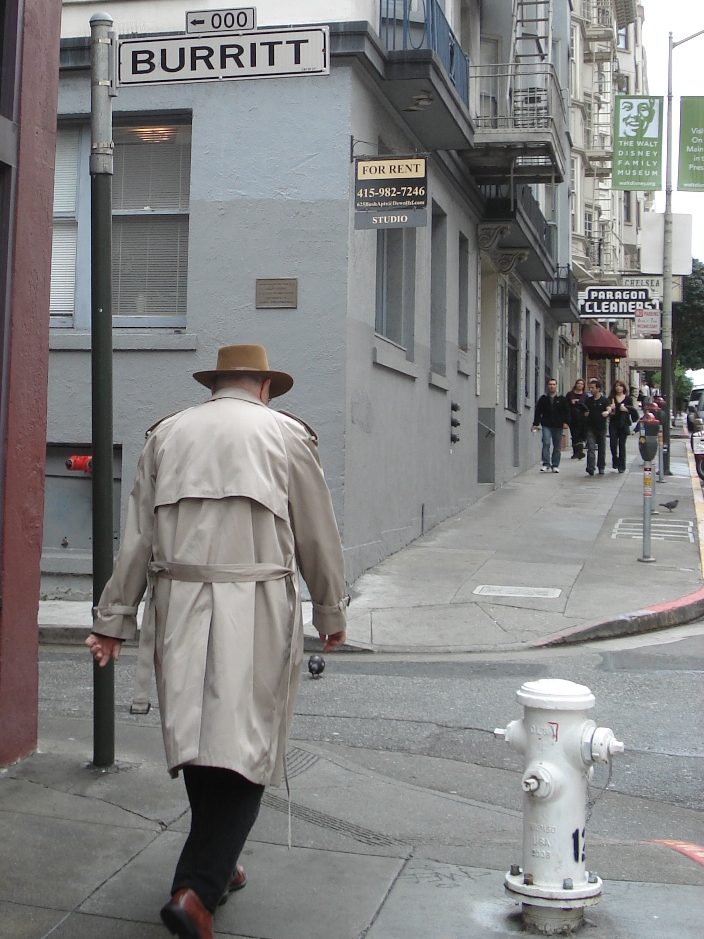
Comfortable gumshoes, hats and trench coats — well, that’s up to you.

(Pic at top — showing off the plaque next to the doorway of 891 Post Street, where Hammett wrote The Maltese Falcon.)

Posted in Frisco, Tour | Tagged , , |

Hammett: All He Wrote

Hunter

 And now, on Birthday 120, it is time to do a recount — we’ll call these The Zobeck Statistics. As anyone who has been on the tour knows, I personally count The Big Knockover as a novel (if a short novel), and I know some people will want to keep “The Parthian Shot” and “Immortality” in the list as full-fledged stories (if super-short vignette-style stories). Pulp dealer Paul Herman was just on the walk this past Sunday, and kicked over the idea of anything being taken off the list.

Hashing it out, that’s half the fun.

Still, niceties aside, here’s the up-to-date count on Hammett’s known output — five or six novels, depending — around eighty short stories.

And to do the official tally, once again we give you the Master Record Keeper and Prince of the Pure Texts, Terry Zobeck:

It’s been three years to the month since I began posting guest blogs here on the Mean Streets on the pure texts of Hammett’s short stories. Back then I provided a brief overview of Hammett’s stories and the edits Dannay made to them. At that time I noted Hammett had published 66 short stories, the final one, “A Man Named Thin” (Hammett’s original title was “The Figure of Incongruity”), appeared in Ellery Queen’s Mystery Magazine just days after his death on January 10, 1961.

With the publication of The Hunter and Other Stories we can now update this overview. The new volume includes 15 stories from the Hammett archives at the Harry Ransom Center at the University of Texas, Austin that were unpublished during his lifetime. This would take the total to 81; however, after reading Hammett’s article “Vamping Samson”, I think we should remove from the total two very short pieces — “The Parthian Shot” and “Immortality” — that Hammett himself did not include among his stories; he considered these two pieces to be “short miscellaneous matter.”

So, Hammett’s published oeuvre now consists of the following material:


  • 79 short stories (including “The Man Who Loved Ugly Women,” which is unlocated);
  • 5 novels (the first four of which were serialized in earlier states in 17 issues of Black Mask, and the final one in a bowdlerized version in Redbook);
  • 1 edited short story anthology, Creeps by Night;
  • 4 poems;
  • the pamphlet, The Battle of the Aleutians;
  • 9 non-fiction articles;
  • 45 book reviews (plus the unpublished review of Finnegans Wake);
  • 2 short miscellaneous pieces;
  • 1 book of letters (and 5 letters to the editor of various publications that have not been collected);
  • 1 screenplay (Watch on the Rhine) and 6 screen stories;
  • 2 volumes collecting the comic strip Secret Agent X;
  • 3 introductions to books (the Modern Library’s edition of The Maltese Falcon, Wind Blown and Dripping — the collection of cartoons from the Adakian, and The Communist Trial — the second printing only);
  • Editorship of the Adakian, the Aleutian Islands U.S. Army camp newsletter (including 13 pieces signed by him);
  • 13 miscellaneous political statements; and
  • 3 classified ads for editing services.


This list does not include the fragmentary material published in The Hunter (the ARC and e-book version contain additional such material) or the unfinished first version of The Thin Man, or “The Thin Man and the Flack” (a photoplay with captions supposedly written by Hammett that appeared in the December 1941 edition of Click), advertising copy for Samuels Jewelry Company, political petitions signed by Hammett, interviews, or his contributions to Lillian Hellman’s plays.

Posted in Dash, Tour | Tagged , , , , , , , , , , , , |

Hammett: Zobeck Takes on The Hunter and Other Stories

Harper's Bazaar March 1932


And in celebration of Birthday 120 for Hammett, how about the thoughts of a long-time Hammett fan and collector on the most recent collection of his stories?

Ladies and Gentlemen, here’s Terry Zobeck:

Back in October Don reviewed The Hunter and Other Stories, a new collection of previously unpublished or uncollected Hammett stories, for Publisher’s Weekly. He wrote, “I know fans of crime writer Dashiell Hammett who have been waiting decades to read the stories collected in this book.”

Yeah, that would be me, all right.

About 20 years ago a kindly book dealer put me in touch with Bill Pronzini, creator of the Nameless Detective and author of many other books. Over the course of the next couple of years we exchanged several letters. In one he told me that a couple of years previously Jack Adrian, British author and anthologist, had sold Oxford University Press on a Hammett collection to commemorate his centenary that would include uncollected stories and six unpublished ones.

During a visit to Adrian, Bill read three of the stories and found that “one is quite good and the others are worthy of publication.” He added, however, that the project collapsed due to a dispute over ownership of the stories between the Hammett family and Lillian Hellman — there’s a surprise. Most importantly, Bill replied to a question from me that none of the stories featured the Op — hey, even then I had my priorities straight.

I’m sure I knew of these stories before receiving Bill’s information, but I don’t recall quite when it was. But, they certainly have haunted me for years. You may have concluded from my pure text blogs on These Mean Streets that I’m somewhat obsessed with Hammett’s work. Knowing these stories existed but that I couldn’t read them was incredibly annoying. Now, thanks to Rick Layman and Julie Rivett (and Otto Penzler, of course), the wait is over, and it was very much worth it.

The book contains 15 stories not published during Hammett’s lifetime, two previously uncollected stories, three unpublished screen stories, and an unpublished fragment of a Sam Spade story. Layman provides an introduction and commentaries to each section of the book: Crime, Men, Men and Woman, and Screen Stories; and Rivett provides an afterword.

Pulp Fiction-The Villians

Of the former group of stories, three were published in recent years: “Faith” appeared in the Otto Penzler collection, Pulp Fiction: The Villains (2007); “The Cure” (as “So I Shot Him”) in the 2011 Winter/Spring issue of The Strand Magazine; and “An Inch and a Half of Glory” in the June 10 & 17, 2013 issue of The New Yorker. (The editors do not acknowledge the prior publication of this last story; it may have been sold to The New Yorker following printing of the book).

Hammett was no pack rat; very few of his manuscripts survive. However, he thought enough of these stories to carry them along as he changed residences and moved across the country. Some were accepted for publication, but the magazines failed before they could be printed. Others were submitted, but for some reason rejected. Others may never have been submitted.

It’s curious that once he found widespread fame he did not re-submit them. By that time most magazine editors would have jumped at the chance to publish a story by the author of The Maltese Falcon and The Thin Man. Hammett could have extended the impression he was still writing publishable fiction for several years beyond 1934. Perhaps it is further evidence of the extent to which he had become uninterested in the whole game by this point.

None of these stories will make you forget the best of the Continental Op stories, but several are exceptionally good and are worthy additions to Hammett’s bibliography. The standouts include “The Hunter,” a hard-boiled detective story, “The Cure,” a story of psychological suspense, “Faith,” a dark character study, and the boxing story “Monk and Johnny Foxx.” These all show Hammett experimenting to good effect.

The two previously uncollected stories are the outstanding “On the Way,” first published in the March 1932 issue of Harper’s Bazaar, and the far less interesting “The Diamond Wager,” first published in the October 19, 1929 issue of Detective Fiction Weekly.

“On the Way” is among Hammett’s last published fiction; it gives us a hint of where he could have taken his writing had he continued to publish (and in that respect, shares some attributes with the best of the unpublished stories collected here). It is a character study set among the Hollywood crowd that Hammett knew well. Kipper is on the way down the ladder, while Gladys is on the way up. He knows that soon there will be no room in her life for him, so he’s looking for the way out.

“The Diamond Wager” is among Hammett’s most forgettable stories; presumably, he too thought little of it since he published it under the none-too-subtle pseudonym Samuel Dashiell. It is written in the Golden Age style that Hammett did so much to make obsolete; it’s curious, then, why he chose to try his hand at it. Nothing exciting occurs and there is little reason to spend much time with it.

The three screen stories are The Kiss-Off (filmed as City Streets), On the Make (filmed as Mr. Dynamite), and Devil’s Playground (never produced). Of these, On the Make is the most interesting. According to Hammett’s affidavit in his 1948 lawsuit with Warner Bros. over the rights to the Sam Spade character, the story started out as a sequel to The Maltese Falcon. As exhaustively demonstrated by Warners in their response, Hammett’s claim was pretty much hooey.

However, one can imagine that the character of the sleazy private eye in On the Make, Gene Richmond, is what many of the characters in The Maltese Falcon presumed Spade to be, much to their regret. In On the Make, Hammett creates a private eye that is perhaps unique in the genre. He is every bit as corrupt and dishonest as cops and the public often suspect private detectives to be. Gone is the lone detective with his own code of honor pitted against corruption and greed. Richmond wholeheartedly embraces corruption and greed, along with dishonesty and just about every other vice. Gutman would have loved Richmond.

It is an interesting concept fleshed out with strong characters and snappy dialog. I especially liked Richmond’s gal Friday, Miss Crane; she’s no Effie Perine. Unfortunately, the climax is weak and contrived. With a little more effort from Hammett and a stronger cast it could have been a terrific movie.

I was especially pleased to find that the editors included all that remains of Hammett’s attempt at another Sam Spade story, “A Knife Will Cut for Anybody.” I saw this fragment for sale in 1993 at a rare book show in Washington, D.C. (the other highlight of this show was meeting, for the first time, special guest James Crumley). Biblioctopus, the L.A. rare book dealer, had it for sale along with what appeared to be the draft of a section of Tulip, Hammett’s never completed mainstream novel. I was able to read the opening page and had been tantalized by it ever since. The eventual owner made it available to the editors for inclusion in The Hunter. Many thanks to whomever you are.

The last couple of years have been good ones for Hammett fans. We’ve had Otto Penzler’s reprinting of the original text of The Maltese Falcon as it appeared in Black Mask and two volumes of rare Hammett from Layman and Rivett. But it looks like the well may be dry. About the only thing left is to issue the definitive collection of Hammett’s stories — all the stories in their pure text forms, including the serialized versions of the other three novels first published in Black Mask.

It is the stuff dreams are made of.

An Inch and a Half of Glory

Posted in Dash, Film, Lit, News | Tagged , , , , , , , , , , , , , , , , , , , , , , , , , , , , , |

Hammett: Birthday 120

DFW October 19, 1929

One hundred twenty years ago today, May 27, 1894, Samuel Dashiell Hammett eased out onto the Mean Streets, and after awhile slipped on his gumshoes, spent a few years bouncing around as a Pinkerton’s op before another few years knocking out stories like Red Harvest and The Maltese Falcon, and the rest is history — and some mighty good reading.

For a birthday tribute I was thinking about doing my planned essay on Red Harvest, but one thing and another distracted me. (Maybe I can get it done in time for Xmas. . . .)

Which doesn’t mean it isn’t going to be party-time today here at Up and Down These, because our regular Guest Blogger Terry Zobeck has popped in some material to mark the occasion — pictures, reviews, even a final count of Hammett’s literary output. After 120 years, it looks like the numbers are in.

(The pic above of Detective Fiction Weekly from October 19, 1929 comes from Terry’s private collection — this is the issue containing one of Hammett’s worst stories. Most of his product was far superior, or else we wouldn’t be celebrating the birthday.)

Posted in Dash | Tagged , , |

Sinister Cinema: Bogie and The Duke

Got in a note from Terry Zobeck — who has Material of Substance lined up in my in-box, but you can’t always do the Deep Pure Text stuff. Terry has this piece of cinematic history to relate:

All that talk recently on the Mean Streets about the various connections of the film of The Maltese Falcon must have seeped into my subconscious.

A couple of weeks ago I was watching TCM and they had on John Wayne’s Big Jake, one of his pretty awful late period Westerns, a poor retread of the plot of the classic The Searchers.

Wayne’s grandson is kidnapped by a gang led by Richard Boone. Wayne, his sidekick and two sons — played woodenly by his real-life son Patrick and Robert Mitchum’s son Christopher — track down the gang.

The highlights of the film are the two scenes between Wayne and Boone. The final one concerns Boone opening the chest that supposedly contains the ransom money. Wayne tosses the key to the chest to Boone who picks it up and walks over to the chest. He looks down and asks, What’s in it?

The Duke replies: “The stuff that dreams are made of.”

Holy !&#@! I’m only half watching by this point, but this line certainly catches my attention. I give an appreciative chuckle and end up watching the big shoot ’em up.

Lousy film, but it had the class to steal a good line..

Posted in Film | Tagged , , , , , |

Rediscovered: Roger Craig vs. the Riddle of the Bejeweled Statue

Hammett and The Maltese Falcon have become quite the staples on Jeopardy! By no means do I report on each instance — most recent one I thought worth notice was when Hammett and 891 Post actually got mentioned on the show, and from those clews you had to figure out that the detective would have been Sam Spade.

The broadcast for April 11 also deserves a blurb. A tournament-of-champions-from-three -decades-of-the-show deal. One of the contestants: Roger Craig.

I lean toward Craig as my fave Jeopardy! champ ever, because I happened to be watching when he got back-to-back Daily Doubles and both times bet everything — referred to, accurately, as the “ballsiest 60 seconds of Jeopardy!-playing in history.”

All I have to say is that I’d hate to be one of the competitors up against him or Ken Jennings or some other Monster Player.

So, on April 11 you had a category called Historic Objects. The $1600 slot. Revealing a Daily Double.

What’s the bet?

Craig to Trebek: “You know how I like to roll, Alex — true Daily Double.”

Card turns with the statement: Today thought of as a bejeweled statue, it was the Knights of Malta’s annual tribute to the Holy Roman Emperor.

Craig: “What is the Maltese Falcon?”

Posted in Dash, News | Tagged , , , , |

Hammett: Red Harvest Begat the Three Stooges?

You never know what you’re going to find drinking joe/surfing around the net/trying to wake up.

Today I came across a brief review of Hammett’s Red Harvest by Ron Scheer, who usually blogs about Old West stuff — worth checking out because of the lines:

But combine Hammett’s narrative style and the wild excesses of the novel’s storyline, and you have something that goes beyond deadpan to undisguised farce. . . . It’s not the Three Stooges, but you can see them from here.

And none other than our new Guest Blogger Michael S. Chong chips in with a perceptive comment!

Almost woke me right up. Then I slumped back into a vague stupor and stumbled off for more coffee.

Now at least half-awake and thinking about it, kind of a wild appraisal. Reminds me of when Sergio Leone was being hassled by Akira Kurosawa over A Fistful of Dollars which Kurosawa maintained was pirated from Yojimbo, which Kurosawa adapted (unofficially, to be sure) from Red Harvest. Leone said he took the plot from the “mid-1700s Commedia dell’Arte farce A Servant of Two Masters” (quoting myself from page 90 of the tour book).

Hey, there are worse things than being compared to the Three Stooges, but I’m guessing that the mindset of your usual Old West fan tends toward the more serious side of things (in real life, the Old West also gave us Mark Twain and the sardonic Ambrose Bierce, along with humorless gunhawks — though who’s to say that each and every gunhawk was morose?).

Anyway, as I always suggest to Old West guys, if you want a really interesting reading experience, track down the first few western novels written by Eugene Cunningham in the immediate wake of Red Harvest seeing serialization in the pulp Black Mask, where Cunningham also appeared. Riders of the Night, Buckaroo — cascades of Harvest-like violence. Later Cunningham dropped back to more typical action westerns, but the ones done when he was high on the gunsmoke wafting off Hammett’s seminal novel — great reading, if you’re a Hammett fan.

Posted in Dash, Film, Lit | Tagged , , , , , , , , , , , , , , |