Frisco Beat: William Worley

WorleyMy article on collecting San Francisco mysteries wraps up with a sequence from William Worley’s 1948 novel My Dead Wife, which captures in an evocative thumbnail moment the appeal of that hobby:

I ran uphill a dozen paces to the parapet and looked in the opposite direction towards Montgomery, where the street dropped steeply by concrete steps. No one there. Nothing. A hundred blank doorways, a thousand shadows, a million hiding places for murder.

And that has lead Lester Hardy to surf into Up and Down These Mean Streets, bringing with him more info on Worley — who was born April 22, 1915 in Glendale, California — died May 27, 1988 in San Francisco — in the interim enlisted in the Army in 1942 — a founding member of the Mystery Writers of America in 1945 — My Dead Wife in 1948 — the story “Mayhem on the Menu” in Detective Tales, November 1949 — with other members of the NorCal branch of the MWA contributed a chapter to the 1951 round robin novel The Marble Forest by “Theo Durrant” — taught English in Lowell High School in San Francisco from at least 1956 on.

And in his Tenth Grade Honors English class is where Lester encountered Worley:

“I entered Lowell in the fall of 1967 and graduated in June, 1970. In my English class Mr. Worley spoke of certain psychological elements common to the fiction published in pulp magazines, and it was my distinct impression that he had published short stories in the genre he referred to — this might easily have been before he entered the armed forces.

“It was very clear that after My Dead Wife, he published multiple mysteries under a pseudonym. And it seems to me there’s a pretty good chance he set at least some of those novels in San Francisco.

“Worley, as befits a mystery writer, was a real character himself, straight from Central Casting. He was a rather gaunt chain-smoker who rolled his own — the fingers of his right hand were permanently stained brown from the tobacco, and his skin had the distinctive, weathered texture of a lifelong smoker. He spoke to us about the ways in which an author’s psyche is unconsciously revealed in his or her fiction, and stated that was the reason he published under a pseudonym.

“That’s all very polite. The guy was flat-out weird.”

Lester tells me that a fellow student stopped into Worley’s office at 8 a.m. to find him taking a shot from a bottle of Scotch he kept in his desk — and that he seemed genuinely obsessed with the idea that a writer’s unconscious processes could be discerned in creative writing, hence Worley’s suggestion that he published under pennames later on.

Years after leaving Lowell, Lester says he bumped into another student from that time who clued him in to the moment that got Worley fixated on the idea: the writer went to a party where the father of a Lowell student — a psychoanalyst — spent most of the time expounding on the mindset of the author of My Dead Wife!

What’s more, the analyst wasn’t just some garden-variety shrink off the street. He was Dr. Meyer Zeligs.

Locally, Zeligs apparently was involved on the therapeutic side of things in the famous Cable Car Nympho case from 1964.

More importantly, he did a book in 1967 on Alger Hiss — his notes and papers for that project currently held at Harvard.

During one party, he apparently scarred Worley for life.

Lester wants to discover the crime novels Worley hinted at writing under assumed names, so he couldn’t be analyzed on the sly by Zeligs and company. If, in fact, these novels exist — who knows, Zeligs might have frozen his creative juices forever over those rounds of cocktails.

So, no more crime novels — or quite a few, in disguise?

Anyone with info, vague leads, or further anecdotes of Worley in the English classroom or at cocktail parties, feel free to pop them in.

Posted in Frisco, Lit | Tagged , , , , , , , , , |

Rediscovered: “Just Ask Luis Rodriquez”

luis1

So, to follow-up on the idea of doing In Memoriam: Willeford, how about we premiere a new Guest Blogger with a new series?

The blogger: Michael S. Chong, Willeford fan (who ain’t on the mean streets?). The series: articles with some Willefordian presence he’s tracked down, which aren’t cited in the biblio in my book Willeford. In short, cool new-to-almost-everyone stuff.

Plus, you’ll find Michael’s story “Suitcase Pimp” in the forthcoming “sexy” issue of the magazine Crime Factory, going out under the moniker Pink Factory.

Here’s Michael:

Quite recently, I was in a used bookstore in London, Ontario and while browsing,
I heard a younger man asking the clerk, also quite young, if they had any books
by Charles Willeford.  After the clerk said she had never heard of Willeford, I
pulled him aside and spoke to him.  It seems he had read Cockfighter and (being
bit by the Willeford bug) was looking for more.  I walked him over to the Mystery
section where I saw a Black Lizard copy of The Burnt Orange Heresy.

It made my day. Hopefully, writing these pieces will have the same effect.

Working as a researcher has its perqs. While my colleagues are going for cigarettes and drinking their coffees, I will take the time to look for something interesting to read.

During one of these, I typed “Charles Willeford” into the archive I was already working in and up came some unknown articles. They were ones I had not read in Dennis McMillan’s collection Writing and Other Blood Sports, mostly from John Keasler’s column written for The Miami News.

In Miami Blues, Willeford writes about this column:

“Sergeant Bill Henderson, Hoke’s hefty partner, sat on a royal blue couch and read John Keasler’s humor column in The Miami News.”

Mr. Keasler and Willeford were friends for 25 years and the amount of times Willeford shows up in his column makes you think they were pretty tight.

In the obituary from March 29, 1988 for his friend, Keasler wrote: “The more serious he looked, the closer you had to watch him.  He was the confidence man supreme, and the more con-proof you thought you were, the more joy he took in stinging you.

“Willeford, a friend once said, had the rare ability to tell the truth and make you think he was lying.  And vice versa.  (Once he convinced outraged Thomas Mann admirers that Hollywood was substituting a pretty girl for the pretty boy in Death in Venice to get rid of the homosexual angle and thereby get a PG rating.)

“He looked right straight down the bore of life and, essentially, laughed at it.

“He was at home at a literary tea, and he was at home at an alley crap game.  And he was good at both.  Charles leaves great memories.  His humor is a rare thing.  A friend once wrote, ‘Charles, the old centurion, wearing his rue with a jaunty difference. . .’

“Different indeed, different indeed.  He lived enough life for an entire platoon.  He wasted nothing.  He wrote it all down.”

John Keasler’s Miami News column was syndicated and the pieces by and about Willeford I found are from all over the United States.  “Just Ask Luis Rodriquez,” is from Mount Carmel Daily Republican Register for Wednesday, April 18, 1979, a guest column by Charles Willeford — while the circumstances depicted may not seem based in reality, the way Willeford writes about them, with a wry bluntness, makes them so.

luis2

Posted in Willeford | Tagged , , |

Tour: On Palm Sunday

dinan2a

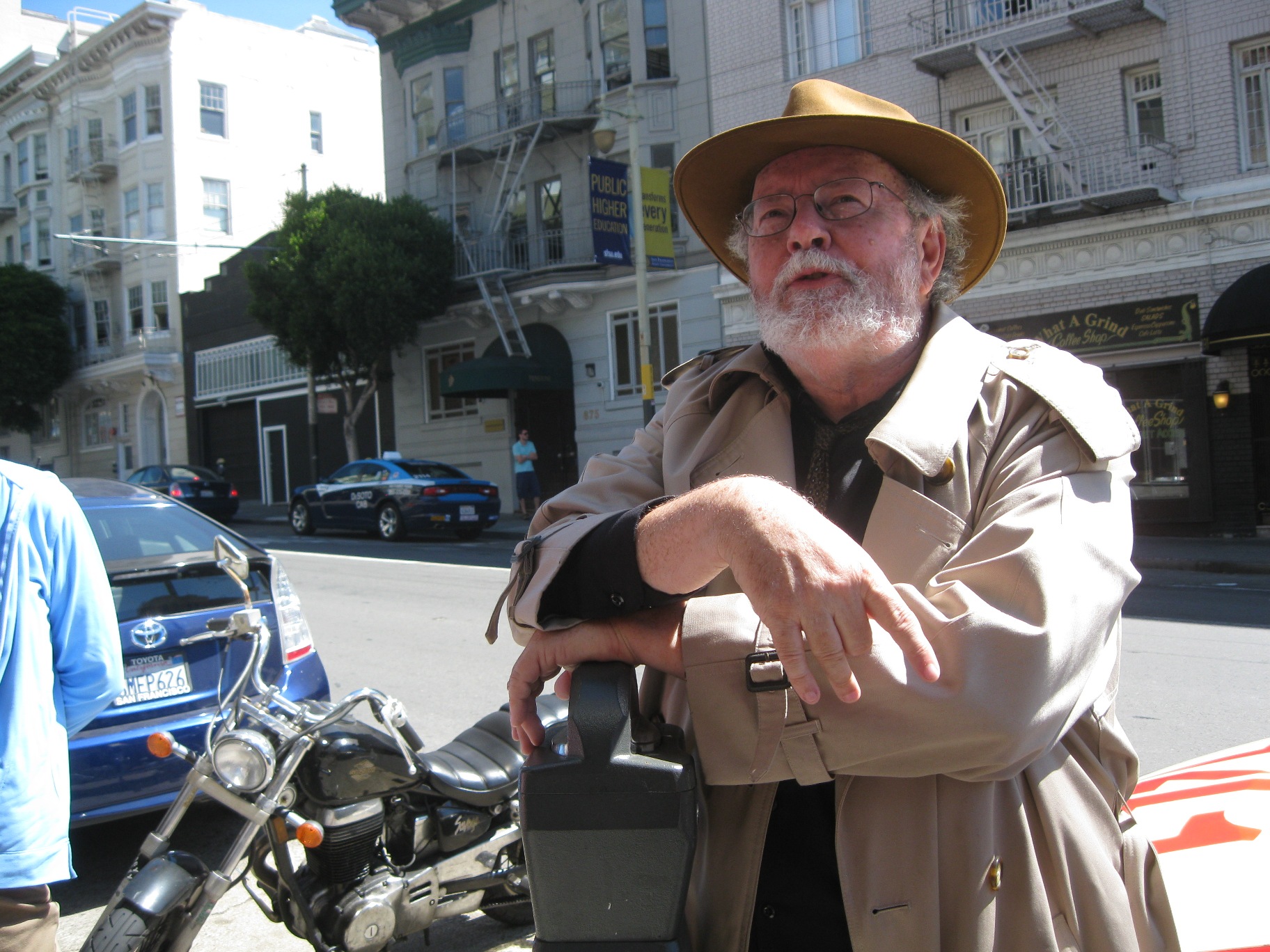
Jim Dinan sent in the shot above from the walk on September 8, 2013 — 891 Post is in the background, right, with the What a Grind coffee house sign and a bit of the front awning visible. Thanks, Jim.

To kick off the gumshoe action this year how about we return to an old tradition? — the Palm Sunday walks in memory of the late, great Charles Willeford. He passed away on a Palm Sunday, March 27, 1988 — an unbelievable 26 years ago this month.

This time around, though, Palm Sunday falls on April 13 — so if you’re in the mood to shadow the footsteps of Sam Spade, show up next month with twenty bucks and four hours to spare. I’ll toss in as an extra the hotel where Willeford told me he wrote his first novel.

(A couple of years ago I did a Memorial March theme — with notices for Willeford, and Lovecraft, and Edgar Rice Burroughs, and Philip K. Dick, as well as Robert E. Howard critic Steve Tompkins. Tough month for writers.

(I’m thinking if I can grab a moment I may have to use the rest of this month to try to catch up on various pals of mine who have been dropping like flies, a somewhat different handling of Memorial March. Honest, it almost seems as if everyone I know is dying.

(Depressing.

(Just heard last week that fantasy writer Michael Shea died last month. Only knew him casually, but a nice guy, came over for bar-b-que a couple of times when I was doing my stint in Sonoma County. His story “The Autopsy” in particular is one of the more gruesome things ever committed to paper.)

Posted in News, Tour, Willeford | Tagged , , , , |

Noir: A Fast Dose of Bleak for Monday

Got a note from Nathan Ward to tell me that he took a little break from working on his new bio of Hammett to knock out a 750 worder for Akashic’s “Mondays Are Murder” web featurette.

His gritty excursion into neo-Black Mask territory is titled “The Widow Never Showed” — check it out if you’re in need of some bleak and hard-boiled to start the week.

Posted in Dash, News | Tagged , |

Rediscovered: More on Alice Speed Stoll

Speed StollA year ago, this very month, our Guest Blogger veteran Terry Zobeck explored the references to real life kidnappings in various incarnations of the Hammett story “Death and Company” — which included the 1934 Alice Speed Stoll caper.

Just got a note from Steven Key Meyers, who tells me, “As it happens, my 2011 book All That Money (and, yes, I filched the title from Hammett) was inspired by the Stoll kidnapping.”

You can read a couple of chapters on his website, plus I see that the kidnapper did part of his stretch on no less than Alcatraz. Big case in that era — Meyers mentions that the “New York Times alone carried more than a hundred stories about it.”

Posted in Dash, Lit, News | Tagged , , , , |

Tour: And the Oscar Goes To

stary dogsPer my norm of recent years, I hadn’t seen any of the films up for major awards — still haven’t caught up with Argo from last year — but as usual watched the Oscar ceremonies last night anyway. I guess I consider it general cultural research, in case I’m ever called up to appear on Jeopardy!

In fact, the only movie nominated for any kind of award I had under my belt was Iron Man 3, which lost for Visual Effects. And I watched that on Blu-Ray, long after the theatrical run. While it seems I must have spent half my life in darkened movie theatres, I guess those days are almost over — the only upcoming release I’m sure I’ll pop for on the modern big screen is The Raid 2: Berandal, and I’m guessing that won’t be up for an Oscar next time. (Like The Butler, it’s appearing too early in the year to keep Oscar buzz going — and movies I like almost never make the cut, anyway. My absolute favorite Oscar moment this time was the commercial which asked if Danny Trejo had ever turned down a part, and Danny answered “No.” Very cool, acknowledging a cult icon. No Oscar, probably never an Oscar, but if you don’t know Danny Trejo, man, you’ve been living under a stump.)

And then the Best Adapted Screenplay category came up, and John Ridley won for 12 Years a Slave.

Hey-hey.

“I know him,” I said.

Ridley is the guy who interviewed me for the 2005 NPR special on Hammett — we recorded my material as we walked all over town, so you can hear some breathless moments as I do my schtick, though as I recall (I haven’t listened to it since that time) Ridley recorded his questions over in the studio so he sounds much more composed, as if we weren’t in fact climbing up hills.

(The producer for that segment — the guy carrying around the recorder — said that my name was very familiar to him. Well, I replied, I have been doing the tour forever. No, that’s not it, he said. Eventually we figured out that he knew my name because of my series of articles in Firsts: The Book Collector’s Magazine. On Willeford. Robert E. Howard. Don Wandrei. Clark Ashton Smith. San Francisco Mysteries. Arkham House ephemera. Fritz Leiber. Floyd Salas. Those were pretty nice articles.)

I had met Ridley a few years before, circa 2003, when I made a run down to L.A. to appear on a panel about noir — also the first time I bumped into George P. Pelecanos. I recall that Ridley and Pelecanos both thought that Sweet Smell of Success was the greatest noir movie ever, and I disagreed. Sure, it has many noir elements, it is noiresque, but it’s not noir.

I had seen Ridley’s first movie, U Turn, directed by Oliver Stone, based on Ridley’s novel Stray Dogs. Pretty good neo-noir/Tarantino-esque black comedy. (My fave aspect was the reunion of Nick Nolte and Powers Boothe from Extreme Prejudice.) But the very last moments I found kind of weird, not really the stuff of a satisfying ending.

I asked Ridley about it as we hiked around, but he said, What else would have worked?

I don’t know, almost anything. Didn’t quite ruin the movie for me, but took a chunk out of my regard.

Still, congrats to John Ridley. A guy like Hammett with roots in crime fiction, nominated for Best Adapted — and unlike Hammett, he took home the statue.

Posted in Dash, Film, News, Tour | Tagged , , , , , , , , , , , , , , , , |

Hammett: Falcon Hits the Boards

Back in the day Hammett apparently toyed around with the idea of turning The Maltese Falcon into a play. While this one isn’t that one, how far apart could any two plays get when using the same story and characters?

Through March 9 over in Concord anyone interested in a live theatre version can check it out. A reviewer for the San Jose Mercury News liked it.

Posted in Dash, News | Tagged |

Frisco Beat: Those Theatres of Yesteryear

book-cover-2_550

Doing the bits about the Novato Theater reminded me that I’ve been meaning to blurb a Julie Lindow project for, what?, at least a couple of years. (Julie hitched up with San Francisco Noir editor Peter Maravelis during the heyday of those books getting released, and going to the wedding almost felt like doing another signing, but with more food and dancing.)

While I really began my quest to see all the Bogart movies when I was in St. Paul in 1975-76, I put most of the list to rest after returning to San Francisco in 1977, then home to many, many rep houses.

The Gateway. The Richelieu. (Gateway specialized in color movies, Richelieu b&w. Another venue I haunted screened silent era flicks.) The  Warfield (where I first caught The Wild Bunch). The Embassy. St. Francis I (downstairs) and II (upstairs).  A few from those days survive. The Roxie. The Castro. The 4-Star.

Hop over to Left in the Dark for some photos of old school San Francisco movie houses — and if you’re into collecting actual books, they’ve got info on that, too.

As I’ve said before, I’m really glad I was around for the last glory days of movie theatres and bookstores.

Posted in Film, Frisco | Tagged , , , , , , , , , , , , , |

Sinister Cinema: And the Bleak Noir Rains Crashed Down

theaterI’ve got my slideshow talk in Livermore tomorrow, after warming up with the Q&A in Novato the other day.

Wow. You can tell when you’re showing a genuine noir classic, because the sky breaks open and cold rain paints everything in shades of gray. . . .

And did it ever do the noir rain thing for the benefit for the Novato Theater. Freeways flooded — the near Biblical works, folk! I’m surprised I made it out alive.

But people showed up for the Q&A despite the weather — and I have it figured out that a few people bone up on their Qs by looking over the IMDb trivia. The idea that the Knights Templar, blurbed in the opening scroll, had disbanded circa 400 years before the Knights of St. John moved onto Malta — whose error was that?

Well, as I always say, blame John Huston — he can take it.

Hollywood always conflates names/dates/facts — they did it then and they still do it today. Got to tell the story in a couple of hours or so, not get people too confused.  And let’s face it, the term Knights Templar is pretty well known, has a nice ring to it.

But the Knights of St. John? Have you ever tried to say Hospitallers with a straight face?

Not long ago on the walk itself, a woman mentioned that The Maltese Falcon was a bad movie. Why? Because the shadow of a boom mic can be seen briefly in one sequence (I looked for it, didn’t spot it). That’s one of several technical goofs listed on IMDb, though if you think something like that completely ruins a movie, I’m guessing you don’t have very many favorite films. If any. Continuity errors, anachronisms — from top critically acclaimed titles such as Citizen Kane and Vertigo on down, pretty much every movie has them. And no one thinks Peter O’Toole actually was Lawrence, of Arabia, right? (He deserved the Oscar for the performance, I think, and it is a genuine travesty that he never got an acting Oscar — one of many.)

It’ll probably take a couple of years before the Novato Theater is renovated fully and ready to rock, but I told the committee that if I’m still alive and kicking when the day comes, I’d be happy to come back up for some kind of little film festival spotlighting Charles Willeford, who began his long career as a novelist while stationed at Hamilton Fields. They could show Cockfighter — hey, maybe Roger Corman would pop for a restored print. Miami Blues. The Woman Chaser with Patrick Warburton.

And a memory resurfaced as I watched the Falcon yet again, seated in that magical near dark, taking me back to 1975-76 when I was first getting into Bogart movies. I haven’t seen every Bogart film, but I have seen most — and I tracked them down in various rep houses in those years, not on TV, not off video or DVD.

I was talking with Donald Wandrei about the movies, maybe the Falcon proper, but perhaps the Bogie version of The Big Sleep, which I had just seen with Phil Rahman. Wandrei was a pal of H.P. Lovecraft, and co-founded Arkham House in 1939 with August Derleth to collect Lovecraft’s work in hardcovers after his death.

Wandrei started telling me about seeing The Maltese Falcon when it had opened in 1941, and how he regretted that a scene he remembered vividly was later cut. He claimed that when Gutman was explaining the shadowy history of the Black Bird that parts of the sequence actually appeared as scenes — the Knights, the pirates seizing the ship.

He swore that’s what he had seen in the first release.

Now, as far as I know, no extra scenes such as those were ever shot. The movie was on a tight budget and shooting schedule. What you see now was what you saw then.

But Wandrei with his imagination — he was just short of Lovecraft and Clark Ashton Smith as one of the major visionaries of cosmic horror to emerge from the pulp magazine Weird Tales — conjured up the images even as he watched Sydney Greenstreet relate that incantatory history devised by Hammett.

The power of words, of story. The power of cinema.

Wandrei didn’t say one word about noticing a boom mic.

Posted in Dash, Film, Lit, News, Willeford | Tagged , , , , , , , , , , , , |

Hammett: By That Sweet Neck

neck

Eighty-four years ago today the publisher Alfred A. Knopf debuted an instant classic titled The Maltese Falcon. As I always say, the sickest Valentine’s day novel ever.

Yeah, maybe I love you and maybe you love me.

This side of the scale and that side.

If they hang you.

By that sweet neck.

I wonder if someone at Knopf beat each and every post-modernist hipster to the punch in the irony department by about 80 years?

Posted in Dash, Lit | Tagged , , |