Hammett: “Mike or Alec or Rufus”

We just had a post from occasional Guest Blogger Brian Leno — how about one from the much more frequently appearing Terry Zobeck?

As you might expect, Terry spent some of his spare time during PulpFest prowling the stacks of the Ohio State University rare books library to track down another Hammett story for a check on possible edits made by Frederic Dannay. I believe that leaves us with only two more to go.

Here’s Terry:

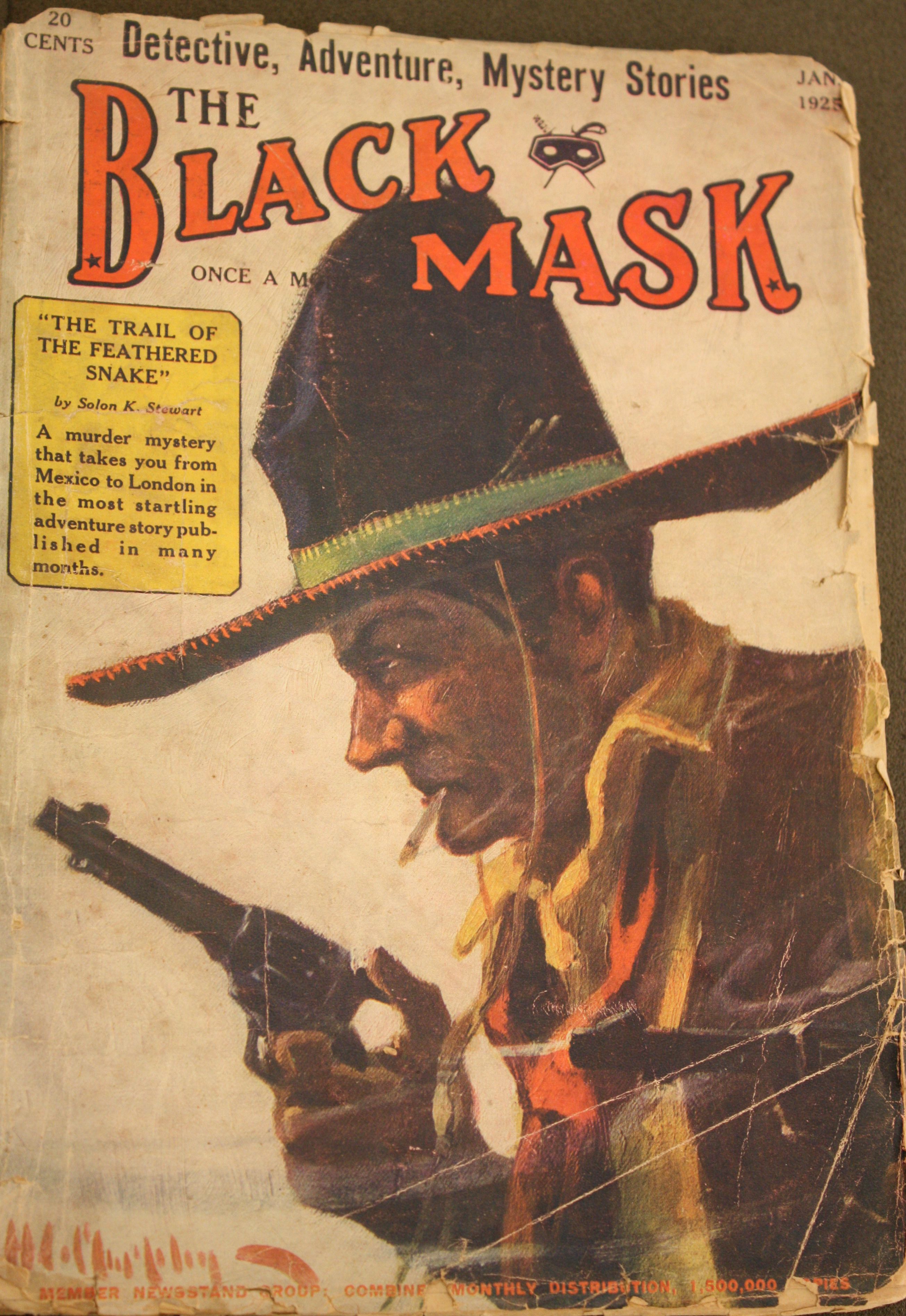
“Mike or Alec or Rufus,” the 15th Continental Op story, appeared in the January 1925 issue of Black Mask. No more proof of Hammett’s insincerity in his letter to the editor in the August 1924 issue is needed, where Hammett wrote:

. . . this sleuth of mine has degenerated into a meal ticket. I liked him at first and used to enjoy putting him through his tricks; but recently I’ve fallen into the habit of bringing him out and running him around whenever the landlord, or the butcher, or the grocer shows signs of nervousness.

The landlord, butcher, and grocer must all have been hospitalized with a severe case of nerves for Hammett to have submitted this story. For me, it ranks as the least of the Ops, with little to recommend it beyond the fact that it is an Op story. If you have read any of Hammett’s book reviews you know that his most damning criticism of his contemporaries’ efforts was that they lacked excitement. It’s too bad he didn’t apply a little bit more self-criticism to this story; it lacks any kind of interest, let alone excitement.

Like “One Hour,” “Mike or Alec or Rufus” is an obvious exercise on Hammett’s part. In “One Hour” he wanted to see if he could write a story in which all of the action occurred over the course of an hour. While not altogether successful, at least “One Hour” features a terrific (and exciting) brawl between the Op and a gang of toughs.

In “Mike or Alec or Rufus” the exercise was to see if a story could be told solely through the Op interviewing victims and suspects. All of the action, as it were, occurs in an apartment building, mostly in the apartment of the victim, over the course of an hour or two. The problem is that for a story that relies so heavily on dialogue, the talk lacks crackle and snap. There is none of the humor that Don and I like so much in other Op stories, or anything else, to hold the reader’s interest.

On the other hand, after this story, Hammett hit his stride, turning out eight classic Op stories in a row: “The Whosis Kid,” “The Scorched Face,” “Corkscrew,” “Dead Yellow Women,” “The Gutting of Couffignal,” “The Creeping Siamese,” “The Big Knockover” and “$106,000 Blood Money.” Given this run, it is easy to forgive “Mike or Alec or Rufus.”

When Dannay came to collect the story in The Creeping Siamese (1950; he did not first reprint it in Ellery Queen), he made numerous edits, the most significant of which were a change of title to “Tom, Dick, or Harry” and the deletion of a paragraph. Hammett’s original title is nothing more than a reference to a throwaway line from the Op near the end of the story. Dannay’s substitute is simply a more modern cliché with no more relevancy to the story than Hammett’s original.

In 1950, the events of the Holocaust had received worldwide attention only five years before, so the most interesting edits are those made in presumable sensitivity to their potential to being cited as anti-Semitic. The case involves the Op, acting on behalf of an insurance company, investigating the apparent theft of jewelry. The victim’s daughter is named Phyllis, and is described as “a smart little Jewess of the popular-member-of-the-younger-set type.” Dannay deleted reference to her being Jewish, changed the family name from Coplin to Toplin, and the father’s first name from Jacob to Frank. These changes comprise the majority of Dannay’s edits to the story.

The story also was collected in Nightmare Town (1999), still in print; the editors used Dannay’s version.

As usual, the following list provides the page number, the line number and whether it is from the top or bottom of the page, and the affected text — Hammett’s original wording is underlined. The page numbers refer to the story as it appears in The Creeping Siamese.


Page    Line     Top/Bottom    Text

62        Title                            Tom, Dick or Harry Mike or Alec or Rufus

62        1          top                   Frank Toplin Jacob Coplin

62        6          top                   Also Besides he and I in the room that first time, there were his wife,

62        8          top                   Phyllis, a smart little Jewess of the popular-member-of-the-younger-set type;

62        16        top                   I told Toplin Coplin

62        17        top                   Toplin’s Coplin’s yellow sphere

62        11        bottom            Now, Frank Jakie,

62        10        bottom            Phyllis Toplin’s Coplin’s dark eyes twinkled, and she winked one of them at me.

62        6          bottom            loss stuff [“stuff” should be italicized]

63        9          top                   had called to them to hurry with their dressing when the doorbell rang.

63        17/16   bottom            where Mr. Toplin Coplin was, and he shot Mr. Toplin Coplin

63        15        bottom            Toplin Coplin took the

63        6          bottom            he didn’t don’t say a word all the this time, not a word-just made makes motions

64        6          top                   Toplin Coplin said

64        6          bottom            I asked Mrs. Toplin Coplin

64        5          bottom            “Twenty-five, I’d I’ll say.”

64        3          bottom            “I don’t know exactly, sir,; but he wasn’t very old.”

64        1          bottom            Toplin Coplin said.

65        17        top                   Phyllis Toplin Coplin

65        15        bottom            and got a pencil and sheet of paper

65        12        bottom            I got the list half an hour later [should be a separate paragraph]

65        11        bottom            I asked as I reached for my hat.

65        7          bottom            and outdoor athletics written all over her.

65        4          bottom            that insured the Toplin Coplin’s jewelry,

66        2          top                   A penalty of femininity.I forgot

66        6          top                   “Inside, Kid!” [should be a separate paragraph]

66        15        top                   man, so I tried to take him in hand.

66        17        bottom            of the Toplin Coplin robbery.

66        2          bottom            Blue,. his His hair

67        9          top                   broad-shouldered [should be one word]

67        15        top                   the Toplin’s Coplin’s door,

67        14        bottom            an’ the Toplin’s Coplin’s apartment

67        11        bottom            Ambrose, the elevator boy, to give the alarm

67        4          bottom            Then we let the Toplins Coplins out

68        8          top                   like old man Toplin Coplin

68        13        top                   “Who is the newest tenant you have?” [should be a separate paragraph]

68        2          bottom            I see him with Phyllis Toplin Coplin a lot”

68        1          bottom            How long have the Toplins Coplins been here?”

69        7          top                   outside of the Toplin’s Coplin’s door,

69        3          bottom            [prior to this paragraph should be] Neither of them had seen anyone in the building either before or after the Coplins were turned for their jewels who fit the robber’s description.

70        5          top                   The Toplin Coplin doings for the insurance company.

70        12        top                   Before pressing the Toplin Coplin bell

70        15        top                   diamond ring that looks like one of the Toplin Coplin lot

70        14        bottom            where Mrs. Toplin Coplin

70        2          bottom            “Why certainly!” Mrs. Toplin Coplin exclaimed. “That’s  Thad’s Mr. Wagener [Dannay corrected an obvious typo]

71        4          top                   “Certainly!” Mrs. Toplin Coplin said, looking the ring. “It Id belongs to Phyllis, [another obvious type corrected by Dannay]

71        9          top                   “I can explain everything,” she announced. [should be a separate paragraph]

71        9          bottom            “Mrs. Toplin Coplin,” I asked

71        7          bottom            “No! He could not be id (“id” should be “it” or “him”; Dannay sorted it out by just dropping “be id”; this line should be a separate paragraph]

72        6          top                   Toplins Coplins. Second: the Toplins Coplins framed the robbery themselves

72        16        top                   [After: I don’t ask for any more than I’ve got.” Should be this line, which should be a separate paragraph] That wasn’t so foolish.

72        13        bottom            I’m showing the boy to old man Toplin Coplin

72        9          bottom            send him to the Toplin’s Coplin’s apartment.

72        1          bottom            I took her into the Toplins’ Coplins’ apartment

73        1          top                   found everybody in Frank Toplin’s Jacob Coplin’s bedroom

73        5          top                   “You’re wrong,” she said. “That’s not he.” [should be a separate paragraph]

73        6          top                   It was a pipe that if the Toplins Coplins were tied up

73        11        top                   The other one rang the bell just then, and the maid brought him into the room.

73        13        top                   “Know him, McBirney?” [should be a separate paragraph]

73        17        bottom            “No-o-o-o,” the janitor drawled,

73        2          bottom            It’s dollars to doughnuts marks

74        13        top                   I turned to Frank Toplin Jacob Coplin.

74        16        top                   I could get at least a one-eyed view of everybody else

75        6          top                   Frank Toplin Jacob Coplin, his wife, young Wagener

75        8          top                   Phyllis Toplin Coplin was looking at me

75        15        top                   Phyllis Toplin Coplin exploded.

76        8          top                   “Your gallantry does you credit, and all the like of that, but I think

76        10        top                   I hauled her (or him,—whichever you like)to his or her feet [the edits here are a bit confusing—Hammett’s original does not have the parentheses, the comma after “him”, or the space between “which” and “ever” and adds an em-dash after “like”]

76        11        top                   “Feel like telling us about it?” [should be a separate paragraph]

76        17        top                   —what do you call it?

76        10        bottom            twist his plans to account for it—; [the em-dash should be deleted and the semi-colon added]

76        3/2 bottom                  But the The Toplin Coplin sparklers came to light


While attending the recent Pulpfest in Columbus, Ohio I took the opportunity to visit the Rare Book & Manuscript Library — the Thompson Library — of Ohio State University, which archives a copy of the January 1925 issue of Black Mask. I am indebted to Dr. Eric Johnson, Assistant Professor and Associate Curator at the Library, Rebecca Jewett, Assistant Curator, and Benjamin — the graduate student who held the pages open while I photographed them — for providing access to the magazine and permitting me to photograph the story.

Posted in Dash, Lit | Tagged , , , , , , , , , , , , , , , |

Hammett: vs. Thurber

Inspired by the trip to PulpFest and the side visit to the James Thurber house in Columbus, our occasional Guest Blogger Brian Leno pops in some info he uncovered which ought to amuse any and all surfers and lurkers in Up and Down These Mean Streets.

Here’s Brian:

Was digging around in some books in my basement and discovered an old Thurber biography that I must have purchased years ago — forgot I had it. Anyway, I skimmed through a few pages and read that Thurber’s second wife did indeed edit for the pulps — that’s about all that Burton Bernstein (author of the bio) says on the subject that I’ve come across so far.

He also has a bit about Thurber and Hammett:

Other Tony’s regulars were less enchanted by Thurber. Lillian Hellman described a night in the speakeasy when Thurber threw a glass of whiskey at her. Dashiell Hammett, her boy friend and an old Pinkerton man, rose to her defense and pushed Thurber against the wall, but Thurber heaved another glass at Hammett, missing his target and hitting a waiter, who happened to be Tony’s cousin. Tony decided he had had his fill of Thurber and called the police, an extreme action for a speakeasy proprietor. As Lillian Hellman put it, almost everyone agreed with Tony about Thurber but nobody squealed when the police arrived, “and while I don’t think Thurber liked me afterwards, I don’t think he had liked me before. In any case, none of us ever mentioned it again.”

Bernstein has a footnote:

There is something about Lillian Hellman that makes men, and some women, want to throw whiskey at her. Thurber simply and inexcusably did what everybody else thought better of doing.

Posted in Dash, Lit | Tagged , , , , , |

Rediscovered: The Thurber House and Grave

When he was checking out the web to see what attractions we might want to see on the side during PulpFest, Brian Leno spotted a James Thurber house open as a museum in Columbus, Ohio. As I’ve said before, I’ll track down any literary residence for a look — and who doesn’t like Thurber?

Had to go, and we went. If you have the same jones for lit sites and you get to Columbus, don’t miss it — in addition to T-shirts and mugs they sell Thurber Bobblehead dolls. Can’t you just see Robert E. Howard or H. P. Lovecraft Bobbleheads? Zane Grey. Hammett. Hemingway. Kerouac.

(Hey, they’ve Bobbled Kerouac already! I’ll have to check to see how many lit Bobbles have been done — might be a good safety valve for my Collecting Impulse — or it might lead to an epic invasion of the Bobbleheads. . . .)

And if you’re in Columbus specifically for PulpFest, really, what is more Ur Pulp than Thurber’s 1939 short story “The Secret Lives of Walter Mitty”? If the original pulp readers poured through those pages in search of adventure or romance, thrills beyond the grind of the day-to-day — and I think they did — then Thurber summed it up nicely.

Furthermore, when he got back to his homebase in North Dakota, Brian sent a note to report:

Looking through my copy of The Shudder Pulps I ran across a reference to A. A. Wyn and his pulp magazines. Robert Kenneth Jones includes a statement by Frederick C. Davis (of the Operator 5 series) where Davis writes of a woman editor working for Wyn named Helen Wismer.

“Helen was a highly intelligent, very personable young woman who soon left her editorial chair to marry James Thurber.”

“Pretty cool,” Brian said, “one more reason why some of these pulp fanatics should pay a visit to Thurber’s abode.”

(And as I was saying the other day, it was his weird menace or shudder pulp T-shirt that almost got Walker Martin jumped during PulpFest — I wonder if we can put any of the blame on Helen Wismer, sitting at an editorial desk, facilitating nudes being menaced by grotesques, in issue after issue. . . .)

Brian also discovered that Thurber is buried in Columbus in the gigantic expanse of Green Lawn Cemetery. His house is pretty easy to find, his grave was nothing short of brutal. I recommend a GPS device with the co-ordinates plugged in, which we didn’t have — from memory, Thurber is in section M, in the pointy end near the sunken area called The Pit (I think it was — and, no, I’m not trying to drum up a pulp adventure/Walter Mitty vibe here — I think it is called The Pit).

Stand looking toward The Pit and the bird-feeding boxes they have set up for birders. Point with your right arm and you’ll be gesturing toward the arrow-like end of section M. Walk around on the right side. Stay near the driveway. Thurber’s marker is near the base of a tree near the roadway, maybe the second tree in. Right in there.

Good luck.

Posted in Lit, News | Tagged , , , , , , , , , , , , , , |

Rediscovered: Stabbed in the Forehead! (and Other Pulp Thrills)

How about a postmortem on PulpFest before something else ripping Up and Down These Mean Streets distracts me? It’s always something — latest is juggling a date and time to do a walk for a Private Eye convention in October. (Tours for PIs are usually good, because they know how to shadow a guy around, their gumshoes always in tiptop condition.)

I decided to hit PulpFest again this year because convention honcho Mike Chomko specifically asked me to be on the panel celebrating the creation of Conan eighty years ago. Why not? The panel could serve as the latest token in a long line of tokens to the Texas pulp fictioneer Robert E. Howard. See some of the REH guys I haven’t seen in awhile. . . .

Plus I realized I could do some touristy stuff on the side, since I suddenly tied in with the Jim Tully crew and had access to local guides for his childhood haunts. I asked Brian Leno if he wanted to join in on the action — and he mentioned that if we’d be in Ohio, in addition to lit sites we might as well check out Serpent Mound. The German Village district in Columbus. And — back to lit sites — a James Thurber house. Thurber’s grave.

The hotel this time was much more upscale than the last one — tied in to the Columbus convention center, a gathering of 400 or 500 pulp collectors barely made a ripple in the warren of wide hallways and epic foyers. One grand ballroom for the pulp displays, one conference room for the talks — with what seemed like dozens more stretching away into the distance, entire buildings unexplored.

Big on seeing the sights, my favorite angle with the new hotel was the view I got from the fifteenth floor room, looking out over Nationwide Blvd and downtown — especially nice when a thunderstorm or two rolled through the city. I could see the Arena, which didn’t mean much to me until I got to St. Marys after the convention and the guys showing me the Tully sites mentioned that the Arena is built on the location of the old Ohio State Pen, where Tully’s boyhood pal Fat Charley Makley — one of the guys who taught Dillinger how to rob banks — was shot down by the bulls in an escape attempt in 1934. And then I tumbled to the info that the same prison was where O. Henry served his time. And I just finished Buz Howard’s book on Fat Charley, which reminded me that the same prison incarcerated hard-boiled great Chester Himes for many years — Himes was still an inmate as some early stories began appearing in Esquire, such as “To What Red Hell” in 1934, where he wrote about the 1930 fire he had witnessed, which killed 322 prisoners — the deadliest prison fire in U.S. history.

The current view was nice enough, but the view into the past — wow.

My only “complaint” about PulpFest, the same complaint others have voiced, is that there was no hospitality suite. Rusty Burke of the Robert E. Howard Foundation came prepared to stock the suite with beer and soda and snacks, just like he did a couple of years ago, but here was the Achilles’ heel of having a big, modern hotel — the suite where people could hang out and chat over free drinks would have cost $350 or so, plus they’d have had to use a hotel bartender to serve each and every item, and all the drinks would have had to come from the hotel stock. A lot of loot for a small convention just to provide “free” drinks, so they opted for the hotel bar as a forced substitution. I don’t blame them at all. Simple economics.

But the idea of the hospitality suite, aside from free beer, is that you may meet someone you otherwise might not have talked with, the various cliques break up and mingle more. I probably wouldn’t have talked that much with Walker Martin the last time I went except for randomly sitting at the same table in the hospitality suite — but since I had, he would play a big role in this year’s visit.

As predicted, I didn’t buy a single original wood pulp magazine — but I did purchase five more double Shadows for my reserve stockpile, against the day I get that urge to haul out the twin automatics and terrorize gangdom alongside good old Lamont Cranston. Publisher/editor Anthony Tollin encouraged me to get #44 in the series with Atoms of Death, where Shadow scribe Walter B. Gibson predicted the atomic bomb in 1935 and got a visit from worried state department officials. Yeah, what did The Shadow Know about what they knew. . . .

And I picked up a few items of Arkham House ephemerae, stocklists and brochures, to keep that hobby nudging along. I think I already had the stuff I purchased, but this ought to keep them clear of the landfill for awhile.

I also plucked a double Spider off the free table near registration, just in case I ever get a Spider urge. I read one once. Plus three double novels from Stark House Press, which generously provided huge stacks of six or seven of their books, which collect 1950s and 60s noir.

I could have grabbed everything, yes, but there’s only so much room in the garment bag, only so much weight I want to lug around — which means I’m not a typical PulpFest guy. I didn’t look through each and every box filled with pulps and digests, but the typical PulpFest guy did.

You want a convention report from a guy who inhales pulp dust day in, day out, then check out the coverage by Walker Martin — that’s what real PulpFest attendees do. I told Brian Leno, a serious autograph hound, about the stockpile of cheques Walker had for sale from pulp publishers, made out to and endorsed by various pulp writers, and we went by his dealers table several times to find it empty — but I could see Walker sitting on the floor digging through boxes of digests at another dealer’s table across the hall! A real collector. Fortunately for Leno, he got a chance the next day to riffle the cheques and buy the ones that caught his eye.

If you read deep enough into Walker’s report, by the way, you’ll find the most exciting incident to happen during the convention that I’ve heard of, as Walker almost got jumped by a couple of drunks on an elevator. I think it was the T-shirt he had on that set them off — from one of the Terror Tales sort of pulps, which typically feature bound, almost naked women being menaced by the demented and deformed. Really, probably not the sort of thing you’d want to wear out in public — and in a venue like the Hyatt Regency Convention Center, PulpFest just isn’t big enough to take over the place and provide safe passage for guys sporting weird menace T’s.

I happened to be chatting with Walker at his table just as Terry Zobeck got to registration. I wasted hardy a moment saying hello, before bringing Terry over and introducing him to Walker — “Terry, this is one of the three or four guys I’ve heard of who ever assembled a complete collection of Black Mask.” To say Terry was impressed, well, we can skip that part — you’ve followed his posts here covering pure text Hammett from Black Mask, and his efforts to track down the last few copies he needs — brutal, and he’s just trying to get all the Hammett and Chandler in Black Mask, not every single issue of the Mask!

Walker gave a quick recap of how he assembled his collection, beginning in the late 60s or early 70s. One story I’d forgotten was that he and a rival completist both had found all but one last issue — and they both needed the same issue! And they both found copies of the issue! Right there, the essence of PulpFest.

Also, if you remember my review of the recent Big Book of Black Mask where I mention that before this book came out it would have cost you thousands of dollars to assemble and read the original Black Mask text for The Maltese Falcon, Walker told about how he sold the complete collection to Nick Certo, another longtime dealer in such things. Certo tried to keep the set intact, but eventually sold it off in parts, and the issues containing the Falcon went for $4000 — which today sounds pretty cheap to me. The trick with that sale was that the guy who bought them didn’t pop thousands for the installments of Hammett’s most famous novel — he was a rabid Erle Stanley Gardner fan who needed those specific issues for the appearances of some Gardner short stories about Ed Jenkins the Phantom Crook, or something like that.

Just as I didn’t buy any pulps or even that many reprint items, I also skipped most of the panels. I’d rather hang out in the bar and talk with people, just as a matter of personal preference. But I did catch the presentation about the influence of French literature on the pulps, a slideshow done by Rick Lai (pronounced Lay, like the potato chip). Yeah, no question that Dumas, especially with the Count of Monte Cristo, and Fantômas were bedrock for the pulp heroes such as Doc Savage and The Shadow. But Lai got much deeper in than that, delivering his talk in a deadpan rhythm — and suddenly he came up with the catchphrase I liked best for the 2012 PulpFest. Some more obscure French writer (I wasn’t taking notes, I was just there letting it roll over me) had a character who developed a super-secret fencing move, where suddenly, finally, he would STAB HIS OPPONENT IN THE FOREHEAD! From the droll deadpan delivery to STABBED IN THE FOREHEAD! It got my attention.

And then some other French writer also had a character who would use a move to, yes, STAB the swordpoint into someone’s FOREHEAD! Rick suggested that this specific bit may have influenced the red death mark the Spider leaves on the foreheads of the fallen. I don’t know, but I ran around to everyone for the next couple of days saying, “And then, he STABBED THEM IN THE FOREHEAD!”

I might have caught other panels, except they fell opposite the times when Leno and I were out looking for other stuff, getting lost (you really want to get lost looking for something, I recommend Green Lawn Cemetery). Still enthusiastic from this year’s John Carter movie, I did catch the video of the efforts by cartoonist Bob Clampett to do a series of John Carter of Mars animated movies in the 1930s — what was it? — The Air Factory of Mars, and others?

And I caught some of the panel with slideshow on illustrating Robert E. Howard on Saturday night, since it fell just before the Conan panel I was on, where we decided to do only thirty minutes instead of the full hour. The guy on the Argonotes blog (like Walker’s report, probably a more truly PulpFest experience than mine, more boxes looked into) wanted the full hour, but here’s what happened: the PulpFest business meeting apparently ran late, pushing into the illustrating REH time. The illustrating guys had their slideshow planned out for an hour and apparently didn’t realize that the Conan panel was up against a hard deadline — or what Rusty Burke and I agreed was a hard deadline — the start of the annual auction.

Since we started a half hour late, if we’d done the full hour the auction, set for a 9:30 launch, wouldn’t have begun until 10 or after — and as it was, it ran until 1:30 or 2 a.m. I figure a lot of attendees are there for the auction, to buy stuff — and as your typically courteous REH guys, we weren’t going to stand between a fan and his acquisitions.

Before Leno and I headed out on Sunday to hit Ohio Caverns and get closer to St. Marys for the Tully tour, we made a last pass through the dealers room. Walker Martin showed me the issue of Smart Set he had for sale (which he hadn’t had on his table through the entire convention, as far as I know — his sales methods are arcane, but they apparently work for him) with Hammett’s very first appearance in print, priced at $2000. He had another issue of Smart Set with the second or third story for merely $700 (it’s those firsts that bring in the big bucks, always has been, and I suspect always will). I told him I’d tell Terry Zobeck about them (hey, Terry, if you’re interested. . .), but I think Terry is saving his dimes for the better Black Mask appearances. Hammett’s first few appearances are half-page or one-page vignettes — but if you’ve got to have the original printings of everything, yeah, you need them.

For me personally, I just can’t see jumping wildly into pulp collecting, at least not at this late date. I kind of admire the guys who do, sure, but I guess if I shelled out $2000 for a single issue of a magazine, with dozens more magazines to go before I had everything, I’d feel as if I just stabbed myself in the forehead.

Posted in Dash, Film, Lit, News, REH | Tagged , , , , , , , , , , , , , , , , , , , , , , , , , , , , , , , , , , , , , , |

Tour: Yeah, Every Sunday in September

Another September is on us, with a Hammett Tour set for each and every Sunday — yes, even Sunday September 2nd in the middle of the Labor Day Weekend.

You want to walk the walk, then show up by noon, and be ready for the four hour, three-mile extravaganza. You want to do the tour some other day, or cut it down to a two hour or three hour version concentrating on The Maltese Falcon (like some people were doing the other Monday), go to the By Appointment Page and work something out.

No appointment needed, however, for the walks in September. See you there, if you’re there.

Posted in Tour | Tagged , |

Hammett: The Fat Man

I took a little break from reading Haefele’s upcoming book on Derleth, Lovecraft, and the Cthulhu Mythos to tie in with Bill Arney and shoot a couple of segments of Cheese Theatre for the upcoming third season.

Which meant I finally had to track down and watch the 1951 film The Fat Man starring J. Scott Smart, spun off the radio show “created by Dashiell Hammett.” Like Roadhouse Nights, this is another Hammett-related movie I had never bothered with until now — if you don’t want to wait for the Cheese Theatre production with our commentary, it’s easy to find on YouTube, archives.org, what have you.

As I say in my comments, this is a movie where the sum of the parts is greater than the whole. The overall film just doesn’t kick in, but it’s worth watching for various reasons. An early role for Rock Hudson. Directed by William Castle, later famous for The Tingler, House on Haunted Hill, etc. First film appearance by Emmett Kelly, the famous clown, with a whole circus sub-plot to it. Jayne Meadows. Parley Baer in an uncredited cameo. The Fat Man dancing. . . .

As I was watching it play out, I suppose my fave moment occurred early on, when files in a dentist’s office in LA are being riffled through in close-up. Suddenly, the name “R. CHANDLER” appears on a folder.

Pretty funny.

Of course, I completely forgot to mention that little hard-boiled nod during my comments, but it might have gotten cut in editing, anyway.

Also neglected to mention that The Fat Man stays in the Beverly Wilshire, one of Hammett’s usual haunts.

Yeah, worth watching just for the pieces.

Posted in Dash, Film, News | Tagged , , , , , , , , , , , |

Rediscovered: The Derleth Mythos

Man, has LitCrit Month been disrupted, or what? Lots of potential posts as yet undone — but I’ve got a cool excuse for inaction.

On the side I’ve been reading a proof of John Haefele’s upcoming book-length study of how August Derleth of Arkham House took the Cthulhu Mythos, out of H. P. Lovecraft and others, and ran with it.

Wall-to-wall litcrit, lots of it. I promised Haefele I’d look it over when he got the book done, and that’s what I’ve been doing, especially with an eye to making sure that Haefele doesn’t leave any big holes in his arguments.

You jump into the knife-fight, you want to watch your back.

He’s taking on the almost thankless task of defending Derleth, whipping post for recent generations of Lovecraft scholars, and does a great job of it — in particular, he’s razor sharp on pointing out how certain otherwise respected scholars repeatedly get the facts wrong as they make their attacks on Derleth. That stuff is interesting, but the manuscript begins to fly when he gets into Lovecraft’s original fiction — the best writing on good old HPL I’ve read in a long time.

I think the book will be ready before Xmas. I’ll put out the word when it hits print.


Posted in Lit, News | Tagged , , , , |

Tour: Every Sunday in September

Coming up fast: September 2012 — featuring a Hammett tour at noon each and every Sunday in the month.

No reservations needed. Just show up.

I can’t make taking the four hour, three mile walk any easier. . . .

Posted in Tour | Tagged , |

Rediscovered: Tully and Hammett and Chaney (Oh My!)

Finally got back from PulpFest, finished shaking the flakes of rotting wood-pulp dust off my traveling gear, and guess it’s time to jump back into the blogosphere. To reboot the action, how about some comments from Mark Dawidziak, the Jim Tully biographer, on the recent review of that book and the post about the biography of Tully that Charles Willeford wanted to write?

(Plus we get a swell snap of Mark doing his Hammett impersonation, and he looks a lot more like Hammett than most people I know.)

Here’s Mark:

Many thanks for the many kind words about the Tully biography. They were greatly appreciated, particularly coming from someone so familiar with this territory.

I also enjoyed the follow-up piece about Willeford. I suspect you’re absolutely right about the type of book he would have written on Tully. Without doubt, it would have been fascinating to get a book-length Willeford take on Tully. But that fascination would have been overshadowed by regret if the price of that full-scale biography included unwritten Willeford novels.

I, too, yearned for proof of a Hammett-Tully encounter. Nothing has yet surfaced. The best we could find was a late-’30s solicitation letter signed by Hammett, asking for a donation. The signature looked like those you see of Hammett’s, but, in all ways, this had the feel of a form letter. Tully, not being active in political groups, would seem to have moved in other Hollywood and Manhattan circles.

I also was looking for an encounter with another Irish-American author, Eugene O’Neill. That apparently never happened, although Tully expressed interest in having a sit-down with O’Neill (and it could have been arranged by their strong mutual friend, George Jean Nathan). Physically, they would have been the Mutt and Jeff of Irish-American literature: tall, lean O’Neill, short, squat Tully.

The London story (the one about Tully saying he was turned away from the ranch) sounds apocryphal, if only because the timing seems all wrong. London died in 1916, well before Tully had started writing for Mencken or The American Mercury (which Nathan and Mencken got rolling in 1924). Not that Tully was above embellishing. A good deal of Shanty Irish is borrowed or, let us say, extrapolated. And not that he didn’t take some shots at London in the 1920s. But if someone complained about anything Tully wrote about London in the 1920s, clearly it wasn’t London.

Also on the wish list, I hoped we’d find a manuscript-length account of Tully friendship with Chaney. That, obviously, would have been some find. It’s difficult to chart how deep some friendships went with Tully. The Chaney friendship certainly seems to have been important to him. But while the mentions of Chaney are frequent, they don’t run all that deep.

The best Tully account we have of Chaney is the February 1928 Vanity Fair profile. There’s a nice Chaney passage in one of his 1939 “Tully-Grams” columns:

Lon Chaney, Sr., the son of a deaf and dumb Irish barber from Colorado, was a colorful figure now gone with the tide. He was a great enough personality to remain simple. Generally seen in the distortions of screen make-up, he was seldom recognized on the street.

Attired in a blue suit, soft shirt and cap, he would often wander about Los Angeles with me.

Tully told the story of introducing Chaney, thus attired, to a lawyer. When the lawyer asked his name, he said, Lon Chaney.

The lawyer shot back, “Well, my name’s J.P. Morgan.”


And back to me for an end note. Mark is correct that Jack London could not have objected to anything published in The American Mercury because of his death date, but in the book on Willeford I just let the story slide as Willeford told it. Without checking back issues of the Mercury, my guess would be that Tully indeed may have written such an article (he seemed to have had a little grudge going against Jack in the 20s) and that London’s widow Charmian would have been the one who wrote in to protest that no hobo had ever been turned away hungry from Beauty Ranch. But whether the story is completely apocryphal or is rooted in some sort of truth, Willeford thought that it was great that Tully would have just made something like that up to mess with people.

One road kid appreciating a gag by another road kid.

Posted in Dash, Film, Lit, Willeford | Tagged , , , , , , , , , , |

Rediscovered: Yet More Fantômas

In a couple of hours I’m out the door for PulpFest (boom-boom-boom, boom-boom).

Noticed that for the first evening’s programming they have a talk titled The French Connection — “How French Literature May Have Influenced American Pulp Heroes.” Dumas. Fantômas. To which I say, hell, yes! Of course.

And as it happens, good old John D. Squires just popped in another tidbit about Fantômas, something he picked up from the Library of Congress newspaper website.

JDS writes, “Presumably for copyright reasons, it only includes digital copies of papers published through 1922, which pretty much leaves Hammett out of the loop, but I found five Shiel stories & a great mass of Louis Tracy serials & other stuff.

“Also just did a quick look for Fantômas. If any of your readers are interested, among lots of ads you can now see some of the stories as published in the Perrysburg Journal in Oct & Nov 1916. Sample attached. I’ll leave it to the Fantômas fans to dig out the rest. . . .”

So, if you’re intrigued by this serial villain, who by twists and turns of influence led to The Shadow, and Batman, hop on the site and search for the newspaper for those months — or just plain old Fantômas — and see what you find. The masks, black clothing, rooftop scenes, noir cityscapes, death traps — who doesn’t dig it?

Posted in Lit | Tagged , , , , , , , , |