Tour: More Writers Who Have Walked the Walk

Remember the “guy from Australia” who asked for the tour on June 17? Turns out he was none other than Christopher Sequeria, big into Sherlock Holmes, with sidelines in horror, comic book scripting, etc & etc. When I found that out I made sure to show the group the only place Sir Arthur Conan Doyle ever stayed in San Francisco (the Clift Hotel, if you didn’t know). And I told them the story of 2151 Sacramento Street which has a big plaque on it stating that Doyle occupied the place (yeah, for a couple of hours, one morning).

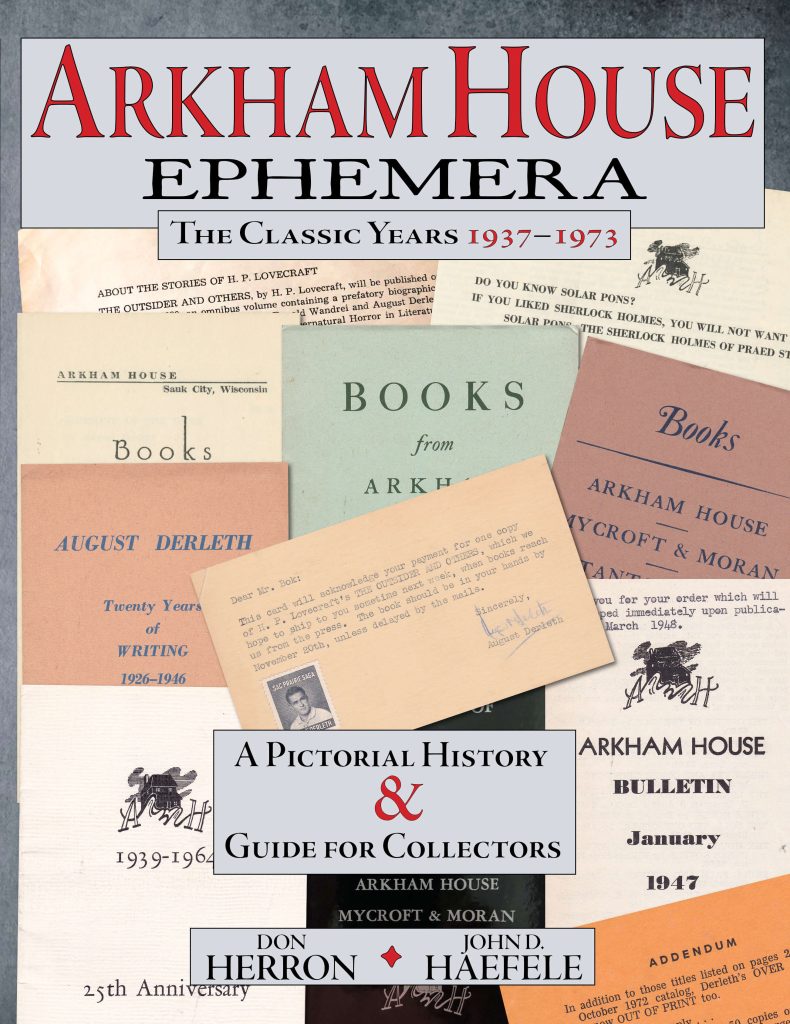
The last writer who came out for the walk that I remember offhand was Chris Ewan of the Good Thief series — and before him you had Charles Willeford and Ace Atkins and a host of others. I did a tour by appointment for fantasy and science fiction writer David Drake one time, who told me about his first story being accepted by August Derleth at Arkham House — who informed him in detail of every little thing that was wrong with the story and how he would rewrite it to suit himself — the “most brutal acceptance note” he ever got. And later when the World Fantasy Convention came into the area I did a couple more tours for more f&sf guys — didn’t catch all the names, but bestseller Steven Erikson and Laird Barron and a bunch more.

Clark Lohr apparently wasn’t a published writer when he walked the walk, but he is now, he tells me, with The Devil’s Kitchen — kind of that Southwest soaked by heat thing I associate with Dennis McMillan after visiting him in Tucson when it was 115°.

And during the last Bouchercon that stopped in San Francisco I learned that Ken Wishnia apparently took the tour long before he became a writer, too — in the early days of the walk when the grooves in the mean streets weren’t as deep. I believe he said he was a student at State (or City College, as the case may be) at the time. I did some walks for that convention, too, and doubtless some writers snuck in without me knowing who they were — I do remember Jonathan Woods in his white suit, not least because I actually had read Bad Juju at the time (nice souped up neo-noir).

Posted in DMac, Frisco, Lit, News, Tour, Willeford | Tagged , , , , , , , , , , , , , , |

Tour: Sunday July 1

The next walk anyone can show up for, no reservations, no questions asked, will be Sunday July 1. The usual routine. Four hours. $10 per person. Start at noon near the revolving “L” sculpture.

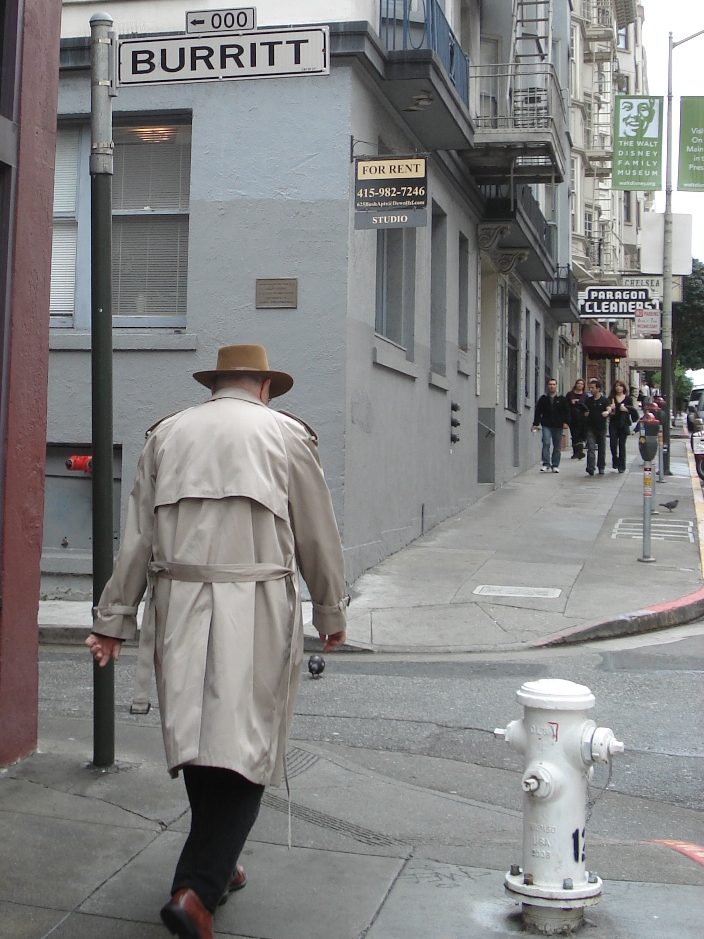
The shot above may be of interest to people who’ve never taken the tour, never been in San Francisco — it looks west up Bush from the parapet above the Stockton tunnel and shows where Dashiell Hammett Street meets Bush. Just above Mike Humbert’s left shoulder (that’s Mike Humbert with left shoulder visible). The red banners on the Vintage Court hang on the far side of Dashiell Hammett Street (where this etched-in-concrete wording may be found). The street sign on the near side of Dashiell Hammett Street is obscured by the small round tree — here’s a shot from the other side, looking east down Bush.

Posted in Frisco, Tour | Tagged , , , |

Hammett: A Couple of Thoughts on Including Murder

As I’ve been brooding over the Robert S. Powell article about the first Continental Op collection Including Murder, two kind of random thoughts hit me:

First, Powell describes the emendations in pencil on the tearsheets as being done in a “consistent hand” — which I take to mean that he doesn’t recognise Hammett’s holograph. Before anyone could use the corrections in any future editing on a Complete Continental Op volume, the marks would have to be by Hammett and not by someone else. I presume they are Hammett, of course — while I haven’t seen those I have held the long Knopf galley sheets for The Dain Curse hand-corrected by the author. It doesn’t take more than a few minutes to become familiar with Hammett’s handwriting, which in its own way is as distinctive as that of H. P. Lovecraft (guys who can’t recognise authentic Lovecraft script kill me).

Second, while I have not the slightest doubt that the collection would have been all Op — not mostly Op with a couple of random standalone crime stories tossed in — I wonder how they would have referred to the Op on a finished book. Without checking all the stories thought to be in the lineup for the contents, my impression is that no one — not Hammett, not editorial blurbs at Black Mask — was referring to the anonymous narrator as “the Continental Op.”

Maybe as an op. As an operative for the Continental Detective Agency. As a short fat sleuth.

I suppose I need to do a reread on the whole series again, but I was kind of surprised as I was rereading Red Harvest a couple of years ago to find that the Op does (almost) call himself the Continental Op in chapter six, Whisper’s Joint: “I’m the Continental op who tipped Dinah Brand off. . . .”

But by late 1924 or early 1925?

I’d love to have seen blurb lines for the book, trying to explain the detective. Anonymous, tough, short, fat operative for a detective agency in San Francisco. . . .

Even better, Hammett might have had to coin the descriptive term for his Op on the spot, and might have come up with something else entirely. Not left it to default mode where fans such as Frederic Dannay prowled the stories and novels and decided on “the Continental Op.”

Posted in Dash, Frisco | Tagged , , , , , , , , |

Two-Gun Bob: PulpFest 2012

Among other things PulpFest is going to commemorate this year will be the eightieth anniversary of the coming of Robert E. Howard’s Conan — exploding into the culture in the December 1932 issue of Weird Tales.

In many ways, and given that Howard killed himself at the age of thirty, the Conan series is the artistic peak of his career.

Sure, there are other stories he wrote that are as good as the best of the Conans. After a decade toiling in the pulp jungle Howard had achieved a professional polish that opened the gates of such prestigious markets as Argosy, and no doubt would have enabled him to move on to books and perhaps even film writing — but for what Howard did that no one else could touch, then or now, the Conan stories are him at his best, blazing away on the typewriter in Cross Plains, Texas.

If you’re in Columbus, Ohio in August you can catch me on the panel celebrating Howard’s landmark character. Rusty Burke — El Burko of the Howardian a.p.a. REHupa — will moderate. Also on board you’ll find my occasional Guest Blogger Brian Leno, who has emerged in recent years as one of the major new Howard scholars (Brian is especially good on Howard and boxing, and I think is far and away the reigning expert on the subject today — he just started a multi-part series of posts on a favorite boxer of Howard, Kid Dula).

Rounding out the panel is another name familiar to surfers into this blog, John D. Squires — JDS is one of those guys, like his and my pal Steve Eng, whose storehouse of knowledge is so vast I suspect no one starting out today would ever be able to equal it.

(Plus JDS has been on scene for firsthand moments in the history of Sword-and-Sorcery, such as a friendship with Karl Edward Wagner of Kane fame: “I met Karl during my years at Chapel Hill after the army. At that point he had published the first two Kane books and was just starting Carcosa. I was at a party at his house when he’d just gotten the galleys for Bloodstone.  I grabbed them, sat down and started reading, ignoring the party except when I commented on a scene or two. He finally had to let me take them with me to get me out of the house. I took them home and finished them that night.” Me, I got to meet Harry Otto Fischer at Fritz Leiber’s apartment, and Fritz and Harry were Fafhrd and the Gray Mouser — so between us JDS and I cover the two best S&S writers post-Howard.)

Anyway, the panel should be fun. If you’re there, say hello.

Posted in Lit, News, REH | Tagged , , , , , , , , , , , , , |

Hammett: The Lineup for Including Murder

If you don’t have the issue of Clues with the Robert S. Powell article on Including Murder, you may wonder which stories would have made up what would have been Hammett’s first book, if it had been published — all Continental Op tales straight from the wood pulp pages of Black Mask.

With the address 620 Eddy Street on the mockup for the book, Powell deducts that Hammett would have compiled the stories before the end of 1926, by which time he had left Eddy Street, and more likely by early 1925 — “Holograph material is in pencil in a consistent hand and suggests the paste-ups and emendations were carried out in a brief period following publication of the final piece.”

And the final piece, per Powell, was “The Golden Horseshoe” from the November 1924 issue of The Mask, which takes up pages 120-141 of the manuscript — a “manuscript” consisting of pages torn from the magazine, pasted down onto typewriter sheets. (One imagines Hammett got contributors copies of issues he appeared in, and sacrificed a couple for tearsheets he glued into place, front or back as needed — I can feel the agony of pulp collectors at the very idea, but I believe most pulp writers pulled tearsheets without thinking twice about it.)

Powell has the idea that Hammett and his editor at Black Mask, Phil Cody, may have been planning the book as a side product of the magazine, though against better evidence it is possible that Hammett mocked it up to shop around to other publishers. Powell refers to the info in Richard Layman’s Hammett bio Shadow Man that “in the summer of 1925” Cody urged Hammett to write a longer work — a novel. Layman guessed that this “first novel” would have been “The Secret Emperor,” never finished, the fragment held in the Humanities Research Center along with other fragments and miscellania such as Including Murder.

We do know that sometime in 1925 Hammett fell out with Cody and Black Mask and gave up crime writing in favor of advertising work. I’ve heard it was because Cody capped his word rate at 3¢ — but some fallout over the short story collection, I suppose, now can’t be ignored as a factor. And why finish a novel for a magazine you’ve decided to leave?

According to Powell, the mockup contains sheets with five Op tales:

“Crooked Souls,” pages 1-9 of the manuscript, with the title changed first to “The Gatewood Thing” and finally to “The Gatewood Caper” — from Black Mask for October 15, 1923

“Bodies Piled Up,” pages 10-19 — from BM for December 1, 1923

“Night Shots,” pages 20-30 — from BM February 1, 1924

“Women, Politics and Murder,” pages 103-119 — from BM September 1924

“The Golden Horseshoe,” pages 120-141 — from BM November 1924

For the lost pages 31-102 Powell figures the missing stories are “hypothetically. . . discernable.” He decides that Hammett put aside “Arson Plus” from October 1, 1923 and “Slippery Fingers” from October 15, 1923 because otherwise the stories included are in order of publication and these fall before “Crooked Souls.” “It” and “The Tenth Clew” do not appear and they fall between Crooked/Bodies and Bodies/Night Shots respectively.

Powell speculates that the first two Op tales may have been passed over because “they are early experimental stories,” and the later two “on critical grounds.”

He concludes, then, based on Op stories that had appeared, that a “correlation of pagination” from the original layout in Black Mask “generally supports” his assumption that the “seventy-two missing sheets contained the following Op stories:”

“Zigzags of Treachery” — from BM March 1, 1924

“One Hour” — from BM April 1, 1924

“The House in Turk Street” — from BM April 15, 1924

“The Girl with the Silver Eyes” — from BM June 1924

Assembled from stories published barely two years into Hammett’s writing career, that would have made for one fine collection.

Posted in Dash | Tagged , , , , , , , , , , , , , , , , , , , , |

Sinister Cinema: Fort Point

As I just mentioned, when Evan/Dave Lewis came to town I showed him and his wife around for a few hours, witnessed by the shot above.

Fort Point, under the south end of the Golden Gate Bridge.

Classic noir locale.

Behind us, behind the blue car, you can see a fenced-off area, where the terrain is eroding away — when I first came to the burg in 1974 and for many years after, you could walk out to this area and around toward the Pacific. No more.

That’s where Jimmy Stewart dives in after Kim Novak in Vertigo.

(Mel Brooks of course sets a scene here in High Anxiety, as well.)

To the left in the image, out of frame, there is a large rocky hill — where Bogie dukes it out with the punk in Dark Passage. (One of the on-the-ground flaws in the movie is that anyone who has been to the spot knows there is no way anyone could drive out to that area without alerting a passenger wayyyyyy in advance that something hinky is going down. Nonetheless, a great movie.)

And in the Civil War era fort itself, the scenes with Lee Marvin at the end of Point Blank — supposed to be Alcatraz, as I recall, but they couldn’t get an okay to shoot on The Rock.

Even a glimpse of the spot in Lady from Shanghai.

Yep. Classic noir.

Posted in Film, Frisco | Tagged , , , , , , , , , , , , , , |

Hammett: Including Murder

A few months back Evan Lewis of Davy Crockett’s Almanack let me know he was drifting into town, so I lined up a day where I could show him and his wife as many of the lost byways, precipice gradiants, obscure Victorians, and noir sites as they could endure.

If we’d ever met before, it was during the 1982 Bouchercon that I chaired, and Evan checked to see if I had a copy of an item from that era.

He asked how many issues of Clues: A Journal of Detection I had in my collection.

Easy one. Exactly one issue — featuring an interview with Tony Hillerman in which he talks some about how much he likes the writing of Charles Willeford. I’ve got that one somewhere in a box of Willeford stuff.

I may have seen a couple of other issues along the way — Clues has been around almost as long as the Hammett Tour, after all — but I’d never been tempted to subscribe, given the academic bent of the magazine. In Robert E. Howard circles especially, I’m known for butting heads with various academics, but then it’s possible REH criticism has an overall lower grade of academics than other disciplines.

And of course there are critics and there are great critics, there are academics and there are professors who have legendary stature. In hard-boiled circles, the late E. R. Hagemann is one of the legends — compiler of A Comprehensive Index to Black Mask, 1920-1951 from Pop Press in 1982. I’ve had that title since publication, with a letter inserted that I got from Hagemann thanking me for letting him know that “H. W. Guernsey” was a penname for Howard Wandrei, brother of Donald Wandrei — and Hagemann added some data sent to him by Will Murray, that “Leslie Charles Bowyer Lin” was an alias for Leslie Charteris of The Saint fame (“I goofed here,” he noted) and “Scott O’Hara” was actually John D. MacDonald (“another mishap”). A cornerstone work, the few errors can’t really do more than make a slight chip in the marble.

It turned out that Hagemann also had edited a whole section of Clues v2n2 for Fall/Winter 1981 concerning Pulp Detective Fiction — and Evan had an extra copy for me. Back then Clues was published by Bowling Green’s Pop Press and Evan Lewis was using the name Dave Lewis for his articles, including one in the Hagemann section about Frederick Nebel — “The Backbone of Black Mask.” Among other pieces, Will Murray provided an essay on Doc Savage author Lester Dent, one of his specialities. Hagemann contributed a really nice article on Cap Shaw, which has been reprinted in Blood and Thunder — but anyone with a major interest in hard-boiled crime fiction should track down the original seminar, one of the best I’ve ever seen —

And I’d never heard about it, as far as I can remember. Really amazing. If something this good is out there, sure, there’s probably more interesting essays I’ve never heard about, maybe even in other issues of Clues.

Yeah, I’ve got the excuse that those were pre-Internet years. This one slipped through the cracks. Whatever.

It goes on the shelf next to Hagemann’s Black Mask index, and I’m glad to have it.

The most startling piece in the seminar was “Including Murder: An Unpublished Hammett Collection” by Robert S. Powell — again, something I can’t recall ever hearing of before. Apparently among the Hammett papers in the Humanities Research Center in Texas, where Lillian Hellman housed various unpublished story drafts and fragments and so on, Powell found no less than sixty-nine 8½ x 11 pages under the title Including Murder. The address is 620 Eddy Street. The author’s byline: Dashiell Hammett.

On the sheets are paste-up pages taken from Black Mask of five Continental Op tales. Some of the planned contents are no longer with the archives, since the page numbers run from 1 to 30 — break — and then from 103 to 141.

Powell details several title changes Hammett contemplated, but more significantly “numerous instances of slight rewording or changes in sentence construction, obviously made to clarify or accelerate narrative.” He gives five examples each from “The Gatewood Caper,” “Bodies Piled Up,” and “Night Shots.”

Five more examples show Hammett editing “melodramatic excesses in dialogue and narrative. Punctuation, too, is less exaggerated.”

I looked over the examples in wonder:


and the room showed no signs of having been the scene of a struggle

to

and the room showed no signs of a struggle

and

“Dresses well and doesn’t look like a rowdy — but harder than hell! A big game hunter! Our meat, I bet you!” “It doesn’t look bad,” I agreed.

to

. . . A big game hunter.” “It doesn’t look bad,” I agreed.


I almost couldn’t believe it. This Powell guy was like some kind of proto Terry Zobeck!
Posted in Dash, Frisco, Lit, REH, Willeford | Tagged , , , , , , , , , , , , , , , , , , , , , , , , , |

Tour: Some Kindle Some More

Got another note from Vince Emery, letting me know that the dustup between Amazon and IPG — Independent Publisher Group — has been resolved and you can once again purchase the Hammett Tour book on your Kindle, if you’ve got a Kindle and want an eversion of the tour book.

Back on track to becoming a Kindle bestseller!

And this reminds me — every now and then I wonder what Lillian Hellman would think about ebooks.

In the tour book I quote from her introduction to the collection The Big Knockover (1966) where she writes about the Op stories, “by publishing them at all, I have done what Hammett did not want to do; he turned down offers to republish the stories, although I never knew the reason and never asked.”

As we all know, in ten volumes Frederic Dannay collected (sometimes with brutal editing) a total of 54 out of 66 Hammett short stories. And Hammett himself, or his agent, sold an unknown number of his short stories to newspapers over a period of decades. Those stories, they got around.

It’s quite possible Hellman never knew about the many reprints. She could have been busy with other matters, more uptown stuff, not paying attention.

But I’ve always thought she must have been one of the people who didn’t think of something as a “real book” unless said book appeared in hardcovers from a respectable press such as Knopf or Random House. Paperbacks, they weren’t real books, they didn’t count.

I’ve actually met several people who held that idea — around thirty years ago a guy who was telling me about how it was too bad Fritz Leiber didn’t have more than a handful of books published, he was such a good writer.

What do you mean? I said — Fritz has published at least thirty or forty books.

After wading through the confusion, I finally figured out that the guy didn’t count paperback first editions, only first edition hardbacks. You could have a huge body of work but until you started hitting hardcovers, none of it counted — which is why it took a long time for writers such as Philip K. Dick and Charles Willeford to bust their reps out of the paperback ghetto.

And if some people didn’t think a paperback was a real book, what will they think about an ebook?

Even I don’t think of ebooks as real books, and I try to remain open-minded on the subject.

Posted in Dash, Lit, News, Tour, Willeford | Tagged , , , , , , , |

Hammett: The Complete Op

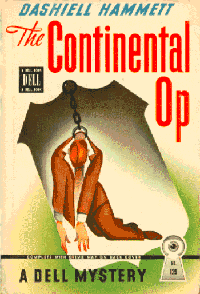
Say what you will about Frederic Dannay — and we’ve said so much about him on this site that his name is threatening to take over the Tag Cloud — but at least in his ten collections of Hammett’s shorter fiction he managed to get each and every Continental Op tale into uniform editions. Even today, if you want to get each and every Op, you still need to track down a couple of the Dannay edits — or the pricey original pulp publications.

Yeah, Dannay butchered “Death and Company” in his edit, taking changes already made at King Features and adding more. Changed some titles. If only he’d gotten it right, we wouldn’t need the piecemeal collections that have been appearing post-Dannay — I’d never have bothered with Crime Stories from Library of America if I already had a complete set of the Dell Mapbacks with authentic first appearance texts (yes, yes, stickler people — I know that the last two collections, Woman in the Dark and A Man Named Thin never made it into mapback reprints — I’d have them stuck off to the side as backup for the Maps).

Library of America volumes currently have prestige, but the Dell Mapbacks are forever cool.

In my review of Crime Stories I lamented the fact that they didn’t go for a complete collection of the Continental Op stories. In theory, they could have — a lot of space was wasted on material such as the short novel Woman in the Dark, already easily available in its own trade paperback edition, and the fragment of the early draft of The Thin Man (if you’re going to use fragments, then why not the partial draft for an Op story titled “Three Dimes”??? — that’s something Hammett fans might want to see, that wasn’t already in another book), plus miscellaneous standalone crime tales that don’t add up to much. When Dannay gathered almost every story Hammett wrote in ten collections, yeah, the standalone crime tales seemed to have some purpose, but just a handful taking up space in one book where the page count could have been used for something grander? I’d rather have seen more Op stories, including a missing classic such as “Corkscrew” and even the tight little actioner “One Hour.”

Since they couldn’t find the original pulp text for “This King Business” by the time they issued Crime Stories in 2001, it’s possible that other texts might have been impossible to track down (I’m getting the sense that “Who Killed Bob Teal?” may be a tough one to locate, as well). But a stab at it would have historic. Instead, sure, the largest story collection so far — but someday I expect that we’ll get larger collections.

What Hammett — or Hammett fans — need at this point is one nice big book with all the Op tales, and another big book with the rest of his short stories. Boom. Boom. You spend your money, you get what you want.

At this moment, after you acquire Crime Stories, you still have to buy some recent editions to round up the strays —  the 1999 Nightmare Town for a few other Op tales, the 1966 Random House version of The Big Knockover for “Corkscrew,” and you’re still left with two loose Ops: “Death and Company” from Dannay’s The Return of the Continental Op (1945) and “It” from Dannay’s Woman in the Dark (1951) — and after you run those down then you need to hop back to Terry Zobeck’s pure text posts to find out how the original texts read.

I’ve heard that one prominent New York editor has said that there is no market for a Complete Op, that no one would buy it. That’s one opinion.

Personally, I’d buy a copy of the complete pure text Op tales, instantly.

A guy from the Netherlands came out on the tour last month and wanted to get all the Op stories — I gave him the info as above, told him good luck in hunting it all down. He’d have gone straight to a bookstore and bought a Complete Op.

I think any Hammett fan would — and any and all Hammett fans that emerge as the years march on.

The only big question facing whoever finally assembles all the Op stories in one big book will be whether to use the original pulp texts, as Library of America chose to do with Crime Stories — or use preferred texts and titles in the cases where Hammett edited the stories, especially for the proposed but never published story collection Including Murder.

Posted in Dash, Lit, Tour | Tagged , , , , , , , , , , , , , |

Tour: Sunday June 17

About three months ago a guy emailed from Australia, letting me know he was rolling into the burg and wanted to walk the walk.

Great advance notice.

Anyone interested can join him on the tour on Sunday June 17. Just show up with ten bucks and four hours available to go the distance. Noon at the “L” sculpture.

And if you can’t make that one, the next Hammett tour open to anyone who wants to show up will be Sunday July 1.

Posted in Tour | Tagged |