Hammett: “One Hour”

Guest Blogger Terry Zobeck returns with another look into the edits made by Fred Dannay, and this time finds that the blue pencil smote lightly back in 1944! Plus he discovers yet another “pure text” Hammett story available in a modern edition, figuring one of the editors must have had access to Black Mask — my guess is that they took the text of “One Hour” from its appearance in The Pulps (1970) by Tony Goodstone, a standard collection everyone had in a home library at one point in time. Thinking about it, that appearance of “One Hour” might have been the first “pure text” treatment of any of the Op tales in modern times (if 41 years ago still can be considered “modern”).

And while I agree that “One Hour” is fairly minor compared to such Op extravaganzas as “The Gutting of Couffignal,” I always liked it because it shows Hammett displaying his significant chops as a mystery writer, setting the scenario up so that the whole shebang takes place in just one hour — a nice little tour de force. Here’s Terry:

In an earlier post, I indicated that the 1999 collection Nightmare Town, edited by McCauley, Greenberg, and Gorman, did not use the original texts of Hammett’s stories. While for the majority of the contents this statement remains accurate, it is not for “One Hour.” Apparently one of the editors had that issue of Black Mask.

I was surprised to find that Nightmare Town is a curious mixture of original and Dannay-edited texts — the editors make no statement about the source of the texts. At least five other stories rely upon Dannay’s edited versions: “The Second Story Angel,” “The Man Who Killed Dan Odams,” “Women, Politics and Murder,” “Bodies Piled Up,” and “Mike, Alec or Rufus” — the latter three use Dannay’s re-titles of “Death on Pine Street,” “House Dick,” and “Tom, Dick or Harry,” respectively.  There may be other stories in this collection that use the original texts — after I’ve reviewed “Ruffian’s Wife,” “A Man Called Spade,” “Too Many Have Lived,” “They Can Only Hang You Once,” and “His Brother’s Keeper” I’ll let you know.

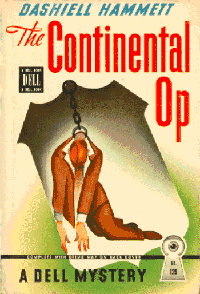
“One Hour” was originally published in the April 1, 1924 issue of Black Mask. When Dannay reprinted it in the May 1944 issue of Ellery Queen — and collected it the following year in The Return of the Continental Op —he made very few edits. The only changes were dropping the three chapter numberings, a splitting in two of a single paragraph, and deleting characterization of speech by some employees of a business being investigated by the Op as being “red” — surely a concession to the times.

While “One Hour” is one of the weakest of the Op stories, there are two things I like about it: 1) a couple of observations indicate the Op knows what he’s talking about, especially his comment “a gun isn’t a thing of miracles. It’s a mechanical contraption that is capable of just so much and no more.” And 2) the description of the Op’s predicament facing down five bad guys in a small room and the beating he takes. Even with the least of Hammett, there is something of interest.

Perhaps the most interesting thing about this story is the editor’s notice that appears at the end of the story:

“The paintings from which the cover of any issue of The Black Mask is made will be sold to the highest bidder. Bids of less than $10.00 will, however, be rejected. All bids for covers prior to this time must be received by May 31st; and all bids for covers published hereafter must be received within 30 days after the date of issue (i.e., bids for May cover by June 1st, etc.). No printing of any kind appears on these original paintings; they make ideal pictures for your den or living room.”

Imagine acquiring a collection of original Black Mask cover art for a few hundred dollars — or less! I wonder what the response to this notice was and how much of this art still exists today.

Next up: “Ruffian’s Wife.”

Posted in Dash, Lit | Tagged , , , , , , , , , |

Tour: Last Day of the Month


Anyone interested, with an extra tenspot to burn and four hours to spare, can show up for The Dashiell Hammett Tour at noon on Sunday July 31 — no reservations needed or taken. If you’re not there, I can’t help you.

I’m thinking of skipping walks in August, keeping the weekends free for a casual run down to L.A. for pitchers of martinis in Musso & Frank, but if you want to wait, in September there will be tours each and every Sunday in the month.

Posted in Tour |

Death Lit: More on Parker

Terry Zobeck and I have been working behind the scenes to polish up some of his “pure texts” posts, in particular his first shot at it for “This King Business.” Looking it over again, Terry realized he’d left any changes to the chapter headings out of the mix, plus a more careful examination of the crumbling pulp pages brought forth a couple of other corrections. Point being, if you’re one of the people who care for these niceties and printed out a version of those changes before July 2, go back now and print out a new, even more corrected version — it’s as close to what Hammett wrote as we can determine. And our apologies for the back-tracking — our scrappy guerilla action advances in sudden raids, rallies in riotous retreats. . . .

As we were working up these changes, on the side I found that Terry is a big fan of Parker and Spenser, and like various other people doesn’t much like the idea of Ace Atkins (or anybody, not just good old Ace) carrying on with the Spenser character. The way I look at it, if Parker had wanted to set himself up as a literary writer whose ouevre should be left alone, he should never have written his two fake Raymond Chandler novels — reading a page or two in those was more painful than I could take at the time, so I figure Parker is fair game for whatever his estate authorizes. If you are a Spenser purist, hey, don’t read the Ace titles. Since I have no interest in the original Spenser novels, though, I am more likely to read a couple by Ace to see what he does with it all.

And as for the Parker novels based on Hammett that Ace mentioned (since I haven’t read them, the titles just went in one ear and out the other), Terry tells me that the classic Op yarn “The Gutting of Couffignal” inspired Rough Weather (but that in the course of the action “Spenser does not read any M.P. Shiel” — now, that would have been a great in-joke!). What Parker did was divide the “Couffignal” plot, with Rough Weather covering the idea of guarding wedding presents and the Jesse Stone novel Trouble in Paradise taking the concept of an island community under siege — as Terry puts it, “A bunch of crooks knock over a rich enclave, Stiles Island, separated from Paradise, MA — Jesse Stone’s town — by a bridge.” Yep, that’s “Couffignal.”

The novel inspired by the Op tale “Corkscrew,” Terry reports, is Potshot: “I think Parker enjoyed writing about the western setting of Potshot so much, he created his western series featuring Virgil Cole and Everett Hitch. They are quite good.” I hear various people talking about how his westerns are perhaps the best work Parker ever did. Interesting that a tribute to Hammett may have moved him in that direction.

Posted in Dash, Lit, News | Tagged , , , , , , , , , , |

Hammett: “The New Racket”

Terry Zobeck kicks off another month for us here at Up and Down These Mean Streets with an entry in his series of pure text corrections for Hammett’s short fiction — contrasting the blue pencil work editor Frederic Dannay was making on the original pulp magazine versions of the stories as he saw them reprinted in a set of ten paperbacks. For “The New Racket” Dannay barely made a dent, but you can check out more vigorous editing stacked against “The Man Who Killed Dan Odams” and “The Second Story Angel” and “Death and Company” and “This King Business.” Take it, Terry: 

There’s not much to correct this time around. “The New Racket” is quite short. Apparently Dannay didn’t feel the need to shorten it any further to fit his space requirements. The most important change he made was to the title. The story was originally published in the February 15, 1924 issue of Black Mask. When Dannay first reprinted it in the March 1944 issue of Ellery Queen, and immediately in the 1944 collection The Adventures of Sam Spade, he retitled the story “The Judge Laughed Last”.

“The New Racket” is one of Hammett’s humorous pieces. The best that can be said about it is its use of criminous slang: “beak” for judge; “sinkers” for doughnuts; “damper” for cash register; and “mouthpiece” for lawyer.

In the interest of accuracy and completeness, here are the few edits that return the story to its original text. The page numbering refers to the story as it appears in The Adventures of Sam Spade.

Page       Line        top/bottom      Text

108         6             top

                   Should be a new paragraph: That turned the trick.

108         3             bottom

            Should be a new paragraph: “We make a drug-store.

110         17           top

                   “You’ll see before I’m through. . .

110         18           top

                  Should be a new paragraph: They put their witnesses back on the stand again, then.

110         12           bottom            sixty 60

Next up, the relatively obscure Continental Op story “One Hour”.

Posted in Dash, Lit | Tagged , , , , , , , , |

Hammett: Ode to Op

Damon Sasser just popped me a link to “This Ain’t Sherlock Holmes,” a nice tribute to Hammett’s Op tales on the Vintage Crime website — written by Scott Montgomery, who may be the same Scott Montgomery I met during the secret noir underground readings hosted by Peter Maravelis during the Bouchercon in San Francisco last year. Includes cool quotes by Ace Atkins and others.

Scott, whichever Scott it is, does commit a couple of boners you don’t need to believe. He indicates that Hammett served in WWI in Europe, but had to come back when he contracted tuberculosis — Hammett served stateside in the Ambulance Corps, he never went to Europe. Scott also has him returning for a TB cure to Tacoma, Virginia — he took one of his cures in a lunger hospital outside Tacoma, Washington.

And an assumption I have seen a thousand times also pops up, that Hammett’s fellow Black Mask writer Carroll John Daly kind of “got there first” with the hard-boiled detective tale, since his first story with P.I. Race Williams appeared in the Mask a few months before the first Op yarn. As I mention in The Dashiell Hammett Tour book, page 32, in fact Hammett and Daly both appeared in those pulp pages for the first time in the December 1922 issue — both with P.I. stories. They came out of the gate at the same moment, and if you’ve ever heard of Daly, it’s because he appeared in Black Mask alongside Hammett.

Posted in Dash, Lit, News | Tagged , , , , , , |

Hammett: “Dan Odams”

Terry Zobeck returns with another Guest Blog detailing the edits Frederic Dannay made as he gathered Hammett’s short stories into a series of paperbacks over half a century ago — editorial cuts and changes which have been perpetuated in editions of Hammett still for sale today. Previously Terry has provided lists of corrections for “This King Business,” as well as “Death and Company” and “The Second Story Angel.”

In doing these posts I’ve re-read a few stories I haven’t read in ages, this being one. I’d forgotten how damn good “The Man Who Killed Dan Odams” was. It’s been years — decades — since I read it last.

It’s early Hammett — published in the January 15, 1924 issue of Black Mask. He’d been writing for little more than a year, but already this story showed what a fine stylist he was becoming.

Hammett draws upon his time spent in Montana as a strikebreaker, providing evocative descriptions of the open and storm-swept landscape:

He turned from the south now, toward the west, his short, heavy legs pushing him on toward where Tiger Butte bulked against the leaden sky like a great couching cat of black and green, with dirty white stripes where snow lay in coulee and fissure.

As the story opens, the killer is in jail awaiting trial — Hammett never tells us the killer’s name. With the aid of a fake pistol made of soap, he escapes from jail and travels across country where he comes upon an isolated homestead inhabited by a woman and her young son. The woman displays remarkable calm and fortitude in the presence of the killer. The story is tough and hardboiled with sharply drawn characters, and the ending, though reliant upon coincidence, is satisfying.

Even at this early stage in his career, Hammett was using his fiction to explore what would become one of his recurring themes: the nature of moral ambiguity. Joseph Shaw, Hammett’s editor at Black Mask beginning in 1926, the man who would encourage him to go for novel-length works, claimed that Hammett “was one of the most careful and painstaking workmen I have ever known.”

“The Man Who Killed Dan Odams” is proof of Shaw’s judgment. It is particularly unfortunate that Dannay decided to alter Hammett’s text. One assumes that Hammett worked over his manuscript, choosing the words he thought best fit his story. The edits may be minor, yet they somehow lessen the impact. “The Man Who Killed Dan Odams” is a prime example of why there needs to be a definitive edition of Hammett’s stories, restored to their original texts.

In providing these corrections, I have once again followed the same format as my earlier posts: page number, line number, whether it is from the top or bottom of the page, and the text. The underlined words are what Hammett wrote, but which Dannay deleted. The page numbers refer to the story as published in the currently available collection Nightmare Town (1999), which just reused the text as edited by Dannay for his digest collection The Creeping Siamese (1950).

Page Line Top/Bottom Text

69         6           top

          his voice rumbling heavily within the narrow concrete walls.

69         10         top

          After: ‘the man in the cell said’, should be: “Something that –”

69         6           bottom

     Should be a separate paragraph: “Now unlock this here door!”

69         1           bottom

     Should be a separate paragraph: “Flop on the bunk, face down.”

70         18         bottom

     in the rear of a poolroom pool-room

70         3           bottom

     a clump of cotton woods, where the new grass peeped out through what rain and Chinook had spared of the snow.

71         6           top

          the side of a near-by nearby hill

71         21         top

          Should be a new paragraph: The rifle snapped again.

71         6           bottom

     Should be a new paragraph: Then he went on.

71         4           bottom

     plowing heavily through the sticky, clinging mud, his dirt-smeared face set grimly.

72         20         top

          the slicker over his head, smoking and dozing.

72         4           bottom

     a boy of ten or twelve eleven [later, Hammett states the boy’s age at ten or twelve; Dannay appears to have decided to make the age estimate consistent]

73         7           bottom

     the undressed board side walls side-walls

73         2           bottom

     the woman’s face turning to follow him.

74         2           top

          After “Gone.” should be:

                                        “Gone where?”

                                        “Don’t know.”

74         15         top

          Should be a separate paragraph: “Get me some grub.”

74         19         top

          She put the food on the table and, with the boy beside her, resumed her seat on the cot.

74         11         bottom

     Should be a separate paragraph: “You’re bleeding.  Let me fix it.”

74         6           bottom

     She had returned to the cot and he buttoned his shirt.

74         5           bottom

     Should be a separate paragraph: Then:

74         2           bottom

     Nobel’s –eight-ten miles up the coulee.”

74         15         bottom

     He scowled at her, started to speak, changed his mind, and left the shack.

75       4-6        bottom

     from the sewing that occupied her,; and her face, still young in spite of the harshness that work had and [Dannay corrected an obvious error] laid upon it, was less sallow than before, and her eyes were brighter.

76         3           top

          Should be a separate paragraph: The man returned indoors.

76         15         top

          stood out sharply against the wooden wall.

76         20         top          he said at last.

76         17         bottom

     Should be a separate paragraph: He stood in the doorway watching her.

76         12         bottom

     closing the connecting door behind her.

77         7           top

          Should be a separate paragraph: “Drop it!”

77         18         top

          The man in the door swayed and spun half around from the shock of the bullet.

77         15         bottom

     Should be a separate paragraph: “Did he get you, Dick?”

77         11         bottom

     Should be a separate paragraph: “Where’s Buddy?”

77         9           bottom

     put him to bed. I’ll ride over with him tomorrow.”

77         1           bottom

     their red savageness glazed over

78         1           top

          he managed, the words blurred by a gurgle deep in his throat.

78         3           top

          Should be a separate paragraph: “Yes.”

So, there we have one of Hammett’s best early stories restored to its original text.  Next up is “The New Racket”.

Posted in Dash, Lit | Tagged , , , , , , |

Death Lit: Drinking with Ace

Ace Atkins was parachuted into town by his publisher for a signing last night, and even though he had a 6 a.m. plane to catch today of course he went out drinking with me and Vince Emery and one of his blues pals, who is working on a documentary film about Howlin’ Wolf and met many of the classic Chicago bluesmen, and Memphis bluesmen — pretty much every bluesman. 

After a round in a swanky hotel bar we hit the streets. Got turned away at the door for Bourbon and Branch because we didn’t have a reservation, or they didn’t like our looks, or whatever. I think Vince was offended, but this isn’t Philadelphia where you can walk for blocks without seeing a bar and maybe die of thirst.

Up on the next corner we stepped into the classic TL dive the High Tide — last time I drank in there with Bill Arney, a Filipino ex-military guy took Bill into the can to show him the scars from where he had been bluewormed. Authentic.

Ace mentioned that some Spenser fans had been complaining that recent novels in that series by Bob Parker had been light on Hawk — he promises that his first book in the series will be Hawk heavy.

I read a Spenser once after the 1982 Bouchercon, but was vaguely interested when Ace told us that Parker took the plot from Hammett’s Op story “The Gutting of Couffignal” as the basis for a couple of his novels, and the plot from “Corkscrew” for another. Don’t think I’ll track those down, but it’s another piece of info to toss onto the mountain of Hammett’s influence.

Vince also had a partial answer to a question someone asked on one of the May tours: When are the promised new, bigger, revised Hammett bios from William F. Nolan and Richard Layman going to see print? No word on the Nolan, but Vince says Layman has turned in his revamp on Shadow Man. But here’s the trick: the revamp is going to appear in French and only in French, which won’t do most of us much good. At least in the short term — maybe an American edition will appear later.

The photo above dates from Ace’s last San Francisco tour in 2009, but he was taking lots of snaps, so if you hop over to his website or Facebook page you might find some images from this round.

Posted in Dash, Frisco, Lit, News | Tagged , , , , , , , , , , , , |

Two-Gun Bob: “Conan vs. Conantics”

I’ve heard that various fans already are drifting into Cross Plains, Texas for the latest Robert E. Howard Days celebration — this one a notable landmark, seventy-five years since the young author killed himself on June 11.

As a memorial token I’ve added my 1976 essay “Conan vs. Conantics” to the drop-down bar under Some Essays, above, spruced it up into the new blog format. It’s kind of a classic in Howard Studies, and apparently people appreciate finding it when they are searching around online. Okay, it’s back in action — and after thirty-five years, still ready to take on the insipid Conan imitations of L. Sprague de Camp and Lin Carter.

Posted in Lit, News, REH | Tagged , , , |

Hammett: More Dumas, père

Recent posts on the idea of influence of the senior Alexandre Dumas on Hammett and the poisoning motif from The Count of Monte Cristo surfacing in the story “Fly Paper” reminded my good pal Jiro Kimura of something he noticed a few years ago, and specifically asked Joe Gores about in November 2005. To the best of his memory, Gores couldn’t recall anyone pointing this out before. Jiro just asked me if I had heard of this snafu in the Op story — no, not me either.

I’ve known Jiro since at least 1982 or 1983, when he launched a Japanese branch of The Maltese Falcon Society. Jiro’s The Gumshoe Site is pretty famous as one of the first and now longest lived websites devoted to Private Eye fiction. And over the years he has acted as translator into Japanese for a lot of crime novels — for example, Gores’ Spade & Archer.

It’s worth noting that Jiro’s discovery adds a nice twist to the idea of pure texts and only pure texts, since The Library of America volume Crime Stories has the erroneous “hundred” angle in the quote from Monte Cristo, which appears about six paragraphs before the end of the story. Should it be corrected because it’s wrong, or left alone because that’s what Hammett tossed into print?

But let’s get on with it: the math on the dosage which causes Sue Hambleton, heartthrob of the hard-boiled grifter Babe McCloor, to expire in “Fly Paper.” Take it, Jiro:

When I was reading one of Hammett’s stories in 2005, I came across a nagging question, as follows:

“Suppose you were to take a milligramme of this poison the first day, two milligrammes the second day, and so on. Well, at the end of ten days you would have taken a centigramme, at the end of twenty days, increasing another milligramme, you would have taken three hundred centigrammes; that is to say, a dose which you would support without inconvenience, and which would be very dangerous for any other person who had not taken the same precautions as yourself. Well, then, at the end of a month, when drinking water from the same carafe, you would kill the person who drank with you, without your perceiving otherwise than from slight inconvenience that there was any poisonous substance mingled with this water.”

This paragraph is indicated by The Old Man to the Continental Op at the end of “Fly Paper,”  which  Hammett quoted almost word by word from Chapter 52  — “Toxicology” — of Alexandre Dumas’ The Count of Monte Cristo. However, the fatal dose does not add up.  How could you take three  HUNDRED centigrammes (that is, 3 grams) at the end of 20 days? So I found the English version of Dumas’ novel online, as follows:

“Well,” replied Monte Cristo, “suppose, then, that this poison was brucine, and you were to take a milligramme the first day, two milligrammes the second day, and so on. Well, at the end of ten days you would have taken a centigramme, at the end of twenty days, increasing another milligramme, you would have taken three hundred centigrammes; that is to say, a dose which you would support without inconvenience, and which would be very dangerous for any other person who had not taken the same precautions as yourself. Well, then, at the end of a month, when drinking water from the same carafe, you would kill the person who drank with you, without your perceiving, otherwise than from slight inconvenience, that there was any poisonous substance mingled with this water.”

Well, it still does not add up. At least, Hammett did not misquote from the English version.  Next, I found the original French version online, as follows:

“Eh bien,” reprit Monte-Cristo, “supposez que ce poison soit de la brucine, par exemple, et que vous en preniez un milligramme le premier jour, deux milligrammes le second, eh bien, au bout de dix jours vous aurez un centigramme; au bout de vingt jours, en augmentant d’un autre milligramme, vous aurez trois centigrammes,…”

Do you notice “trois centigrammes” rather than “trois CENT centigrammes”?  I assume the English translator mistranslated or the editor misedited or the printer misprinted.

Anyway, the English translator may have been partly responsible for Sue’s poisoning in “Fly Paper.”  No wonder she overdosed!

The anonymous translation of Monte Cristo in English (published by Chapman and Hall in 1846) that Hammett used or quoted in “Fly Paper” was widely read. The new translation by Robin Buss (Penguin Classics, 1996) has corrected this fatal error.

Posted in Dash, Lit, News | Tagged , , , , , , , , |

Hammett: Milady

If you know me, you know that I enjoy solid pieces of litcrit. Sure, a “Just the facts, ma’am” kind of article like the typical pulp fan dotes on is perfectly okay — issue, date, who painted the cover art, blah blah. But literature is a living thing, ready to talk to anyone who is prepared to listen, and I really enjoy seeing some new angle opened up on fiction I thought I had down pat.

Barbara Fass Leavy recently popped in an idea I cannot recall hearing before in over thirty years on the mean streets, but one where the parallels just fall neatly into place. A retired professor of English literature at Queens College, City University of New York, who taught courses in crime fiction before she retired, Barbara emailed in to ask if Hammett read Dumas — as I mentioned in the blurb for my first Guest Blogger, Hammett actually included The Count of Monte Cristo in a Continental Op story. He knew Dumas, and pretty much anyone who ever starts reading books will read The Three Musketeers, guaranteed.

Barbara has written a book on Ruth Rendell and has contemplated others: “As far as mean streets: Here is the book I didn’t write. The question at the heart of it would have been how it happened that the detective’s sidekick was transformed over time from Holmes’s Watson to Mosley’s Mouse or Burke’s Clete Purcell or even Parker’s Hawk?  (I use a Freudian vocabulary — from superego:Watson to id:Mouse). At some point the mean streets got so mean that Chandler’s ideal detective could not survive on them with the ethics he lived by. The detective needed, in fact, a sociopathic sidekick unhampered by his scruples.”

At the end of August, Barbara will be doing a couple of talks for the conference Killer Nashville, one of them on the femme fatale in crime fiction. And as our latest Guest Blogger, Barbara tells us what she’ll be talking about — is this very cool or what?:


I would take for granted that Hammett read Alexandre Dumas. As a somewhat old-fashioned literary scholar, I would really appreciate some documentation, although what interests me does not rest on my proving direct influence. 

I will tell you up front what particularly interests me. There seems to me a direct thematic line from Milady de Winter in The Three Musketeers to Brigid O’Shaughnessy. The idea of a femme fatale/murderess being handed over for execution or almost certain execution by a lover or husband is the theme I am following.

Of course, Mickey Spillane takes this one step further.

Posted in Dash, Lit, News | Tagged , , , , , , , , , , , , , , |