Rediscovered: An Otto and Ellroy

Autograph Hound Super-Sunday opens with Kevin Cook refining his terms, and letting us know he’s got even worse autos than the one from Kent Harrington he was talking about yesterday:

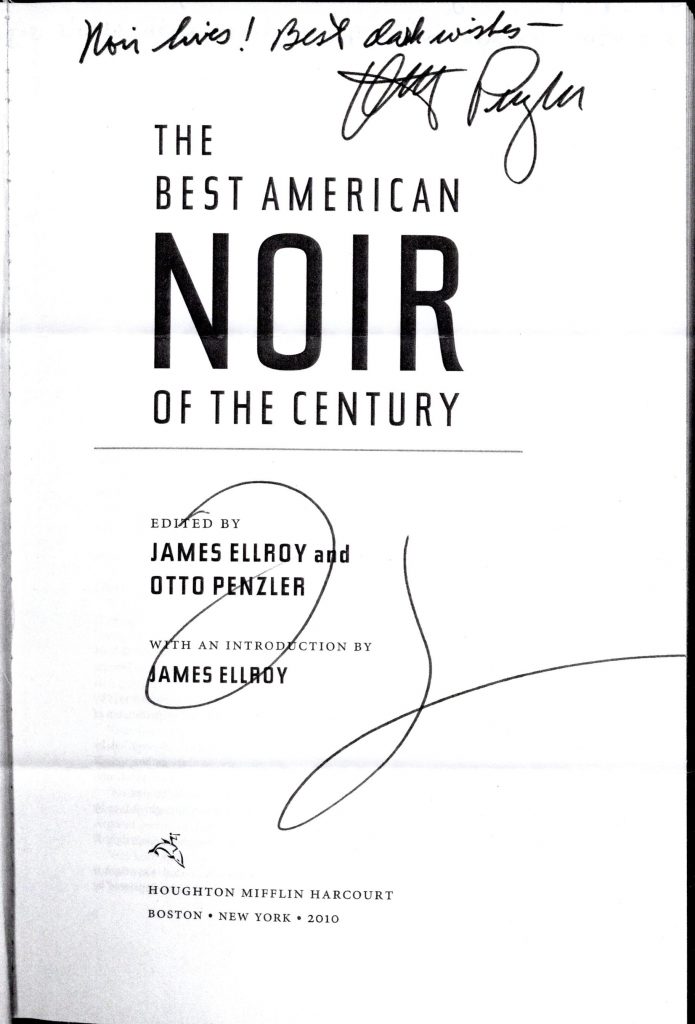
With Kent’s autograph, what I meant to express was that it was the worst autograph ever given to me in a book that I personally asked to have signed — not the worst autograph that I possess. Here’s another piss-poor one from James Ellroy. I wish that I had remembered this one from The Best American Noir of the Century when you were discussing Ellroy’s “signature” the other week. The difference between his effort and that of co-editor Otto Penzler is night and day.

Ellroy’s is a terrible effort, but he did not sign the book for me. His autograph was already in the book when I bought it.

When my office in Manhattan was a couple of blocks away from The Mysterious Bookshop I could bring books there to be signed by authors who came in for readings, talks — or just to sign. Those included Michael Connolly, George Pelecanos, Don Winslow, T. Jefferson Parker and others.

I got Pelecanos to smile and give a little laugh when I told him that I loved the title Down by the River Where the Dead Men Go — because I said it out loud inside The Mysterious Bookshop and Otto absolutely hated the title.

Kent Harrington’s autograph ranks even or perhaps just ahead of Pelecanos. Even when we had a great talk together at The Mysterious Bookshop he still provided me with the sloppy “GPl” autograph in the books I asked him to sign. You can probably see for yourself what I am referring to if you have copies of the Dennis McMillan books that he signed.

Whatever the case, at least I can say that I have “signed” copies of all the early Pelecanos books.

By the way, I suppose most of the sloppy autographs are probably a result of the writers just having lousy handwriting. Only some popular authors such as Michael Connolly deliberately shorten and simplify their autographs because of the shear volume of books that they are asked to sign.    
Posted in Lit | Tagged , , , , , , |

Rediscovered: Kent Harrington, Have Squiggle — Will Inscribe

Strap in!

Autograph Hound Saturday kicks off a weekend long rumination on the topic of nigh indecipherable signatures, by no less a collector than Kevin Cook. Now, don’t take the first thoughts on the subject as the Be All End All.

No, sir or madam. Kevin gnaws on this bone like the autograph hound he is, digging for the marrow.

As he’ll tell you, Kevin has selected a Kent Harrington inscription done at NoirCon in 2008 to kick it off. I actually met Kevin for the first time at that convention in Philly.

And I’ve known Kent for years, too. I told him that his holograph was going to be put under the microscope, as some of the worst handwriting around.

Kent said, “I’ll try to do better in the future.”

And here’s Kevin Cook:

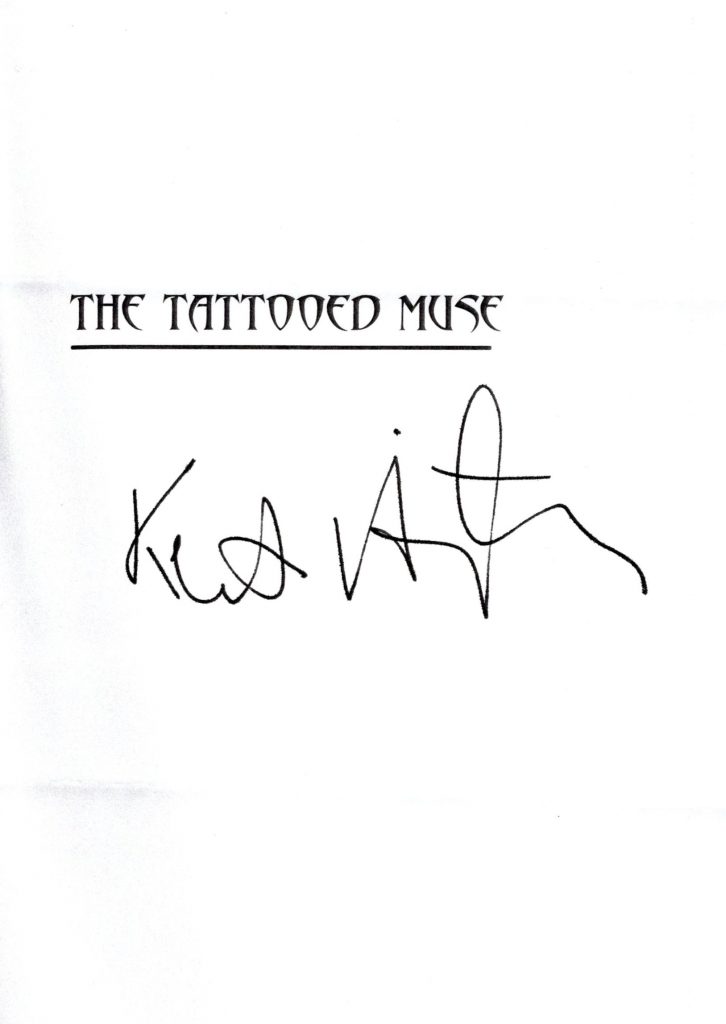
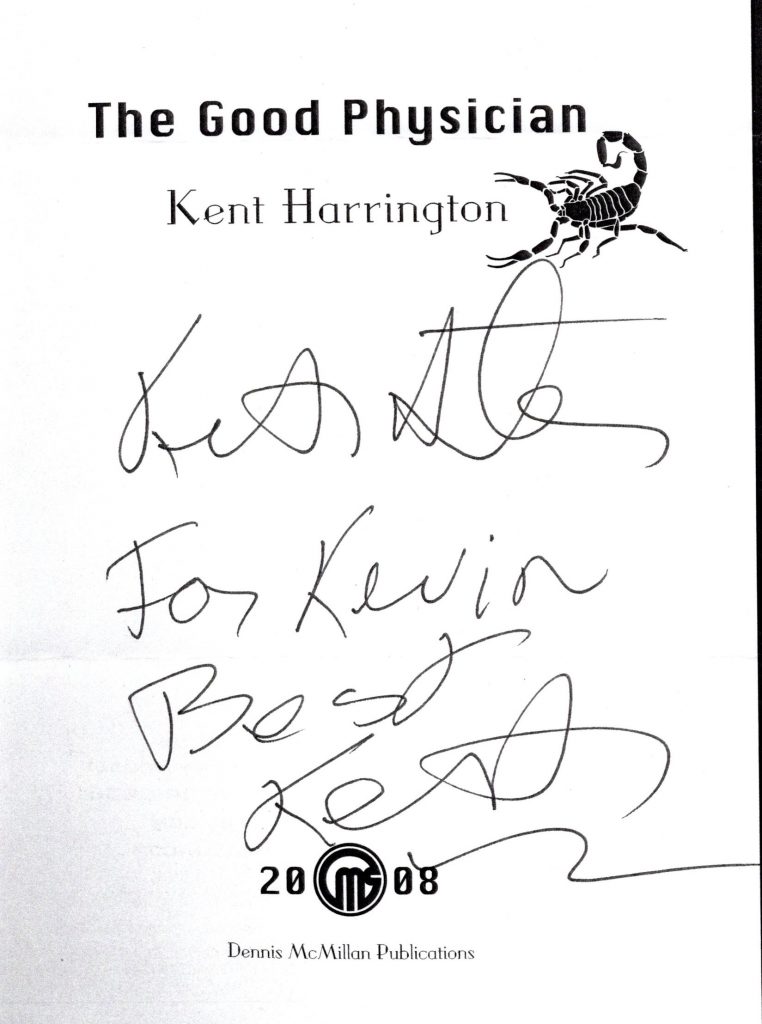
The awkward James Ellroy signatures remind me of the sloppiest autographed book that I own: The Good Physician by Kent Harrington, signed at the Noircon in Philadelphia.

I do not know how Dennis McMillan set up his signing procedure in normal circumstances, but that time you plunked down your $35.00 and stood in line for Kent to sign the book. Looking at it now I am not even sure what he wrote!

Kent never had the neatest handwriting anyway, but the ones on the other Dennis McMillan editions are much neater than the one I got in person. I don’t mind really, as it was nice to have that one opportunity to talk with Kent.

But now that I inspect the book more closely I think that I understand why he signed twice. All the copies were probably already signed as Kent Harrington and then he added the “For Kevin Best Kent” to the book when I was speaking with him.

That makes more sense than him signing it twice while I was right in front of him.

Kent probably had not signed for a line of people with his other books from Dennis, so the different circumstances could explain the “sloppier” than usual signatures.

For comparison, I am also sending two other Kent Harrington signatures, one from Dark Ride, his first novel from 1996, and one from another McMillan release, The Tattooed Muse; none are actually that clear.

If he had just signed a piece of paper like Arthur O. Friel you would have a tough time trying to figure out whose signature it was.

I really like Kent Harrington’s books, especially The American Boys and Red Jungle. I have read them all (or at least those available in the English language!) from Dark Ride up through last year’s Last Ferry Home —  Ferry is my only unsigned Harrington book. 

If I ever run into Kent again I will have to get it signed.

That was one of the great things about the Dennis McMillan publications: almost every book is signed, and in the case of a deceased author the person who wrote the Introduction signed. (The cool one there is the Leigh Brackett book signed by Michael Connolly and Ray Bradbury, who wrote the Intro and Afterword.)

Unlike my McMillan editions the new books I have bought by that crew of writers — Kent, Bob Truluck, Lono Waiwaiole and Kent Anderson — are all still unsigned.

Posted in DMac, Lit | Tagged , , , , |

Tour: Sundays in October — and Sunday November 3

The Dashiell Hammett Tour meets at noon every Sunday in October. The walk starts in front of 870 Market and goes for three hours. About two miles long. $20 per person.

If interested, pick a Sunday and show up. No reservations needed or taken.

Plus, I just got a note in from someone in Portugal who can’t quite make the cut for October, but will be in the burg on Sunday November 3.

Okay, why not? Pencil in Sunday November 3 if that works better for you. Again, just show up clutching a twenty with three hours to kill. (But watch out for the end of Daylight Savings Time that day, which will monkey with the clock.)

How often do you get a hard-boiled tourist in  from Portugal, anyway? (Although, come to think of it, I did have a guy from Portugal on a walk earlier this year — I wonder if they know each other. . . .)

Posted in Tour | Tagged |

Rediscovered: H. Rider Haggard

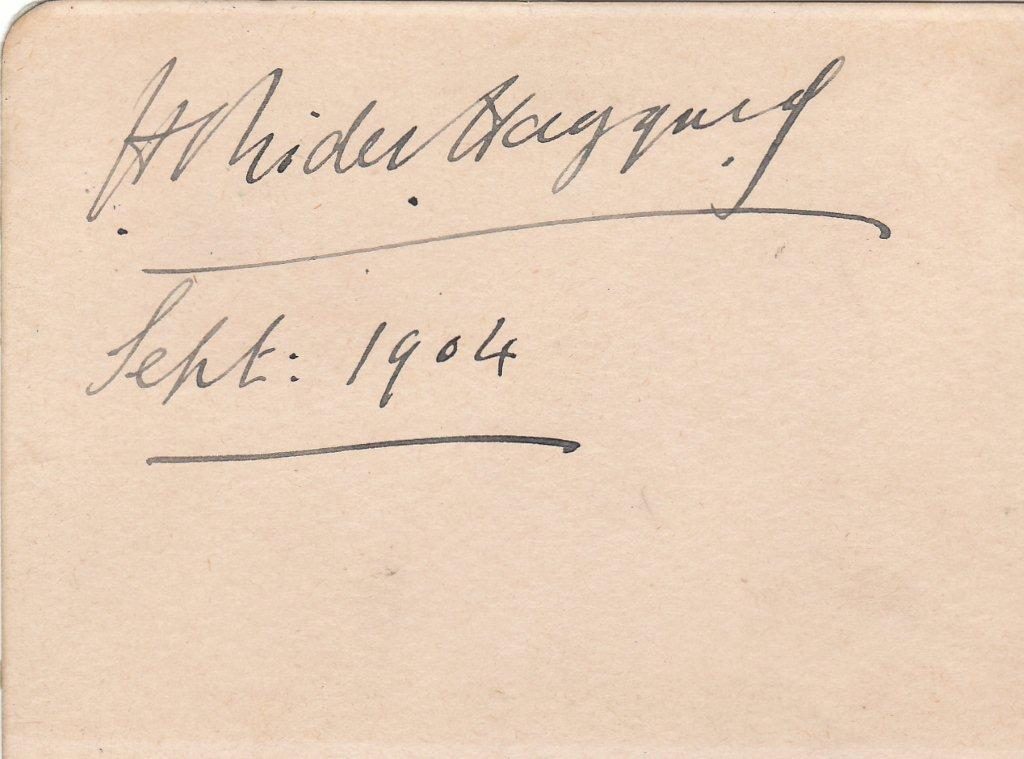
Okay, I know what you’re thinking: What kind of Lost Race Auto Weekend is this, anyway, if you don’t lay down an H. Rider Haggard?

I agree, so we sent Brian Leno into the darkest corners of his cubbyholes and closets, digging, digging — and did he excavate a Haggard?

Sure he did.

Brian notes, “Pretty cool — since it is dated Sept. 1904 it is exactly 115 years old.

King Solomon’s Mines, a book I’ve read a few times and have always enjoyed, came out in 1885, and was quickly followed by She and Allan Quartermain. These three novels pretty much started the ‘Lost Race’ genre. In 1905 another great Haggard tale, Ayesha: The Return of She, would come out in bookform.

“Any writer worth his salt would have given much to be able to sign his name to the above Haggard novels.

“So I had to have a Haggard signature, and I’ve had this one for a while. Haggard, if the collector takes his time, can be acquired for a fairly decent price.

“Autograph collecting, while not having the epic vitality of an Allan Quatermain quest or the excitement of poking about in ruins thousands of years old, is, though, a lot safer.

“Armchair adventure. Haggard’s one helluva guide.”

Posted in Lit | Tagged , , , |

Rediscovered: Andrew Lang

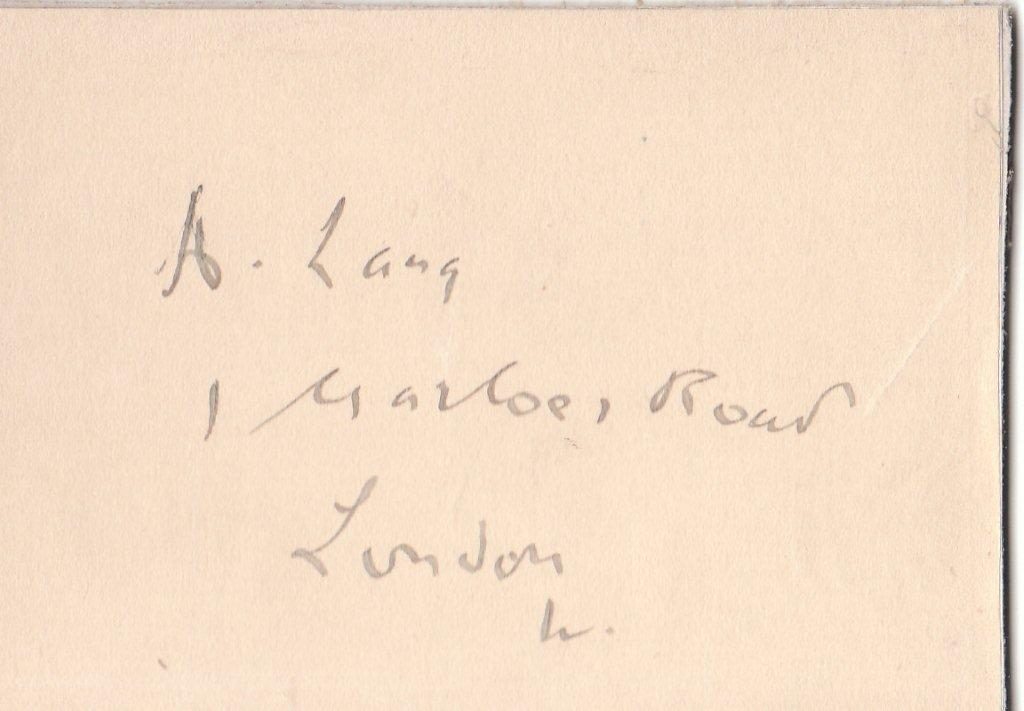
Continuing today’s Autograph Hound Super-Sunday theme of Lost Race — sometimes known as Lost World, guess the fine line drawn depends on how exotic the race involved in the action may be, but the baseline is the Lost part — we bring in Brian Leno to display a John Hancock for a collaborator of H. Rider Haggard. Haggard pretty much kicked this genre into gear.

Brian reports, “The autograph of Andrew Lang can be had fairly cheap.

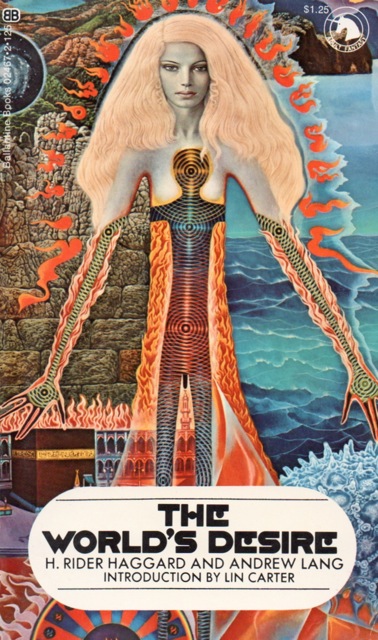
“In a 1927 letter to Clark Ashton Smith, H.P. Lovecraft wrote, ‘Now — if I can get the leisure — I mean to read The World’s Desire, by Haggard & Lang.’ It is pretty apparent the Old Gent was a fan of H. Rider Haggard and Andrew Lang.

“HPL even gives Lang some credit for helping him to create one of his most famous characters, Abdul Alhazred. In a 1930 letter to Robert E. Howard he says, ‘Abdul is a favourite dream-character of mine — indeed that is what I used to call myself when I was five years old and a transported devotee of Andrew Lang’s version of the Arabian Nights.’  

“There’s a bit of a problem with this statement. Lovecraft, born in 1890, would have been five in 1895 — according to an Internet bibliography of Lang, his ‘version of the Arabian Nights‘ didn’t see publication until 1898.

“But, hey, if Lovecraft wants to credit Lang with his creation of the mad Arab Abdul Alhazred that’s fine by me, especially since I have a copy of Lang’s signature.

“Coincidentally, The World’s Desire was published in 1890, the year of the horror master’s birth.

“The book tells of a journey Odysseus took after the events related in Homer’s Odyssey and we find that his Queen Penelope has died and this sets in motion events that ultimately take him to Egypt and Helen of Troy.

“I’m not going to ruin the novel for those who haven’t read it but it’s a good book and for those lovers of the Ballantine Adult Fantasy Series it showed up in the set in 1972, with an introduction by Lin Carter.”

Posted in Lit | Tagged , , , , , , , , |

Rediscovered: Wings of Danger

Months ago I was emailing back and forth with Kevin Cook and he mentioned that he was thinking about getting rid of a couple of his Lost Race novels, because they were duds and he’d never read them again.

Now, I am under the impression that Kevin has a complete collection of Lost Race novels — certainly of the original vintage era — so I disputed for a moment the concept of dumping any. A complete collection is a research tool, something you could donate to a library when you’re finished with it. The more complete, the better.

So what if a novel in the group sucks? Of course some of them will suck.

It’s like collecting San Francisco Mysteries. Doesn’t matter if the book is good, bad or indifferent, what matters is A) it is a mystery of some stripe, and B) is set at least in part in San Francisco. 

Ultimately, of course, I told Kevin to do as he would — his collection to dispose of as he will.

I’ll bet, though, the items he was thinking of dumping weren’t autographed. That would add up to a whole new equation, would it not?

For Autograph Hound Super-Sunday Kevin kicks us off with a signature in a Lost Race novel he assures us is not a dud.

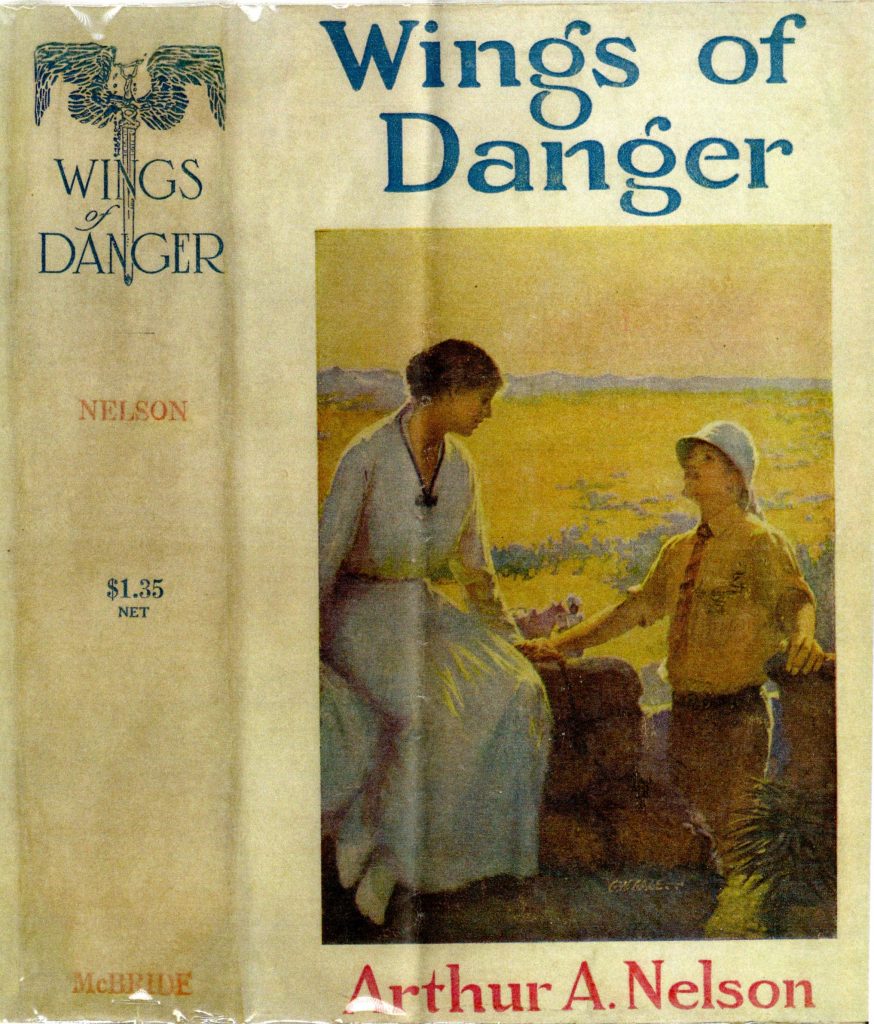
Among his holdings Kevin says, “I have a copy of the special ‘Autograph Edition’ of Wings of Danger by Arthur A. Nelson.

“The novel has to be one of the two or three finest Lost Race novels ever written.

“Vikings in central Africa.

“Apparently a big favorite with Robert E. Howard fans.

“Weird thing is that his novel was so well written, but he apparently never authored another book. His byline appears once in Adventure and not in any other known pulps.

“Plus, Vikings in central Africa — outside the usual parameters for Lost Race fiction, but he pulled it off perfectly.”

This novel saw original publication under the title “The Adventurers” in Adventure in 1915, and is easily available to read in the Altus Press Lost Race Library. You know, if you feel like checking out Vikings in Africa and sinking into a book Kevin Cook has no plans on dumping.

Posted in Lit, REH | Tagged , , , , , |

Rediscovered: Mark Channing White Python Slugfest

Autograph Hound Saturday once more, and it looks as if the theme for the weekend is “Lost Race” John Hancockery.

You know the Lost Race genre, where one dude or another — Alan Quartermain or Tarzan, usually the athletic type — often as part of an expedition — trudge into Africa or the Himalayas or some other vast and remote fastness, and — What the Hell, indeed —stumble across a lost race from Atlantis or other exotic land, holed up in some corner somewhere — not just hanging out in a village or two like the native population. 

Both of our stalwart Autograph Hounds, Brian Leno and Kevin Cook, jump into the fray — I couldn’t hold them back. Had to let ’em both loose or they’d have torn the joint down.

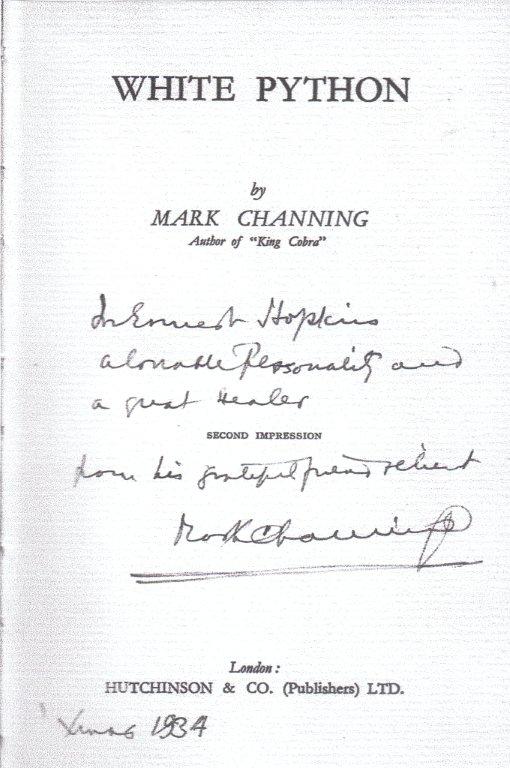
Brian punches in first with the image at the top: “It might be a bit of a surprise to admit that, even though I pursued his signature, I have never read Mark Channing, and so know very little about him.  I guess some people will think I’m nuts to buy signatures of writers I’ve never read, but I’ve never read The Wonderful Wizard of Oz and I continue to look for a L. Frank Baum autograph.

“Douglas A. Anderson has a pretty nice write up about Channing and includes a photo of the author. Channing spent time in India, and his books — as Anderson puts it — ‘were similar to the novels of Talbot Mundy, and their mix of adventure and Indian mysticism was popular with readers, particularly in the United States.’  

“I first heard of Channing years ago,” Brian continues, “when I was reading Talbot Mundy.

“I always liked Mundy, and so I thought I’d dip into Channing but I wanted to get his signature first. He’s not an easy find, and he can be high, usually too much for what I wanted to pay.

“But a few weeks ago I found his White Python, signed, for a very reasonable price from an U.K. dealer and that book is now in my collection.

“Which means I can begin to start reading Channing, although I’ll have to find cheap copies of his books, because I certainly don’t want to take a chance on breaking the spine or spilling something onto the signed volume.

“Any person who treasures inscribed copies knows exactly how I feel.

“I believe the inscription reads: ‘To Samuel Hopkins adorable personality and a great healer from his grateful friend and client Mark Channing Xmas 1934’ — I like Christmas signatures.

“I looked up Samuel Hopkins, if that’s who it is, and really found nothing of value that might trigger who this ‘healer’ might be.

Brian wraps it up: “Channing’s handwriting is a bit sad. The inscription is in a Hutchinson, second impression.”

I’m willing to bet that Kevin Cook’s copy is a first, because that’s how he usually rolls.

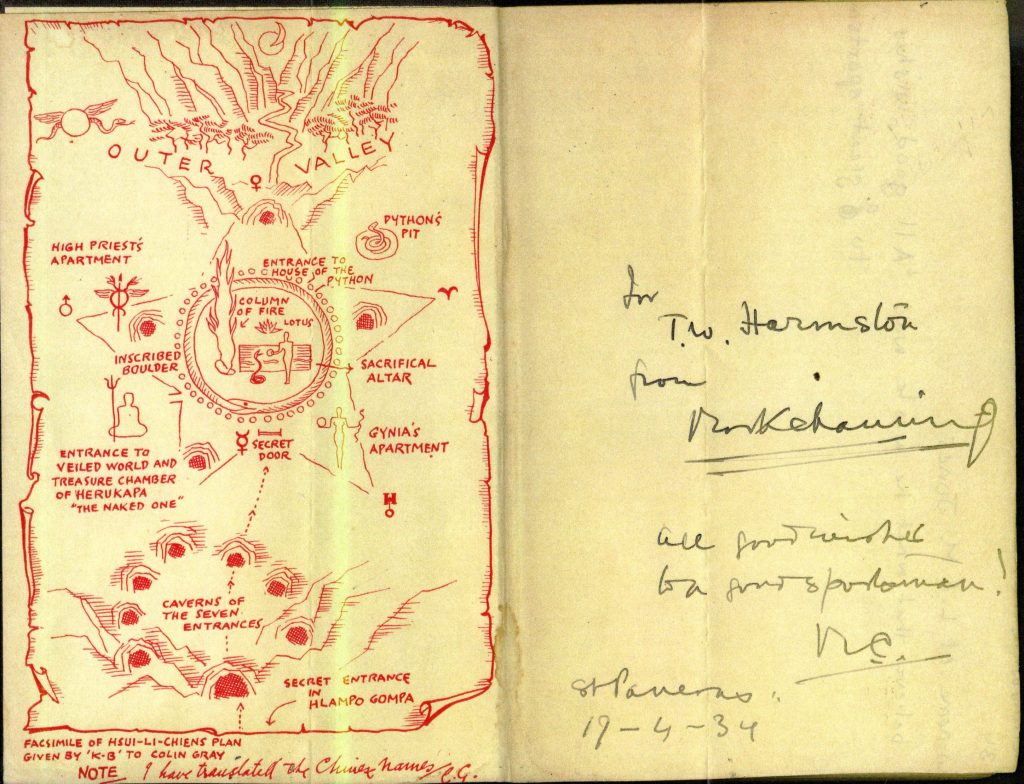
The holograph remains crummy, but it’s a double whammy signature — full “Mark Channing” after the “For [decipher the name to your heart’s content] from” and then an additional note initialed “M.C.”

Kevin says, “I believe that what he wrote was ‘All good wishes to a great sportsman!'”

Looks like the writing is on the front free endpaper, in a Hutchinson edition from 1934.

Posted in Lit | Tagged , , , , , |

Rediscovered: Lovecraft — the Reason There’s Arkham Ephemera

If we’re celebrating John D. Haefele’s landmark article on Modern Arkham House Ephemera in the September/October issue of Firsts (with the checklist of items to follow soon in the November/December issue) — and we are — then how about bringing out the Big Gun?

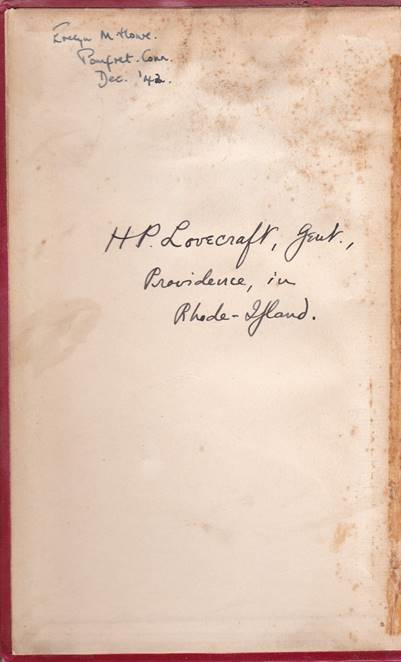
For Autograph Hound Super-Sunday check out the ownership inscription by none other than H. P. Lovecraft in a Dr. Syntax volume from his library. No Lovecraft, no Arkham House — no Arkham House ephemera.

Haefele says, “Something of possible interest from my files.

“On August 29, 1936 HPL wrote Henry Kuttner, ‘I enjoyed yours of Aug. 14, & am very grateful for the glimpse of the Combe-Rowlandson ‘Dance of Death’. These quaint early 19th century products have always held a particular charm for me — ‘Dr. Syntax’ having been encountered at an early age. I wish I had acquired a whole set of these red-covered reprints when they were cheap. As it is, I have only the first ‘Syntax’ book.”

The item entry from Lovecraft’s Library: A Catalogue (Fourth Edition):

941. Syntax, Doctor [pseud. of William Combe (1742-1823)]. The Tour of Doctor Syntax in Search of the Picturesque. <1812> New ed. New York: D. Appleton & Co, 1903. 266 pp. … Poem.

Posted in Lit | Tagged , , , , , , , , |

Rediscovered: Modern Arkham Ephemera

Autograph Hound Saturday rolls around once again, and What the Hell!

Brian Leno is off for the weekend on an expedition into the darkest corners of lowlife gambling dens, and he’s incommunicado.

Kevin Cook apparently is digging through all his books and pulps and cheques, determined to determine exactly which autograph in his holdings features the absolute worst handwriting. Caveman and sub-caveman stuff.

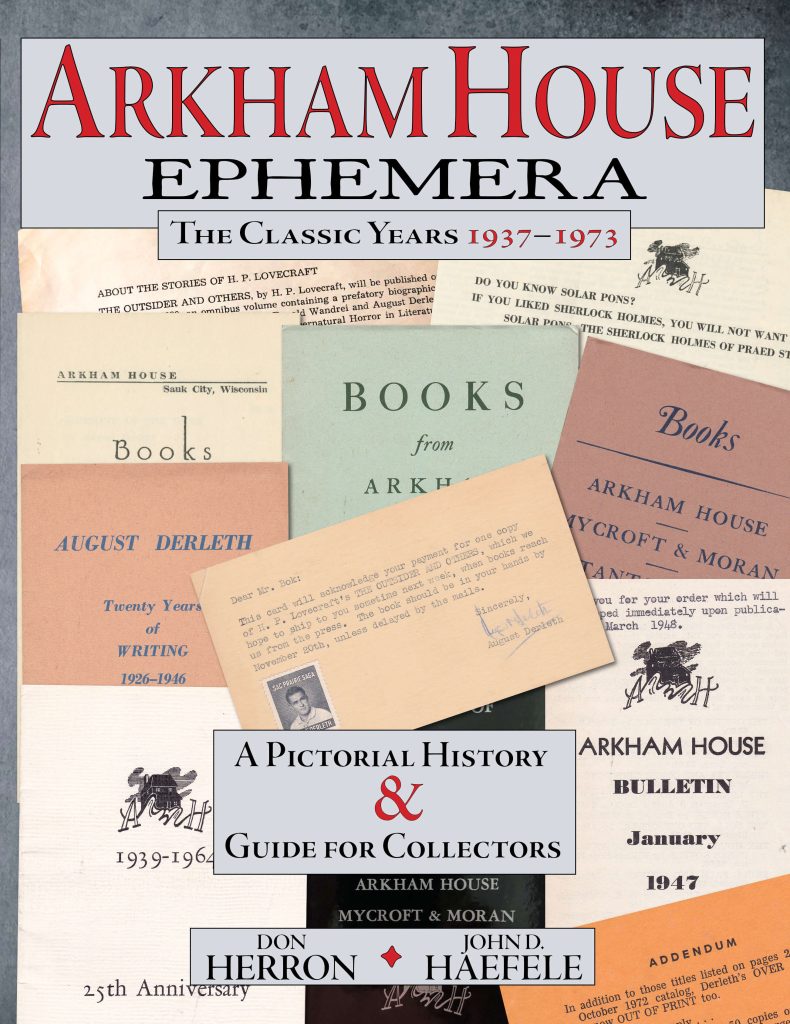
Fortunately — it saves me the trouble of digging any John Hancocks out of my own holdings — John D. Haefele pops in a couple of items, kind of in celebration of his article “Arkham House Ephemera: The Modern Years” appearing in the current issue of Firsts: The Book Collectors Magazine.

Haefele chipped in as a research assistant when I covered “Arkham House Ephemera: The Classic Years” back in 2002.

He reports, “Firsts arrived today, & overall I am very pleased with what I see. Apparently these days there are fewer pages, the 2002 issue had 72, but this one only 40.

“The layout & featured text blurbs look professional & very handsome. They only used three images — not numbered — but they are large & clear & good choices. I’m thinking — hoping — they will use many others to illustrate the actual checklist next time.

“They included the entire article — everything — except for three lines — only three, they carefully chose to drop, I think, so that the article fit the 9-page spread perfectly.

“All in all, I am thrilled with this appearance. A much more meaty & comprehensive piece than it seemed on my computer screen.”

Haefele’s article was excellent in Word doc, but there is something magical about seeing the thing in print. The minor deletions were just the usual editing one would expect in a pro magazine. The longest, and most interesting one, refers to the Phil Mays List, which really launched ephemera collecting as a hobby: 

“Following Mays, the early pieces traded for as much as $30 or $40 apiece. Though the Ruber-era pieces trade at $10 or $20, they do trade — and without any reference tool. As for Vanderburgh-Weinberg pieces — other than a few insiders, who before now even knew they existed?”

Get the point? The appearance of the Modern Era checklist in the next issue of Firsts ought to start a stampede, and prices, hey, the prices may go up a few notches.

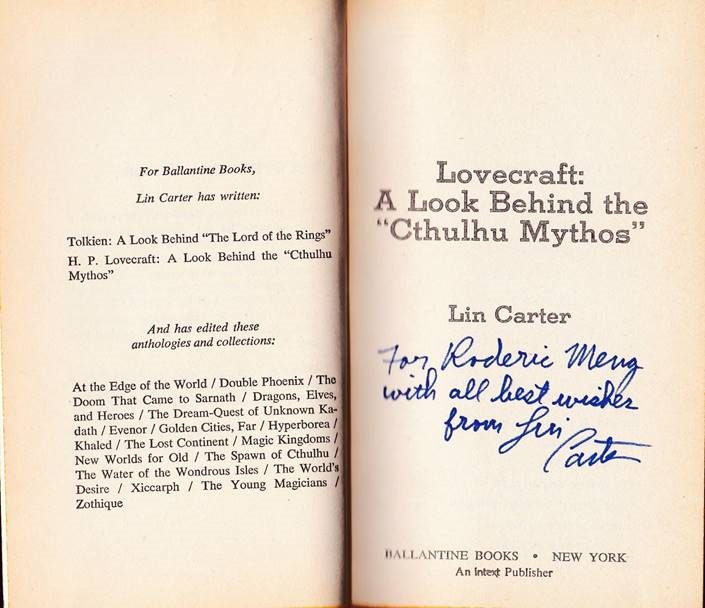
In case you’re not savvy in this corner of the collecting world, the image at top features an inscription by author Lin Carter to Roderic Meng — Meng managed Arkham House after the death of August Derleth in 1971, a key figure in the Modern Era.

Carter wrote many, many books, including a poetry collection released by Arkham. Before he left the firm, Don Wandrei told me he had rejected the Carter volume, but apparently the poet noodled around and got Meng to put it back in the lineup.

Ah, the history of good old Arkham House.

Posted in Lit | Tagged , , , , , , , , |

Hammett: Final Jeopardy(!)

Watching Jeopardy!, S36 E8 for 9/18/19, I roused to some attention when they did a clew featuring Lillian Hellman — but, hey, it’s only Lillian Hellman, who cares, right?

Since they just did Hammett recently, I admit I was caught completely flat-footed when Final Jeopardy rolled around.

The category was The 1940s.

The statement when it rolled out read:

This nickname for a history-changing weapon of 1945 came from a character in “The Maltese Falcon”

Whoa!

The champion, Jeopardy Jason, pulled out another win with the answer:

“What is the Fat Man?”

Another contestant also got Fat Man. The third went with Little Boy — which Alex Trebek noted was “also inspired by Dashiell Hammett.”

Yeah, kind of. You can look it up and read all about it, but the bombs dropped on Japan to cut to the chase in World War II were named Fat Man and Little Boy. The initial names for the double whammy duo were Thin Man and Fat Man, based on the thin and fat designs for the weapons. And an apparent awareness of Hammett’s works from somebody in the bomb lab.

When something wasn’t right with Thin Man, they tweaked it — but apparently couldn’t keep the original name. So Thin Man became Little Boy and the rest is indeed history.

Final jeopardy, and how.

And you thought Hammett was just another pretty face, limited to books and movies.

Posted in Dash | Tagged , , , , |