Rediscovered: ERBivores on the Prod

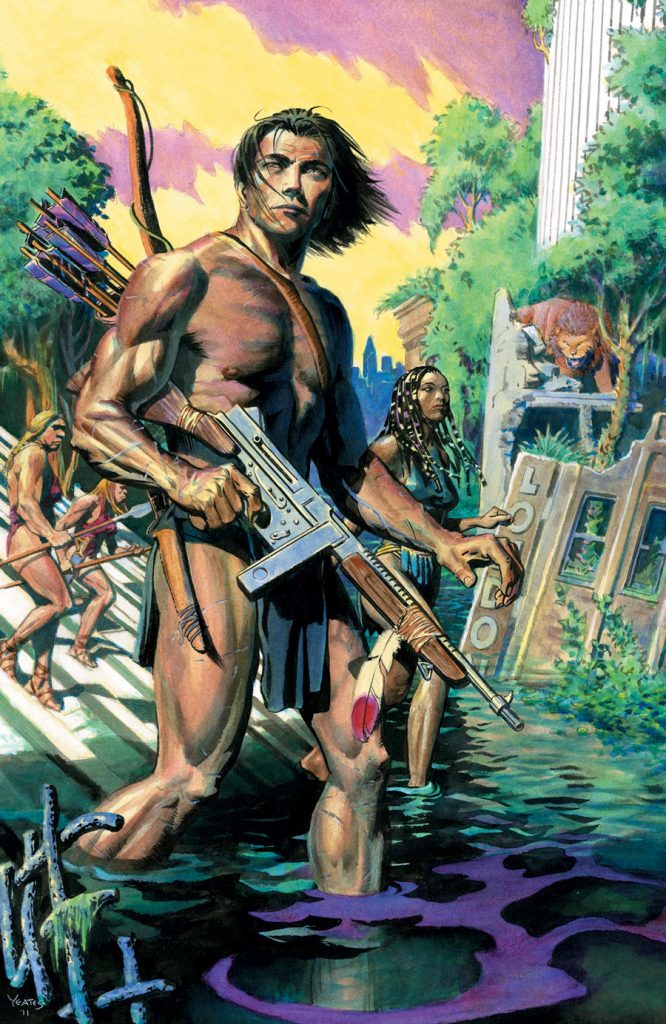
On Saturday the 11th I made a run up to Folsom to do a little talk for a gathering of Edgar Rice Burroughs fans, assembled for North Coast Mangani III (aka NCM3). Thomas Krabacher talked me into it, figuring I could handle the assignment. The artist guest-of-honor was Thomas Yeates — some Tarzan, Swamp Thing, currently doing Prince Valiant — the image above from a Dark Horse comics gig where Tarzan rips things up with a tommy gun. Richard A. Lupoff was the author guest-of-honor, and wouldn’t require any introduction in that crowd — he’s done ERB stuff since the 1960s, in addition to mucho science fiction, radio — a fixture for decades. 

On the drive up I was chatting with Morgan “The Morgman” Holmes and he mentioned that Burroughs wasn’t that important to him, and then spent an hour talking ERB.  In particular he said he’d like to have War Chief and Apache Devil in the 1960s Ballantines to read. ERB did saddle-up in the hunt for Geronimo, years before he turned to writing. Morgan remembered those covers and had never read them. I picked up the pair in the dealers room — I don’t think I read them back in the day, either, though must have knocked down close to fifty Burroughs books. Or more.

Yeates did a talk with slideshow on a future-history Tarzan plot he did, set in a flooded London, with descendants of Hippies one major surviving faction of humanity vs. the forces of oligarchs. Deciding to have Tarzan popping around with a Thompson proved to be bad timing, since the Aurora shootings occurred near the release date. He left to do Prince Valiant and the next guy got to illustrate a sequence about growing vegetables.

I held down the next hour of programming, talking initially about ERB and his influence on Robert E. Howard, how many Burroughs titles REH had in his personal library, that sort of thing — eventually getting off into all kinds of pulp and film stuff, even the Continental Op.

Lupoff came next, apologizing for his current rasping quiet voice against his mellifluous tones of yesteryear. His topic was surveying the multi-year gaps between the appearance in print of Tarzan clones, when you’d think there’d be dozens — and there might well be dozens, except he hasn’t found them. Lupoff mentioned his findings might see print in an upcoming issue of The Burroughs Bibliophile.

My memory — I didn’t take notes — is that it jumped from the first Tarzan in 1912 to the next thing many years later, 1923, then a jump to circa 1932, then 1936, then the 40s and then the 50s.

The adventures of Ki-Gor in the pulp Jungle Stories became the most prolific, with some 59 novellas — or “short novels” for purposes of pulp publication. I’m guessing the Ki-Gors run less than half the length of a Tarzan novel, but since you have 59 Ki-Gors against 24 Tarzans by Burroughs, I think the word count might come out close to even.

But then, you have One Man vs. the Legion.

One man: Edgar Rice Burroughs. The legion: the group of house writers churning out copy for Jungle Stories.

It’s usually observed that today the average age for bigtime ERB fans tops 70, so I am closing in. Give me a few years. I did have the thought that maybe I ought to clear other stuff  — Hammett, Machen, Starrett, Haefele, Clark Ashton Smith, The James Gang and the rest — off the shelves and go full Apeman. 

ERB can fill up a lot of shelf space.

Posted in Lit, News, REH | Tagged , , , , , , , , , , |

Tour: Summer & Fall 2019

Shot above: leading the pack across the intersection of Post and Hyde Streets during the tour by appointment for Sisters in Crime, August 5, 2017.

Let’s say you’ve had the Hammett Tour on your bucket list for awhile, or you want to take it again after 20 or 30 years to see if it’s still any good. If so, the walk will meet Sundays at noon in front of 870 Market:

May 19 and 26.

June 9 and 23.

July 14 and 28.

August 11 and 25.

September 8 and 15.

October 6 and 13 and 20 and 27.

Three hours. A couple of miles. $20 per person.

After October the winter rains ought to come drifting in, so I’ll play it by ear from that point on — until next spring and summer.

Posted in Frisco, Tour | Tagged , , |

Rediscovered: On a Postcard, Halloween 1944

Brian Leno reports in bright and early from behind the lines, after another raid on his autograph collection:

“Was going to send you this image sometime back, but never got around to doing it.

“Sorry about the blurry picture — it’s under glass and that’s never a good thing when it comes to scanning.”

Brian says he got the postcard “mainly because of the Francis X. Bushman autograph, as I also picked up a Ramon Novarro signature at the same time. Put them both together and you’ve got Ben-Hur.”

The 1925 silent Ben-Hur, of course. Chariots by Canutt (who stepped back in to give Chuck Heston a boost in the remake).

“That’s Bushman’s feet at the top,” Brian reveals, “couldn’t scan the whole thing.”

“But I figured you might get a kick out of the Ricardo Cortez auto. The original cinematic Sam Spade, no less, and a lot cheaper than a Bogart.

“The other signatures, Marsha Hunt I remember mainly from a Gunsmoke episode ‘The Glory and the Mud’ — Jay Kirby was in a few Hopalong Cassidy movies.”

From the most casual net research I don’t see any 1944 film projects that would have brought those names together, so guess that someone hauled the card around for scrawls before winging it off to the Bronx.

Postmarked Halloween, the City of Angels.

Kind of interesting that Novarro would be murdered “Halloween eve,” October 30, 1968. Jeez, maybe I ought to get into numerology. . . .

Posted in Film | Tagged , , , , , , , , |

Hammett: Jeopardy! Watch

They haven’t been dropping Hammett clews on Jeopardy! recently, although I did notice another Lovecraft item with a mention of Cthulhu — could old HPL be easing out Hammett as the show’s new go-to pulp-era writer?

Nathan Ward has been holding down a stakeout, too, and notes: “I have kept track of Jeopardy! and I don’t believe the super competitor has been challenged yet on his Hammett knowledge.”

At the moment a guy now nicknamed “Jeopardy James” is having a record-breaking run and has knocked over a million-plus in winnings.

Nathan says, “Maybe that will be his undoing” and suggests this clew:

This portly sleuth worried about going blood simple.

Yeah, that could stop your typical Jeopardy! contestant like a dum-dum through the pump. 

Posted in Dash | Tagged , |

Hammett: And Fechheimer

Got a note in from Nathan Ward commenting on the death of P.I. David Fechheimer

“Here is my Hammett-related obit that was picked up in Crimereads.

“Just repaying a debt.

“Too bad that guy never wrote his book.

“I had the same feeling Terry did that the Times obit missed the Hammettish core of Fechheimer’s contribution.

“Also, I don’t put too much stock in those old Esquire quotes. David said he was not converted in one night by reading Falcon to run to the phone in the morning and call the Pinks, but writers loved the romantic story, so it passed on from profile to profile down the years.

“As for Spade sleeping with his client, I have always assumed he did it partly to get her key from her and check her room.

“A job-related sacrifice.”    

Posted in Dash, Frisco | Tagged , , , |

Rediscovered: John D. Haefele on the History of Arkham House

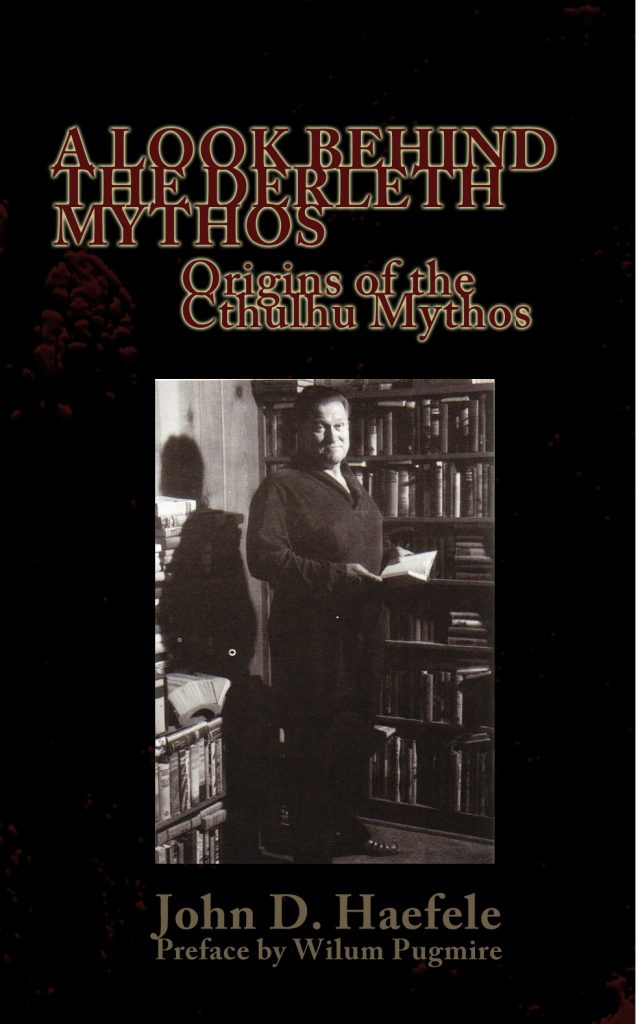
Our resident expert in everything Arkham returns to review a new (if repurposed) book on the fabled press. John D. Haefele certainly burst fully-formed on the scene with his A Look Behind the Derleth Mythos, but he’s done a ton of stuff on the subject, most recently a run of articles appearing in Crypt of Cthulhu. See his Amazon page for a thorough list of books, chapbooks, monographs, web and print surveys. He knows the turf.

Take it away, John:

The introduction to S. T. Joshi’s Eighty Years of Arkham House: A History and Bibliography, released in 2019 by his own imprint, the Sarnath Press, concludes with this positive note:

Arkham House remains the most significant small press in the history of weird fiction, and its legacy remains imperishable. It has inspired legions of other small presses to take up the work of publishing the leading luminaries in this field, and for that alone it will deserve to be remembered.

Considering that Joshi at every opportunity—for more than four decades—has spent his time maligning Arkham founder August Derleth (among the legion of opinions, citing his “incompetent and error-riddled editions of Lovecraft’s work”), his current verdict for purposes of this book seems. . . perhaps “generous” is the word?

“Jarring” might be another.

In 1939 Derleth and his co-founder Donald Wandrei published the first Arkham House: The Outsider and Others, by H. P. Lovecraft, but for most of the years before his death in 1971 the press was a solo operation by August Derleth. He paid the bills—which greatly exceeded publishing income—wrote all of the promotional materials, did bookkeeping, shipping and handling of orders. His vision initiated all of the innovations and successes for which Joshi praises the publishing firm in his nine-page introduction.

During his tenure, Derleth launched two additional imprints that complimented Arkham House: Mycroft & Moran and Stanton & Lee. Taken together, the books published with Derleth at the helm—what we Arkham collectors refer to as the Classic Era—dwarf everything that came after his death, often dubbed the Modern Years.

Derleth, of course, set down the template for this book in Thirty Years of Arkham House (1970), where he covered 125 items. Joshi was hired to do Sixty Years of Arkham House (1999) as a further authorized bibliography for the press, which incorporated the entirety of the previous book and followed Derleth to the letter—and added the roughly one hundred titles released during the intervening years. (It’s too bad Joshi didn’t wait out the next decade this time to do the more perfectly apposite Ninety Years of Arkham House.)

The effort Joshi put into this new book, however, seems to be wanting.

After admitting the book’s “inevitable” resemblance to Sheldon Jaffery’s Arkham House Companion (1990)—one book listing the contents of an Arkham being similar to another book also listing the contents of an Arkham—Joshi reiterates from his Sixty Years preface that he compiled all information “independently.” Strangely, despite listing the book in the reference bibliography included, he doesn’t refer otherwise to Leon Nielsen’s Arkham House Books: A Collector’s Guide (2004), the most recent such reference after Sixty Years of Arkham House.

Likewise, Joshi repeats that he is the first to include the contents of the house magazine Arkham Collector (1967-70). Joshi apparently forgot that I compiled exactly the same detailed list in 1997 in The Arkham House Supplement: Bibliographical Additions, Comments, Marginalia (on pp. 82-87), right before he released Sixty Years. The Supplement was my first book, I suppose, in a run of only some 45 copies, most of them distributed to the membership of the Esoteric Order of Dagon amateur press association. Joshi was the compiler for EOD mailings at that moment, so all the submissions went through his hands.

Eighty Years picks up right where Sixty Years leaves off—yet, even including items without assigned numbers, Joshi adds to the tally of the three major Derleth imprints only 13 books.

Scarcely worth the effort.

Especially since this grand total represents only six more books than Leon Nielsen listed in his guide. Six. Nielsen’s 240 entries against Joshi’s new total of 246. Such small numerical advances hardly seem to warrant new books.

Even if Joshi did compile every iota of even his newest information “independently”—and was lucky enough Arkham House/Mycroft & Moran/Stanton & Lee managed in combination to publish 13 more books—the worth of such a bibliography is in the asides, the deep knowledge that may be imparted to the prospective Arkham House completist.

Joshi ignores most of the charming items of Arkham House ephemera, the stock lists and brochures that drummed up orders to keep the company afloat. The only published sources on these items are the 1985 chapbook The Phil Mays Collection of Arkham House Ephemerae released by the bookseller Roy Squires, and the greatly expanded “Arkham House Ephemera: A Checklist of the Classic Years” Don Herron complied for the October 2002 issue of Firsts: The Book Collectors Magazine. Any book that purports to combine history with a bibliography of Arkham House, given today’s interest in the publisher, leaves the job half done if it doesn’t include the hundreds of booklets, brochures and other advertising items, always chock-full of original “autobiographical” material in terms of the life of the press.

The closest Joshi comes to acknowledging the ephemera is the handful of pieces he incorporates into his primary Arkham list, which—unlike most printed ephemera—were issued with intentions that they would be of lasting significance, because they fulfill some sustained reader interest. Taking cues from Jaffery, Joshi includes exactly the same ones: Derleth’s bibliographical Years of Writing chapbooks, and the AH 1939-1964: 25th Anniversary booklet. Except, Joshi demotes them, removing Jaffery’s separate ID numbers.

His explanation? “Not part of the Arkham House list.” One wonders why they show up in his book, in that case.

Joshi likewise “un-numbers” Lovecraft’s Autobiography [:] Some Notes on a Nonentity, a chapbook traditionally stamped with the publisher’s imprint, and offered for sale in Arkham’s regular Stock Lists as a limited release. Neither did Derleth number this item in 1969, but Joshi misses the opportunity to delve into possible reasons.

Also lacking separate numbers are both versions of Lovecraft’s The Shunned House, an attempt made by W. Paul Cook in 1928 to release what would have been Lovecraft’s first book. The pages had been printed and organized into signatures for binding, but the project fell through. While some experts understandably relegate the unbound House signatures to a non-Arkham status, no expert worth his salt categorizes as less than full status the bound edition that has “Arkham House” printed on the spine. Derleth’s edition was the first time any of the surviving sheets were bound commercially.

Perhaps the numbering ambiguity in Sixty Years is what prompted Nielsen’s bibliography to reintroduce the numbering system favored by collectors in the field. In Eighty Years, Joshi undoes it all again. Odd for a work he claims is geared for “a wide variety of individuals, from collectors to librarians to scholars to general readers.”

Sixty Years had adequately covered the period when Jim Turner acted as editor for Akham House—Turner probably signed that book’s contract with Joshi and afforded him insider access to company records. But the more recent intervals, with Peter Ruber as editor, followed by the team of Robert E. Weinberg and George A. Vanderburgh (whose name Joshi misspells throughout), are responsible for every one of the 13 new titles we find in Eighty Years.

Not surprisingly, Joshi gives them short shrift.

Joshi’s Baker Street Irregular entry (at this writing Arkham’s last book) is complete—he identifies both limited printings, the “Presentation” and “Author’s” editions—but for Vanderburgh’s 17 lettered Shunned House Facsimile copies, each with a pasted-in pocket holding a rare unused signature from the actual 1928 printing, there’s not a word.

In addition, Joshi inexplicably assigns a single number to four different collections of Derleth’s weird tales promoted by Vanderburgh in 2009 as “The Macabre Quarto”— though not necessarily a set, each could be purchased separately. (Nor does Joshi indicate that all of the Quarto books were available in limited hardcover editions, as well as softcover.) The result of this single entry is more ambiguity. Nor is this combo-entry much different than if Joshi had included his own “pure text” series of Lovecraft volumes in the Jim Turner era as one unit, per the pre-release “The Arkham Lovecraft” hype.

Joshi listed 19 entries for Mycroft & Moran in his 1999 bibliography, which Nielsen upped to 20, which is where Joshi left it.

If he had done the homework—perhaps contacted George Vanderburgh—he could have added the ten Steve & Sim titles George published under the M&M banner 2001-2010, and even some later collections featuring Carnacki and Dupin. More than doubling the ranks of post-Sixty Years releases. One wonders how “independent” Joshi felt he had to be if he didn’t interview the last living Arkham House editor.

Stanton & Lee, alas, is more neglected. Total books add up to 16, same as in Sixty Years—same as Nielsen. And once again two S&L books from 1971 left out of Sixty Years are omitted: This Undying Quest, by Grant Hyde Code, and Night Letters, by Francis May.

Joshi is barely phoning it in. Checking the list of the “Lost” Arkhams—proposed titles that never saw print from the press—Joshi’s new list is Jaffery’s list. Both, if one looks closely, name 62 of these lost titles, if you include several titles Joshi kept from Jaffery, but only in small print and without his separate number. Besides this, Joshi finds several mainstream Derleth titles to add, but deducts an equivalent number of what he deems “minor title variants”—inconsequential categories, but which offset each other when it comes to counting.

What is consequential is that Joshi’s “Lost” list lacks important additions he should have listed, including such provocative titles as Ghost Stories by R. H. Malden, Collected Weirds by Fitz-James O’Brien, a Selected Tales of Lord Dunsany omnibus, The Gargoyle by Marjorie Bowen, and a Farrar, Straus & Young sci-fi anthology titled Morning Stars.

Personally, and making use of only published records, I could have added a baker’s dozen lost titles—at least.

And at eighty years after the birth of the press—beyond updating what was already there—why not a list of publishers that were so influenced by Arkham House they chose to carry on, for a while, where Derleth left off? Why not direct the Arkham bibliophile to Mirage, Carcosa, Whispers Press, Fedogan & Bremer, and others? One might make the case that the Joshi-affiliated Necronomicon Press and Hippocampus Press fall into this tradition.

Simple lists, easy to populate. A trove of hard data. How nice it would be to have it all in one place.

Instead, exploiting a benchmark opportunity apparently to make a buck.

Once again leveraging Derleth’s reputation.

“Arkham House remains the most significant small press in the history of weird fiction, and its legacy remains imperishable.”

At least Joshi got that part right.

Posted in Lit | Tagged , , , , , , , |

Hammett: Fechheimer v. Spade

You know Terry Zobeck, if he notices some ref to Hammett he considers “off,” he’s on it like a dog on a bone. He spotted just such a remark in the obit for David Fechheimer.

Here’s Terry:

As Don deduced, Lawrence Block sent me the New York Times obituary for legendary PI David Fechheimer, knowing I’d be interested. As the obit notes, upon finishing The Maltese Falcon Fechheimer applied for a job with Hammett’s old outfit, the Pinkerton’s. He was hired for $2 an hour.

He had a life-long interest in Hammett, conducting some ground-breaking research into his life. Most notably he tracked down Hammett’s wife Jose Dolan Hammett and conducted the only known interview with her (City Magazine, November 4, 1975)—risking fearsome retribution from Lillian Hellman who was, up to that point, successful in keeping Jose away from reporters and potential biographers.

One comment attributed to him in an Esquire profile, however, really caught my attention. “Sam Spade may be the best detective in literature, but he’s still a lousy detective,” he told that magaine. “He never gets paid. He sleeps with his clients, and he winds up poor.”

This quote rang a bum note in my mind, especially coming from a guy who was inspired to pursue his career by reading the Falcon. Hammett held no illusions that Spade was in any way a realistic portrayal of a detective. In his introduction to the Modern Library edition of The Maltese Falcon he said as much: “Spade has no original. He is a dream man in the sense that he is what most of the private detectives I worked with would like to have been, and, in their cockier moments, thought they approached.”

At least at the beginning of his career, Fechheimer fit that bill.

And then there is that matter of Spade never getting paid. That’s just flat out wrong. As a matter of fact, Spade and Archer get paid right up front for the Falcon job—Brigid gives them $200 in the opening chapter, which leads a couple of chapters later to one of my favorite lines in the book. After Miles is killed (I trust this is not a spoiler for anyone here on the Mean Streets), Brigid confesses to Spade that her story was just that, a story.

Spade replies, “Oh, that. We didn’t exactly believe your story. We believed your two hundred dollars.”

Back in 1929 that was a good pay check for three day’s work—Spade’s share would amount to nearly $1,500 in today’s dollars—and knowing Sam, he probably kept Archer’s share.

Fechheimer was right about sleeping with the client—a bad, even unethical, move. But without that moral slip we wouldn’t have that powerful final scene between Sam and Brigid where he tells her he won’t play the sap for her.

In the end Hammett was writing a novel not a biography.

So opines Terry. He could have mentioned the scene in the Coronet where Spade takes a big roll of cash off Brigid and tells her that if she needs day-to-day folding money, she can pawn her jewelry. He takes $10,000 off the Fat Man, and but for circumstances might well have kept it.

No, Sam Spade got paid. Maybe Fechheimer conflated him at that moment with Philip Marlowe. . . .

Posted in Dash | Tagged , , |

Hammett: The Passing of Fechheimer

Just heard from Terry Zobeck, who heard it from Larry Block, who must read the New York Times, that David Fechheimer died April 2 at the age of 76 — reportedly from complications after open heart surgery.

Once again, ouch. Brings it all forcibly back to mind.

In the pic above l. to r. you have me, Fechheimer and Nathan Ward, from a Hammett deal we did in the Mechanics’ Library. Pretty sure that was the last time I saw Fechheimer.

I’d spot him on the street occasionally. Many years ago when the tour kicked off from the old Main Library in 200 Larkin I noticed him coming out the doors and pointed him out to the group as one of the main and certainly most important researchers into Hammett’s life. He did that detective thing of turning his face away and moving off — as opposed to coming over and saying Hi to the crowd — because detectives don’t want too many if any people recognizing them.

I understood. No offense taken.

In more recent years I especially recall bumping into him once near 4th and Mission, where he told me he had a ticket to a performance by Ken Nordine (believe Fechheimer referred to him as “the first rap artist”) in the Yerba Buena Arts Center — but for some reason he couldn’t use the ticket and urged me to see the show. And so I did. Expanded my cultural horizons.

The way I look at it, when Fechheimer’s old boss Hal Lipset was alive, he was the most famous real detective in San Francisco (nobody is going to ace out Sam Spade overall). When he died, then Fechheimer took the title.

I always enjoyed seeing him and hearing the occasional story, such as the time he and another prominent detective — then young guys — hit a remote compound to rescue a kid whose rich father had abducted him in a custody dispute. When the other op didn’t make it back to the helicopter in time, Fechheimer left him behind and he had to walk out. Hard-boiled.

Posted in Dash, Frisco, Tour | Tagged , , , , , , , |

Rediscovered: Arcane Arkham Arch-Collectors Corner No. 2

I don’t know how many obscure tidbits of Arkham House collecting lore Paul Dobish is privy to, but I’ll bet it’s more than you or me or the average joe walking down the street.

The average joe might dream of assembling a complete collection of Arkham books from 1939 to date. And this generic joe might well gather all the books, after years of searching and plenty of pazoors dropped down the rathole.

But would such an imaginary being be able to amass a complete collection of Arkham ephemera? Would he, like one guy I know, collect each Arkham House release signed by the author that could be signed by the author?

Would this would-be collector have ever heard of the Shorty Dunwichs?

I think you have to be a deep-diver to have heard of the Shorty Dunwichs, but I know John D. Haefele plans to cover them in his upcoming August Derleth of Arkham House. He was in on the quest to seek them out with the late great Arkham collector Richard Jefts — Jefts filled notebooks with data and measurements of the Shorties.

But back to Dobish. He dropped the info on this site that the Stanley McNail poetry collection Something Breathing is bound in two distinct shades of green cloth. I’d never heard about that variation. Consider that his Arkham Arch-Collectors tidbit numero uno.

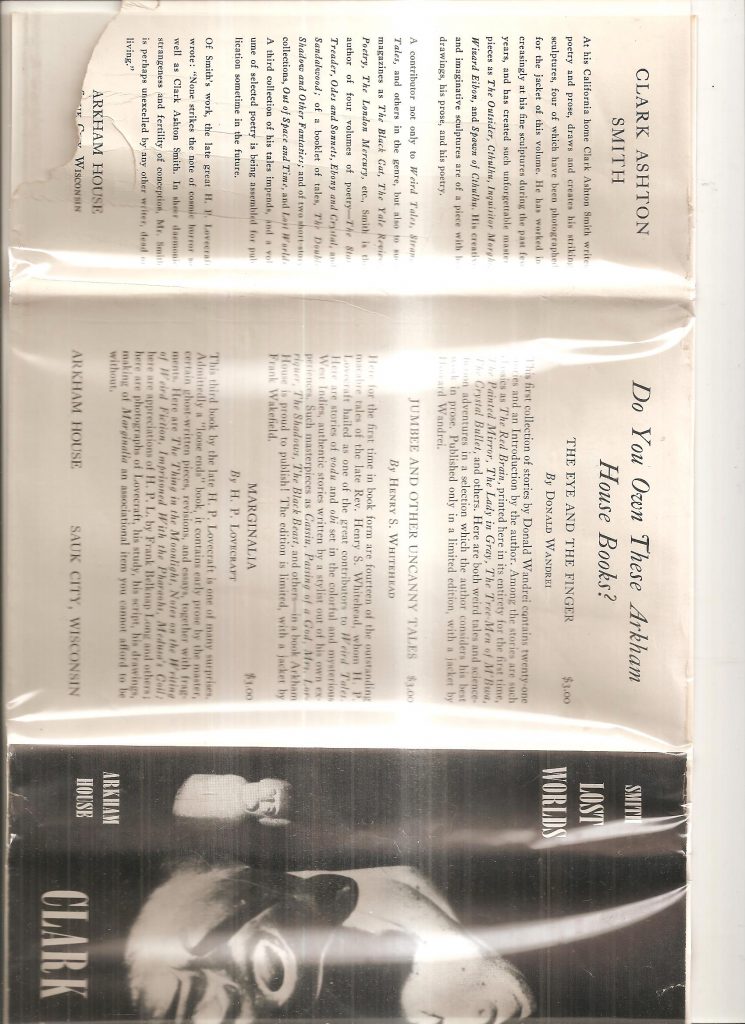
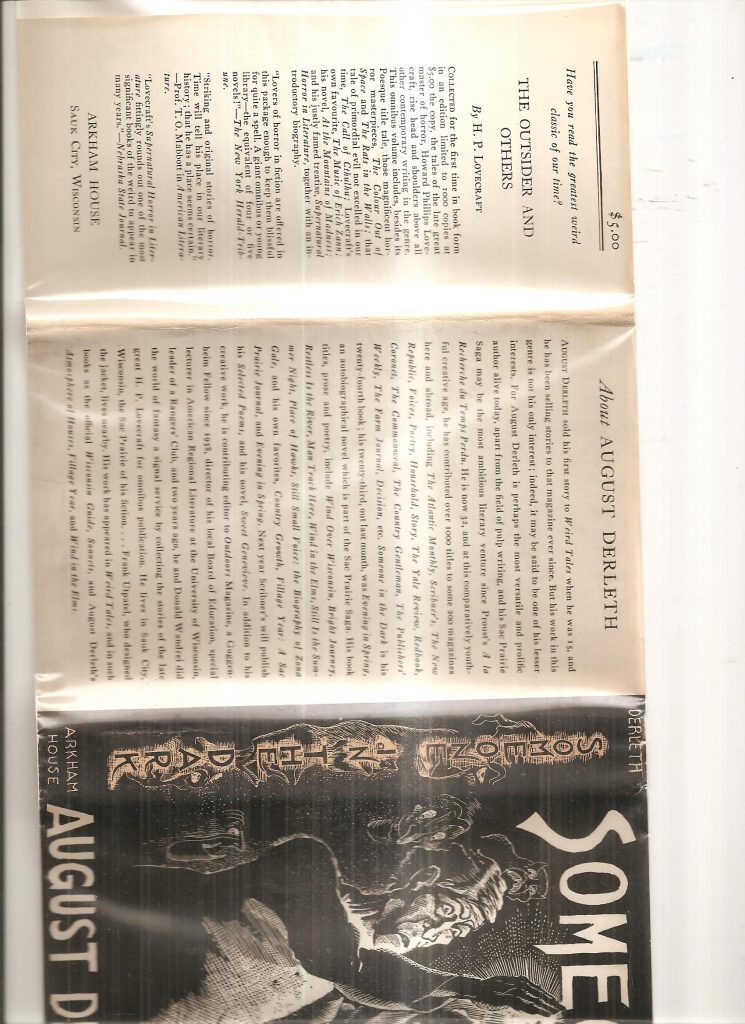
Now he returns with more info I hadn’t heard about — dustjackets on two early Arkham releases printed on white, rather than colored, paper. Clark Ashton Smith’s  Lost Worlds (Arkham no. 7)  and Derleth’s Someone in the Dark (Arkham no. 2).

Dobish reports, “A previous seller of the Lost Worlds Dust Wrapper had described it as being a unique proof. Either/both DWs could be that, or something else.  (And not necessarily the same thing for both DWs).

“The reverse side of each DW is completely blank. The paper stock of each is of a similar ‘reasonable’ thickness (that is, not unduly flimsy).

“I am not certain as to their true nature. However — particularly as there is an example of two different titles rather than just a single title — I strongly suspect that they are trial/test Dust Wrappers of some sort. Perhaps less for color choice, a la the black/blue/green Outsider trial Dust Wrappers, than for higher contrast to better check the quality of the printed art/text.

“I believe that Someone in the Dark  was simply received in place of the usual DW on a copy of the book routinely ordered by an original period customer. Still, absent more information, the possibility that they are ‘counting sheet’ or some similar type of accidental (rather than intentional) pieces can not be entirely ruled out. While I am not aware of any similar examples (either of these or any other titles of the period), that does not mean that any such do (or/and at least did) not exist.”

Got that? The translation is that if you must have each and every possible permutation of every Arkham title, you now need to track down the white-paper dustjackets on Lost Worlds and Someone in the Dark, and keep an eye peeled for any other white-paper jackets on other Arkhams of that bygone era.

I’ve got the first of Lost Worlds, and can tell you that the jacket ought to be on a blue or greenish-blue paper. Age and sunning have had their way with many of these books — Don Wandrei’s The Eye and the Finger (Arkham no. 5) is in a solidly green jacket, but if sunned for years it might register to the eye as more brown than not.

A couple of detail scans included — not the best scans, but they’ll give you the idea.

Posted in Lit | Tagged , , , , , , , , |

Rediscovered: From One Derleth Devotee to Another

And after word got around that Wilum Pugmire took his last breath on the 26th, John D. Haefele sent along the following in memoriam statement:

I was deeply saddened by news of Wilum Pugmire’s death. I never met him in person, but know people who did — an individual whose company they enjoyed, who happily shared the knowledge he’d gained in his chosen literary field. 

For a while — and at the same time — Wilum and I were members of the Esoteric Order of Dagon, the amateur press association devoted to our author-favorite, H. P. Lovecraft — who was his especial interest. I don’t remember that his journals in that venue stood out to me, except that he unabashedly demonstrated admiration for August Derleth — my own especial interest.

Several uneventful years passed. But I did learn something about Wilum’s generosity when out of the blue he sent me a book — gratis  —  I needed to complete a project I was working on.

More years passed, and I found myself completing the first draft of A Look Behind the Derleth Mythos: Origins of the Cthulhu Mythos. It occurred to me that because of his sustained interests, and sudden, emerging status as a weird tale writer, Wilum would be the perfect choice to write an introduction.

I provided the script to him in February 2011 — he answered the same day saying that he was “thrilled and honored” to have been asked, and added unequivocally: “I am a Derleth fan, and I credit him with inspiring me.”

Following the book’s release, Wilum, who in the introduction praises Derleth Mythos thoroughly, was bewildered by the toxic reaction from perhaps his closest friend, the weird tale scholar S. T. Joshi, who wrote that “no one takes him seriously as a critic.” 

I will always treasure Wilum’s subsequent remarks to me about Joshi’s review.

Most importantly, Wilum and I remained friends — and on my bookshelf is The Strange Dark One, which he warmly inscribed:

“To my Derlethian Brother [from] W. H. Pugmire.”

Posted in Lit | Tagged , , , , , |