Hammett: Zobeck Takes on The Hunter and Other Stories

Harper's Bazaar March 1932


And in celebration of Birthday 120 for Hammett, how about the thoughts of a long-time Hammett fan and collector on the most recent collection of his stories?

Ladies and Gentlemen, here’s Terry Zobeck:

Back in October Don reviewed The Hunter and Other Stories, a new collection of previously unpublished or uncollected Hammett stories, for Publisher’s Weekly. He wrote, “I know fans of crime writer Dashiell Hammett who have been waiting decades to read the stories collected in this book.”

Yeah, that would be me, all right.

About 20 years ago a kindly book dealer put me in touch with Bill Pronzini, creator of the Nameless Detective and author of many other books. Over the course of the next couple of years we exchanged several letters. In one he told me that a couple of years previously Jack Adrian, British author and anthologist, had sold Oxford University Press on a Hammett collection to commemorate his centenary that would include uncollected stories and six unpublished ones.

During a visit to Adrian, Bill read three of the stories and found that “one is quite good and the others are worthy of publication.” He added, however, that the project collapsed due to a dispute over ownership of the stories between the Hammett family and Lillian Hellman — there’s a surprise. Most importantly, Bill replied to a question from me that none of the stories featured the Op — hey, even then I had my priorities straight.

I’m sure I knew of these stories before receiving Bill’s information, but I don’t recall quite when it was. But, they certainly have haunted me for years. You may have concluded from my pure text blogs on These Mean Streets that I’m somewhat obsessed with Hammett’s work. Knowing these stories existed but that I couldn’t read them was incredibly annoying. Now, thanks to Rick Layman and Julie Rivett (and Otto Penzler, of course), the wait is over, and it was very much worth it.

The book contains 15 stories not published during Hammett’s lifetime, two previously uncollected stories, three unpublished screen stories, and an unpublished fragment of a Sam Spade story. Layman provides an introduction and commentaries to each section of the book: Crime, Men, Men and Woman, and Screen Stories; and Rivett provides an afterword.

Pulp Fiction-The Villians

Of the former group of stories, three were published in recent years: “Faith” appeared in the Otto Penzler collection, Pulp Fiction: The Villains (2007); “The Cure” (as “So I Shot Him”) in the 2011 Winter/Spring issue of The Strand Magazine; and “An Inch and a Half of Glory” in the June 10 & 17, 2013 issue of The New Yorker. (The editors do not acknowledge the prior publication of this last story; it may have been sold to The New Yorker following printing of the book).

Hammett was no pack rat; very few of his manuscripts survive. However, he thought enough of these stories to carry them along as he changed residences and moved across the country. Some were accepted for publication, but the magazines failed before they could be printed. Others were submitted, but for some reason rejected. Others may never have been submitted.

It’s curious that once he found widespread fame he did not re-submit them. By that time most magazine editors would have jumped at the chance to publish a story by the author of The Maltese Falcon and The Thin Man. Hammett could have extended the impression he was still writing publishable fiction for several years beyond 1934. Perhaps it is further evidence of the extent to which he had become uninterested in the whole game by this point.

None of these stories will make you forget the best of the Continental Op stories, but several are exceptionally good and are worthy additions to Hammett’s bibliography. The standouts include “The Hunter,” a hard-boiled detective story, “The Cure,” a story of psychological suspense, “Faith,” a dark character study, and the boxing story “Monk and Johnny Foxx.” These all show Hammett experimenting to good effect.

The two previously uncollected stories are the outstanding “On the Way,” first published in the March 1932 issue of Harper’s Bazaar, and the far less interesting “The Diamond Wager,” first published in the October 19, 1929 issue of Detective Fiction Weekly.

“On the Way” is among Hammett’s last published fiction; it gives us a hint of where he could have taken his writing had he continued to publish (and in that respect, shares some attributes with the best of the unpublished stories collected here). It is a character study set among the Hollywood crowd that Hammett knew well. Kipper is on the way down the ladder, while Gladys is on the way up. He knows that soon there will be no room in her life for him, so he’s looking for the way out.

“The Diamond Wager” is among Hammett’s most forgettable stories; presumably, he too thought little of it since he published it under the none-too-subtle pseudonym Samuel Dashiell. It is written in the Golden Age style that Hammett did so much to make obsolete; it’s curious, then, why he chose to try his hand at it. Nothing exciting occurs and there is little reason to spend much time with it.

The three screen stories are The Kiss-Off (filmed as City Streets), On the Make (filmed as Mr. Dynamite), and Devil’s Playground (never produced). Of these, On the Make is the most interesting. According to Hammett’s affidavit in his 1948 lawsuit with Warner Bros. over the rights to the Sam Spade character, the story started out as a sequel to The Maltese Falcon. As exhaustively demonstrated by Warners in their response, Hammett’s claim was pretty much hooey.

However, one can imagine that the character of the sleazy private eye in On the Make, Gene Richmond, is what many of the characters in The Maltese Falcon presumed Spade to be, much to their regret. In On the Make, Hammett creates a private eye that is perhaps unique in the genre. He is every bit as corrupt and dishonest as cops and the public often suspect private detectives to be. Gone is the lone detective with his own code of honor pitted against corruption and greed. Richmond wholeheartedly embraces corruption and greed, along with dishonesty and just about every other vice. Gutman would have loved Richmond.

It is an interesting concept fleshed out with strong characters and snappy dialog. I especially liked Richmond’s gal Friday, Miss Crane; she’s no Effie Perine. Unfortunately, the climax is weak and contrived. With a little more effort from Hammett and a stronger cast it could have been a terrific movie.

I was especially pleased to find that the editors included all that remains of Hammett’s attempt at another Sam Spade story, “A Knife Will Cut for Anybody.” I saw this fragment for sale in 1993 at a rare book show in Washington, D.C. (the other highlight of this show was meeting, for the first time, special guest James Crumley). Biblioctopus, the L.A. rare book dealer, had it for sale along with what appeared to be the draft of a section of Tulip, Hammett’s never completed mainstream novel. I was able to read the opening page and had been tantalized by it ever since. The eventual owner made it available to the editors for inclusion in The Hunter. Many thanks to whomever you are.

The last couple of years have been good ones for Hammett fans. We’ve had Otto Penzler’s reprinting of the original text of The Maltese Falcon as it appeared in Black Mask and two volumes of rare Hammett from Layman and Rivett. But it looks like the well may be dry. About the only thing left is to issue the definitive collection of Hammett’s stories — all the stories in their pure text forms, including the serialized versions of the other three novels first published in Black Mask.

It is the stuff dreams are made of.

An Inch and a Half of Glory

Posted in Dash, Film, Lit, News | Tagged , , , , , , , , , , , , , , , , , , , , , , , , , , , , , |

Hammett: Birthday 120

DFW October 19, 1929

One hundred twenty years ago today, May 27, 1894, Samuel Dashiell Hammett eased out onto the Mean Streets, and after awhile slipped on his gumshoes, spent a few years bouncing around as a Pinkerton’s op before another few years knocking out stories like Red Harvest and The Maltese Falcon, and the rest is history — and some mighty good reading.

For a birthday tribute I was thinking about doing my planned essay on Red Harvest, but one thing and another distracted me. (Maybe I can get it done in time for Xmas. . . .)

Which doesn’t mean it isn’t going to be party-time today here at Up and Down These, because our regular Guest Blogger Terry Zobeck has popped in some material to mark the occasion — pictures, reviews, even a final count of Hammett’s literary output. After 120 years, it looks like the numbers are in.

(The pic above of Detective Fiction Weekly from October 19, 1929 comes from Terry’s private collection — this is the issue containing one of Hammett’s worst stories. Most of his product was far superior, or else we wouldn’t be celebrating the birthday.)

Posted in Dash | Tagged , , |

Sinister Cinema: Bogie and The Duke

Got in a note from Terry Zobeck — who has Material of Substance lined up in my in-box, but you can’t always do the Deep Pure Text stuff. Terry has this piece of cinematic history to relate:

All that talk recently on the Mean Streets about the various connections of the film of The Maltese Falcon must have seeped into my subconscious.

A couple of weeks ago I was watching TCM and they had on John Wayne’s Big Jake, one of his pretty awful late period Westerns, a poor retread of the plot of the classic The Searchers.

Wayne’s grandson is kidnapped by a gang led by Richard Boone. Wayne, his sidekick and two sons — played woodenly by his real-life son Patrick and Robert Mitchum’s son Christopher — track down the gang.

The highlights of the film are the two scenes between Wayne and Boone. The final one concerns Boone opening the chest that supposedly contains the ransom money. Wayne tosses the key to the chest to Boone who picks it up and walks over to the chest. He looks down and asks, What’s in it?

The Duke replies: “The stuff that dreams are made of.”

Holy !&#@! I’m only half watching by this point, but this line certainly catches my attention. I give an appreciative chuckle and end up watching the big shoot ’em up.

Lousy film, but it had the class to steal a good line..

Posted in Film | Tagged , , , , , |

Rediscovered: Roger Craig vs. the Riddle of the Bejeweled Statue

Hammett and The Maltese Falcon have become quite the staples on Jeopardy! By no means do I report on each instance — most recent one I thought worth notice was when Hammett and 891 Post actually got mentioned on the show, and from those clews you had to figure out that the detective would have been Sam Spade.

The broadcast for April 11 also deserves a blurb. A tournament-of-champions-from-three -decades-of-the-show deal. One of the contestants: Roger Craig.

I lean toward Craig as my fave Jeopardy! champ ever, because I happened to be watching when he got back-to-back Daily Doubles and both times bet everything — referred to, accurately, as the “ballsiest 60 seconds of Jeopardy!-playing in history.”

All I have to say is that I’d hate to be one of the competitors up against him or Ken Jennings or some other Monster Player.

So, on April 11 you had a category called Historic Objects. The $1600 slot. Revealing a Daily Double.

What’s the bet?

Craig to Trebek: “You know how I like to roll, Alex — true Daily Double.”

Card turns with the statement: Today thought of as a bejeweled statue, it was the Knights of Malta’s annual tribute to the Holy Roman Emperor.

Craig: “What is the Maltese Falcon?”

Posted in Dash, News | Tagged , , , , |

Hammett: Red Harvest Begat the Three Stooges?

You never know what you’re going to find drinking joe/surfing around the net/trying to wake up.

Today I came across a brief review of Hammett’s Red Harvest by Ron Scheer, who usually blogs about Old West stuff — worth checking out because of the lines:

But combine Hammett’s narrative style and the wild excesses of the novel’s storyline, and you have something that goes beyond deadpan to undisguised farce. . . . It’s not the Three Stooges, but you can see them from here.

And none other than our new Guest Blogger Michael S. Chong chips in with a perceptive comment!

Almost woke me right up. Then I slumped back into a vague stupor and stumbled off for more coffee.

Now at least half-awake and thinking about it, kind of a wild appraisal. Reminds me of when Sergio Leone was being hassled by Akira Kurosawa over A Fistful of Dollars which Kurosawa maintained was pirated from Yojimbo, which Kurosawa adapted (unofficially, to be sure) from Red Harvest. Leone said he took the plot from the “mid-1700s Commedia dell’Arte farce A Servant of Two Masters” (quoting myself from page 90 of the tour book).

Hey, there are worse things than being compared to the Three Stooges, but I’m guessing that the mindset of your usual Old West fan tends toward the more serious side of things (in real life, the Old West also gave us Mark Twain and the sardonic Ambrose Bierce, along with humorless gunhawks — though who’s to say that each and every gunhawk was morose?).

Anyway, as I always suggest to Old West guys, if you want a really interesting reading experience, track down the first few western novels written by Eugene Cunningham in the immediate wake of Red Harvest seeing serialization in the pulp Black Mask, where Cunningham also appeared. Riders of the Night, Buckaroo — cascades of Harvest-like violence. Later Cunningham dropped back to more typical action westerns, but the ones done when he was high on the gunsmoke wafting off Hammett’s seminal novel — great reading, if you’re a Hammett fan.

Posted in Dash, Film, Lit | Tagged , , , , , , , , , , , , , , |

Rediscovered: “Say It Simple”

Say it simple 1


And today Michael S. Chong returns, with the third entry in his series of “lost” Willeford bits scattered through the newspapers of North America — this time an item about Willeford’s interest in playing around with big, fancy words (subject of the chapter “Nugatory” — pp97-99 — in my book on the author of Miami Blues).

Here’s Michael:

After enjoying all the Willeford works I could find through used bookstores, I turned to Dennis McMillan Publications and ordered copies of Don Herron’s biography Willeford, the collection Writing and Other Blood Sports, and the existential western The Difference.

Reading the biography Willeford is like spending some time with the man. I have read my share of literary biographies and nothing else has come close to being as intimate and candid as the transcriptions of the tapes Don recorded while visiting the Willefords.

Willeford comes across as a mischievous uncle who would tell you everything straight up, even the dark stuff — and always with a smile.

“Say It Simple” is a John Keasler column found in the Mt. Carmel, Illinois Daily Republican-Register on Friday, January 4, 1980 which depicts the teaching side of Charles Willeford from his days with the English department of Miami-Dade Community College. Using clichés made incoherent with big words, Willeford shows his students that simple sentences are better.

say it simple 2

Posted in DMac, Willeford | Tagged , |

Tour: And Add One for Sunday June 22

don8

A guy hauling in from New Zealand popped me a note today to ask for a walk on Sunday June 22 — TWO months advance notice (excellent), a long ride in — why not?

Add that date to the schedule, and anyone interested in showing up is welcome to join in.

$20 per.

Four hours, or slightly longer.

Meet at noon.

In other words, the usual.

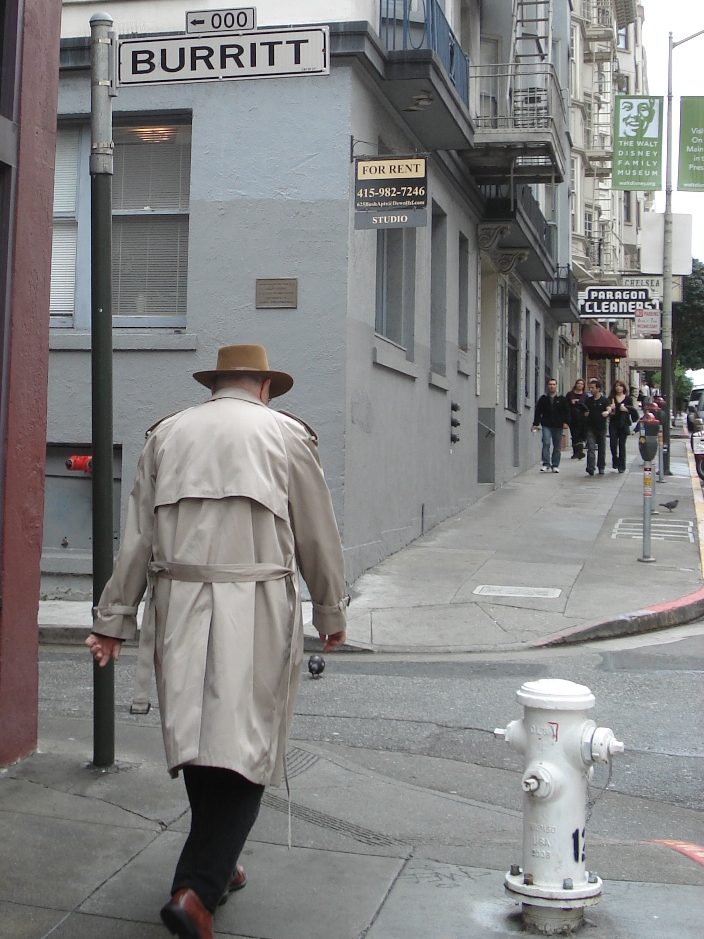
(Photo this time: tour with the windows of the Sam Spade apartment on top floor, directly above the fedora. . . .)

Posted in Tour | Tagged |

Sinister Cinema: You’re Making the Movie Anyway?

After John Ridley won an Oscar a few weeks ago, I happened to surf into a post covering his activities — lured in by a tagline about a “feud” he had or was having with 12 Years a Slave director Steve McQueen. Whatever. Didn’t seem to amount to much.

But the piece mentioned his movie about Jimi Hendrix, with André 3000 as the Master of the Stratocaster. I’d noticed a blurb about this project months ago, without digging deep enough into the copy to see that Ridley was connected, much less the screenwriter and — at least now — the director.

Interesting.

Then I got to the part about how the Hendrix estate isn’t allowing a single note of his library to ring out in the film. Which is the reason a couple of previous biopics, blurbed in the article, were set aside.

Yeah. That’s what I’d do, too. Why bother? 3000 could well be excellent as Jimi sitting in a diner or hanging at a party, but people are going to be ticked off when the music plays and it isn’t the music played.

In the grand scheme of things, it doesn’t matter to me — I wouldn’t have seen it, anyway, likely as not. I’ve seen Jerry Lee Lewis in concert more times than anyone except my buddy R. J. Mischo, but had no interest in seeing the Dennis Quaid film. Why? I’ve seen the Killer.

I did catch The Doors at some point, thought it did a great job (as far as I know anything about it) capturing the people and times — and the music. They got to use the music.

Without that okay, you might as well not try to do the actual person — fall back on a thinly-veiled fictional version like the Coens did for Dave Van Ronk with Inside Llewyn Davis. At least then people won’t be waiting, and waiting, for “Teddy Bears’ Picnic” or some staple from Jimi’s catalog circa 1966.

I’m curious to see how this one will do. Yeah, I expect it to bomb, but maybe it’ll surprise me. Could be an art-house-level hit, I suppose.

And if it snags an Oscar next year, well, it’ll be another contender I haven’t seen, per norm.

Posted in Film, News | Tagged , , , , , , , , , , , |

Tour: Three Sundays in May and June

don12

Pic: leaning on the parapet atop the Stockton tunnel.

Various people asked for some walks, giving me more than a month advance notice, so mark your calendars for Sunday May 11, Sunday May 25 or Sunday June 1 if you’d like to show up and join in. No reservations required, or taken.

You need at least 4 hours free. And $20.

Noon start near the n.w. corner of the Main Library in San Francisco.

As simple as that.

Posted in Tour | Tagged , |

Rediscovered: Eddie Little

Little

In May of last year Joseph Hirsch dropped me a note which mentioned, “I’m on the hunt right now for good literature by ex-cons. Not sure if you’ve heard of Eddie Little, but he was one of a small group of hardcore criminals who could really write.”

Not only had I heard of Eddie, but I got to meet him a few months before his death. I told Joe, hey, if you want to do something on him, just send it in. Eddie Little is about as perfect a writer to spotlight on Up and Down These Mean Streets as you can get.

And here is Joseph Hirsch, on his discovery of Eddie Little:


I have been fortunate in my short literary career to correspond with several talented writers, one of whom is John Sheppard, the author of the underground classic Small-Town Punk. Sheppard has turned me on to several writers with whom I was previously unfamiliar, like Charles Portis and Harry Crews. I have returned the favor to the extent that I can, recommending neglected authors such as Floyd Salas or Iain Levison.

Two of the books I gave John, Education of a Felon and Steel Toes, were written respectively by Edward Bunker and Eddie Little. Both men belonged to a select group of authors who excelled in both crime and in writing, unlike say, James Ellroy or Elmore Leonard, who had to rely more on imagination than experience when it came to telling their tales.

Both Bunker and Little were involved in robberies and the drug world, and both men did time, but this is where the similarities end. Bunker is (or was) emotionally a block of ice, similar in the affectless tone of his writing to someone like William Burroughs, or Bret Easton Ellison at his coldest. He can describe a fight with razorblades, a strong-arm robbery, or even the murder of a child with chilling dispassion. Eddie Little, on the other hand, was a raw nerve, more prone to mining the immediacy inherent in the present tense. His was the sentence fragment-laden prose of a man who must scream or go mad.

I remember the exhilarating and terrifying feeling that his second (and last) novel Steel Toes evoked in me the first time I read it. One passage in particular struck me as so strong that I underlined it. The scene concerns a racial conflict between the “Peckerwoods” and a gang of young black cons that has erupted in an Indiana prison:

As we roll into the gym, warmth and the smell of sweat hit me like a wall that is overlaid now by the rank odor of fear and adrenaline.

And the madness that we have worked so hard to create or that we are forced into.

Or that just appears like black magic, like we’re all voodoo dolls waiting to get stuck. Whatever causes the madness between races and religions in countries and neighborhoods.

The one thing I know is that everyone of us there is trapped by a tangible force that you can feel like the bass coming out of the hugest speakers ever made, rattling through your bones and shaking your soul, setting up its own rhythm that is going to make you dance.

If you got two left feet. If you’re on crutches. If you’re in a wheelchair. It doesn’t matter.

You’re going to dance. Like Nureyev, like Bojangles, like Gene Kelly, like Fred Astaire.

You’re going to dance, motherfucker, because your life depends on it.

There are other differences between Edward Bunker and Eddie Little. Little, as the previous quote shows, grew up in the post-MLK assassination milieu of America’s prisons, where he regrettably found that his skin was his uniform, and like it or not, his options were quickly narrowed down to becoming either a victim or a “peckerwood,” which in his argot meant a white male willing to fight and stand his ground on the inside of the rock walls, even if death were the price for his stubbornness.

In both Mr. Blue and Education of a Felon, Edward Bunker describes sticking up for a black inmate because he admired the man’s character. He also notes that such an act in the late 1960s would have been akin to a Hutu taking the side of a Tutsi. Judging a man by the content of his character rather than the color of his skin was by that time, at least in prison, something completely unthinkable.

Drugs were another generational gulf between Bunker’s era and Eddie’s. When Bunker embarked on his criminal career the “-land” suffix was still appended to the “Hollywood-” sign nestled comfortably in L.A.’s hills, and the mafia had not yet leaped with both feet into the heroin trade. To paraphrase the notorious Austrialian criminal Chopper Reid, drugs had not completely destroyed the criminal world when Bunker was an outlaw.

Heroin was in Edward Bunker’s orbit, but it was at the center of Eddie Little’s universe, and in the end dope took his life. “I’ve done time before for offenses ranging from robbery to mayhem,” Little once said. “That was before my career as a writer. This round I’m in because of a regular, aggravating character flaw of mine. Despite a book contract, a movie deal and a sweet girlfriend, I couldn’t stay off mama heroin. Even though I had been off the junk. So here I am, hooked like a laboratory monkey and kicking like a dog, trying to accept the fact that I fucked up.”

Eddie Little died in May of 2003, “of a heart attack in a Los Angeles motel room,” at the age of forty-eight, according to his obituary. And while the world at large may be indifferent to the man’s memory, I’m not and I’d like to think that some other fans of the his work are out there, wondering if there isn’t more to his story, or quite possibly even an unpublished manuscript.

Little showed exponential growth from the writing of his first novel, Another Day in Paradise, to the penning of his follow-up, Steel Toes. Had he lived, I have no doubt that he would have continued to hone his skillset further, and that he would have produced a third book several orders of magnitude better than everything that came before. The successful adaptation of Paradise into a Larry Clark film starring James Woods and Melanie Griffith also makes me think he might have had another career waiting for him in Hollywood.

Few writers possessed his experience, his ear for realistic dialogue, or the descriptive powers he marshalled when writing about the underworld. His short fiction is a must for fans of gritty, lived-in accounts of the criminal world.

In the best of several articles Little wrote for L.A. Weekly, titled How to Rob a Drug Dealer, Eddie describes spending a lazy afternoon in the barrio with a man who makes his living robbing drug dealers:

I size up homeboy as he flips the carne. He’s got fine features, green eyes — could be of Spanish or Cuban descent, even Scot or Irish as long as you throw in some Latino cut. He’s put together like a boxer. Healthy without having the bulk you get from weights. A regular matinee idol except for the ink all over his face and neck — original L.A. tribal.

Andrew’s house is very much home sweet home, with the yard full of women and kids wearing bright colors; the men taking hits of cold cervezas and wine coolers; the smell of pot hanging sweet and heavy in the air, mixing with the aroma of barbecue

A heroin addict as a youth, he’s put that behind him for now. He kicked the habit on his own, because he sees 12 steps or any kind of program as a cop-out for the weak. “Sitting in a room of sniveling motherfuckers ain’t for me.”

But there’s something out of place in this scene of contentment, and it’s not just the 9mm stuck in Andrew’s belt, nor the rottweilers circling the yard silently. I narrow it down to Andrew’s eyes. They’re beyond watchful. It’s like he’s always appraising everything around him, always waiting.

That makes sense. Even when he doesn’t have cops to worry about, there’s always the chance, at any given moment, that some burned drug dealer with no sense of humor is going to settle the score for good.

The penalty for hitting a big-time slinger of hard drugs is death — obviously — and not by lethal injection or some other relatively humane method. Nope. It’s got to be bad enough to send a message.

“Anything you care about makes you weak,” says Andrew. “So I don’t care too much — I don’t let myself. That don’t mean I don’t love my old lady and kids. But I wake up every day knowing it’s like my last. Like I’m a dead guy already, and I just got one bonus day with my family.” This guy has learned to live in the present — without any help from a Beverly Hills shrink.

Andrew is once again playing cops and robbers with his boys, going down in a hail of play gunfire, and I’m wondering how long he has until it happens for real. No more magic resurrections. No starting the game over.

I ask him what he thinks his chances are of living to 40. He points a cocked finger at me and says, “None.” He punctuates his last statement with a whispered, “Pow. Gotcha.”

The carne is delicious, the tortillas fresh, the company pleasant. The oldies keep playing, and life is great.

Both Another Day in Paradise and Steel Toes are littered with references to Rosie, a young girl who Bobby Prine loved, a girl who died of an overdose in the midst of a crime spree, a girl who no doubt had her own counterpart in real-life, as assuredly as Bobby Prine was Eddie Little’s alter-ego. Hopefully, if there is an afterlife, they have been reunited there.

He was once a fatalist and a romantic, and it was perhaps impossible that things could have ended any other way for Eddie Little. That said, I see no reason why his memory should die with him. All eulogies aside, the man was frankly too good (and too rare) a writer to be forgotten.

I’ve done what snooping I can on the internet, searching out people who might have known Little or could potentially have additional info or leads into any extra literary works he may have left behind. So far my search has not turned up many auspicious leads. In a “Fresh Air” interview with Terry Gross, Eddie Little mentioned that he was running “We Care,” visiting AIDS patients in LA and the surrounding area.

Wikipedia has been of very little help, noting thatEddie Little was born on August 25, 1955,” and that “Little else is known about his early life.”

His obituary contains some biographical information about Little, specifically the means by which he developed an interest in the written word: “[H]is father, a schoolteacher, taught him to read by twisting his arms behind his back and squeezing tighter if he mispronounced a word. After that, Little said, he became a compulsive reader and writer.”

“He started sniffing glue at 10, ran away from home at 12, got arrested the first time at 15 and started his first novel 20 years later while he was serving yet another prison term.

“He spent most of his adult life on probation or in prison, convicted of phone fraud, robbery, assault and drug possession, among other crimes…”

And that, unfortunately, is about all I could find, aside from a passing mention of a woman who was a “longtime friend,” with whom he had a child and also operated “We Care.” I hesitate to mention her name out of respect to both her and the deceased, but if she is interested in providing any additional details about Eddie or his writing, and she happens to be reading this article, please email me at joehirs123@aol.com

Eddie is cold in the ground, and his works are on the verge of being forgotten by the masses.

Don’t let it happen.

If you haven’t read Little before, go for the L.A. Weekly articles. Start here: http://www.laweekly.com/authors/eddie-little/

Then when you get finished with that, take a trip with Mel & Syd and their two adopted junky surrogate children, in Another Day in Paradise and then in Steel Toes.

If after that you’re still hungering for more, then you may have to do some heavy lifting on your own. And if you do manage to unearth some as-yet unpublished gem, then please drop me a line. I’d love to read whatever you find.

Posted in Lit | Tagged , , , , , , , , |