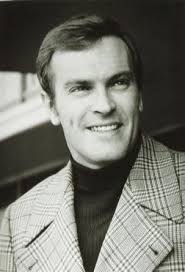
The handsome devil above is Don Chastain, and the mere mention of his name sent Brian Leno off into a web of connections — no doubt prompted by all his ongoing work on the boxing scene known to Texas writer Robert E. Howard, covering pugilists such as Kid Dula, a.k.a. Cowboy Dula. The news is that Brian almost has slugged his way through a complete first draft.
Brian’s a pretty clean writer. A first draft isn’t that far away from a final draft.
Don was the son of Clyde Chastain, a tough boxer who took on Cowboy Dula at least twice.
Chastain, in a bloody fight in November of 1930 took a decision from Dula. The Cowboy beat Chastain, also by decision, in May 1932.
Chastain was a pretty good fighter. Fought some big names in South Africa and for a time was managed by “Pa” Stribling, father of Young Stribling, who was a heck of a fighter and was tragically killed in an motorcycle accident.
I cover this stuff in my book, which will be finished (first draft) as soon as my current computer troubles are fixed.
Robert E. Howard saw Chastain fight, and he mentions in a letter to Lovecraft that he traveled to Fort Worth and saw Chastain take on Jack Doss — Doss shows up in REH’s autobiographical Post Oaks and Sand Roughs as the boxer Jack Goss. (Glenn Lord says it’s so and of course he’s right.)
Back to Clyde’s son. Don was nominated for an Emmy for a Gunsmoke episode — superior entry in the series too. He was in Fathom, which starred Raquel Welch. What a lucky guy!
Another memory after I moved to New York and got a job in the box office of a theatre downtown:
After a show at the Astor Place Playhouse, I would occasionally grab a bite at the Italian restaurant next door. One night standing at the bar was a man who looked quite a lot like Joe Memoli. I couldn’t believe my eyes. I approached him and introduced myself.
When I mentioned Joe’s name, he literally spat. “That fucking prick!” he exclaimed. “Imagine getting sent up for something as stupid as counterfeiting!” He dismissed me with a look of contempt that I should admit to knowing him.
Later I asked the bartender who the guy was. “Larry Gallo” was the answer. He was a distant cousin of Joe’s, and brother to another Joe, Crazy Joe Gallo, who would be murdered ten years later at Umberto’s Clam House in Little Italy.
Also I received a clipping from, I believe, Life Magazine with a picture of Memoli attempting to rob the San Francisco-Oakland helicopter office. I never found out if he went back to jail.
I’m surprised Memoli didn’t appear to get an obit in the Oakland Tribune.
Just got in the following memoirs from Larry Belling. Per norm with this sort of thing (or the net in general, I guess), I don’t know if the following is some of the truth, the whole truth — or something else entirely. There’s some autobiographical sprawl, but it’s heavy enough on mentions of Joe Memoli to pique interest. (I’m thinking, maybe Floyd ought to have taken Memoli up on the proposal to write his biography.)
“My dad fixed Joe Memoli’s radio and TV sets,” Larry said by way of preface, “and he took great interest in me and my work in the theatre. This is from my diary”:
One Saturday, when my father Les was in the back visiting the bathroom, (sitting on the throne, he called it), a large black car pulled up in front of the shop and a man got out. He was dressed in a black suit with a black shirt and a white tie. He wore a black fedora with a green feather in it. His eyes were dark holes and he had no upper lip. Having just seen Edward G. Robinson in “Public Enemy” I knew immediately that this guy must be some kind of gangster, and it was thrilling.
He opened the trunk of his car and took out a large table top model Zenith radio. I rushed out to help him and held open the door to the shop. “Thanks, kid,” he said plopping the radio on Les’s workbench. Les came out of the bathroom. “Oh, hello Joe, what seems to be the trouble.”
“It just doesn’t work,” said Joe Memoli, who I would learn was an Oakland restaurateur with an Italian joint downtown, and close relatives in the New York families.
Les plugged the radio in an electricity socket. “It smells funny,” he said, “but it’s not an electrical smell. Let’s open her up.” He fiddled with his screwdriver and loosened the back panel. “Whew! What a smell!” he exclaimed. As the back panel came off, a dead rat fell to the floor.
I can hear Joe’s whoop of laughter to this day. “No wonder the damned thing didn’t work,” he exclaimed. “Fix it up, Les and come to dinner at Memoli’s — everything on the house.” He flipped me a quarter and was gone.
Memoli’s was a typical spaghetti-and-meatballs-looking joint in downtown Oakland on Broadway at Eighth Street opposite the Simon Hardware store. The tablecloths were checkered red and white, a green, white and red Italian flag hung limply outside, and delicious smells of meatballs and spaghetti sauce wafted down the street.
Specialties of the house were veal and eggplant parmigiana, spaghetti with various sauces, lasagna, baked ziti, meatballs in red sauce, and Italian sausages. These were taste thrills we didn’t get at home and I was instantly hooked. I took an interest in how the dishes were prepared and Joe took a liking to me. The feeling was mutual. He showed me how he half cooked spaghetti so that he could serve it quickly al dente after it was ordered, unlike most joints that kept it on the boil. He let me grate the fresh parmesan — no pre-grated stuff for Joe.
On the walls were framed pictures including one in an impressive prime position — Joe with Frank Sinatra! Wow. Also Joe with some nasty looking wide-shouldered men; Joe with some nasty looking Italian politicians; Joe in a big chef’s hat with Dean Martin and some other nasty looking men; and Joe with a few nasty looking fat opera singers I didn’t recognize. The music of choice was Italian opera — Verdi, Puccini, Rossini.
The Belling family went to Memoli’s infrequently — maybe once a year, but every time we did he insisted the food was free and he made me feel as if I were his special friend and never failed to give me a shot of sweet Italian anisette liquor. A few years later I was to be seen there frequently, sometimes when I didn’t even know it.
After Cal Berkeley Memoli came into my life when I got involved with producing a play in San Francisco. I later wrote:
I approached Joe Memoli and he was extremely interested in my ideas of a musical repertory theater in San Francisco. He indicated that he would be coming into some serious money in the near future and that I should pursue it. He sent his attorney, Preston Erickson, to have a look at it (and bless the deal), and Don and Anne, his friends who developed the Cannery (without giving me credit) had a look as well. I started talking to Art Conrad and other talents I had worked with on “Out of Order” about the idea and they were keen as could be, of course. Wow! A repertory musical theater. Great! I paid Joe back his investment in about eight weeks and he was thrilled. “Hey, let’s find another one,” he said magnanimously.
I bussed across the bridge often to schmooze Memoli about the project, and he told me he wouldn’t be ready to think about finance for some months in the future. So I needed an interim job — or a project. I was invited to co-produce a show in L.A. and so:
“Out of Order” lasted for about four months, almost every performance sold out. It had to close as a number of the performers had other engagements and it was not so profitable that it was worth recasting. Also the theater lessees, Tom Sternberg (later to be a movie producer with Francis Ford Coppola) and his partner were demanding hugely increased rents. In the last week, John Storace did a runner (he wanted more pay!) and I had to don a whole lot of padding to take over his roles, including Big Daddy in the Tennessee Williams sketch.
One night a semi-sleazy Hollywood promoter/agent type named Hal Martin saw the show and asked to see Barry and me. He was co-producing a musical revue in Hollywood and was looking for investment partners. The show was “Parade,” Jerry Herman’s first show, which had a 95-performance run a year previously at the Players Theater in New York with Dody Goodman and Charles Nelson Reilly.
The original producer was Larry Kasha, a former stage manager, (“L’I Abner”) who would be directing this production. Joe, Barry and I went down to LA to meet him and Hal Martin and discuss the show. The cast had been set, and quite a stellar one it was. Carole Cook, Michelle Lee, Don Chastain, Tucker Smith and Lee Goodman, all solid musical performers with regular if not starring film and television careers. The theater was the Hollywood Center Theater, a rather sleazy, run down 500 seater on Santa Monica Blvd. in Hollywood.
On our arrival in LA, Joe and I, without Barry, went to dinner at the famed Barney’s Beanery, in those days a grubby thin long room with wooden booths, checked linoleum tablecloths, and a huge inventory of beers from around the world. Joe had an altercation with another patron. Some pushing ensued, and I watched in horror as Joe let loose with a right cross which decked the guy. He got up. Joe’s uppercut floored him for the count. Joe threw some notes on the table and dragged me out before the cops could arrive. It was the closest I’d ever been to a fist fight. Joe was proud of his achievement. I was somewhat horrified.
Joe agreed to put in the required finance for the show and I signed on as stage manager. I got Dave Colyer to join me and we split duties on lights, sound and stage management. Dave and I took a small apartment at the somewhat sleazy Hollywood Center Motel next to the theater.
The show closed with a total loss of Joe’s money. He was most gracious about it. “Hey, we had a big hit with ‘Out of Order,'” he said. “Let’s remember that one!”
Back in San Francisco, I took a small apartment out near the Mint on Market Street. It was a typical San Francisco craftsman-type apartment with wood everywhere and little warmth, but it was great to be on my own. I hustled up a few jobs in clubs and small theaters. I tried unsuccessfully to get work at the Hungry I, the famous San Francisco nightspot, but I did manage to get in to see Mort Sahl, Nichols and May and Woody Allen.
During this time I actually ran the lights and follow spots in a strip club on Broadway where the women were big, bored, blonde and Scandinavian and the drunks plentiful and smelly.
I found myself getting on buses rather frequently and crossing the Bay Bridge headed towards Jack London Square and Joe Memoli’s restaurant. Joe had a regular cast of Oakland characters in the joint most nights. He wouldn’t listen when I volunteered to help out in the kitchen. “You’re in the theater now,” he said, as if that was some sort of elevated position that precluded getting one’s hands dirty
I’d help myself to a bite from the kitchen. Joe would ply me with anisette liquor. We’d smoke, putting out our cigarettes in the Golden Gate Casino ashtrays he had on every table.
One night, none of the regular guys were in the upstairs part of the restaurant. I was told they were downstairs in the basement and I trotted down to find out what was going on. Joe seemed a little surprised when I came into the low-ceilinged long room. There were six or seven men, most of whom I knew by sight, gathered around a table in the center, and they were playing with bits of paper. On closer observation I noticed that dollar bills had been bleached out so they were almost white.
“Hey, there’s a great idea,” I yelped. “Bleach out dollar bills and print $100s on top of them.” Nobody laughed. “You’re a riot, kid,” said one of them named Smitty, dryly.
One evening a few months later I had returned to my apartment near the Mint. There were three Oakland policemen awaiting me, and I was requested to take a short journey in their police car. They wouldn’t tell me what it was about, nor would they listen to my pleas of exhaustion. We drove over the Bay Bridge to Oakland in silence.
After a short wait at the Oakland police station a detective questioned me: “Why were you at Joe Memoli’s restaurant 21 times in the past three months?”
“Gosh was I?” said I. “It didn’t seem that often. I was visiting my friend Joe and” (I fibbed) “helping out in the kitchen.” (I didn’t want to tell them I was not permitted to cook and I didn’t think talking about a musical repertory theatre at the old Globe Chinese Theater would interest them.) “Why?”
“We’ve just arrested him as the leader of the biggest counterfeit ring ever broken in the State of California.” My mind flashed to those bleached out dollar bills, and Smitty’s acerbic reaction to my suggestion about printing $100s on them. In fact, that’s not what they were doing. They were printing $20s on stolen paper stock and aging them in washing machines at the laundry of Alameda County College. Police also recovered hundreds of fake $1 gold pieces — replicas of those which commemorated the 1904-05 Lewis and Clark Exposition at Portland, Oregon. They had been coined in Mexico.
Needless to say, I was sent home that night as my honest face required no polygraph. The fact that Memoli’s had been staked out for the previous five months was rather a shock! Did he really intend to finance our theater with counterfeit money?
Joe got four years at San Quentin where he was assigned to the laundry room, rather than to the kitchen where he would have been much more appropriate.
Noted book and pulp collector Kevin Cook is back to show off another signed item from his shelves, to spotlight another of his favorite writers.
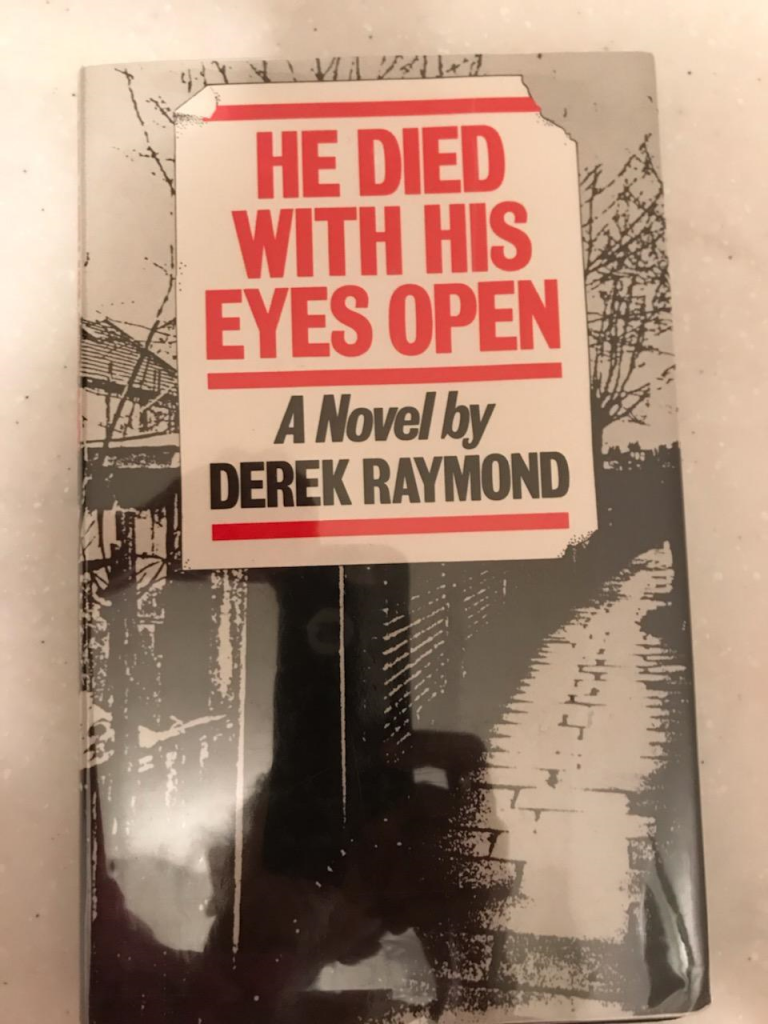
“Perhaps someone will be intrigued enough,” Kevin says, “to give Derek Raymond a try. It would certainly be worth their time. After Nisbet told me about Raymond at NoirCon I found a paperback edition of He Died with His Eyes Open and fairly inexpensive copies of the hardcover first editions of the next four novels in the series.
“Couldn’t locate any hardcover copies of that first book for a few years, though.
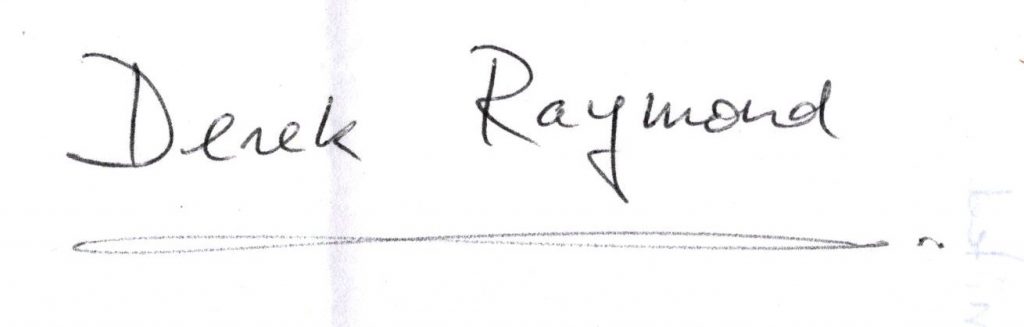
“Then one day scrolling through book listings on the internet I found a British dealer selling the book for ten pounds. It was a mint, unread, signed copy, and he obviously had no idea what the book was or who Raymond was. I bought it in a heartbeat of course.”
Jim Nisbet has pushed Raymond for years. My memory is that he knew him personally, which puts Nisbet one degree of separation from the notorious Kray Brothers — again, if memory serves, the Brit noir writer rubbed elbows with the Krays and lived in the same underworld.
Here’s Kevin with a formal statement:
Every time you read an essay, article or biography of Dashiell Hammett a paraphrase of the following statement will appear: Hammett had the perfect background for writing detective/crime fiction because he had previously been a Pinkerton’s Detective.
What about the polar opposite of being a detective? Could a man with a criminal background also be a perfect choice to write crime fiction?
Enter Derek Raymond.
Born on this date in 1931 as Robert William Arthur Cook and known to his friends as Robin, Raymond rebelled against his privileged birth as a member of the British upper class and became a con man. After one con too many he had to leave the UK and ended up living in France.
He had previously published books as Robin Cook, but now hid his identity behind the name Derek Raymond.
His autograph is from the first Raymond book, He Died with His Eyes Open (Martin Secker & Warburg Limited, 1984). That volume is also the first book of his acclaimed Factory Series where Raymond’s unnamed police officer works in the Bureau of Unexplained Deaths.
Jim Nisbet, a noted noir author himself, has stated that Raymond was the world’s finest noir writer. He was speaking about pure noir: misery, corruption, hopelessness and death.
The greatest critical acclaim goes to the fourth book of the Factory series, I Was Dora Suarez, It would be a simplified analysis to describe this book as the British equivalent of Laura, the police officer falling in love with the dead murder victim, because Raymond’s vision is much darker than Vera Caspery’s, and there is no happy ending.
Those last words are not really a spoiler because anyone who had already read the first three Factory novels would not expect the tone of black despair to change.
Eighty-four years ago today, at his final age of 30, pulp writer Robert E. Howard shot himself in the head outside his home in Cross Plains, Texas.
To commemorate the somber anniversary we bring in lifelong REH fan Brian Leno. Part convention report, part book report, part REH history and all Texas history, Brian’s got a tale to tell you. In honor of Two-Gun Bob.
Here’s Brian:
It was raining hard in Cisco during the Summer of 2009 when my three road companions and I booked rooms in one of the local motels. The rooms were only necessary for sleeping, because we were planning on spending most of our time 23 miles away in Cross Plains.
Festivities were in full swing honoring Robert E. Howard that weekend in Cross Plains — the weekend closest to the date he killed himself. I had been twice before to view Howard’s home, once in 1967, and the last time in 2007.
This one was special however. One of my traveling companions was Donald Sidney-Fryer, an expert on the poetry of Clark Ashton Smith, Howard, and many others.
A high point came when we rescued DSF from participating in a mind-numbing reading — by rank amateurs — of Howard’s verse. Known as the Poetry Throwdown, this sophomoric event sometimes even degenerated into these would-be poets reciting their own lackluster rhymes.
We hustled Donald back to the Cisco motel and the night was spent drinking beer and listening to an actual poet recite bits of Howard’s and Clark Ashton Smith’s poetry. An intellectual acrobat, DSF kept the interest alive with many excursions into the realms of writing, including comments on J. D. Salinger, pulp verse — he even dipped a toe into tales of a book he was writing on the history of ballet.
It was good times.
What wasn’t such good times, however, and something I didn’t know much about, was a bank robbery that had occurred in the little town of Cisco on December 23, 1927, over 80 years earlier.
The so-called Santa Claus Bank Robbery was a story I had heard about, of course, but the Kris Kringle business had conjured up images of a gang comprised of members of Monty Python’s Flying Circus and the Bowery Boys.
I couldn’t have been more wrong.
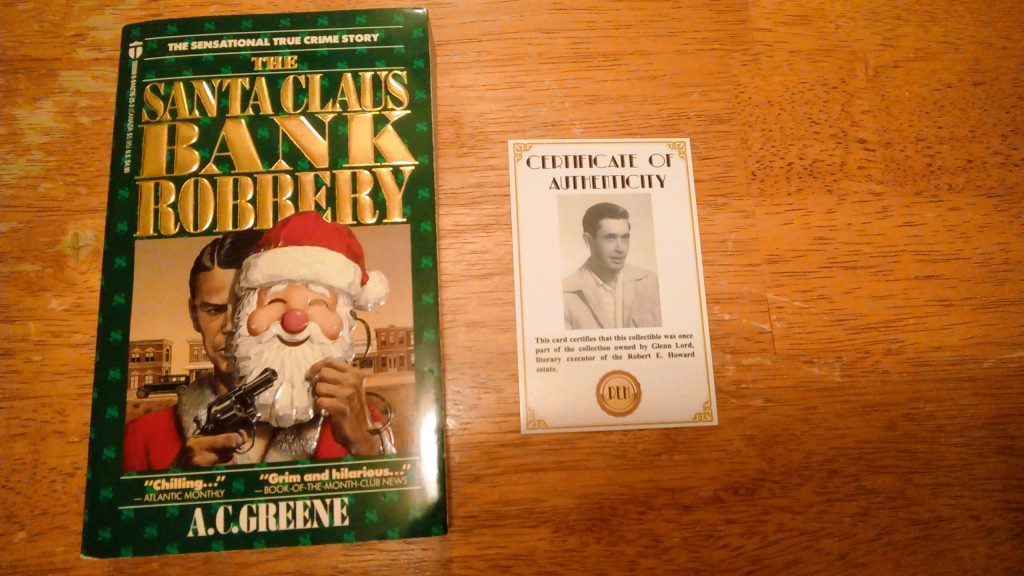
Recently I was fortunate enough to purchase The Santa Claus Bank Robbery (Tudor 1988), by A. C. Greene. This copy once belonged to the late Glenn Lord, for many years the literary agent for the Howard estate, so out of respect for this greatest Robert E. Howard scholar, I cracked it open and began to read.
It was a book that really was too good to put down, and that is a rarity. Once finished, hard to forget.
There were four bank robbers who stepped into the First National Bank in Cisco on December 23, 1927. Henry Helms, who ended up getting the electric chair. Louis Davis, who died during the intense manhunt following the robbery. Robert Hill, who was paroled eventually and lived the rest of his life under a different name.
The fourth member of the gang, Marshall Ratliff, was the only one of the robbers known by sight to the Cisco townspeople.
A woman named Midge Tellet, a friend to the robbers, was making a suit for her husband who was going to dress as Santa Claus for Christmas that year, and Marshall Ratliff borrowed it. Red coat, no pants, but she had a Santa hat and fake beard.
Ratliff apparently felt a jolly Santa getup would keep him from being recognized — and not draw too much attention.
Just not-thinking-it-through of the highest order.
Ratliff told his buddies to drop him off a few blocks before the bank.
By the time Ratliff got to the First National he had a mob of screeching kids tugging on his Santa coat, wanting to know if he had received their letters. Was he bringing them what they had asked for? Would he buy them some ice cream?
Ratliff probably figured taking the bank would be easier than getting the damn brats off his back.
He was wrong.
If you read the book, it appears that everything that could go haywire during the robbery did, including the fact that the crooks forgot to fill the getaway car with gas — and it was running on empty.
Anyway, Bad Santa Claus ended up in a jail cell in Eastland, just a few miles distant from Cisco. There Ratliff started acting like he was crazy, hoping to escape the electric chair.
But Ratliff soon found a chance for a jailbreak and ended up shooting Tom Jones, one of his jailers. The escape attempt failed.
A mob formed. After subduing the lone jailer left standing, they started climbing the stairway to Ratliff’s cell, laughing and yelling “Come on out, Santa Claus, we’re coming to get you!”
Greene’s writing, always decent throughout his book, takes on new life here, and it’s undoubtedly one of the most harrowing and terrifying passages I’ve read in many years. After showing Ratliff a knife and threatening to feed him his own testicles for lunch, they burst into his cell, tearing his clothes off and dragging him down the stairway, laughing as his nakedness on full display for the sizable group of ladies that made up part of the mob.
They beat the hell out of him.
The first attempt to hang Ratliff failed. His body hit the ground with an audible thud.
But the second try, with a group of people grabbing the rope to pull Ratliff off his feet into the air, succeeded. Ratliff’s strangling body gave up the ghost.
His corpse was left to sway in the breeze — like a ghastly made-to-order scarecrow, to frighten would-be robbers away.
All of this happened within a short drive of Robert E. Howard. In a famous July 13, 1932 letter to H. P. Lovecraft, Howard goes into hyperbolic overdrive and describes that after a wild night of drinking with his pals, he was asked to join the “man-hunt” but refused, stating “we were in no shape to even lift a gun to our shoulders, much less confront a band of desperate outlaws.”
I have trouble believing that Howard wouldn’t have joined a posse if asked.
But after reading Greene’s book I’m glad he didn’t.
I’m really happy that the Texas writer was not part of the mob that hanged Ratliff, because there is a bit of mob mentality in all of us, and we can sympathize — even if just a little — with Ratliff, because if times get desperate enough who knows what any of us might be capable of doing.
Some might fear to spot woodpulp fiction mags in one of the most beloved — and prestigious — movies of all time. Oscar winner for Best Picture. Best Director. Among others.
He spots a pulp, he reports a pulp — and he tells it like it is:
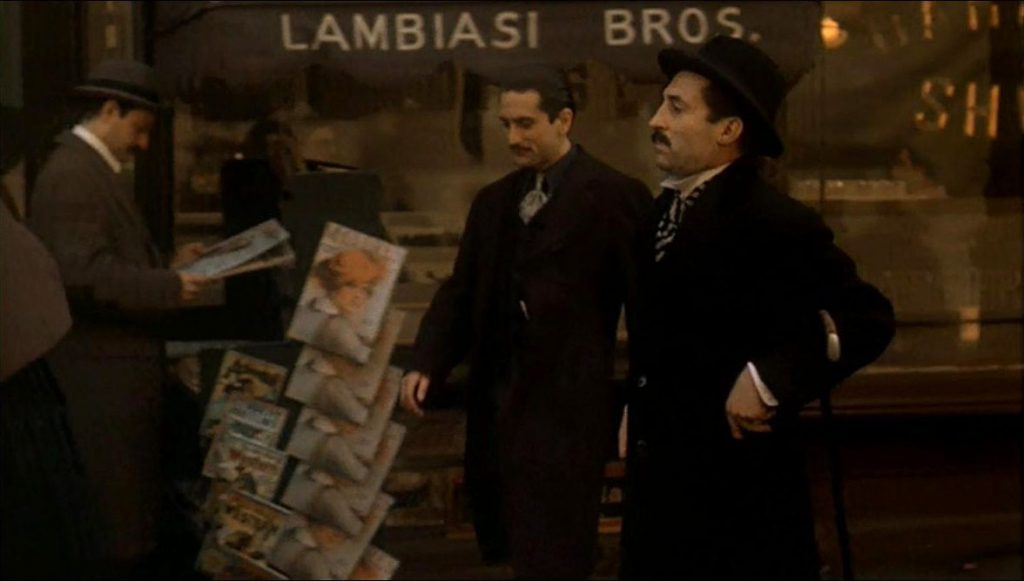
Godfather II (1974) featured extensive sequences showing how young Vito Corleone became the Don (the Mafia title, not the Herron, though the two may be closely related).
The year was 1917.
This shot follows Vito’s assassination of Don Fanucci, the Black Hand boss who was the reigning parasite of Little Italy. Note how smartly dressed Vito (Robert De Niro, middle) is now, a clear contrast to his shabby workman’s clothes of previous scenes. He’s cashing in on the power of fear.
Vito passes a newsstand with a sullen landlord who’s just wilted before the suggestion he cut the rent of a poor widowed tenant.
Well, this is embarrassing — not the landlord’s failure to withstand the polite pressure of the dangerous new Don, that is, but the contents of the newsstand.
Here at Pulps in the Movies, we’re enslaved to a high level of exactitude.
One of Godfather II’s six Oscars was for Best Art Direction–Set Decoration.
And now we must give this Oscar an asterisk it can’t refuse.
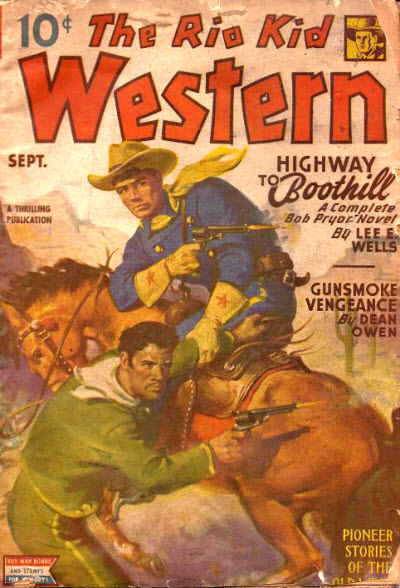
A column of pulps, the left row, adorns the newsstand. Adventure (top), began in 1910, but the issue on display is dated February 1945. The Rio Kid Western (middle) ran from 1939-53, but this issue is for September 1945. (We’re stumped on the western pulp closer to the bottom, though it looks like another 1940s issue. Can anyone help?)
These issues were on sale roughly when Michael Corleone returned from WWII, where The Godfather (1972) begins.
(There’s a second magazine below Adventure. I have no idea what it is. It could even be a dime novel. The fifth mag at the bottom of the stack — impossible to make out with what’s showing. As for the larger mag on the right, they seem to have obscured the logo. It may be a McClure’s, a woman’s mag at that time, but I couldn’t find a matching cover. Clearly mock-ups, given the multiple copies. If you look at the copy the reader is holding, it appears to have a stiffer cover than an actual magazine.)
No doubt, these particular pulps were chosen because their yellow backgrounds pop off the screen better than earlier pulps. Authentic 1917 covers were printed with muted, often dull, colors.
In 1977, Harry Steeger, founder of Popular Publications, who published the 1945 Adventure, was asked about pulp cover colors. His answer:
“There were certain colors and color combinations used on covers which attracted buyers more than other colors. I made a complete study in considerable depth of every color in the artist’s palette. I made all the various combinations possible and then studied them at various distances to note and study the eye appeal. In addition to this, I kept a newsstand in my office and arranged covers on the newsstand to see which ones stood out above the others. This study went on year after year. I became aware of the fact, for instance, that the hot colors like reds and yellows appealed to men, whereas the cooler colors like the greens and the blues and the pastel colors appealed more to women. The magazine covers were planned accordingly.”
Thus, Steeger created the other Yellow Peril in the pulps, a ridiculous proliferation of yellow-background pulp covers.
For me the most interesting moment was learning that Daniel Woodrell, author of Winter’s Bone (star turn vehicle for JLaw), was once a resident of Sam Spade’s burg.
Very light on the info, though. No address. No neighborhood. No year dates.
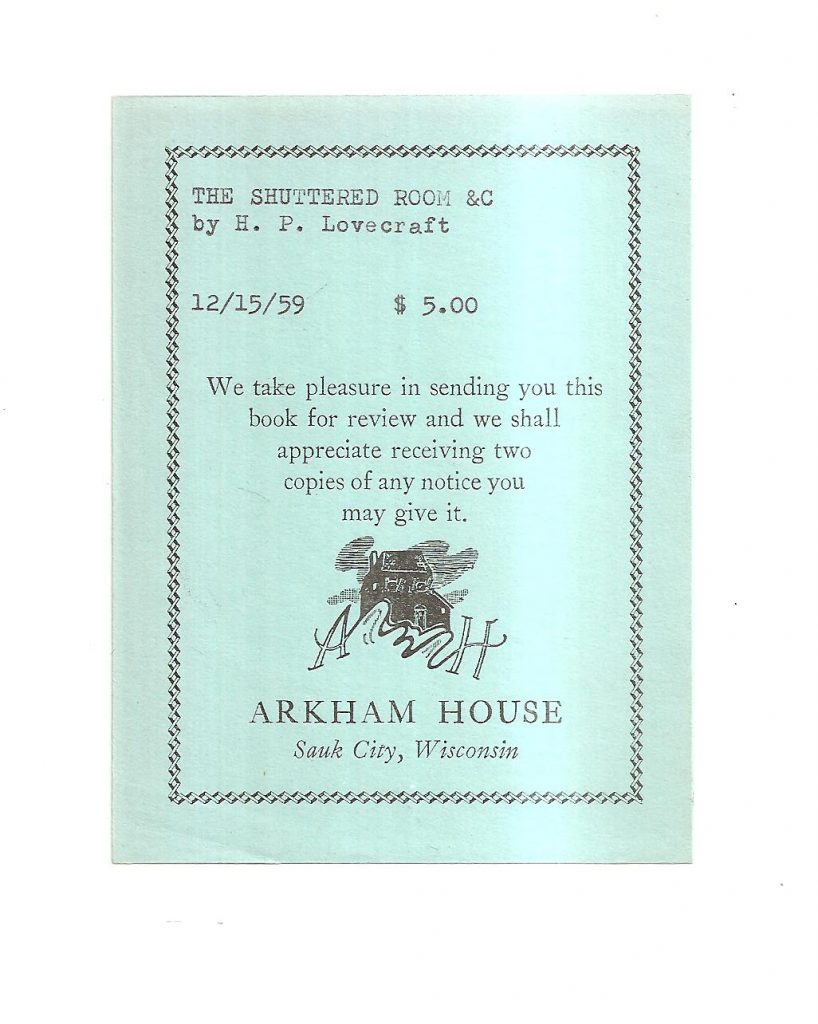
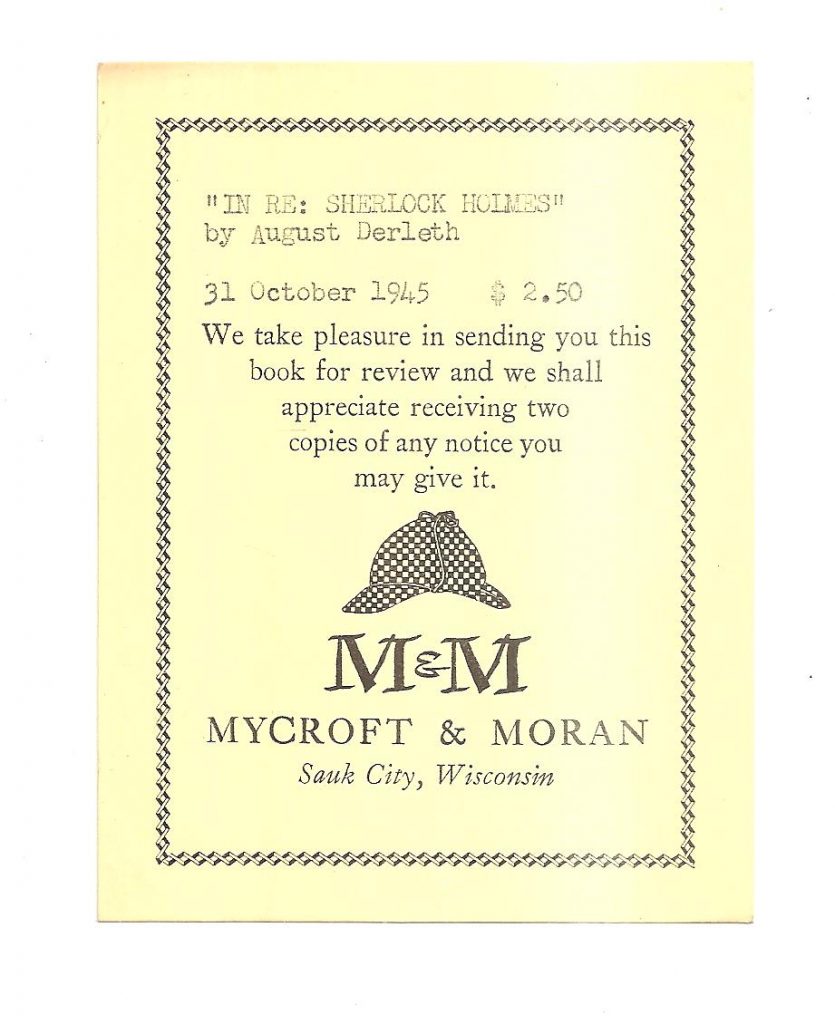
Inspired by looking over the Paul Dobish list of Arkham House review slips yesterday, Arkham and August Derleth savant John D. Haefele sent in an image of a related item for your instruction and amusement.
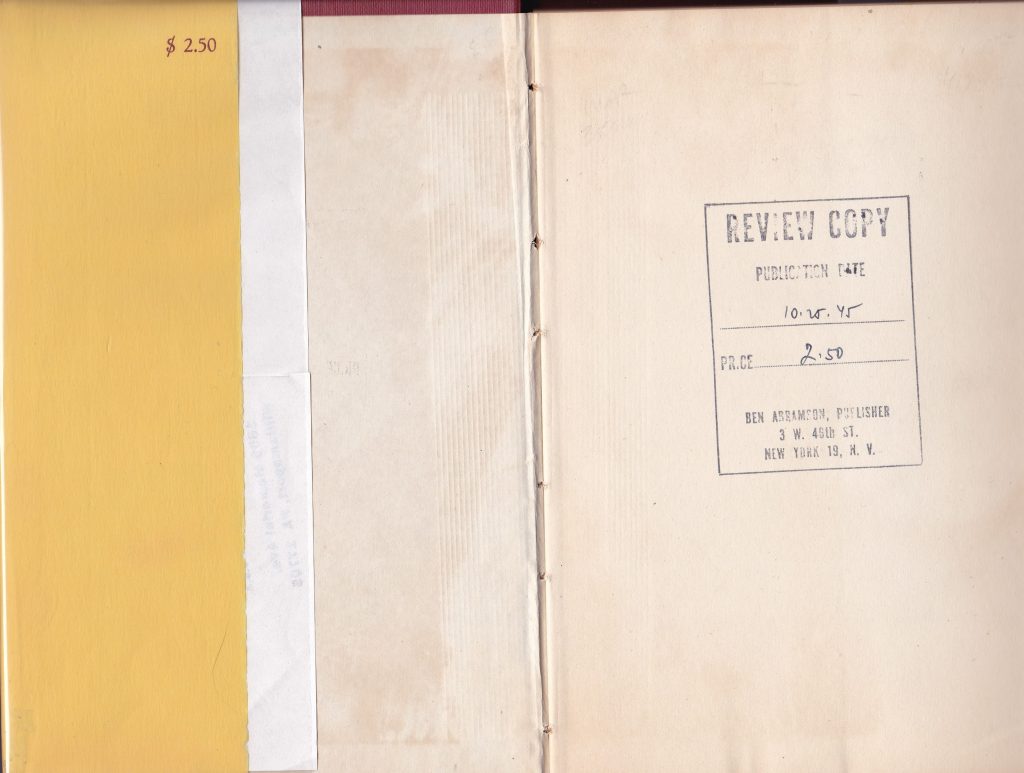
Check out the way the Ben Abramson company dealt out the info in a review copy of Derleth’s 1945 H. P. L.: A Memoir.
Not a review slip but a rubber stamp, with the pub date and price left blank to be filled in by hand.
No, not Arkham, but given the authorship of Derleth and the subject matter, pretty damn close.
I’d keep it with my Arkham stash.
“I imagine,” Haefele says, “that the Abramson edition of Lovecraft’s Supernatural Horror in Literature was done in similar fashion.”
If you recall my essay on Arkham House ephemera in Firsts: The Book Collector’s Magazine back in October 2002, I wrapped it up by mentioning that much other ephemera existed than just the stock lists and brochures I concentrated my attention on. August Derleth ordered Arkham House matchbooks to spread around — those must be more ephemeral than the ephemera!
And Paul Dobish Jr made a plea for recognition of the review slips that went out with review copies from Derleth’s various imprints. Yes, sure, those items are interesting, but I cut the Gordian Knot by saying that I would “regard the review slips as desirable extras in the actual review copies, parts of a book, like the dustjacket.”
I still think of the review slips that way, and Paul still wants collectors to know about them, so we cut a deal: I told him, Put together a list and I’ll put it up on the net. See if it stirs up any further info.
The main list below consists of items Paul has in his personal collection — like the legendary The Phil Mays Collection of Arkham House Ephemerae from 1985 consisted only of items Mays had assembled, and nothing more.
But I’m sure Paul would be interested in knowing of any items he doesn’t have to hand. I imagine, too, he’s open to buying any strays. I’ll forward the info.
Paul writes, “I suspect many others exist.”
And now, Paul Dobish Jr with an Intro:
I have been seeking the review slips/letters for a long time. I never found a significant “batch” of them. Nearly every example that I have is the result of a “one-off” purchase, usually accompanying a “regular” copy of the book, not one of the formal plastic comb-bound style advance/proof copies of the books, which often had a review slip affixed to them.
For regular trade copies of the books that went out for review purposes, the slips were typically laid in or sometimes tipped-in to the front free endpaper. This list includes those loose slips as well as slips that I only have affixed to proofs of the books.
I have not distinguished nor annotated which slips are entirely printed and which had the book specifics — title, author, publication date, price — typed on review “blanks” of the period.
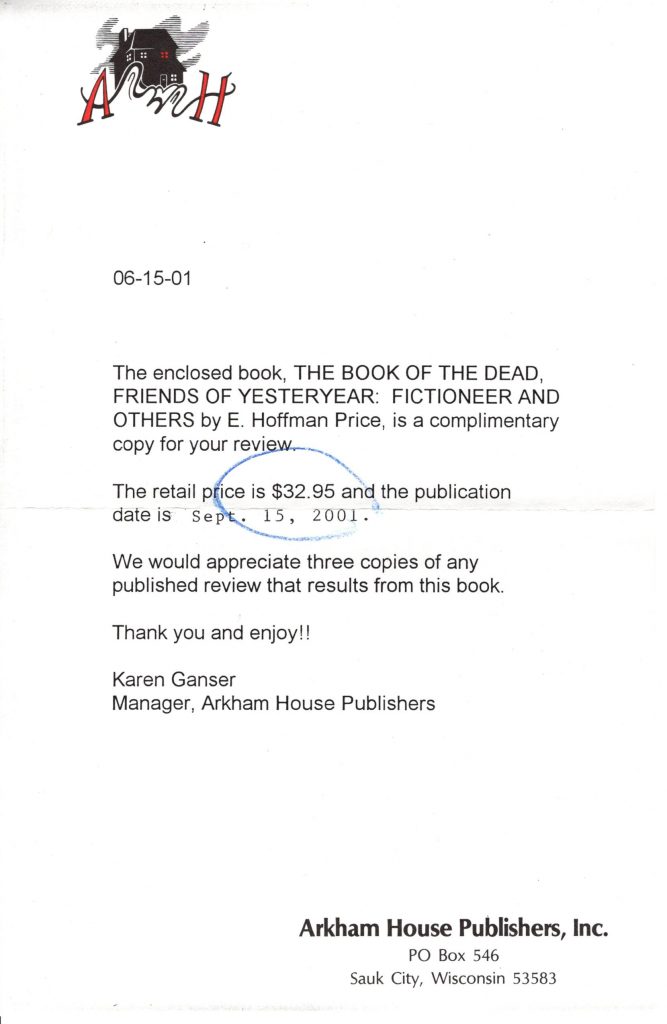
“Letter” means the generic type, pre-printed in multiples. Not individualized correspondence, done only as a single copy. An example shown here comes with E. Hoffmann Price’s The Book of the Dead.
Sizes of the slips varied, but generally the slips were roughly from 3.5″ to 4″ wide x 4.5″ to 5″ tall — save that the Lellenberg, one of the last books to date released under the imprint of Arkham House, is a bit larger at roughly 4.25″ x 5.5″.
The later review slips and letters seem to have been done on white paper (again, the Lellenberg being an exception). As can be seen in the scans, at least some of the earlier slips were done on variously colored paper.
I do not know:
1. how many others exist
2. which was the first title to have one
3. which titles — if any — did not have one (although a few likely “suspects” come to mind).
As with advance/proof copies of the books themselves, generally speaking the slips from the 1970s/1980s seem to be the easiest to obtain.
But all examples are scarce/rare.
I once passed on an example of ALWAYS COMES EVENING paired with the book at $1500. (I asked, but the seller would not split up the pairing.)
And a collector once told me that he had a slip for HORNBOOK FOR WITCHES. (How I wish that I had that one!)
NB: SELECTED LETTERS OF CLARK ASHTON SMITH and CAVE OF A THOUSAND TALES share a single physical review letter, of which I only have one copy.
NB: The two printings of SELECTED LETTERS [III] 1929-1931 each have their own separate slip/letter.
No pretense of anything remotely like completeness is suggested.
I strongly suspect that most of the books published by Derleth “missing” from this list also had review slips/letters.
Arkham House / M&M review slips/letters:
Bear: THE WIND FROM A BURNING WOMAN [NB: slip only on a comb-bound proof]
Bishop: BLOODED ON ARACHNE [NB: slip only on a comb-bound proof]
Bishop: ONE WINTER IN EDEN [slip]
Bishop: WHO MADE STEVIE CRYE? [slip]
Blaylock: LORD KELVIN’S MACHINE [slip]
Bloch: FLOWERS FROM THE MOON AND OTHER LUNACIES [letter]
Bond: THE FAR SIDE OF NOWHERE [letter]
Bond: NIGHTMARES AND DAYDREAMS [slip]
Bowen: KECKSIES AND OTHER TWILIGHT TALES [slip]
Brennan: STORIES OF DARKNESS AND DREAD [slip]
Campbell: ALONE WITH THE HORRORS [slip]
Campbell: THE HEIGHT OF THE SCREAM [slip]
Campbell: NEW TALES OF THE CTHULHU [NB: slip only on a comb-bound proof]
Cannon: LOVECRAFT REMEMBERED [slip]
Carter: DREAMS FROM R’LYEH [slip]
Case: THE THIRD GRAVE [slip]
Coppard: FEARFUL PLEASURES [slip]
Copper: FROM EVIL’S PILLOW [slip]
Copper: NECROPOLIS [first printing] [slip]
Counselman: HALF IN SHADOW [slip]
Derleth: HARRIGAN’S FILE [slip]
Derleth: IN RE: SHERLOCK HOLMES [slip]
Derleth: NEW HORIZONS: YESTERDAY’S PORTRAITS OF TOMORROW [slip]
Derleth: THE SOLAR PONS OMNIBUS [slip]
Derleth: WISCONSIN MURDERS [slip]
Durbin: DRAGONFLY [letter]
Grant: TALES FROM THE NIGHTSIDE [slip]
Harvey: THE CLEANSING [letter]
[Joshi, as editor] see under: Lovecraft MISCELLANEOUS WRITINGS
Joshi: SIXTY YEARS OF ARKHAM HOUSE [letter]
Kessel: MEETING IN INFINITY [slip]
Kirk: WATCHERS AT THE STRAIT GATE [NB: slip only on a comb-bound proof]
Kress: THE ALIENS OF EARTH [slip]
Lawrence: NUMBER SEVEN QUEER STREET [slip]
Le Fanu: THE PURCELL PAPERS [slip]
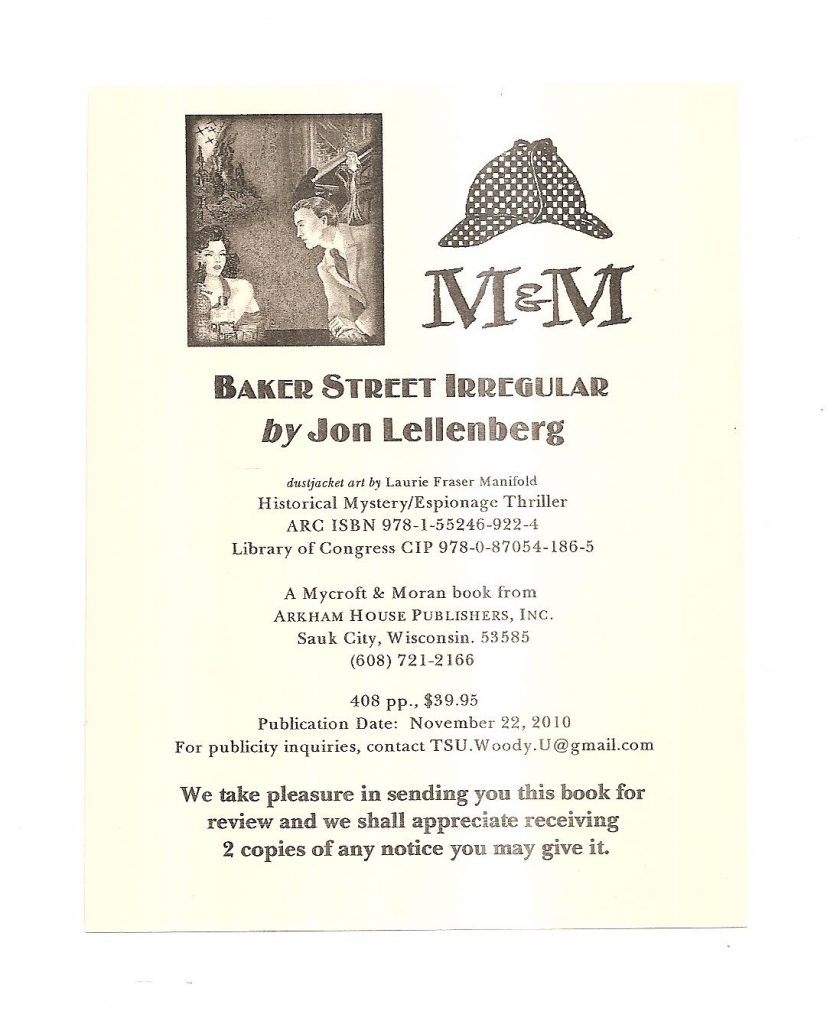
Lellenberg: BAKER STREET IRREGULAR [slip]
Long: HOWARD PHILLIPS LOVECRAFT: DREAMER ON THE NIGHT SIDE [slip]
Long: IN MAYAN SPENDOR [slip]
Lovecraft: AT THE MOUNTAINS OF MADNESS [Corrected fifth printing] [slip]
Lovecraft: THE DUNWICH HORROR AND OTHERS [Corrected sixth printing] [NB: slip only on a comb-bound proof]
Lovecraft [edited by Joshi]: MISCELLANEOUS WRITINGS [slip]
Lovecraft: THE SHUTTERED ROOM & OTHER PIECES [slip]
Lovecraft: SOMETHING ABOUT CATS [slip]
Lovecraft / Derleth: THE SURVIVOR AND OTHERS [slip]
Lumley: BENEATH THE MOORS [slip]
Lupoff: LOVECRAFT’S BOOK [slip]
MacLeod: VOYAGES BY STARLIGHT [letter]
Malzberg: IN THE STONE HOUSE [letter]
Price: BOOK OF THE DEAD: FRIENDS OF YESERYEAR: FICTIONEERS & OTHERS [letter]
Ruber: ARKHAM’S MASTERS OF HORROR [letter]
Russ: THE ZANZIBAR CAT [slip]
Schultz/Conners: SELECTED LETTERS OF CLARK ASHTON SMITH [letter: NB: this title combined with Thomas’ CAVE OF A THOUSAND TALES: THE LIFE AND TIMES OF HUGH B. CAVE]
Shea: POLYPHEMUS [slip]
Shepard: THE JAGUAR HUNTER [first printing] [slip]
Smith: THE BLACK BOOK [slip]
Smith: POEMS IN PROSE [slip]
Smith: A RENDEZVOUS IN AVEROIGNE [first printing] [slip]
Smith: SELECTED LETTERS OF CLARK ASHTON SMITH [NB: listed above under: Schultz/Conners rather than under: Smith]
Smith: SELECTED POEMS [slip]
Smith: TALES OF SCIENCE AND SORCERY [slip]
Starrett: THE QUICK AND THE DEAD [slip]
Sterling: CRYSTAL EXPRESS [slip]
Swanwick: GRAVITY’S ANGELS [slip]
Thomas: CAVE OF A THOUSAND TALES: THE LIFE AND TIMES OF HUGH B. CAVE [letter: NB: this title combined with Schultz/Conners: SELECTED LETTERS OF CLARK ASHTON SMITH]
Tiptree: TALES OF THE QUINTANA ROO [NB: slip only on a comb-bound proof]
Turner: CTHULHU 2000 [slip]
Walter: IN THE MIST AND OTHER UNCANNY ENCOUNTERS [slip]
My review of the latest translation from French noir master Jean-Patrick Manchette — No Room at the Morgue — recently popped at PW.
Here’s the really good news — New York Review Books lined up another translator to work on the Manchette oeuvre. For years now it’s been either Donald Nicholson-Smith or James Brook, and I’m not complaining about their product — between them they made Manchette one of my all-time favorite noir writers. But with Alyson Waters added to the mix, it is possible they might translate the rest of Manchette’s novels in my lifetime — I honestly didn’t think it would happen. They might even be able to put his criticism and reviews, such as Chroniques, into my vernacular.
Manchette is legendary for writing ten crime novels and then quitting after he wrote his obvious masterpiece, The Prone Gunman.
But then he made a comeback to write a decades-spanning saga of assassins and spies, supposed to go on book after book. Manchette didn’t quite get the opening finished before his death. That novel-length fragment appeared under the title Ivory Pearl.
Of the previous ten novels, six now have seen American print.
Four left.
I’m hanging on. I can make it, I can make it.
Go, New York Review Books, go!
While the top half of my No Room at the Morgue review presents the info points I sketched in, the wordage is switched up to the point I normally wouldn’t link to it. However, the last couple of sentences are pretty good, and those are mine.
If you’re interested, you’ll find it in the list of Manchette reviews in PW that follows, presented in order of American publication. Surfing around their site, I could not find a review for Nada, so I’ll cover that one on These Mean Streets in the next day or two.
If PW reviewed it, it wasn’t me at the keys.
Of the other reviews, I did all but one — acknowledging whatever editorial input tweaked a few words here or there:
Welcome to a hard-boiled and not without noir blog with news and reviews, occasional outbursts of maniacal Autograph Hound activity, plus archival records from the forty-five year run of The Dashiell Hammett Tour.