Rediscovered: EQMM Today


EQMM TodayUsually on this blog any chatter about Ellery Queen Mystery Magazine harks back to the days of yesteryear, when the two cousins who wrote as “Ellery Queen” ran the show, and one of the two — the redoubtable Frederic Dannay — reprinted a lot of Hammett short stories, which he assembled in various paperback collections.

But EQMM is still alive and well, issues hitting the newsstands a couple of months before the cover date (a time-honored tradition with newsstand magazines, which I’ll refer to again soon enough).

I was reminded that EQMM deserves a little blurb by news on the Dave/Evan Lewis website, where he announces that he has a new Sherlock Holmesian sort of tale in the current issue — dated February next year but on the stands any second now. I read a previous one in this series that also appeared in EQMM and liked it — some of the other entries in the set saw life on webzines and didn’t have as much oomph as you need to crack the print market, so I’m assuming this one will be on that higher plane.

Plus Evan’s byline makes the cover — congrats!

Posted in Dash, Lit, News | Tagged , , , , |

Rediscovered: “Fly Paper” in EQMM

newstand

I noticed in passing this shot of a newsstand — from 1942, it turns out — on James Reasoner’s blog, but Andy Bienstock from Baltimore brought to my attention that I needed to hop over to the Shorpy site where it “originally” appears for a closer look.

On Shorpy you can explode the image so that you can tell which magazines are shelved, and Andy noticed, “Top right is Ellery Queen with ‘Fly Paper.’ Fun looking!” Shorpy also allows readers to add to the info and a guy pinpoints the issue of EQMM as July 1942.

At that time you still had a lot of regular-sized wood pulp magazines on the stands, but digests such as EQMM were working their way in — like tiny mammals in the age of the dinosaur, preparing to invade and take over that environmental niche.

Andy is the guy from Baltimore who asked for a tour back in May — and gave me lots of advance notice. Give me enough advance notice, and I always try to accommodate any Hammett fans coming in from out of town (though living in Hammett’s old hometown of Baltimore is almost as good as hiking up and down the mean streets of Frisco, I’m guessing).

Posted in Dash, Frisco, News, Tour | Tagged , , , , , , |

Sinister Cinema: La Cuidad Maldita

Previously on this blog, our pal from Spain — Dr. Jesús Ángel González López — tipped the Up and Down These Mean Streets community to the existence of a movie version of Hammett’s Red Harvest that many — probably most — of us had never heard of before.

Amazing, really.

Now he’s back with more info, after tracking down a copy of the film and doing some additional gumshoe work into its history.

Here’s Jesús:


I have finally been able to get a VHS copy (in Spanish) of “La ciudad maldita”, the Spaghetti Western adaptation of Red Harvest. As I told you in my previous post, it was produced in 1978 and acknowledges credits to Hammett and Red Harvest. 

If you look closely at the screen during the credits, you can read “argumento de Jason E. Squire, basado en Red Harvest de D. Hammet” (just one T, they couldn’t get everything right…), and “guión de Juan Bosch y Alberto de Stefanis”.

Jason E. Squire is the author of The Movie Business Book and he now teaches at USC, but in the 70s he worked as the key executive in America for Italian producer Alberto Grimaldi (The Good, the Bad and the Ugly; Last Tango in Paris), and he wrote a screenplay for him adapting Red Harvest. I have contacted him and he has given me the whole story:

“Flashback: It’s 1977 and I am working for Alberto as his creative executive in the United States, based at the offices of P.E. A. Films., Inc. New York. Back then, he was spending more time in the U.S. than before. I’d become enamored of Red Harvest (as you can imagine) as one of the great novels never made into a movie. Taking this as a challenge, I sat down to write a screenplay adaptation of the book without letting Alberto know. When it was done, I gave it to Alberto who enjoyed it. As I recall, he had bought the rights to Red Harvest from the Dashiell Hammett estate (Lillian Hellman as executor) but a clause in the agreement required that a movie of Red Harvest had to be made by a certain deadline. So Alberto asked me to re-write my screenplay as a western, so he could produce a Red Harvest movie before the deadline and retain the rights to the Hammett novel. I finished the western version in August, 1977 … I never worked with the two who have screenplay credit on the movie … The western movie was never released in English, sorry to say.”

Juan (Joan) Bosch, AKA John Wood, was a Spanish (Catalan) director who had made a few Spaghetti Westerns in the early 70s with Grimaldi. So, apparently, Grimaldi used Squire’s screenplay and he contacted Bosch, who rewrote it (with De Stefanis’s help) as a Spaghetti Western at a time when Spaghetti Westerns had already had their day.

The Spanish title translates as “The cursed city” (or “The city with a curse”), but the Italian and English titles give you some food for thought: La notte rosa del Falco, The Crimson Night of the Hawk… Not that there are any hawks, or anything in a crimson color, and most of the action takes place during the day (it was probably cheaper to shoot like this), but I am guessing “Hawk” is a reference to The Maltese Falcon and “Crimson” a reference to Red Harvest itself.

How can anybody know what was in the mind of the translators?

Gone is the name Poisonville (with the allegorical implications it carries in the novel), the Op’s voice as narrator, and the criticism of the hard-boiled-hero-turned-murderer the attentive reader can glimpse after the “red harvest” unleashed by the Op. Gone is also Bill Quint, the IWW member who acts as the novel’s social conscience and provides it with a deeper socio-political critique than any other Hammett novel (excluding perhaps The Glass Key and its denunciation of the corruption of city politics).

Having said all that, the film is surprisingly faithful to Red Harvest.

The Op, who is unnamed but describes himself as working for the San Francisco Continental Agency, comes to Personville to meet Donald Wilson, but finds his client dead, after which Wilson’s father asks the Op to clear Personville of riff-raff. Ring a bell?

Almost everything else from the novel’s plot is there: Max Thaler, Sheriff Noonan, Pete the Finn, Dinah Brand (and Hammett’s lunger alter ego Dan Rolff), the fixed boxing fight, the icepick scene where Dinah dies, the Op’s stirring-up moves…  But it is a Spaghetti Western, and therefore we find all the subgenre conventions:  cowboy hats and horses, the music, the dizzying travelling shots and shocking close-ups, the cheap settings of the stereotypical small western town (which does not look at all like the Personville described in the novel, just like the Madrid and Almería settings do not look at all like Montana).

As one can easily imagine, the conventions of the two genres fit very uncomfortably: there is too much dialogue for a Spaghetti Western (how many words did Clint utter in the whole Leone trilogy?), too many closed spaces, and very little landscape for a western, and although the film ends with a shoot-out, I doubt that Spaghetti Western fans really enjoyed this movie.

On the plus side, we can finally see a character called “Continental Op” (“Agente de la Continental” in Spanish) in a movie, although he is neither short nor fat. The actor’s stage name is Chet Bacon, and I haven’t been able to find out anything else about him. Bosch says he was a “third-rate regional actor”, and he is often confused with Gianni Garko, a well-known Spaghetti Western actor.

In fact, he is just another Hammett-look-alike, thin, moustached and tall. Just like William Powell in The Thin Man, or James Coburn in The Dain Curse adaptation that CBS did precisely in 1978 (and where the protagonist had a name: Hamilton Nash, although he was called Ham or Nash, probably because they couldn’t call him Sam or Dash…).

At any rate, Hammett fans may enjoy finding out more about this movie, even though we might have to wait long for a true adaptation of Red Harvest

Posted in Dash, Film, News | Tagged , , , , , , , , , , , , , , , |

Hammett: “Holiday”

Holiday-The New Pearsons 7-23

Jeez, maybe I’ll take the rest of this blogging month off — I think Terry Zobeck has it under control!

For part three of his new series detailing edits made by Frederic Dannay — you’ll need your copy of the 1951 digest Woman in the Dark for this one — Terry deals with the Hammett short story “Holiday.”

Not exactly a tale of Xmas cheer, as you’ll find out.

“Holiday” currently is available in a pure text version in the collection Lost Stories (I’m sure you can figure out the Dannay cuts and edits by referring to this edition, too, but it’s more fun to juggle the paperbacks of over half a century ago).

Here’s Terry:


“Holiday” is a highlight of Hammett’s early fiction, among my favorites of any of his stories. It is not a crime story, but rather a slice of life character study, one that is hard not to see as heavily autobiographical. It was first published in the July 1923 issue The New Pearson’s and reprinted by Dannay in Woman in the Dark (1951).

Paul Hetherwick is a veteran enrolled as a patient at Public Service Health Hospital No. 64 in San Diego. We’re not told specifically what he’s suffering from, but there are several references to his cough. Sound familiar?

Hammett gives us a sharply drawn portrait of a day in the life of Paul Hetherwick. He obtains a day pass from the hospital administrator, withdraws $100 from the bank, and catches a bus to Tijuana. He spends some time playing the ponies at the track and then drinking with a couple of bar girls.

With economical, evocative prose Hammett lets us know that in addition to his lung disease, Paul is suffering from a bad case of ennui; he doesn’t care whether his horses pay off or if bar-girls drink up his money. He’s not even interested in sex with “the girl with red hair”. This attitude is presumably driven by the uncertainness of the future common to tubercular patients.

“Holiday” is only Hammett’s sixth published short story (not counting two early “miscellaneous” pieces) but he is already in high gear; here’s his description of the first bar-girl he encounters:

He let her lead him to a booth — feeling a perverse delight in her utter coarseness — where she sat leaning heavily against him, one hand on his knee. He wondered what it would be like to lie in the arms of such a monster: middle-aged, bull-throated, grotesquely masked even under her tawdry garniture, manifestly without sex.

After buying her several more drinks, Paul decides it’s time to move on. As he is leaving he begins to feel shame at the thought of being just another easy mark for her bar tab scam. Before he leaves he tells her:

“You’ve got me all wrong,” he assured her, seriously. “I don’t mind letting you take me for a ten or so when it’s all I’ve got. Ten isn’t much money one way or the other. But don’t think I’m coming down here with a roll to let you —”  Suddenly he saw himself standing in the doorway trying to justify himself to this monstrosity. He broke off with a clear, ringing laugh and walked away.

Typical of Hammett, having Paul cut off his self-loathing with a laugh.

At the next saloon Paul encounters the real reason for his Tijuana trip — the horses and the first saloon were just excuses to heighten his anticipation of seeing the red-haired girl. She’s a dancer and bar-girl at a saloon down the street from the first one. They talk some and drink for a while, comfortable, but not intimate; then:

He was filled with a strange affection for her: an affection that, though it was personal enough, had nothing of desire in it. Drunk as he undoubtedly was he did not want her physically. For all her beauty and pull upon his heart she was a girl who “hustled drinks” in a border town. That she might be a virgin — there wasn’t anything impossible about that unlikely hypothesis: her profession didn’t preclude it, even compelled continence during working hours — made no difference. It wasn’t even so much that she was tainted by the pawing of strange hands — she had a freshness that had withstood that — as that in some obscure way the desires of too many men had rendered her no longer quite desirable. If he ever turned to a woman of this particularly sordid world it would be to some such monster as the one down the street. Given a certain turn of temper, there would be a savage, ghoulish joy in her.

It may not be a crime story, but it is certainly hard-boiled.

If you’ve been hanging around the Mean Streets for awhile, then you know the drill: page number, line number, whether it is from the top or bottom of the page, and the edited text; Hammett’s original text is underlined.


Page       Line        top/bottom      Text

114         8             bottom            and bought a racing form, studying it carefully, together with some figures in a memorandum book,

115         3             top                   and kept him coughing his sharp, barking cough.

115         10           top                   for his two colored tickets. He had not been especially stirred by either the race or the result: he had thought the horse would win without difficulty.

115         17/18      top                   Between races he drank whiskey at the grandstand bar, being served liquor of the same quality that was procurable north of the border and paying the same prices.

115         3             bottom            grotesquely masked even under her tawdry garniture,

116         17           bottom            They took me down the line at the track

116         16           bottom            “Tough luck,” she said, with facial sympathy,

116         15           bottom            She grew confidential. [Should be a separate paragraph]

117         10           top                   waited for his beckoning nod.

117         17           bottom            they stood drinking slowly, close together but not touching, not talking very much, but smiling

118         11           top                   And then, resting one hand lightly on his sleeve,

118         12           top                   He backed away shaking his head. “So long!” He turned toward the door.

119         1             top                   because it was 444 Fourth Aavenue.

119         16           top                   in a thin, plaintive voice, and her companions—two sailors from the Pacific fleet—argued loudly some question having to do with gun-pointing.

Posted in Dash | Tagged , , , , , |

Hammett: Tracking Down Two “New” Stories by “Peter Collinson”

strength

The Holiday Season seems to have uncorked Terry Zobeck! He’s back with another Mystery in Hammett Bibliography — and even better, he’s already got the mystery solved!

Take another trip with Terry into the archives of the Library of Congress, tread the arcane pathways known only to the dedicated bibliographer. . . .

Think about it. From 1930 till today, this information has been lost, misfiled, missing in action.

Here’s Terry:

feb cover

Back in July Don sent me an email passing along a question from a Mean Streets reader, asking about a story called “Ah, Fate!” by Peter Collinson.

Now as we all know, “Peter Collinson” was a pseudonym used by Hammett on eight of his early stories.

And as we all know, no such story has ever been attributed to Hammett.

So I checked the FictionMags Index, a wonderful resource maintained by Bill Contento, and found a listing under Hammett’s name for the story in the February 1930 issue of American Short Story. I sent Bill an email asking about the story and he replied that since Hammett only used the pseudonym from 1922 to 1924, it was unlikely that he used it as late as 1930 for this story. He concluded the attribution to Hammett in the FM Index was most likely an error and that this was a different Peter Collinson — he noted that there were two others in his database — and that he would correct the Index, which he did.

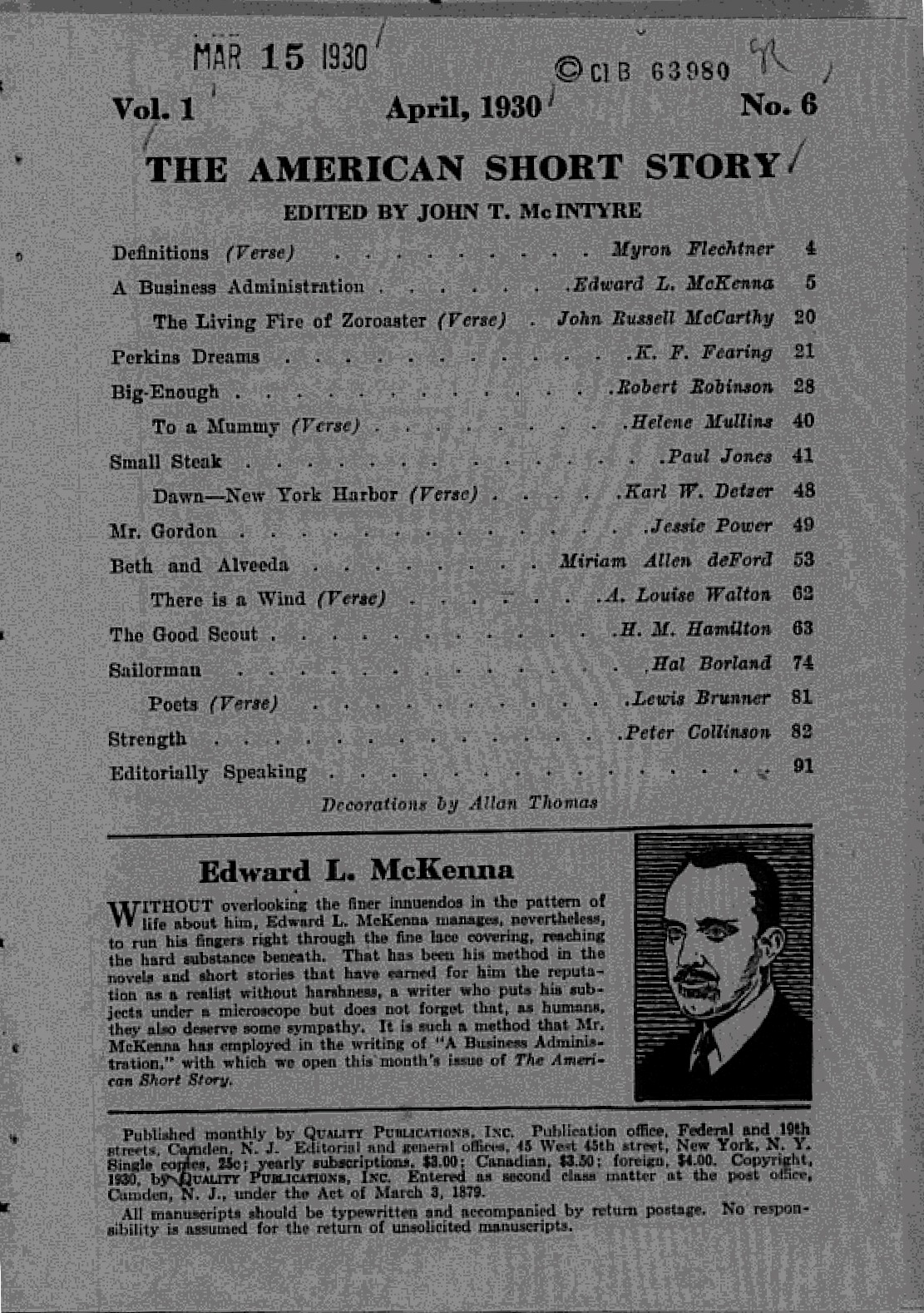
But this past week I’m surfing the web for some Hammett information and paid another visit to Mike Humbert’s excellent Hammett website. One of his pages is devoted to documenting Hammett’s short fiction, accompanied by images of the covers of the original magazines and pulps in which they were first published. In scrolling down this page I came upon “Ah, Fate!” as published by Collinson in the February 1930 issue of American Short Story — there was no image illustrating the cover and no other information about the story.

feb titles

This time I thought to ask Hammett authority Richard Layman about it. He replied that he was unfamiliar with any such story, but would be interested in anything I could discover.

Yesterday I had a few spare hours, so it was off to the Library of Congress. Earlier in the week I had sent an email request to the LOC to determine whether they had the magazine in their archives. A quick response established they did indeed have it on microfilm. Turns out it was a short-lived digest-sized magazine, published from November 1929 through April 1930.

I arrived at the LOC and headed straight to the microfilm collections and requested the relevant roll of film. Within a half hour it was retrieved from the archives and I was ready to load it onto the modern reader — it would let me save any images desired to my USB flash-drive device.

With great anticipation I fumbled the roll onto the reader and scrolled to the February 1930 issue. And there it was: “Ah, Fate!” by Peter Collinson.

There was no biographical information on this Collinson.

I quickly searched the table of contents of the other issues to see if Collinson published anything else with American Short Story.  He did. The final story in the final issue of the magazine (April 1930) was “Strength” by Peter Collinson. Again no biographical information.

april cover

I scrolled back to the February issue and began to read the story.

Mystery solved.

It was a reprint of “The Sardonic Star of Tom Doody”; the story I had just written up for my latest blog!

“Strength” similarly turned out to be a reprint, “The Barber and His Wife,” also recently blogged by me.

april titles

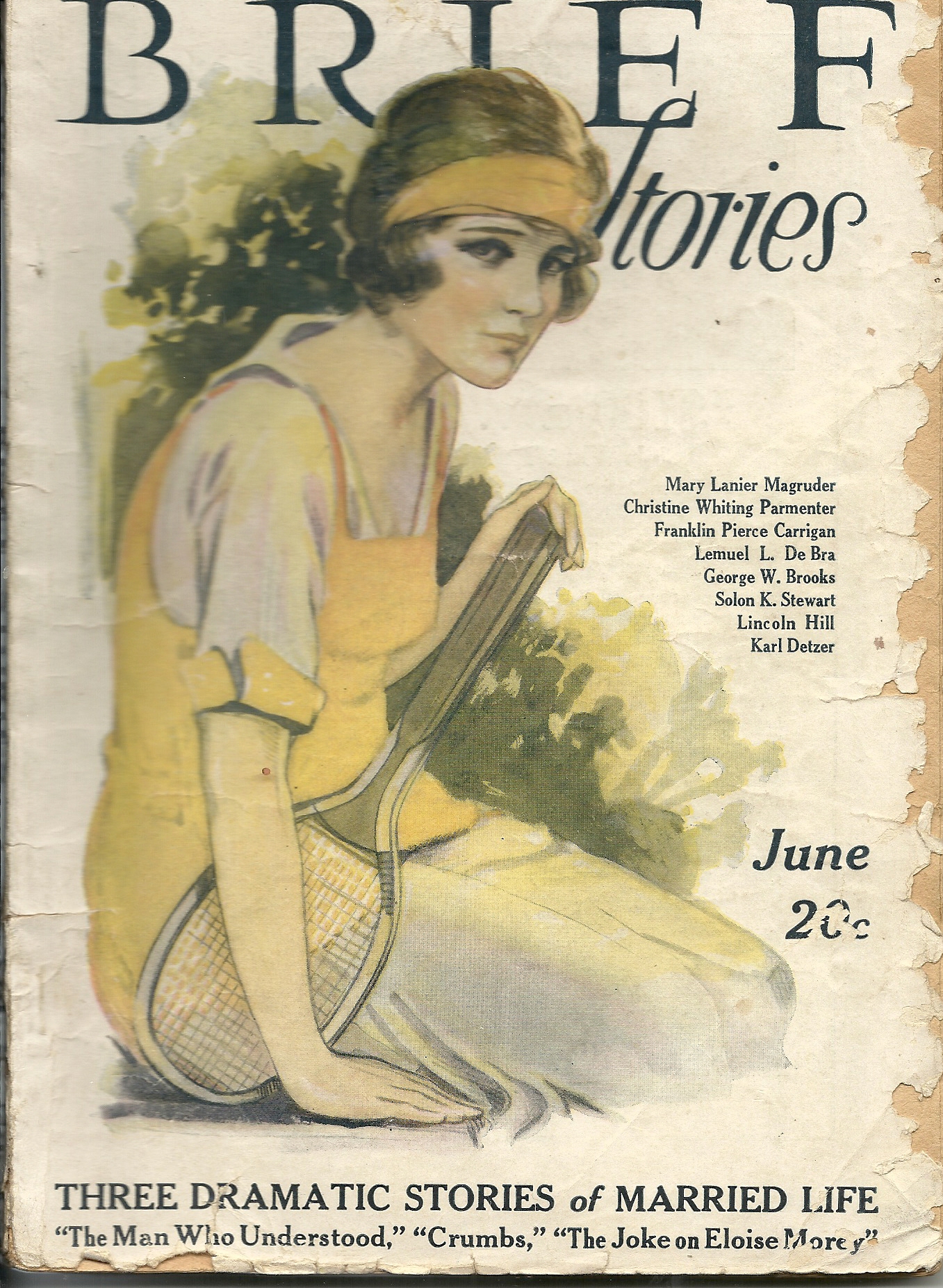
Turns out that American Short Story made a habit of reprinting stories originally published by Brief Stories. Both of the Collinson stories had appeared in this pulp, in February 1923 and December 1922, respectively.

Interestingly, unlike the other Brief Stories reprints, Hammett’s stories were retitled (even worse choices than Frederic Dannay’s). There is no copyright information that would indicate these were reprints. (A quick examination also revealed that both stories used the pure text of the originals, so Dannay’s versions were edited by him and not the American Short Story editor.)

We have no indication of whether Hammett approved these reprints or even knew of them.

These two stories may be the earliest examples of Hammett’s work being reprinted. They precede the King Features syndicate newspaper reprints by several years. As such they form an interesting footnote to Hammett’s bibliography.

fate

Posted in Dash, Lit, News | Tagged , , , , , , , , , , , , , |

Posse McMillan: The Legend Continues

Along with other distractions of the season to keep me away from posting, it turns out that no less than Dennis McMillan has shown up in town — that’ll eat up some time. He’s got me roped into a book party of some sort at Green Arcade Bookstore tomorrow night, and I bet I’ll have to sit in on one or more breakfasts eventually.

Fortunately, like a sane person, Dennis seems to eat breakfast around noon or 1 p.m. That I can do.

But if you think Dennis just rolls into San Francisco and that’s it, then you don’t understand the Dennis legend, and how he became legendary.

No, Dennis rolled into Frisco, parked his car in front of Jim Nisbet’s tall book-lined manse, like something out of Baudelaire, and within two hours his car was stolen with a suitcase filled with vintage ties in the trunk.

Welcome to Christmas in the City.

Kansas plates. If you see the machine abandoned somewhere, let me know.

[And what do you know — a quick phone update from DMac, letting me know the event at Green Arcade for Monday the 9th has been cancelled — the musical trio all got the flu, or something. Score another one for wintertime.]

Posted in DMac, Frisco, News | Tagged , |

Hammett: “The Sardonic Star of Tom Doody” & “The Joke on Eloise Morey”

Another month on the mean streets, ready to be kicked into gear by Terry Zobeck with part two of his new series probing the various changes made by Frederic Dannay to Hammett’s short stories. . . .

You can find “pure texts” of these stories available on the market today, but if you ever wonder what wordage Dannay changed around back in the day, here you go. The guy had a blue pencil and wasn’t afraid to scribble.

Once again, Terry apologizes for only having an image for one of the original magazine covers to show off, but tells me he’s cover-ready for his next installment.

And here’s Terry:

This time around we have two of Hammett’s cynically comic pieces, or — telegraphed by the title of the first one — sardonic. Both stories originally appeared, appropriately, in Brief Stories, the first in the February 1923 issue and the second four months later.

“The Sardonic Star of Tom Doody” was most likely inspired by Hammett’s knowledge of small time crooks and their frequent jail-house conversions. Many of the cops I’ve known through my work are just as cynical as Hammett in their doubts of such religious awakenings.

Hammett put a humorous twist on this one and added another frightened little man character to his fictional stockpile.

“Tom Doody” was among the last of Hammett’s stories reprinted in the pages of EQMM, appearing in the November 1957 issue. Dannay included it in his final volume of Hammett stories, A Man Named Thin (1962). He applied a light pencil to the story with the most significant change being the title; he published it as “Wages of Sin”. Neither title is all that compelling, but it’s a slight story in any event.

“The Joke on Eloise Morey” is the better of these two, but that’s not saying much. Eloise is the domineering, unpleasant wife of Dudley Morey, a failed artist with a sensitive nature to match. She takes great pleasure in detailing just what a miserable failure he is, to the point of driving Dudley to suicide. Hammett exercises no subtlety in telegraphing the “joke” to the reader.

The most interesting aspect of the story is the editing done to it by Dannay before he reprinted it in The Creeping Siamese (1950). He made several inexplicable word changes (e.g., “scornful” for “acrid”), deleted words and phrases for no discernible reason, updated some language (e.g., changing “little iron stove” to “open fireplace”), and protecting readers’ sensitivities from Hammett’s raciness (deleting “virginal” from the description of Dudley’s blank canvas).

I’ve followed my usual style of noting the edits: page number, line number, whether it is from the top or bottom of the page, and the edited text; Hammett’s original text is underlined. The page numbers refer to A Man Named Thin (“The Sardonic Star of Tom Doody”) and The Creeping Siamese (“The Joke on Eloise Morey”).  Both stories were reprinted in Lost Stories (2005) using the pure texts.

“The Sardonic Star of Tom Doody”

Page       Line        top/bottom      Text

31           3             bottom            Wages of Sin The Sardonic Star of Tom Doody

31           1             bottom            with the protruding lower lip and the black bow tie.

33           3             top                   You were very nearly acquitted, at that; weren’t you?

33           10           bottom            she took especial pains with the story

34           16           top                   a fifteen-by-thirty field of glaring virginal white

35           12           top                   The truth of it was that there were no crimes prior [should be the start of a new paragraph].

“The Joke on Eloise Morey”

56           15           bottom            Her husband winced blanched, cringed under the last of each scornful acrid word, but said nothing.  He could not say anything. His was far too sensitive, too delicate, a nature mechanism to permit of any of the answers he might have made

56           11           bottom            As always, his silence, his helplessness, the evident fact that he did not know what to do or say, spurred her on to greater cruelties.

57           6             top                   He turned and stumbled blindly through the doorway. [This should be followed by a section break].

57           7             top                   Alone, she raged up and down the room with the lethal, cushioned step of a panther some great forest cat.

57           7             bottom            be a lot of unpleasant publicity, with her name displayed in not too flattering a light. Then too, it would be hard upon her to think that she had driven him to it; though, of course, his failure with his work was more directly responsible. Still— She decided to go to his studio at once. [Dannay made this last line the beginning of a new paragraph; in the original, it was a single paragraph].

58           4             top                   The line ran past the building in which he had his studio, and she would get there sooner than if she called a taxicab.

58           5             top                   when she stepped from the car she She left the car at the corner above the studio and

58           15           bottom            Eloise crossed the room slowly [Should be preceded by a section break]

58           11           bottom            The revolver had fallen over against the wall, under a window. He still wore his topcoat and gloves.

58           8             bottom            It was all over now [Should be part of the preceding paragraph].

58           6             bottom            She tore it open and read the inclosed letter.

59           10           top                   She went to the old-fashioned, open fireplace, little iron stove in the corner in which a feeble coal fire burned,

59           16           top                   some of them mentioned his name as if recognizing him.

59           11           bottom            for which she was grateful. She sat on the edge of the couch looking with cold, inscrutable eyes at her hands clasped about a handkerchief in her lap.

59           10           bottom            Someone Some one knocked on the door

59           6             bottom            DdetectiveSsergeant Murray

60           15           top                   Only take a few minutes [Should be followed by a section break]

60           16           bottom            “Just wait a couple minutes here,” he said.  “I’ll see if I can hurry things up.”

61           3             top                   This morning you had a row peach of a battle.

61           12           top                   She had the sensation of a heavy net, sinuous, clammy, inescapable, closing about her.

61           15           bottom            And I find that your husband was a Catholic, the same as I am, and I guess maybe just as set against divorces

61           7             bottom            “You fools!” she cried, “You –” [Should be a separate paragraph]

61           3             bottom            the letter she had burned in the fireplace little iron stove.

Next up, perhaps my favorite of Hammett’s early stories, “Holiday”, from the July 1923 issue of The New Pearson’s.

Posted in Dash | Tagged , , , , , , , , , , , , |

Sinister Cinema: Next Time, Make It 10 Million Dollars

Michael Soltys — who last showed up here on these mean streets over a year ago with info about Hammett stopping in Key Largo — was first to let me know that the falcon statue on the block at the Bonhams auction cleared over $4,000,000 in open bidding.

Not a typo.

That’s 4 mil.

4 Big Ones.

Any vague concerns I may have had about the dingus not bringing in at least a mil were obviously misplaced, and not that serious. For years now on the tour I’ve been saying that I consider any authentic figurine from the 1941 Bogie flick to be worth at least a million (the guy who paid $398,500 for the other lead bird in a 1994 auction was prepared to go up to one million, no questions asked — but he was bidding against a bunch of people who obviously had no money to speak of, and so saved himself over half a million).

This Black Bird that just changed hands was in San Francisco some years ago for a charity deal, and then owner Dr. Gary Milan kept saying that it was the real Maltese Falcon — the only one used in the movie.

Every time Milan made the statement, Bill Arney (then the Inhabitant of Sam Spade’s Apartment) would turn kind of red and exclaim: “BUT IT’S A FAKE!!!! The Maltese Falcon Is A Fake!!!”

“Yeah, Bill,” I would say as I pulled him further out of everyone’s earshot, “but it’s the fake that was used as a prop in the movie.

“It’s the fake that was handled by Bogart!”

It’s the fake that courtesy the magic of Hollywood and the touch of legend is worth millions of dollars. . . .

Posted in Film, News | Tagged , , , , , , , |

Sinister Cinema: Tomorrow, If You’ve Got the Loot. . .

When last heard from on this blog, I was wondering if the lead statue of the mysterious Black Bird due to go on the auction block tomorrow might not be the dingus from the collection of Dr. Gary Milan — and it turns out it is, since the Sam Spade armchair, also from his Bogie hoard, is up for bid, too.

(I didn’t do any kind of thorough — it was barely casual — look-over of items for sale, but one thing Milan had in his collection I always thought was the most impressive: the gigantic doors from Rick’s Café Américain. The guy is a Bogie fan without equal. A falcon statue any body could make room for, but those doors. . . .)

Our good pal Brian Leno (The Famous Masochist) scouted around on the web and sent me the links to the Bonhams and TCM auction — a treasure trove of items, if you’ve got the treasure. Or you can just follow the proceedings, gavel stroke after gavel stroke.

Someone let me know what the rara avis pops for and I’ll spread the word. If it isn’t at least a million, I might be a little disappointed. . . .

Posted in Film, News | Tagged , , , , , , , |

Sinister Cinema: On the Block

I should note the news that one of the falcon statues from the 1941 Bogie movie sits atop the auction block again — with a cool million sales point not out of the question. You can look up earlier articles that herald the event, and soon enough word on the sum that changed hands.

There are worse hobbies.

One bit from the Daily News article may need comment: “There were reportedly four props on the set — three made of plaster and one made  from metal.” Now, I wasn’t around in 1941, much less in Hollywood keeping tabs on the Warner Brothers prop department, so that might be correct.

But the idea seems to be that the prop on the block is the only “metal” one. I personally have seen two individual props made of lead, with a bronze patina — the one belonging to arch-Bogart fan Dr. Gary Milan and the one that sold at auction in 1994 for $398,500 (I actually had the later one in my mitts, heavy as hell).

In the Vince Emery book Discovering the Maltese Falcon and Sam Spade (the first letter “A” on Vince’s Ace Performer shelf, which thus far has gotten all the way to “U” with my tour book) you’ll find info and photos of the two previously known lead birds, as well as on two resin models — plus mention of a “plastic” copy. Someone explained to me once that they didn’t quite have plastic as we know it at the time, so for “plastic” think “bakelite.” But, whatever — I’m no authority on plastic, either.

Over the years various plaster versions have been manufactured and sold, but as far as I know, none of those were around when the movie was being shot.

So, what do we have? — two resin and now three lead statues? When I first heard the news I wondered if this one might be the Milan statue making the rounds, but from the little you can glean from the articles, it seems to be a new entry in the sweepstakes.

Posted in Film, News | Tagged , , , |