Hammett: James, Joyce

Tough one — this post from frequent Guest Blogger Terry Zobeck could be held over till August for LitCrit Month — nothing is more LitCrit than James Joyce and Finnegans Wake, right??? — or just popped online right now during Biography Month to show that Hammett was doing something I also do, on occasion: reading about the lives of Old West Outlaws.

A coin is tossed. . . .

And here’s Terry:

In writing these Guest Posts I frequently consult Richard Layman’s essential 1979 bibliography of Hammett. Over the past thirty years I must have pored over it hundreds of times. But recently I came upon an item I’d overlooked: the final book review Hammett published.

And I was reminded of one other review, one that was never published.

It was apparent I had some work to do to finish documenting Hammett’s career as a book reviewer.

The first thing I did was return to the Library of Congress to find Hammett’s review of Desperate Men: Revelations from the Sealed Pinkerton Files by James D. Horan. What an exciting title.

What would this former Pinkerton’s Op have to say about a book based upon old, sealed files from his former employer?

As Layman documented, the review was published in the November 27, 1949 issue of the New York Herald Tribune, and was titled “Outlaws of the Old West.” As the review’s title suggests, the book is a study of western outlaws, with a focus on the gang ramrodded by Jesse James, and Butch Cassidy and the Wild Bunch.

Unfortunately, Hammett doesn’t have much to say about the “sealed Pinkerton files” other than to note that Horan:

. . . has used the Pinkerton files and some additional rather cursory research to puncture a few legends, to correct a few dates, to authenticate the presence or absence of this or that robber at or from the scene of some particular crime, to straighten out confusion between the towns of Independence and Liberty, Missouri.

He didn’t think too much of the book — while acknowledging all this detail might be of interest to the specialist, “there’s not much meat in it for the general reader.”

The second piece is Hammett’s long-lost review of James Joyce’s Finnegans Wake produced for PM, a leftist New York City daily paper. PM was published by Ralph Ingersoll from June 1940 to June 1948 and was financed by Marshall Field III, Chicago millionaire and department store heir. Hammett was an editorial advisor to the paper as it was being prepared for publication.

Layman’s bibliography lacks any detail on when this review might have been produced; noting only that it was done for a trial issue of the newspaper — at the time of publication for the bibliography, Layman hadn’t located it.

The Library of Congress’ catalog notes that the launch of the paper on June 18, 1940 was preceded by four “introductory” issues: June 13-15 and 17, 1940; the Library’s archive only has the June 14 issue and it does not contain Hammett’s review.

The Library’s catalog also notes that “printer’s specimen” issues exist for April 26 and 29, 1939, more than a year before the paper began regular publication. The Library’s archives do not contain either of these issues.

Having run out of ideas on how to locate this review I contacted Layman and asked whether he had ever located the review. He had! He found a micro-film copy at The New York Public Library. He provided me with a scan of it and it turns out that Hammett’s review appears in the April 26, 1939 printer’s dummy issue.

Unfortunately, the New York Public Library’s micro-film copy cuts off the edge of the right-hand column of the page with Hammett’s review so that the final four or five letters of each line are missing — sometimes this is a whole word, other times the end of a word. In addition, the copy is poor and several words are illegible; however, enough is legible that reasonable guesses can be made as to the majority of the missing or illegible text.

(In the quotes provided here the text in brackets are mine and Don’s best guesses based on the shape of the letters that can be made out and the context of the sentence. Regular text in brackets are words or parts of words that are cut-off at the right-hand edge of the paper; these again are our best guesses at the missing words or letters based on the partial words that are still present and/or the context of the sentence. There are only two words in the first quote below for which we could not make a guess).

Hammett was impressed with Joyce’s difficult final book. He observes that much of it deals with dreams and that in describing these dreams Joyce set them down . . .

in a [shifting] dazzling eelish prof[usion] [of] half hints and distortions, songs, sagas, [illegible] [drink], [brawls], Tristan and Isolde, the [seven] [seas], American comic strips, Shakespeare, [missing] the battle of Waterloo, saints, Oliver Cro[mwell–]set down in English that needs the h[elp of a ] dozen other languages and jargons ranging [from] Sanskrit and Lapp to pidjin [sic] English.

Hammett acknowledged his own difficulty with the book and concluded perceptively that:

To read “Finnegans Wake” is to bog [down] more often than not and seldom to be sur[e] [you] [are] not missing more than you are finding.

But you have another choice — to say to [hell] with the whole thing. Just what you will [miss] [if] you take the third and easiest way [out is–] and will be for sometime — a very deba[table] point. Certainly you will miss much beauty[,] [you] will miss the greatest of all experiments i[n the] refreshening of a language, and you will [miss] several thousands of deathless, hair-raising [and] preposterous puns. I think you will also [miss a] better book than “Ulysses.”

Finnegan’s Wake was published in 1939. It is impressive that Hammett read the book with a critical eye so quickly and produced a perceptive review in such short order.

Hammett’s favorable opinion was not shared among the majority of reviewers of the book upon its initial release. Hammett had little formal education, but his letters reveal him to be a prodigious and wide-ranging reader, one who was perceptive and formed his own opinions rather than relying upon those of others. It’s a shame this review was never published for general release.

This leaves only two of Hammett book reviews unlocated. The first is the topic of a March 6, 1925 letter to the editors of the Forum, in which Hammett requests that they make some changes to the review of Upton Sinclair’s Mammonart: An Essay in Economic Interpretation that he had sent two days previous.

The Forum often published unsolicited reviews from readers; apparently Hammett’s review was one of these. It was never published. Unless it survives tucked away somewhere among his papers at the University of Texas, it is probably forever lost.

The second, Eyes of Reason by Stefan Heym, is mentioned by Hammett in a March 11, 1951 letter to Maggie Kober. He writes that “I’ve got a stack of work I’m supposed to do tonight, like writing a review of Heym’s Eyes of Reason for the Liberty Book Club.” Assuming he actually did get to work that night (or sometime around then) and this review was produced, it has never been located. Most likely it would have been written for a promotional pamphlet for the Book Club rather than for publication in a periodical.

Posted in Dash, Lit | Tagged , , , , , , , , , , , |

Posse McMillan: CrumDog Speaks


The magazine Contrappasso is going a little interactive. You now can read the piece of autobiography Floyd Salas contributed to the first issue online — and the interview with James “Crumdog” Crumley by Noel King also gets an online direct-to-the-talk hook-up. Plus I understand that you’re able to stream audio for at least parts of the Crumley interview. Even better. Figure out the tone and inflection on your own, so you get a better idea of how the interview should read.

Every now and then over the years I have nudged Dennis McMillan to do a memoir of when he lived in Missoula, down the back alley from Crumley’s place — great stories about one of the best modern hard-boiled writers, and they should be in print, or online, not just in the memories of people who have heard them.

Posted in DMac, Lit, News | Tagged , , , |

Hammett: “Who Killed Bob Teal?”

Step-by-step, story-by-story, Terry Zobeck is chipping away at the editing done to Hammett’s short stories by Frederic Dannay over fifty years ago, and this round returns with another tale of the Continental Op. Most Op tales take place in San Francisco — and “Who Killed Bob Teal?” is no exception. Most first saw publication in the pulp Black Mask — and to that, “Teal” is a major exception.

Here’s Terry:

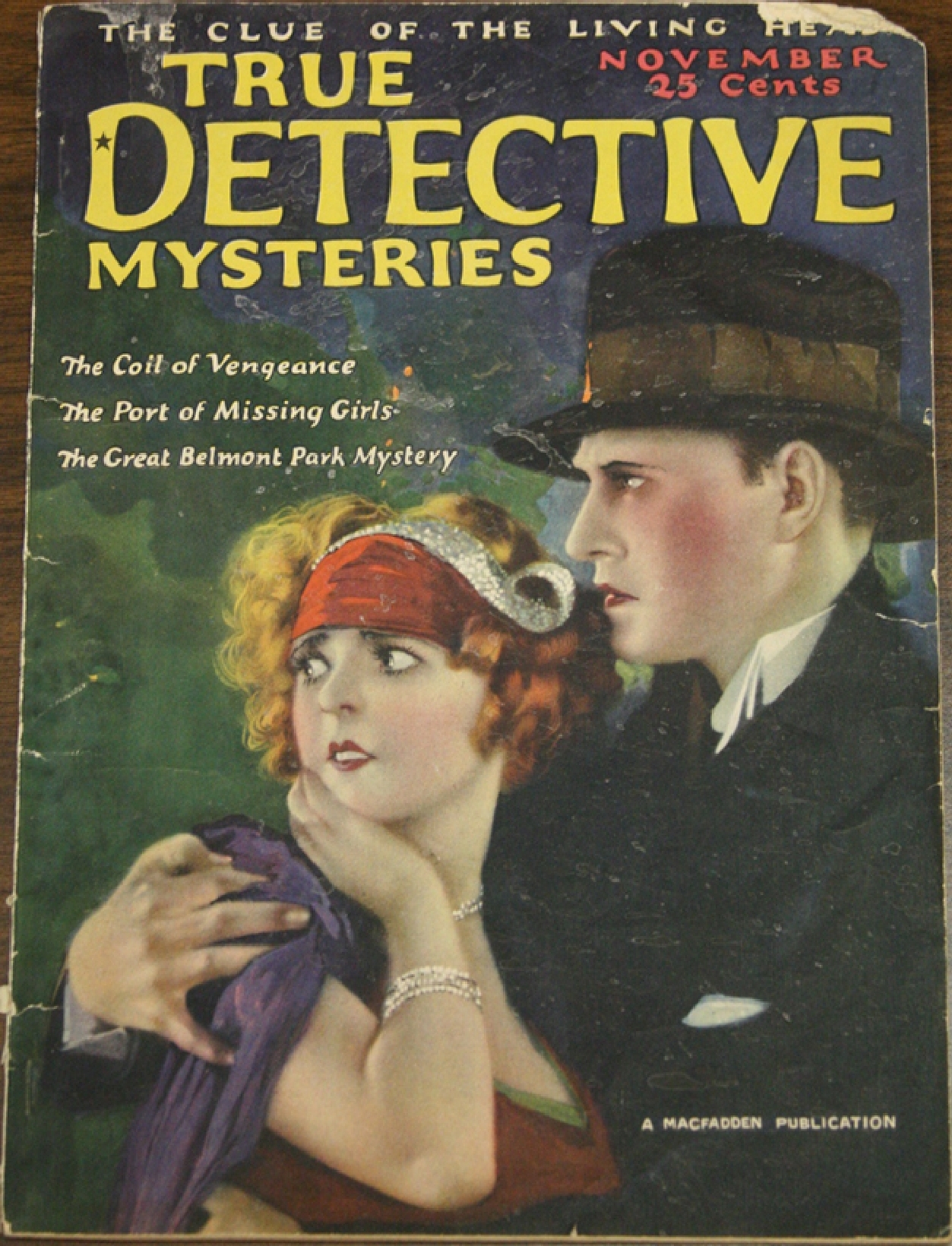
When I started this project I would have bet that “Who Killed Bob Teal?” would have been the last story I would find, given it was published in a rare issue of True Detective Mysteries.

I’ve never seen a copy offered for sale nor have I been able to identify a copy in the archives of any public or university library. But thanks to Hammett biographer Richard Layman providing me with a photographic copy of the story, I’m able to share my documentation of the blue pencil work by Frederic Dannay.

Hammett first submitted “Who Killed Bob Teal?” to Black Mask, but editor Phil Cody rejected it, along with another Op story, “Women, Politics, and Murder.” Hammett famously — if somewhat disingenuously — apologized for these sub-par efforts in a letter to the editor (Black Mask, August 1924):

. . . this sleuth of mine has degenerated into a meal ticket. I liked him at first and used to enjoy putting him through his tricks; but recently I’ve fallen into the habit of bringing him out and running him around whenever the landlord, or the butcher, or the grocer shows signs of nervousness.

There are men who can write like that, but I am not one of them. If I stick to the stuff I want to write — the stuff I enjoy writing —I can make a go of it, but when I try to grind out a yarn because I think there is a market for it, I flop.

Whenever, from now on, I get hold of a story that fits my sleuth, I shall put him to work, but I’m through with trying to run him on a schedule.

He declined to revise and resubmit the two stories to Black Mask (“neither is worth the trouble”); however, something changed Cody’s mind about “Women, Politics, and Murder,” because he published it the following month.

Hammett didn’t just stick “Who Killed Bob Teal?” in a drawer and forget about it. Instead he sent it to True Detective Mysteries, who soon published it in their November 1924 issue; one can assume they were thrilled to get a Hammett Op story, even if it was a reject from Black Mask.

Given the name of the pulp, however, they tried to create the fiction that the tale was a true story from Hammett’s time as a PI — the title page credits the story to “Dashiell Hammett of the Continental Detective Agency”.

The title character, Bob Teal, was a young op that had appeared previously in two tales, “Slippery Fingers” and “Zigzags of Treachery.”  As the story opens, the Old Man informs the Op that “Teal was killed last night.” While not among the top tier of Op stories, “Who Killed Bob Teal?” is significant because Hammett tries out an idea that he would re-use, to better effect, in The Maltese Falcon.

Spoiler Alert: Teal’s body is found with singeing on the breast of his coat — he was obviously facing his killer at short range when he was shot twice through the heart; Teal never pulled his gun. The Op, much like Spade five years later in explaining Archer’s murder in the Falcon, concludes that only Teal’s client could have gotten that close to Teal while he was tailing a suspect, without arousing his suspicion.

The story also contains a great character in the person of Mrs. Whitacre/Mae Landis, the alleged wife of the prime suspect. She’s a tough cookie who can lie convincingly to the Op and then knows how to cut a deal for herself when the lies don’t hold up.

Once again, Dannay felt the need to edit the story when he reprinted it in the July 1947 issue of Ellery Queen and then collected it in Dead Yellow Women later that year —cutting three kids and their puppy out of the story! And, once again I’ve followed my usual format in documenting those edits: page number, line number, whether it is from the top or bottom of the page, and the text corrections, with Hammett’s original text that was deleted underlined.  The page numbers refer to the paperback digest first edition Dead Yellow Women from Spivak.


Page no.    Line #     Top/bottom     Text

95              1             top                   “Teal was killed last night”; should be a separate paragraph.

95              1             bottom            The Old Man didn’t look at me as he went on. He was talking to the open window at his elbow.

97/98         1/1          bottom/top      He looked at me blankly for a moment out of wide brown eyes, and then repeated: “Killed?”

98              7             bottom            Whitacre and the money. I left him trying frantically to get his attorney on the telephone.

99              18           top                   by tomorrow or the next day.

99              10           bottom            Dean’s glance met mine, and I nodded an answer to the question that I read there.

100            15           bottom            Finally she shrugged, her face cleared, and she looked up at us.

101            7             top                   leaving me with only twenty dollars to my name and not even much that I could hock, and with the rent due in four days

101            3             bottom            “Go ahead,” she invited. “Take it apart if you want to. I’m coming all the way with you people.”

101            1             bottom            Whitacre, when he had burned the things that might have given him away, had made a clean job of it.

102            7             top                   Dean and I rode down in the elevator in silence, and walked out into Gough Street.

102            9             bottom            sewing on a pair of overalls, while three dirty kids tussled with a mongrel puppy up and down the room.

102            8             bottom            and told her that we wanted to speak to her in privacy. She got up to chase the kids and their dog out, and then stood with hands on hips facing us.

102            1             bottom            “Who lives in number one?” I asked.: should be a separate paragraph.

103            19           bottom            to see what they look like, and prying into their business.

103            9             bottom            “No.” Triumphantly: Dark.”

“Dark eyes, too?”

“I guess so.”

104            16           top                   an’ maybe sharin’ a cell with ‘em. Think that over.

105            2             top                   and he went to the telephone in the front room to arrange it.

107            7             bottom            they’d need a meeting-place of some sort. The rest of the box of cartridges there helped some too.


This leaves us needing the original text for just three stories: “Corkscrew,” “Mike, Alec, or Rufus” and “The Nails in Mr. Cayterer.”

Posted in Dash, Frisco | Tagged , , , , , , , , , , , , , |

Tour: Sunday July 29

Next tour anyone with ten bucks handy can show up for, walk the four hour walk, will be at noon Sunday July 29. If interested, be there.

I do have a tour by appointment between now and then for the Dashiell Hammett Society of Studs (the DHSOS — and you thought you knew of all the groups, sub-groups, splinter groups, and whatnot — I’m telling you, they are falling out of the trees).

My inclination for August is not to pop anything extra, since I’m off to PulpFest and have other things going on, but in September there will be a tour each and every Sunday in the month.

Posted in Tour | Tagged , |

Hammett: “Vamping Samson”

For me a writer’s life is traditional biography superimposed over strict bibliography. I want to know what was written, when, why, and then follow the writings into print, especially print that occurred in the writer’s own lifetime, when it meant something. If the author met Charlie Chaplin or hopped a freight to Phoenix that same week, cool, but I wouldn’t be interested in this particular life except for the writings. The more you can tell me about the literary work, the better I think a literary biography rates.

Our now seasoned and steady-as-hell Guest Blogger Terry Zobeck returns with a look into Hammett’s early literary life, and a rare statement from the future author of The Maltese Falcon on how he came to create one of his short stories (as Terry said to me on the side, he really wishes Hammett had discussed the creation of one of the first Continental Op tales).

Here’s Terry:

Over the years in collecting Hammett’s original appearances I’ve always been intrigued by the title of the article he wrote for the May 29, 1925 issue of The Editor: The Author Weekly: “Vamping Samson.” I’ve always thought of vamping in the sense of improvising in music, especially jazz. Having finally tracked down the article and learning what it was about, I love the title even more.

The Editor styled itself as “A Journal of Information for Literary Workers: A Weekly Service for Authors.” In a regular featured column The Editor asked authors to discuss “the genesis, conception, development, and writing of fiction, poems, and articles published in current periodicals.”

They tapped Hammett to cover his story “Ber-Bulu,” published just a couple of months earlier in the March 1925 issue of Sunset (and currently collected, pure text intact, in Lost Stories).

It’s somewhat curious that The Editor would reach out to Hammett for an article on his fiction. He’d only been a published author for about two-and-half years. While he had over three dozen stories in print, they appeared mostly in the lowly pulps.

How well-known was he at this point?

The slightly more upscale Forum had published a book review by him (“Mr. Hergesheimer’s Scenario” in the November 1924 issue), but they often published unsolicited reviews from their readers.

Writer’s Digest (June 1924) had published his rebuttal (“In Defense of the Sex Story”) to H. Bedford Jones’ complaint about the increasing use of gratuitous sex in fiction. (The prolific Jones was “the King of the Pulps”; how and why the relatively unknown Hammett was chosen to respond to him remains a mystery.)

The fact remains, however, that The Editor asked.

Hammett opens the article by noting that this version was his second attempt to respond to The Editor regarding “Ber-Bulu”:

I tore up the first one: it was a nice clear account of every step in the story’s construction, and that was what was the matter with it. It explained everything clearly if not truthfully, and was especially logical in dealing with things in the story that were done haphazardly, or, at best, intuitively. I shall try to avoid that sort of deceit now, but it is not likely that I shall be altogether successful; I can see too many things in the story now that I did not see when I was writing it.

Hammett goes on to explain that “Ber-Bulu” grew out of wondering what if Samson was just a “rugged old warrior, nowise extra-human, whose peculiar adventures formed the nucleus of the familiar legend.” In effect, he improvised or vamped on the Samson legend. He threw out all of the bits of the legend and was left with “the mighty hairy giant who lost his strength with his hair, and who was on the whole hardly an admirable figure.”

In writing his story, Hammett renamed Samson Levison. In finding a link between Levison’s hair and his power he shifted the emphasis from his locks to his beard, with the idea that his Samson had an embarrassingly weak chin in need of a disguise. He decided to pluck his story from the Bible-lands and set it down in the Sulu Archipelago shortly after the Spanish-American War, noting:

It had the degree of modernity I needed, it had not been written out of reality, and I liked Moros. Further, the Bible story would be plausibly fresh in the minds of a folk newly acquainted with Christianity, and, with a missionary on hand, I could make that plausibility doubly sure. There need not have been any explicit connection between the older story and mine, but why ignore the value of so solid a stone in my story’s foundation?

Rather than making his Delilah —Dinihari, a Malay girl — the focus of the story, he made Jeffol, a local lad recently converted to Christianity and Levison’s rival for the girl, the hero.

Jeffol brings Dinihari home to his harem. He soon loses all his money gambling, and while depressed, converts to Christianity. The local missionary convinces him, as a Christian, he must divorce all of his wives, except the first. But Jeffol wants Dinihari and so he decides to divorce all of his wives so he can marry her. While he is gone to seek the needed divorces, Levison arrives on the island and takes Dinihari as his girl. Jeffol returns, fights Levison, but loses.

The missionary suggests the Samson story to Jeffol — Hammett acknowledges that “this angle was withheld from the reader until the last, of course, and even then I did not specify the extent to which the missionary had seen through Levison’s mask of hair.” Jeffol’s friends hold Levison down so that Jeffol can shave him, whereupon they all break out in derisive laughter. Levison flees the island in humiliation and Dinihari returns to Jeffol.

Hammett explains with this action invented, all that remained was to clothe “this bald and, as you have discovered, quite hopelessly lifeless plot with words and phrases that would trick the reader, or at least the editor, into some sort of interest.”

An important decision was to tell the story in the first person. Hammett chose to have the gambler, to whom Jeffol lost all his money, be the narrator, thus letting him condense the story, retain its anecdotal tone, and keep dialogue to a minimum.

Hammett writes that the “story went off rather easily: I framed and wrote it in three days, an almost miraculous speed for me, who can seldom do anything in less than three weeks.”

“Ber-Bulu” is among my favorite early Hammett stories. It is one of the few that he set outside of the United States and it is not a crime or detective story.

“Vamping Samson” is a significant piece as it is, along with the introduction to the 1934 Modern Library edition of The Maltese Falcon, one of the few examples of Hammett discussing his writing process. It has further significance to Hammett collectors, however, in that he concludes the article with some rare biographical and bibliographic detail; he writes:

My earlier work is close enough for memory if hardly far enough away for perspective: it is not yet three years since I installed my first typewriter and picked out my first story, “The Barber and His Wife” (Brief Stories, December, 1922). My first sale and appearance in print was as one of the considerable company who came out in The Smart Set under the editorship of Messrs. Nathan and Mencken, though it is conceivable they don’t boast of the discovery.

Because I spent some years sleuthing around the country in the employ of Pinkerton’s National Detective Agency, about half of the fiction I have written has had to do with crime, though, curiously, I was some time getting the hang of the detective story. And while, with the connivance of The Black Mask, that type of story has paid most of my rent and grocery bills during the past two years, I have sold at least one or two specimens of most of the other types to a list of magazines, varied enough if not so extensive, that includes Action Stories, Argosy-All Story, Black Mask, Brief Stories, Experience, Forum, [The New] Pearson’s, Saucy Stories, Smart Set, Sunset, True Detective Mysteries, besides a few book-reviews, articles and short miscellaneous matter here and elsewhere.

There are several interesting tidbits in these two paragraphs.

First, Hammett claims “The Barber and His Wife” as his first story. In an earlier post I discussed Hammett’s short story output. In counting his published stories, I included “The Parthian Shot” (Smart Set October 1922) and “Immortality” (10 Story Book November 1922), presuming them to be his first two stories — as did Vince Emery when he collected them in Lost Stories.

Hammett apparently considered them “short miscellaneous matter.”

Second, he notes that his first appearance in print was in the pages of The Smart Set (presumably the aforementioned “The Parthian Shot”), thus confirming that bit of bibliographic fact.

Third, Hammett acknowledges that, despite his experience as a Pinkerton Op, it took him awhile to get the writing of detective stories right.

And fourth, and perhaps most intriguing, he lists the publications in which he’s published stories. Among them is Experience, in which he had just published “Another Perfect Murder” (February 1925). It may be this reference in The Editor that provided Richard Layman with the date (“prior to May 1925) in which Hammett would have published in Experience (at the time, he indicated Hammett had published two stories in Experience — “The Man Who Loved Ugly Women” is the other, and so far unlocated, story).

In this list of publications, Hammett also includes the Forum. This inclusion is puzzling. According to the standard bibliographies, the only Hammett items that appear in the Forum are three book reviews, only one of which had been published by the time of “Vamping Samson.”

He is specific in listing these publications as ones in which he had published a story; he includes his book review work separately. Is it possible that he published a story in the Forum, one that is unknown to collectors and scholars? Looks like I’ll be going back to the Library of Congress soon.

It also is curious that he claims to have published a “few book-reviews.” As far as we know, as of May 1925, Hammett had published only a single book review; it is, as noted above, “Mr. Hergesheimer’s Scenario” in the November 1924 Forum. Rather than a mistake on Hammett’s part or the possibility of previously undocumented reviews, it is likely that Hammett was thinking of a review he had recently written and submitted to the Forum on Upton Sinclair’s Mammonart. In a letter to the Forum dated March 6, 1925, Hammett asks that they make some changes to the review that he had submitted two days earlier; this review was never published, but, at the time he wrote “Vamping Samson,” Hammett probably presumed it would be.

Posted in Dash, Lit | Tagged , , , , , , , , , , , , , , |

Hammett: And Lovecraft

Whoa. Friday the 13th. Time to get a little eldritch and unspeakable for Biography Month. . . .

And unspeaking of H. P. Lovecraft, I admit I’m just as interested in the Could Have Beens of a writer’s life as the Plain Facts, and old HPL’s life is filled with more Could Have Beens than most.

One of the most fascinating is the idea that the publishers of Weird Tales, the major pulp magazine market for his tales of cosmic horror, thought about doing what would have been the first collection of his stories in 1927. The idea that the same thing almost happened to Hammett with the collection Including Murder apparently intended for release circa 1925 or 1926 from the publishers of Black Mask, his major magazine market — struck me as yet another parallel between the two pulpsters.

I refer to the proposed Lovecraft collection in the essay “Conan the Argonaut,” specifically in the selection which I put up on the anniversary of Lovecraft’s death this year. To recap fast, Lovecraft more or less “starved to death” — little money, a lousy diet, eventual disease and early death — even as the editor at Weird Tales, Farnsworth Wright, rejected one story now considered among his masterpieces, after another. Who knows if the book collection in 1927 would have changed the dynamic, allowed Lovecraft to eat better (years of poverty may have had him firmly in the grip of the dietary habits that led to his demise), break out, reach a wider audience? You can’t say for sure, but you can’t help but think, What If?

Maybe more and even hotter fiction from Lovecraft, over a longer life. . . .

I devoted a few years, off and on, to debating some of those possibilities in the letters column of The Cimmerian — if you’re interested in this sort of thing and ever get a chance to add those issues to your collection, grab them. One angle that keeps coming up is that Lovecraft was in effect the Hammett of Weird Tales, and Robert E. Howard was the Chandler. The first great figure in those pages, as Hammett was for Black Mask, and the hugely talented follow-up, as Chandler was for The Mask. The parallels aren’t precise — Lovecraft died in 1937 thinking he was a failure, while Hammett left Black Mask behind for hardcover publication by Knopf and serious Hollywood money. Lovecraft was handicapped by an editor, Wright, who repeatedly derailed him when he was about to get on a roll — while Hammett in 1926 got editor Joe Shaw, who encouraged him to write novel-length works and really let loose.

See where I’m going? Both writers have become classics, but Lovecraft died broke and Hammett realized success.

But the What If? that intrigues me now that I know about Including Murder is the idea that for Hammett, a collection from a pulp publisher at that date might have handicapped him, soured a major press like Knopf on the idea of picking him up later. Impossible to say, but among Could Have Beens I see a life where Hammett got Including Murder out, chosen from the best of his early Op stories, it didn’t do much, he still quit crime writing by 1926 — and Shaw never came in to lure him back.

Including Murder would have still been a hell of a collection. And so would that ghostly 1927 book by Lovecraft.

Posted in Dash, Lit, REH | Tagged , , , , , , , , , |

Rediscovered: More Life of Floyd

Got a note from Matthew Asprey that he’s got another publishing deal gone down — the magazine Contrappasso.

Haven’t seen it yet, but a star feature for Up and Down These Mean Streets types would be a new autobiographical piece from Floyd Salas, doubtless covering his youth as a streetfighter in Oakland. All Floyd is Floyd’s life — actually, a grand tradition, especially in tough guy writing. Pretty much the same for Jim Tully. Edward Bunker. Eddie Little. And extending out from strict tough guy lives, for a Jack Kerouac. William Burroughs. You like the autobio and fiction, you get roped in on the lives — and from there, you can head off in a thousand directions. I’m betting this new piece is a retitle or extract from the last thing I heard of that Floyd was working on, The Dirty Boogie.

Plus, this first issue includes an interview with the late great James Crumley, a.k.a. Crumdog, author of the classic The Last Good Kiss, once described as “the bastard son of Raymond Chandler” — Crumley ranks among the greats, and I’m really glad I got the chance to meet him. And as we’ve demonstrated here for Biography Month, a good interview is essential for putting together a life.

Posted in Lit, News | Tagged , , , , , , , , , |

Hammett: Thoughts on “House Burglary”

Wrapped in its art deco cover, the lost interview with Hammett from 1929 that Terry Zobeck located — “House Burglary Poor Trade” — is the author at a peak. Still writing for Black Mask. Not yet Hollywood. Charming, and willing to answer questions in detail.

I’ve talked with people who knew him only a decade later, where the answers were at best cryptic or not answers at all. Jerome Weidman, who didn’t believe Hammett’s story about why he included the Alfred Packer bit in The Thin Man (tour book, page 119). Or the guy who met Hammett in Anchorage during the Second World War and wanted to talk about the fiction and got nothing — and left with the impression that Hammett was just a bitter drunk.

But in 1929 Helen Herbert Foster spoke with Hammett when he was fresh. And it is obvious to me she was one sharp reporter. In connection with the tour I’ve been interviewed at least a couple of hundred times, so I trust my sense of what is a hot interview vs. something that is routine and boring, who has the reporter’s nose (the late, great John Jacobs had that nose sniffing every current of air) and who never will.

My favorite moment comes when she notes, “He’s cynically funny though one of the most genial people you’d want to meet.”

There is an entire era of writing about Hammett where it is obvious the commentators don’t recognise that Hammett is funny. Most of the biographies. Most of the litcrit. Yeah, sure, The Thin Man has nice one-liners, everyone will acknowledge that, but then it is The Last Novel, by which time Hammett Had Lost It — Thin Man is no Red Harvest, no Maltese Falcon. Hammett — he did penetrating sociological analysis of a hard-bitten America in the 1920s — he wasn’t funny!

From my first readings of the Op stories, I knew Hammett was funny — and for thirty-five years on the tour have made sure people hearing about those stories know it, too. The big breakthrough came when Jo Hammett began appearing before groups such as The Maltese Falcon Society, selecting passages from Op tales that echo Hammett’s cynical humor — where she could hear her father’s voice saying that kind of line.

Finally, biographers and such like figured out that Hammett was funny — I expect the next wave of biographies to reflect this fact.

(I have a standard for what makes an Op story one of the greats — somewhere in the action there must be a side-splitting moment of humor — more than one is okay, too, but it’s not a non-stop Vaudeville routine — and if it doesn’t have that, it isn’t Hammett writing at full-tilt.)

And in his last story “Death and Company” — an Op story  — for Black Mask, the November 1930 issue, Hammett describes himself as the perp and echoes Foster by noting that he has a “very agreeable personality.” (Terribly interesting for the biographical angles, “Death and Company” isn’t top flight Op — no hilarious moments.)

My next favorite bit of info coming out of the interview is Hammett saying, “I was attached to a national agency as an operative, before and after the war, in the East, Northwest and on the Pacific Coast.”

When I covered the photo of Hammett and the head-breaking crew, I encompassed that area and guessed wider, writing that he worked as a Pink “all across America, from Baltimore and points east to Butte, Montana and Spokane, Washington and points west. And, for all we know, points south, and anywhere in between.” Part of the background for guessing wider is the litany of streets the Op hunts through at the beginning of The Seventeenth Murder, chapter 21 of Red Harvest — including streets in Baltimore, Boston, New York, but also “Aetna Road and St. Clair Avenue in Cleveland, McKinney Avenue in Dallas” — “Berry Boulevard in Louisville” — “Victoria Street in Jacksonville” — “the street that runs past the Federal Building in El Paso as in Detroit’s Grand Circus Park.”

Not long ago a guy on the tour asked about these streets, suspecting the list indicated Hammett had been through those places — he figured that the street names were obscure enough that you wouldn’t know them unless you’d been there, you wouldn’t pick them off a map at secondhand.

Since many people insist on separating strict biography from litcrit angles, purist types now have these three geographical areas — areas we have known about for years now — but nothing new. The only slightly rogue location also “confirmed” by an interview appears in The Bookman profile in 1932 by Eve Sanderson, which reports that “disguised as an ardent I.W.W. he was sent to Minnesota.” But The Bookman piece has several errors, including saying that Hammett fought in World War I — and my inclination would be to think that Hammett told that interviewer that he was sent undercover to Montana and the transcription went wrong.

Finally, Terry Zobeck tells me that when Hammett biographer Richard Layman looked over the interview, he noticed that “it includes some of the most famous language from Raymond Chandler’s ‘The Simple Art of Murder.'”

Well, not word for word, but certainly thought for thought. Hammett predates Chandler’s defense of the Black Mask school of crime writing — the When in Doubt, Have a Guy Come into the Room with Gun Drawn riff — with his bit about writing “a story about a detective rather than a detective story. Keeping the reader fooled until the last possible moment is a good trick and I usually try to play it, but I can’t attach more than secondary importance to it.” In terms of mystery litcrit, that’s the most important moment — knowing that Hammett, who almost always provided clews and played fair, still knew that he was going beyond the basic puzzle format into something bigger and better.

The entire riff about the Op going forward presages Chandler’s classic down these mean streets statement quite effectively. I very much doubt that Chandler would have seen this interview, so he’s not copying Hammett’s ideas — he has the same ideas, the same intent.

And the reference to Manuel — how seldom do we get much of Hammett’s Catholic background. An icing-on-the-cake biographical moment. I’m no Biblical scholar, but a quick web search handed me the idea of “Be true to who you are, knowing the cost.”

The Op as Manuel. Yeah, you get beat up, you go on.

Posted in Dash, Lit, Tour | Tagged , , , , , , , , , , , , , , , , , , |

Rediscovered: Tully Dies, The Ring Records

Just finished the new bio of Jim Tully last night — review and miscellaneous thoughts to follow.

And even as I was punching my way toward the final bell, Brian Leno — resident Up and Down These Mean Streets expert on the world of old time boxing — popped in some scans from the September 1947 issue of The Ring with the obit for Tully.

None of the Ring obit makes it into the Tully bio —- you can’t fit each and every piece of info in, without making a book practically unreadable, and the Tully biographers shoot for and hit the readable target.

But I figure it’s worth seeing.

Written by Ring editor Nat Fleischer, it leans toward Tully’s own history as a boxer and writer about boxing, as you’d expect. Only detail that I see Fleischer gets wrong is Tully’s age upon his demise — he had just turned 61 in June 1947.

I especially like that “sorrel-thatched” bit for good old Red Tully.

If you’re interested in exploring the world of this almost forgotten writer, now riding the rediscovery rails, his novel of boxing The Bruiser is one of the titles Kent State University Press has reprinted in a very nice new trade paperback format. A few years back, kind of hard to get, now — for awhile, at least — easy to put a glove on.

Posted in Lit | Tagged , , , , , |