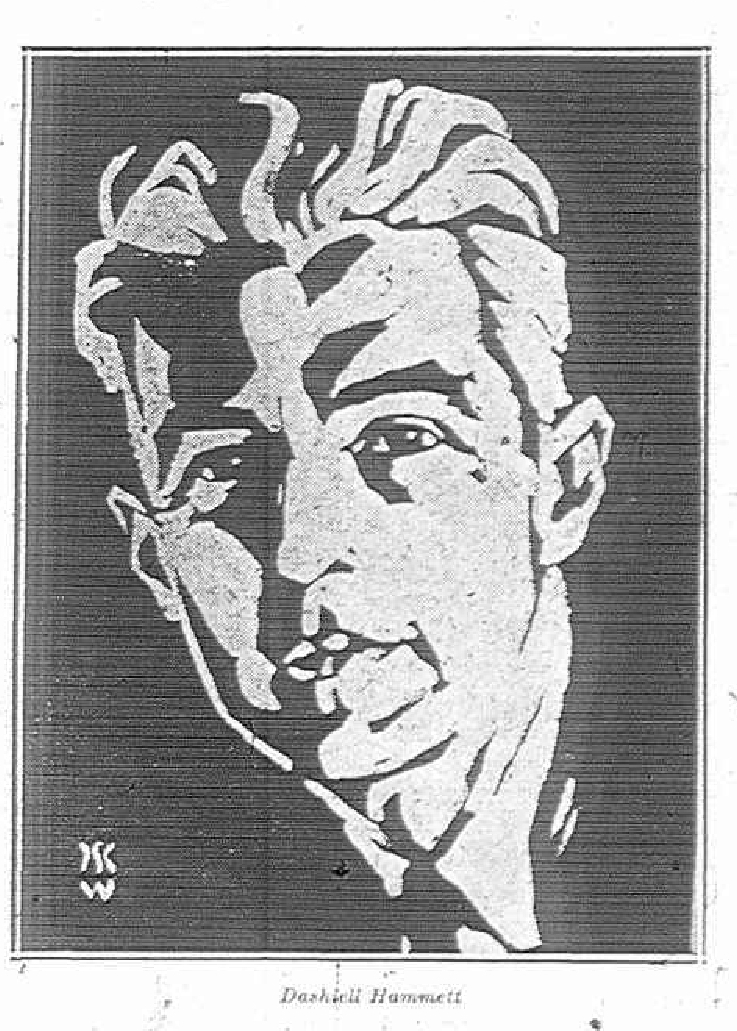
Hammett: The Lost Interview

For Biography Month, what could Terry Zobeck dig up, with which to startle and amaze? How about a forgotten interview with Hammett, filled with a wealth of biographical detail?

Here’s Terry:


Hammett didn’t do many major interviews, other than Eve Sanderson’s piece in the January 1932 issue of The Bookman and James Cooper’s Daily Express interview for March 22, 1957.

I can’t recall another one.

Until now.

Our good friend John Squires alerted us last year to an amazing website containing thousands of microfilm images of historic New York state newspapers, and this past weekend I went diving into the archives in search of Hammett material. I was looking for any evidence of syndicated appearances of Hammett’s work — starting in 1934, Hammett entered into a deal with King Features Syndicate as part of his promotion of the Secret Agent X-9 comic strip. Later he had a similar syndication arrangement with the Hearst papers.

I did indeed find several of his stories appearing in various New York papers through the mid-1950s — and more on these later.

But the most astonishing thing I found was a previously undocumented interview.

Nineteen twenty-nine was perhaps the most momentous year of Hammett’s career. At the beginning of the year, his first hardcover novel, Red Harvest, was published. In July, The Dain Curse followed on its heels. In September, Black Mask began serializing The Maltese Falcon. And by October, Hammett had begun writing The Glass Key. Not a bad year for an ex-detective and one-time lunger.

By October, he had arrived in New York City, after leaving San Francisco. Sometime shortly after landing in New York he sat for an interview with Helen Herbert Foster of the Brooklyn Eagle Magazine (A Magazine of Personalities) — a weekly supplement of the Brooklyn Daily Eagle.

The interview, titled “House Burglary Poor Trade,” occupies a single page and runs for about 1,300 words; about two-thirds direct quotes from Hammett.

The three paragraphs that purportedly recount Hammett’s Pinkerton’s cases are nearly verbatim from his March 1923 Smart Set piece “From the Memoirs of a Private Detective.” I suspect Hammett told her to just quote the stories she liked, while Don believes he just rattled the lines off as schtick, from repeated telling of the tales. Practically one-liners. (Lending credence to Don’s guess, Hammett tells Ms Foster: “This is what you wanted to hear, wasn’t it? All reporters want to hear such experiences from detectives. And these are authentic enough, goodness knows.”)

Hammett speaks of what it takes to be a good sleuth and the impact it has on his writing:

For being a professional busybody requires more energy, more dogged patience than you’d suppose. I got so tired of it that I just had to give it up, though I have a flair for that kind of thing. There never was anything lacking in the matter of my curiosity. It’s not an easy business. A good detective is quite a person. He is a type that has always intrigued me. And for that reason I never subordinate his personality to the plot of my story.

What I try to do is to write a story about a detective rather than a detective story. Keeping the reader fooled until the last possible moment is a good trick and I usually try to play it, but I can’t attach more than secondary importance to it. The puzzle isn’t so interesting to me as the behavior of the detective attacking it.

Hammett then provides a lengthy summation of his life growing up in Baltimore and Philadelphia and the string of jobs he had, noting “I was often fired, I’ll admit that. But always most amiably.” He concludes this section with how he became a detective:

I was attached to a national agency as an operative, before and after the war, in the East, Northwest and on the Pacific Coast. I was a pretty good sleuth, but a bit overrated because of the plausibility with which I could explain away my failures, proving them inevitable and no fault of mine.

Later, he returns to this topic, claiming that, “Thanks to my ability to write pleasing and convincing reports, my reputation was always a little more than I deserved.”

Ms Foster also picks up on Hammett’s keen sense of humor. She observes that “When Mr. Hammett speaks you just have to watch your step. You have the feeling he’s setting traps for you to fall into. And maybe he is. He’s cynically funny though one of the most genial people you’d want to meet.”

The biggest surprise for me was learning that Hammett declared himself to be “. . . an artist, or nearly. That is, I have a tendency to fritter away time over a drawing board trying to make black marks come out beautiful on white paper, which they seldom, if ever, do.” I’d love to have an original Hammett hanging on the wall.

I sent a scan of the interview to Hammett biographer Richard Layman and he replied that he did not know of it.

I checked all the biographies, Hammett’s selected letters, all of Layman’s various reference works. Nothing. The only evidence of any prior knowledge of this interview that I have found in print comes from the quote attributed to Hammett at the beginning of William F. Nolan’s Dashiell Hammett: A Casebook (1969), concerning the dogged nature of the Continental Op:

“I see him. . .  a little man going forward day after day through mud and blood and death and deceit — as callous and brutal and cynical as necessary — toward a dim goal, with nothing to push or pull him to it except he’s been hired to reach it.” — Dashiell Hammett, on the Continental Op.

However, Nolan does not reference it as coming from Ms Foster’s interview, which it surely does. And it does not get a citation in his checklist in the back — in what would be the first of many biographies for Hammett.

Perhaps that lone quote was copied and passed on by someone, even as knowledge of the whole interview was lost.

Posted in Dash, Lit, News | Tagged , , , , , , , , , , , , , , , |

Rediscovered: Red Tully and More Hobo Jungle Sapping History

How about Biography Month here in Up and Down These Mean Streets? I’ve got some bios I’ve been intending to mention piled up on a shelf behind me, and I’m a third of the way through the recent bio of Jim Tully by Bauer and Dawidziak — prepping for the trip to Ohio and PulpFest, and ripping along (a bio of Tecumseh I picked up against the same trip is a slower go, but I think I’ll slog through in time — I’ll finish Tully first).

One specific piece of info that I’ve gleaned so far comes from the six years where a teenaged Tully hopped the freights as a road kid and picked up the moniker “Red” — Tully was only five foot three but with his startling shock of red hair probably reached close to six foot. His rod-riding began in 1901 and 1902, and by the time he left the road he had seen most of America.

Tully’s biographers mention one of his escapades that caught up another hobo coming through the area, who was forced to run a Sapping Day gauntlet because Tully helped overpower a couple of railroad bulls and left the lawmen handcuffed unconcious to a tree with their own bracelets.

They describe it this way:

Small southern and western towns particularly hostile to hoboes kept alive the ugly tradition of the Sapping Day. Men and boys judged to be vagrants were forced to run a harrowing gauntlet past law-abiding citizens armed with stones, whips, and clubs. The runner unfortunate enough to stumble might be stoned and kicked into insensibility.

If you remember my post on that photo of Hammett with a crew of head-breakers, you’ll recall that another famed hobo writer, Jack Black, described something similar involving small trees used as “saps.” I believe Black hit the road a little earlier than Tully, but both surfaced with their autobiographical books by the mid-1920s — both are considered classics in hobo literature.

As I said in that post, obviously the term sap drifted over to apply to the smaller blackjack, not an entire young tree — and the obvious guess is that Sapping Day fell by the wayside somewhere down the years, but we’re all still familiar with the term running the gauntlet. If the language hadn’t changed, I guess the Frank Frazetta poster for Clint Eastwood’s The Gauntlet would have been for Clint Eastwood’s Sapping Day. Somehow, not as good.

And don’t forget that Tully and Black would have been among the sappees, and Hammett would have been among the sappers. Hard-boiled.

Posted in Dash, Lit | Tagged , , , , , , , , , |

Hammett: The Big 88

My spies out there in the world, always keeping an eye on the news, have alerted me to the latest honor for the author who makes The Dashiell Hammett Tour the rollicking fun ride that it is: Hammett’s Red Harvest has cracked a list of only 88 titles that the Library of Congress has called “Books That Shaped America.”

See, I told you it was good.

Edgar Rice Burroughs, mentioned on this blog lately because of John Carter of Mars, gets a nod for Tarzan of the Apes. And Zane Grey, despite a brutal attack on his most famous novel by Brian Leno, sees Riders of the Purple Sage make the list.

Check the whole thing out, see how many you’ve read. If you haven’t done Red Harvest as yet, my honest advice is that you should read as many of the Continental Op tales that precede it as you can, since the buildup to the Op going “blood simple” starts earlier, certainly by “Zigzags of Treachery.”

Looks like I have read eighteen, for certain, sampled five or six more, and some of the plays I’ve seen but haven’t read the actual play.

On the personal front, I have met only one of the authors — Randy Shilts, who once covered a detective game I did during the heyday of The Suicide Club, though we weren’t telling the reporters from outside that The Suicide Club loomed mysteriously behind the action.

I could have met several more, of course. I once saw Allen Ginsberg through the window in City Lights, the shop was so crowded it looked like the floor might collapse. Ditto Ray Bradbury, coming out of a signing in LA — in both cases, I could have nudged my way in or over for a few words, but I was content just to look at them for a couple of minutes.

On the early lit scene, I’ve been to Ben Franklin’s grave in Philly, which is as close as I’ll get. I never met Hammett, but know his daughter. Never met Jack London, but met his daughter. Never met Kerouac, but met his daughter Jan Kerouac.

Posted in Dash, Lit, News, SFSC | Tagged , , , , , , , , , , , , , , , , , |

Hammett: More “Op” Coinage

After his first stab at tracking down when the term “The Continental Op” came into play, Terry Zobeck returns to the pulps and books to search for more clews.

When last seen he had found the Continental Op — cap C, cap O — first used in a tag line for “The Farewell Murder” in Black Mask, February 1930, the next to the last Op story, and I had asked if the term recurred in the final Op yarn, “Death and Company.” Here’s Terry with the answer:


For “Death and Company” in the November 1930 issue Black Mask used “The Continental Op” in both the Table of Contents — The Continental Op turns in a tough case — and in the intro for the story — The Continental Op tackles a Killer.

I also thought to check “This King Business” in the January 1928 issue of Mystery Stories — wouldn’t it have been a hoot if that editor had named him the Op? But, no, he is called “The American Detective.”

Another late Op tale, “Fly Paper,” Black Mask, August 1929, uses “The Continental Detective” (thank god he didn’t become the Continental Dick).

Of course, I don’t have quite a few of the Black Mask Op issues from 1923 through 1927, so it’s possible the name was used earlier, but if so, it wasn’t used consistently. I’m missing most installments of Red Harvest and The Dain Curse, as well, but then I remembered that Richard Layman included some pages from those serializations in his and Bruccoli’s Hardboiled Mystery Writers. So I checked. The first page of “The Cleansing of Poisonville” — no mention of the Op. “Black Lives,” the first part of The Dain Curse, calls him the “Continental Detective” just like “Fly Paper.”

And finally I thought to check Hammett’s letters. Lo and behold, in a July 14, 1929 letter to Harry Block, his line editor at Knopf, he mentions the Continental Op. The letter mostly concerns The Maltese Falcon, but about halfway through, Hammett is discussing other book possibilities when he notes: “Also I’ve about two hundred and fifty thousand words of short stories in which the Continental Op appears.”

By summer 1929 Hammett was calling his sleuth the Continental Op in correspondence and within seven months the term was first used in print with “The Farewell Murder.” Just as the Op saga was wrapping up for good.


Posted in Dash | Tagged , , , , , , , , , , |

Hammett: Some Media Some More

Just got a note from Evan Lewis tipping me off to a BBC production of Secret Agent X-9 — originally a newspaper comic strip written by Hammett and drawn by Alex (Flash Gordon) Raymond. A little neo-Old Time Radio, for those of you with a taste for that sort of thing.

Plus, on the subject of Hammett, and New York, the proposed Johnny Depp remake of The Thin Man has been put on hold, at least for awhile — according to news stories all over the web.

And I heard that a director, in an interview, denies being involved in a movie version of The Big Knockover. That’s one that could be great or mightily indifferent, depending on how it is done.

After watching such films as the Coppola-produced Hammett dance to life back in the day, I’m not greatly interested in media adaptations any more — I still kind of like hearing about the movies and radio shows made when Hammett was alive, with or without his direct involvement, but something done now is just a footnote to Hammett in Hollywood (though a good Depp Nick & Nora would kick Hammett’s name bigtime into current pop culture — he’d be another figure young clueless people on Twitter wonder about — Who Is This Guy? I’ve Never Heard of Him!).

Posted in Dash, Film, News | Tagged , , , , |

Hollywood Beat: Mrs. Parker and the Literary Circle

The LAVA Literary Salon that meets in Musso & Frank has a new meeting scheduled on Dorothy Parker and F. Scott Fitzgerald — sold out already!

I missed their first meeting, on John Fante, but was in M&F only a couple of days before the one for Raymond Chandler — if I’d known I’d have tried to juggle my schedule better so I could have stayed in Hollywood for that one, if I could have grabbed a barstool. . . .

I understand the next one, in October, will be about none other than Jim Tully, and I’m going to make an effort to attend that salon, come hell or high water — and hoping it doesn’t sell out from under me.

A jones for Tully is sweeping over me again. Part of the reason I am hitting PulpFest this year is an excuse to see Tully sites in St. Marys, Ohio, where he grew up — if I’m going all the way to Ohio, I might as well make the most of the trip.

Posted in Film, Lit, News | Tagged , , , , , , , |

Hammett: Coining “The Continental Op”

Was it Cap Shaw? Was it some unheralded editorial assistant?

Terry Zobeck plunged into his Black Mask collection to check on who first used the coinage “The Continental Op” to describe Hammett’s short fat Frisco sleuth.

That’s with a capital C, of course, but also with a capital O — has to be a cap O. (As far as I know, the t in the can go either way, depending on how the term is being used). Here’s Terry:

Don’s recent post on Including Murder the what-could-have-been first book by Hammett — got me going to the shelf to check when his dogged man-hunter may have been referred to first as the Continental Op.

I have six Black Mask issues with Op stories from 1923-25. None of them refer to the detective as the Continental Op either in the table of contents or in the editor’s introduction.

Two of them refer to him as “the San Francisco Detective” — not too memorable.

I also have “Black Riddle”, part 2 of The Dain Curse, from the February 1929 issue of The Mask; there he is referred to as “the Continental Detective” — close, but not quite there yet.

One year later with “The Farewell Murder” in the February 1930 issue the editor’s introduction calls him “the Continental Op.”

Looks like, unless some other installment of The Dain Curse or, earlier, Red Harvest, may have dropped the term, that Terry has done the OED thing and tracked down the first appearance in print to use the term that has become the standard. After “Farewell,” only one more Op tale would appear in Black Mask“Death and Company” in the November 1930 issue, and that was it, no new Op stories in that pulp or elsewhere. Terry’s got that issue, when he gets a chance he can check to see if the Black Mask editorial staff followed through on the usage or went with something else.

But the term was not nailed down in iron with “Farewell,” as Terry himself has shown with his articles on Op tales being reprinted in newspapers, sometimes with new titles, sometimes with various textual changes. Not when a 1937 newspaper reprint of “The Whosis Kid” — with the title “Pick-Up” — could refer to the detective as “Continental Operative No. 7.”

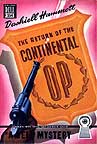
My gut feeling remains that it was Frederic Dannay in his series of reprints who established the term permanently — certainly when that first Dell Mapback collection hit the stands, with the quick one-two punch of the second all-Op collection.

Posted in Dash, Frisco, Lit, News | Tagged , , , , , , , , , , |

Tour: More Writers Who Have Walked the Walk

Remember the “guy from Australia” who asked for the tour on June 17? Turns out he was none other than Christopher Sequeria, big into Sherlock Holmes, with sidelines in horror, comic book scripting, etc & etc. When I found that out I made sure to show the group the only place Sir Arthur Conan Doyle ever stayed in San Francisco (the Clift Hotel, if you didn’t know). And I told them the story of 2151 Sacramento Street which has a big plaque on it stating that Doyle occupied the place (yeah, for a couple of hours, one morning).

The last writer who came out for the walk that I remember offhand was Chris Ewan of the Good Thief series — and before him you had Charles Willeford and Ace Atkins and a host of others. I did a tour by appointment for fantasy and science fiction writer David Drake one time, who told me about his first story being accepted by August Derleth at Arkham House — who informed him in detail of every little thing that was wrong with the story and how he would rewrite it to suit himself — the “most brutal acceptance note” he ever got. And later when the World Fantasy Convention came into the area I did a couple more tours for more f&sf guys — didn’t catch all the names, but bestseller Steven Erikson and Laird Barron and a bunch more.

Clark Lohr apparently wasn’t a published writer when he walked the walk, but he is now, he tells me, with The Devil’s Kitchen — kind of that Southwest soaked by heat thing I associate with Dennis McMillan after visiting him in Tucson when it was 115°.

And during the last Bouchercon that stopped in San Francisco I learned that Ken Wishnia apparently took the tour long before he became a writer, too — in the early days of the walk when the grooves in the mean streets weren’t as deep. I believe he said he was a student at State (or City College, as the case may be) at the time. I did some walks for that convention, too, and doubtless some writers snuck in without me knowing who they were — I do remember Jonathan Woods in his white suit, not least because I actually had read Bad Juju at the time (nice souped up neo-noir).

Posted in DMac, Frisco, Lit, News, Tour, Willeford | Tagged , , , , , , , , , , , , , , |

Tour: Sunday July 1

The next walk anyone can show up for, no reservations, no questions asked, will be Sunday July 1. The usual routine. Four hours. $10 per person. Start at noon near the revolving “L” sculpture.

The shot above may be of interest to people who’ve never taken the tour, never been in San Francisco — it looks west up Bush from the parapet above the Stockton tunnel and shows where Dashiell Hammett Street meets Bush. Just above Mike Humbert’s left shoulder (that’s Mike Humbert with left shoulder visible). The red banners on the Vintage Court hang on the far side of Dashiell Hammett Street (where this etched-in-concrete wording may be found). The street sign on the near side of Dashiell Hammett Street is obscured by the small round tree — here’s a shot from the other side, looking east down Bush.

Posted in Frisco, Tour | Tagged , , , |

Hammett: A Couple of Thoughts on Including Murder

As I’ve been brooding over the Robert S. Powell article about the first Continental Op collection Including Murder, two kind of random thoughts hit me:

First, Powell describes the emendations in pencil on the tearsheets as being done in a “consistent hand” — which I take to mean that he doesn’t recognise Hammett’s holograph. Before anyone could use the corrections in any future editing on a Complete Continental Op volume, the marks would have to be by Hammett and not by someone else. I presume they are Hammett, of course — while I haven’t seen those I have held the long Knopf galley sheets for The Dain Curse hand-corrected by the author. It doesn’t take more than a few minutes to become familiar with Hammett’s handwriting, which in its own way is as distinctive as that of H. P. Lovecraft (guys who can’t recognise authentic Lovecraft script kill me).

Second, while I have not the slightest doubt that the collection would have been all Op — not mostly Op with a couple of random standalone crime stories tossed in — I wonder how they would have referred to the Op on a finished book. Without checking all the stories thought to be in the lineup for the contents, my impression is that no one — not Hammett, not editorial blurbs at Black Mask — was referring to the anonymous narrator as “the Continental Op.”

Maybe as an op. As an operative for the Continental Detective Agency. As a short fat sleuth.

I suppose I need to do a reread on the whole series again, but I was kind of surprised as I was rereading Red Harvest a couple of years ago to find that the Op does (almost) call himself the Continental Op in chapter six, Whisper’s Joint: “I’m the Continental op who tipped Dinah Brand off. . . .”

But by late 1924 or early 1925?

I’d love to have seen blurb lines for the book, trying to explain the detective. Anonymous, tough, short, fat operative for a detective agency in San Francisco. . . .

Even better, Hammett might have had to coin the descriptive term for his Op on the spot, and might have come up with something else entirely. Not left it to default mode where fans such as Frederic Dannay prowled the stories and novels and decided on “the Continental Op.”

Posted in Dash, Frisco | Tagged , , , , , , , , |