Two-Gun Bob: A Living Legend

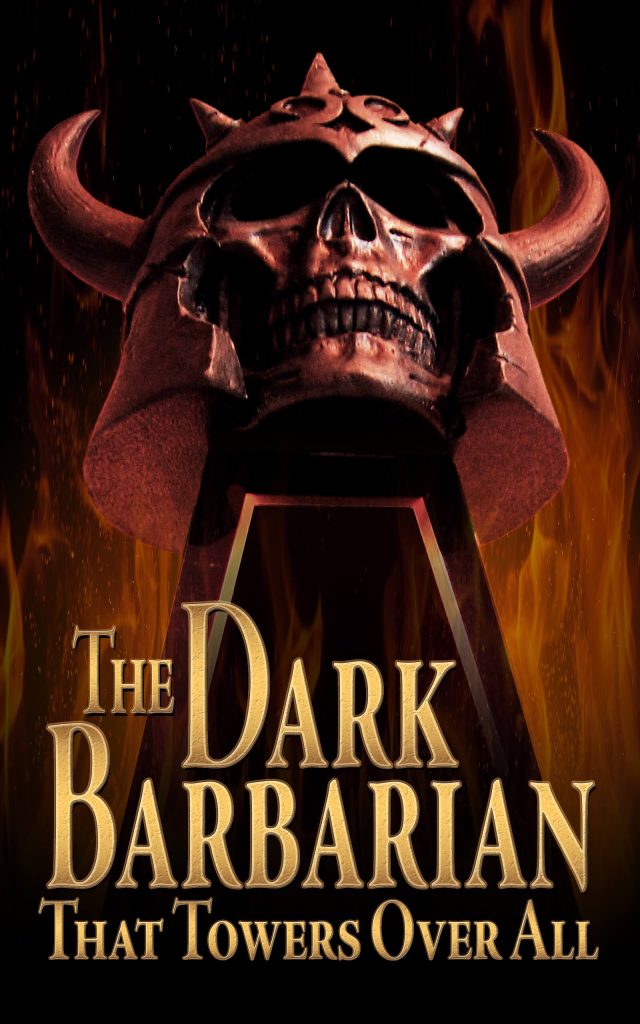
Today they’re tossing a party for Glenn Lord in Texas, to celebrate the father of Robert E. Howard fandom hitting his 80 year milestone on the 17th. Yeah, I kind of wish I was there — I’ve always liked Glenn, who has provided assistance with many of my Two-Gun Bob projects over the years, beginning in 1974 with some notes that I needed before I could write “Conan vs. Conantics.” And of course Glenn was a cornerstone factor in my being able to put The Dark Barbarian together in 1984. No Glenn, no Howard Studies as we know it today — and whatever “studies” there may have been instead probably would have been fairly pathetic. With Glenn, well, here we are — complete pure text editions for everything Howard ever wrote (you can’t say that for even Hammett, unfortunately), complete letters and poetry, some bedrock litcrit. Eighty years on the planet well spent, and that’s only talking REH.

Earlier this year I mentioned yet another book on Howard I contributed something to, and referred to another that appeared as a surprise for Howard Days. I didn’t give out the title, because it wasn’t published as yet, and it has taken awhile for the item to become available online. But I see that it is ready for order now. The book is Anniversary, a tribute to Glenn, which you can get in either hardback or trade paperback states. Editor Dennis McHaney selected my unrestrained cannonade in praise of Glenn as the first volley in the lineup — plus other major Howard fans such as Rusty Burke toss in their two cents, and you get some reprints from Glenn’s The Howard Collector that seldom if ever have been reprinted — for a fuller blurb check the end of the first link above. For any deep, deep Howard fan, a book well worth having on the shelves.

Posted in Lit, News, REH | Tagged , , , , , , , |

Hammett: Another Newspaper Serialization

Okay. This is getting ridiculous.

John D. Squires has come across yet another newspaper serialization of a Continental Op story, this time from 1947. You may recall he recently uncovered a 1956 newspaper run for Hammett’s “The Tenth Clew,” prompting me to speculate that perhaps Hammett used that sort of reprint as supplemental income when he was blacklisted during the McCarthy era.

Hammett was not yet blacklisted in 1947, though, so who knows, maybe he had his Op stories recycling through one newspaper after another for years. I actually pulled Richard Layman’s Dashiell Hammett: A Descriptive Bibliography from 1979 off the shelf to check for any mentions of this sort of later reprint. Nothing. Of course, in those years Layman couldn’t sit at home at the computer like JDS and surf through one digital archive after another. Who knows how many Op stories saw reprint, in how many different newspapers?

The latest discovery is the opening of “Installment Four” of the excellent 1925 Op yarn “Dead Yellow Women” in the Ottawa Citizenhow many more? How many more?

Posted in Dash, Lit, News | Tagged , , , , , |

Sinister Cinema: John Stanley on Cheese Theatre

— and you can read the rest of the description of the most recent book from the long time host of Creature Features on John Stanley’s website, check out what else he’s been up to lately. Among other things I’ve done in the day, I appeared on CF a few times, including the final episode — I recall Fritz Leiber and John Law also showing up to send Stanley off.

And tonight John Stanley is sitting in with Bill Arney for the first of two new guest-starring spots on Cheese Theatre. Last time I mentioned Bill I forgot to note that Cheese has moved from the first season’s Friday night at midnight slot to 10 p.m. on Saturdays. I think it is still almost impossible to download for later viewing, you have to tune in during real time.

But anyone with that Creature Features bug in their bloodstream won’t have any trouble punching Cheese up on the computer and watching some science fiction or horror or noir on a Saturday night.

Posted in Film, Frisco, News | Tagged , , , , , |

Rediscovered: Tad Dorgan

The other day I mentioned how I casually had looked Tad Dorgan up online and noticed his connection with boxing — “a hard-boiled cartoonist, no less,” wrote I. Hey, little did I know. A day or two later Terry Zobeck popped me a link which reports that Tad is credited with coining the term “hard-boiled” — come on, he coins both hot-dog and hard-boiled? And a ton of other terms?

I figured this called for The Return of Brian Leno, first ever Guest Blogger on this site, who holds down a regular spot over on Two-Gun Raconteur — Brian has emerged as the major authority on the early boxing world that so intrigued author Robert E. Howard. The world of boxing before 1936, and long since. Brian was telling me that the just deceased Joe Frazier came into the gambling den where Brian works (ultra-noir) — a really nice guy, but he didn’t seem to like Ali — he conceded that Foreman had beaten him, but not Ali. Brian decided, uh, he wasn’t about to argue the point. Here’s Brian:

Thomas Aloysius Dorgan, better known simply as “TAD”, was a giant within the sport of boxing during the first three decades of the twentieth century. He was an observer at many of the historic bouts, one of the most notable being the Jack Johnson-James J. Jeffries affair in Reno, Nevada in 1910, and if he wasn’t occupying a ringside chair he was probably in his office drawing cartoon-style renderings of important fighters of the period, or he was making the rounds with fisticuff friends like Battling Nelson, Jack Johnson or Jack Dempsey.

Truly a man who seemingly didn’t need rest he was familiar to readers of the San Francisco Chronicle, the New York Journal, and The Ring Magazine, the self-styled “Bible of Boxing.” The artistic and inventive genius of Tad is readily apparent when we view the many new words and expressions he introduced to the English language, terms like “cheaters” and “drugstore cowboy” and “hard-boiled” being only a few of the many that are still used to this day. As neighbors he rubbed elbows with James J. Corbett — the man who conquered John L. Sullivan — and Ring Lardner, well known American author of one of the greatest sports books ever penned, You Know Me Al (1916).

Not only could a reader find Tad’s work in the three periodicals already mentioned, he would also have come across this cartoonist’s distinctive art style in many boxing books of the era — two examples being The Life, Career and Battles of Battling Nelson (1908) by Nelson himself, and Jack Dempsey: The Idol of Fistiana (1929) by Nat Fleischer, editor of The Ring Magazine. An announcement of Tad’s death comes in a 1929 issue of The Ring, and Fleischer does not hold back in his praising of a colleague. He relates the story of Tad’s accident in a machine shop at an early age, how he lost “most of the fingers of his right hand” and yet still developed, using his left hand, as one of the most important cartoonists of his time. Tad’s mishap is well-known, and every site on the internet that tells his biography justifiably mentions it. Battling Nelson, in his autobiography, gives us a bit of a different story, relating that “As a mere strippling [Tad] befell an accident to his right arm, rendering that wing paralyzed” — still, whatever the scope of the tragedy, it greatly changed Tad’s life.

It’s obvious that while Tad was no stranger to adversity, his lively sense of humor can still be shared by anyone who reads his “Tad’s Tidbits” or “Just an Earful,” two columns he ran in Fleischer’s magazine. A funny tale probably not found in The Ring is in Geoffrey C. Ward’s Unforgivable Blackness: The Rise and Fall of Jack Johnson. Those familiar with
boxing know that Johnson had an eye for the ladies, and the girls weren’t exactly bashful around the world’s first black heavyweight champion. Tad evidently spent part of a day watching women going in and out of the fighter’s room — he said he made it seven in twelve hours, and then he added that this was “not counting repeaters.”

Tad’s brothers, Dick and “Ike” were also of the world-class variety, and any blog post dealing with Tad has to likewise make note of their accomplishments. Dick, just like brother Tad, was a very skilled and well thought of cartoonist, and ably assisted Ring Lardner with his comic strip “You Know Me Al” which dealt with the adventures of the busher Jack Keefe.

Ike Dorgan was involved with the sport of boxing probably to a greater level than even Tad. Ike was with The Ring Magazine from the very beginning, being listed in the very first issue as “treasurer and business manager.” At one time he managed Frank Moran who fought twice for the heavyweight title — in 1914 against Jack Johnson and in 1916 against Jess Willard, losing both times. Ike served as press agent to “Tex” Rickard, the man who promoted the million dollar gates for Jack Dempsey when the Manassa
Mauler was the king of the division.

Reading the story of the Dorgans is an absolute necessity for anyone wishing to understand the “golden age” of boxing. Those boys left some pretty big footprints.

Posted in Frisco, Lit, REH | Tagged , , , , , , , , , , , , |

Two-Gun Bob: Thundering Hoof Beats

In the review I did this past summer for issue 15 of Two-Gun Raconteur, I mentioned the moment late in 2005 when a couple of new critical anthologies on Robert E. Howard were being prepped for publication in 2006, his centennial year.

One of them announced it had a bit from Michael Moorcock.

The other announced it too had a piece from Michael Moorcock!

For a moment, I wrote, it was as if the two books were lunging forward neck-and-neck, and you could almost feel thundering hoof beats. . . .

“Yeah,” my Howardian pal Leo Grin noted, “thundering donkey hoof beats!”

Those two books, they weren’t very good. (But they were plenty fun to review.)

Now I realize that people interested in Howardian litcrit have another photo-finish coming up fast — well, no, fast isn’t the word. Coming up maybe sometime in the next few months, or later. . . .

In a sense, I’ve been watching this race since 1984, the year my first critical anthology on Howard, The Dark Barbarian, saw print from Greenwood Press. The big trick with that one was that it was the first book on Howard to appear from an academic press, smashing that scholarly glass ceiling to bits. Before then, the academic community either had ignored Howard completely or dismissed him as a mere pulp hack. After that, grudgingly, they had to concede that Howard was worth some attention — as one of my favorite reviews from an academic journal put it, “Though I still believe that Howard deserves more serious attention from academic critics, The Dark Barbarian will do nicely for now.”

Nicely for now?

Oh. I get it. Until academic critics come along and do it all better. . . .

So, I set my campstool up next to the scholarly track, and began waiting for the academics to bolt forward, froth on their lips. For a few years, nothing happened at all. I had time to break Philip K. Dick’s selected letters down into six volumes. Do the Hammett tour and some other stuff. And what do you know, a quarter of a century eased past with not a single book on Howard published from the academic community.

Good thing The Dark Barbarian was there all that time to act as a placeholder.

But now we’re well into 27 years since publication of TDB, and what ho! — two books on Howard from academics FINALLY have been announced. No doubt unintentionally, they are in a sudden race to see which will be the first book on Howard written by academics, published by an academically acceptable press. Neither is by any stretch of the imagination the first book on Howard — there’ve been a lot of books from the fan press. And not the first book from an academic publisher — that’s TDB.

At long last, though, we’ll get to see what the academics can do in the critic department.

The first of the two books announced was More than Human by Justin Everett and Dierdre Pettipiece — my impression was that it was supposed to come out late in 2010, but then it was announced for release sometime in 2011. (One of the problems dealing with academic presses is that it sometimes takes forever to plow through the system — TDB was held up at least a year during production, which is one of several reasons that when I did a follow-up for the twentieth anniversary, The Barbaric Triumph, I went with a popular press.) Anyway, as far as I know, that’s the one that has the front position at the moment.

But coming up fast on its heels is Conan Meets the Academy — a collection of essays by a variety of profs. While after all this time I’m not bursting with excitement to see what they do, I wouldn’t mind reading the piece from Paul Shovlin — Shovlin was on the cusp of the idea of using Richard Slotkin’s books on frontier violence as a means of exploring what Howard was doing (although he was beaten to the punch by Steve Trout in REHupa, the guy who “discovered” Slotkin for our purposes).

Unless some other academics that I don’t know about have an animal in this race, one or the other of those books will be the winner — yeah, I can see necks stretched out, straining for the finish line. . . .

Go, academics, go! You can do it!

(And the photo at top is taken from The Daily Post in the UK — I never suspected how many images would show up from a simple Google on “donkey racing photos” — from an article on how the local donkey races may be banned for sanitation reasons. Man, don’t ban the donkey races. They’re hysterical.)
Posted in Lit, News, REH | Tagged , , , , , , , , , , , |

Posse McMillan: A Hammett Shout-Out from Pelecanos

Our frequent Guest Blogger Terry Zobeck is back, making sure you don’t miss out on a Hammett plug in the new novel by George Pelecanos. Last time I saw George, we were in Philly, he’d snuck in on the edges of the first NoirCon to see Dennis McMillan (Pelecanos himself would be the author guest at the next NoirCon). Dennis loaded us into his burnt orange Hummer and took us to a cavernous, unheated bookstore where we juggled a lot of books, and George spotted a first edition paperback of The Outfit by “Richard Stark” that he handed to me to buy (he had the full set of firsts already). A fun day.

And now here’s Terry:


George Pelecanos is Washington, DC’s crime fiction favorite son, having written 17 novels since 1992, all set in the city.  He also was one of the head writers on the terrific HBO series The Wire and claims that producer, writer, and series creator, David Simon, selected him to write the most critical episodes. He currently is an executive producer and writer on Simon’s Treme, also on HBO.

While all of his novels are set in the Nation’s capital, it is not the city familiar to tourists. Those familiar sites seldom, if ever, appear in the pages of Pelecanos’ novels. He prefers the real DC, the city of small, close-knit neighborhoods, populated by poor and working class blacks, and by various ethnic groups, especially Greek-Americans. Drugs, the scourge of DC, figure prominently in his novels, both the users and those who deal them. His characters are finely drawn; the bad guys are seldom all bad and the good guys often are flawed. His most recent book, The Cut, is typical Pelecanos.

Spero Lucas, the adopted son of Greek parents, is an Iraqi War veteran now working as a private investigator, specializing in recovering lost property. He is hired by a drug dealer to find several shipments of marijuana that have gone astray; his payment is a percentage of the value of the drugs.  In the course of the case he comes across a young high school student who may have witnessed the hijacking of the marijuana.

The young man, Ernest, shares a passion with Pelecanos — old movies, especially Westerns (Pelecanos started his career working for the Coen brothers). Ernest wants to be a director. His teacher has them reading an Elmore Leonard novel (Pelecanos has superb taste); Ernest tells Spero that it’s a Western in the “disguise of a crime story”.  He tells Spero it works that way in the movies, too.

“How so?” said Lucas.

“You know that first Man with No Name joint?”

A Fistful of Dollars.”

“That was based on a Japanese movie about a samurai. And that one was taken from an old crime story. That Hamlet dude —”

“Hammett. You’re talking about Red Harvest.”

“They made a rack of movies based on that book. Not a one of them gave credit to Hamlet.”

“Hammett.”

“Right.”

“You’re pretty smart, Ernest.”

And Pelecanos is a pretty smart writer. Check him out.

Posted in Dash, DMac, Film, Lit, News | Tagged , , , , , |

Rediscovered: The Hammett Tour Books!

Jeez. You hang around long enough, cycles pass, and if you’re lucky your once new stuff is ready for rediscovery.

Anyway, that’s my thinking after Evan Lewis selected my series of Hammett tour books for a Forgotten Books Friday post. Apparently, Evan picked up the 1982 edition during the Bouchercon I chaired that year, but even then didn’t know about the true first edition in red side-stapled wraps from 1979. I usually describe that one as “little” and “ratty,” as in “the ratty little first edition,” but what the hell, it was the first edition, and for collectors who go for that angle, you’ve got to have it.

Evan is correct that it doesn’t come on the market very often, at least not to my knowledge. Most recent one that I recall is the copy inscribed to my buddy Steve Eng, which wasn’t selling for a lot of loot, but on the other hand was among the many other books in Steve’s library which got drowned in a flood, and may not have been in primo condition.

If you want it, keep an eye out and you may get lucky — like the guy I met years ago who found an inscribed first edition copy of Hammett’s Red Harvest for a dollar at a garage sale. Patience. Vigilance. Luck.

Evan was just in Frisco for a visit, and has been rereading Hammett — see his posts about the Bette Davis Maltese Falcon and the Thin Man TV show, he’s getting back into action on that hard-boiled groove.

Plus he’s finally getting around to reading Charles Willeford. Looks like he’s going to go book-by-book, in order. A major aesthetic experience for anyone who enjoys the hard-boiled and the absurd. And for first edition collectors, Willeford really provides some fun.

Posted in Dash, Film, Frisco, Lit, Willeford | Tagged , , , , |

Hammett: An American Master

Just noticed that the documentary on Hammett done for the American Masters series in 1999 has shown up in the Edward R. Hamilton remainder catalog for $5.95 a copy — of course, there’s a $3.50 shipping fee (on one or as many copies as you order from the print catalog), and if you order from the online service maybe another $3.50 plus 40 cents per item. Still, more than half off (or you can grab one in that same range used off Amazon).

This DVD was the last documentary done on Hammett, and includes the only other brief film clip of the author of The Maltese Falcon found so far (but not as interesting as the clip of Hammett I featured for his birthday this year — that bit needs to show up in the next documentary). And still no audio — you’d think someone as active in film and radio as Hammett was would have left some sort of studio recording. In some archive somewhere. . . .

I haven’t watched this one since it first aired, but it’s pretty good, worth having if you assemble this sort of thing. Pay attention and you’ll spot me and Bill Arney, then the Inhabitant of the Sam Spade Apartment, drinking in a background shot, pulling cameos.

Posted in Dash, Film | Tagged , |

Tour: Nothing Shaking for November

No extra tours set for this month, where you can just show up with a tenspot and walk the walk.
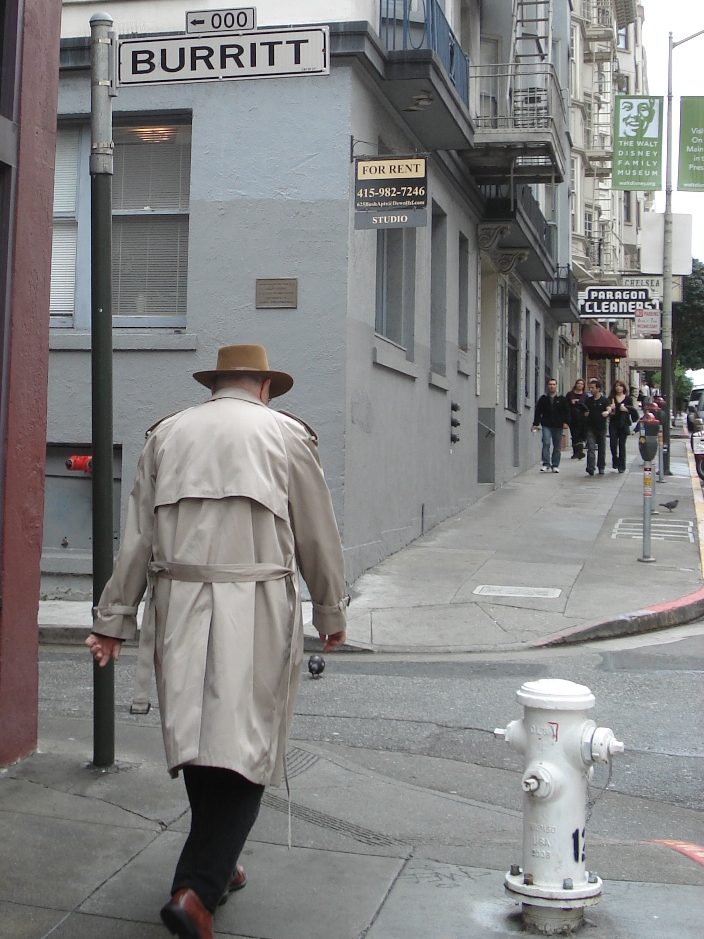
Your next shot at that will be Sunday December 18, rain or shine. If it is raining, a hat and trenchcoat come in real handy.

Posted in Tour | Tagged |

Two-Gun Bob: “The Bright Barbarian”

And what better way to celebrate Halloween and close out October, than with something kind of creepy. . . .

It probably won’t amount to much, but I’ve noticed a possible new trend in the way some people want Robert E. Howard and his work to be perceived. A trend, if it gains ground, which would be in diametrical opposition to my position as set forth in “The Dark Barbarian” (and in “Hard-Boiled Heroic Fantasist” from the same book), kicking it back toward the air-headed approach of L. Sprague de Camp and Lin Carter, which I rebutted in 1976 in the essay “Conan vs. Conantics.”

I touched on it briefly toward the end of a recent post, where I quote Professor Frank Coffman as asking, “Did they suggest that Conan isn’t quite the ‘Dark’ barbarian that Herron maintains?”

Apparently Frank is toying around with the idea of “The Bright Barbarian” — if he can articulate the concept in an essay, maybe he thinks he can dethrone my idea as the dominant theory in Howard Studies of the last twenty years. I don’t know if Frank is up to writing an essay that would have to be That Good, but he’s definitely monkeying with the concept. I first noticed it mentioned in his review of the Jason Momoa Conan movie — if you want to look into it, feel free, but I warn you that Frank is one of the least readable figures in Howard Studies. You’ll have to plow through a lot of verbiage about how only elite intellectuals have the technical stylistic tools to do real criticism, and you’ll be blindsided by a comparison of Conan the Barbarian with Battleship Potemkin. Jeez.

But for what it’s worth, that’s the first place I noticed the term “The Bright Barbarian,” and now I await the onslaught in my impregnable redoubt. (I think I’ll have time to take a nap.)

Meanwhile, Lightin’ Al Harron has done another post on his blog about our back and forth — Al seems to be enjoying the exchange, but his readership is getting kind of frantic:

“No, Al, no! — he’s just toying with you, man!”

“Watch it, Al, he’s got a knife!”

“Behind you, Al, he’s behind you!!!”

Al goes on and on and on and on trying to explain his positions, constantly changing the argument. If you look at the whole shebang, at first he’s wondering where I am, why I haven’t been doing anything in Howard Studies — then he realizes I’ve never been gone, that I do Howardian material steadily — then he admits he’s not really doing criticism — but then he defends what he does do, which has nothing to do with the topic of criticism. If I may borrow the technique from Frank, I have a technical word for this kind of writing, Al: dithering.

During one of our regular phone calls, I told Leo Grin, former honcho of The Cimmerian, about the Al posts, and he surfed over to check them out. First thing he noticed at the top of the page that day was a bit in which a woman who is a new editor on the Conan comic books has decided that they’re going to make Conan “sexier” and also “prettier” — with the intent of getting “more female fans into the fold.” Leo groaned, but after all, it’s only a comic book, it doesn’t matter what they do to the character — have Justin Bieber play him in a movie, the comic book dinks will justify it in their own minds for their own pleasure.  The real fiction is different — as Howard stated prophetically in the poem “A Word from the Outer Dark:”

“I am the Dark Barbarian that towers over all.”

Yeah. Dark. Barbarian. Towering over all the inferior imitations.

Yet, I do hope old Professor Frank manages to knock out a few essays on his side of the argument, such as:

“The Bright Barbarian.”

“The Delicate Barbarian.”

“The Pretty Barbarian.”

“The Girl-Friendly Barbarian.”

Creepy. . . .

Posted in Film, Lit, REH | Tagged , , , , , , , , , , |