Tour: Nada in January


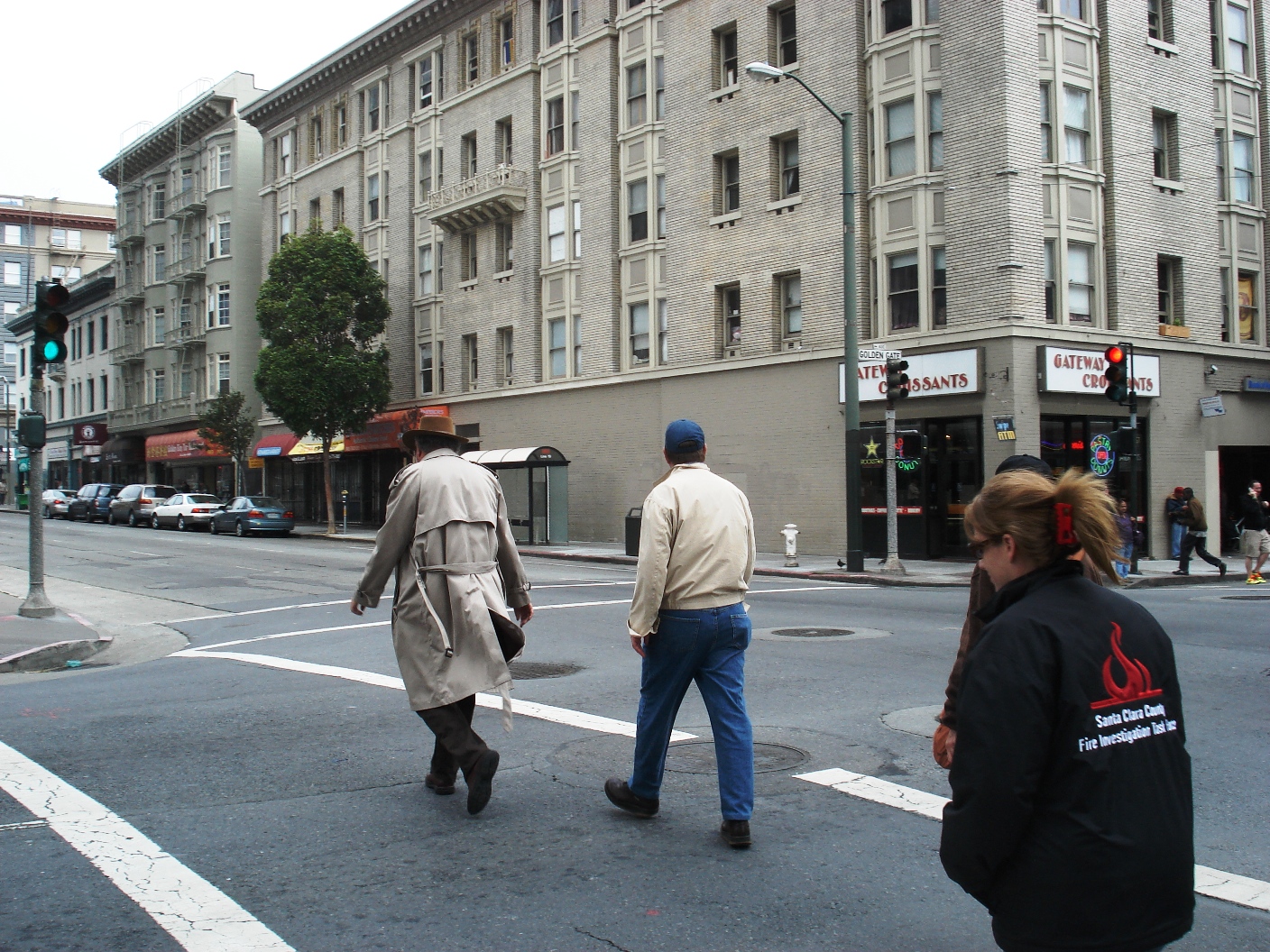
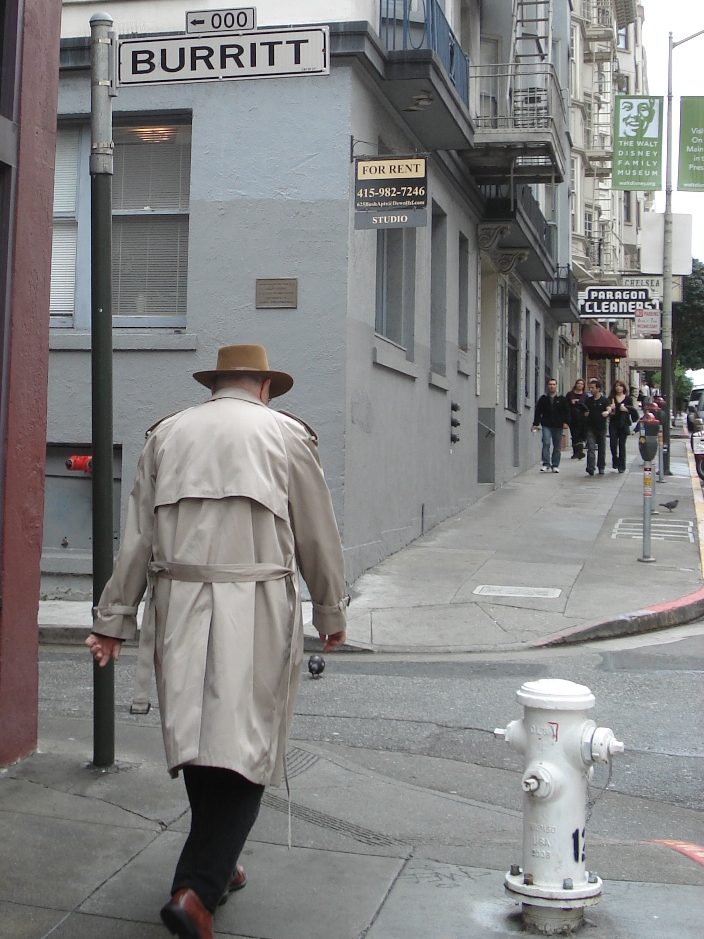
We’ve got winter rains coming in, maybe. We’ve got the lure of a run down to LA on the spur of the moment. And we’ve got no extra tours where you can just show up with a tenspot and grind the mean streets under your booted heels.

Next month isn’t looking any better, but check the Current Walks Page from time to time for the latest updates.

Posted in Tour | Tagged , |

Hollywood Beat: A Fante Salon

Just got word that a new literary salon has scheduled its first meeting for Monday January 23 in Musso & Frank — you know, I’m half-thinking about going, if not to this one, then to a later session. What a great place to stage a salon.

Topic out of the gates is John Fante, with Dan Fante as the main guest speaker.

The salon conflicts with the tenth Noir City film festival at the Castro, but if you can’t make Noir City you can amuse yourself right outside the doors of M&F by tracking down stars on the Walk of Fame — noir stars, and a lot of them. We’ve got noir. They’ve got noir.

Posted in Film, Lit, News | Tagged , , , , |

Two-Gun Bob: Into the West

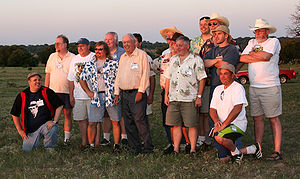
Sometime after midnight, as 2011 had slipped away and the New Year had begun, I did a quick check of email and found a barrage of notes telling me that Glenn Lord had passed away on the last day of the vanished year. A living legend for so long, now a legend — I feel sorry for upcoming Howard fans who’ll never get to meet him. A true honor and a pleasure.

For the recent tribute book Anniversary I did a small essay in flat-out praise of Glenn, and mentioned that during the first Howard Days I attended we ended up talking for a couple of hours in the midst of the revelers. A lot of the talk was catching up on mutual pals in the arena, but we got off on all kinds of subjects, including suicide. The fact that Howard killed himself at age thirty seems to bother a lot of his fans, with some trying to leave that fact out of blurbs. So many writers have committed suicide, I don’t find it that unusual.

Glenn mentioned that a famous western writer also killed himself, but was drawing a blank on the name. I couldn’t figure it out. He said, “Reasoner will know.” We spotted James Reasoner and waved him over. A western writer, Jim. Lots of product. Had a digest magazine named after him in the fifties. . . . “Oh,” Reasoner said, “Walt Coburn.”

Coburn, another in a legion of literary suicides.

And then the talk went on, and on. Among the great conversations I’ve had in my day, and I wish more fans could get such a chance. But I guess they’ll have to be content with the stirrings of legend. . . .

Posted in Lit, News, REH | Tagged , , , , |

Hollywood Beat: More on Jim Thompson

Just got an email from Steve Snow about the burst of Jim Thompson-related posts I did in October. Steve writes:

I enjoyed your Hammett site, and wanted to pass on a few notes about Jim Thompson.

He lived at 1922 North Whitley in the 1970’s, before, during, and after the filming of The Getaway. He and his wife, Alberta, and their adult son Mike were struggling at the time. None of Thompson’s books were in print in the U.S. while he lived on Whitley.

(He made the film deal for The Getaway while living in the tri-plex.)

Also, while living there, he made his appearance in the movie Farewell, My Lovely, with Robert Mitchum. Sal Mineo, Robert Redford and Tony Bill often visited him at 1922 North Whitley. He was not in the best of health in those days, and Tony Bill and others would drive him down to Musso and Frank in the late afternoon.

After his success with The Getaway, he and his wife moved south of Franklin to the Ardmore Apartments on Whitley. The complex still stands.

As I mentioned at the time, we were tossing our search for Thompson addresses together pretty fast — still, the only detail I see that doesn’t jibe with Steve’s notes is the Ardmore. I presume that would have to be the 1850 Whitley address we got from Thompson’s daughter, and the sprawling apartment complex we located didn’t match her thumbnail description of the place. When I get a chance, I’ll look into it some more — which means I’ve got another good excuse to hit Musso & Frank again.

Posted in Film, Lit | Tagged , , , , , , , , |

891 Post: A Noir Advertisement

I got a Xmas card from Bill Arney — a.k.a. The Voice of Noir — which asked if I had seen the trailer for the tenth anniversary of the Noir City film festival. Turns out it was shot in Sam Spade’s apartment in 891 Post Street, Bill’s old digs. Hadn’t caught it yet, but here it is — if you show up for any of the shows, you may spot Bill prowling about between his MC duties.

Of special note to Hammett fans is the wrap-up Sunday, January 29, an all-Hammett-for-hours film fest, with Roadhouse Nights, Mr. Dynamite and other stuff. I’ll try to make the scene for that day, at least, tho some of the other days look cool — I was just showing some visitors a location from Point Blank (adjacent to a location for Dark Passage, overlapping a location for Vertigo, etc & etc).

The trailer shows you brief glimpses of the inside of apartment 401 in 891 Post, with the Murphy bed folded down into the room. The actual strip search scene in the novel, however, takes place in the bathroom — maybe that locale was a bit too hot to handle for the Noir City crew, but it wasn’t too hot for Hammett, which is why he’s the King Daddy of Noir.

Posted in Dash, Film, Frisco, Lit, News | Tagged , , |

Two-Gun Bob: Breakiron and Finn on TGR

Months ago I thought about mentioning Lee Breakiron’s two part history of the Robert E. Howard zines released by Damon Sasser, but the links weren’t working for me. Now they are, opening up PDFs (give it a moment if you’ve got a slow machine). Part One covers the early years, including the appearance of my essay “Conan vs. Conantics” in the third issue of Two-Gun Raconteur. Shook the Howardian world — but check out what Lee says about it, if you’re interested in that sort of thing. He does a thorough job with the history angle, sourcing every quote. And of course Lee covers the head-to-head debate with L. Sprague de Camp that took place in issue 4, and I believe I even come in for a bit of criticism for my efforts to keep the Howardian litcrit arena free of illiterates. Anyway, read all about it with a click of the mouse.

The second part carries the history through issue 14, published summer 2010, where I contributed a similar accounting of each and every issue of another Howardian fanzine, The Dark Man, up to that moment, in what Lee terms my “wry, freewheeling style.” Thank you, thank you. I’m hoping Lee will open up with more pointed comments on the material in a revision or in future histories — he goes for it now and then, so I know he’s got it in him.

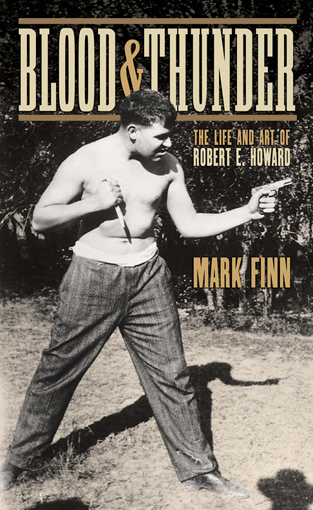
Meanwhile, over on Damon’s Two-Gun Raconteur blog you can find an interview with Mark Finn about the upcoming revision of Blood and Thunder, his biography of REH. I get name-checked in the interview for locating Doc Howard’s medical books (hope that is a transcription error, since I didn’t find medical texts, I found various books, largely religious, from Doc’s personal library — and many bore his extensive doodles, which caused me to think that he may have had TLE, and that his son’s prolific output also may have been spurred by TLE — the same idea that has circulated around other prolific writers such as Virginia Woolf, Philip K. Dick, or H. P. Lovecraft — you get the Temporal Lobe Epilepsy firing in the brain, and out comes a lot of fiction, letters, and journal entries, if you’ve also got talent — or you can doodle like hell — I originally covered that subject in an essay in The Cimmerian v3n9 for September 2006).

Posted in News, REH | Tagged , , , , , , , , , , |

Hammett: The Op’s Brainwork Recognised

From Scotland, Steven Meikle lets us know that the Op made the cut in a roster of deductive sleuths, inspired by the new Sherlock Holmes film from Guy Ritchie — second on the list, from The Observer. Yeah, he was a lot smarter than Philip Marlowe, when you think about it. . . .

Posted in Dash, Film, Lit | Tagged , , , |

Tour: Sunday December 18

Rain or shine. Sunday December 18. Noon. Meet near the “L” sculpture. Last walk this year. If interested, bring a tenspot, and hit the mean streets.

Posted in Tour | Tagged , , |

Hammett: More Newsprint


When I checked my copy of Richard Layman’s Dashiell Hammett: A Descriptive Bibliography the other day for information on newspaper reprints, I noticed that he cites a serial run for The Thin Man in the San Francisco Examiner during March and April 1934. Now John D. Squires has tracked down another reprint on the Australian Trove digital site — a complete-in-one-issue appearance in a free supplement to The Australian Women’s Weekly for Saturday 15 February 1936. JDS reports he got more than 200 hits on Hammett, “though at a quick glance, most are news stories or movie/book notices.”

“The digitizing of all these old papers,” JDS notes, “is really gonna transform traditional bibliography. For some authors, like M. P. Shiel, there isn’t much there, but for popular authors, like Louis Tracy, newspaper reprints were a big income source. Clode acted as his US agent and resold his novels as serials for decades after book publication, sometimes more than once to the same paper.

“It is a wide open field, waiting for the academics to stumble across it.”

Yeah, believe it or not, Louis Tracy — one of JDS’s main topics of research — was a hot name in his day. You can find many of his novels on Project Guttenberg, if curious. I am beginning to suspect that Hammett may have used newspaper reprints much the same way Tracy did, meaning there could be dozens upon dozens of newsprint appearances waiting to be found.

Meanwhile, our frequent Guest Blogger Terry Zobeck couldn’t resist tracking down more info on the reprint of the classic Op yarn “Dead Yellow Women” that JDS spotted in the Ottawa Citizen.

Terry says, “Great discovery by John. I fooled around with the link to the paper. All six installments are available; it ran from September 1 through the 6th. I’ll have to check to see if they used the Dannay edits — his collection of the same name came out in 1947. I wonder if this was some sort of tie-in?”

But then Terry noticed that the story carried a “copyright King Features Syndicate” tagline — “I’m thinking that it is taken from the version published in the 1930s and copyrighted by King Features. We’ve already seen that Dannay sometimes used their texts as sources for his editions, though he made changes to them as well.

“I compared the text of The Citizen’s version with that in Crime Stories from the Library of America, which is based upon the original appearance of the story from the November 1925 issue of Black Mask. It gets interesting in the first paragraph, describing the Op’s new client, a Chinese woman. The newspaper deletes the last few sentences: ‘But there was no slant to her eyes, her nose was almost aquiline, and she had more chin than Mongolians usually have. She was modern Chinese-American from the flat heels of her tan shoes to the crown of her untrimmed felt hat.’

“The newsprint serial also begins with this Editor’s Note:

This thrilling mystery story was written before World War No. 2 at a time when Chinese patriots in America were doing their utmost to send aid to their countrymen valiantly fighting against Japanese aggression.

“Among Hammett’s work,” Terry adds, “‘Dead Yellow Women’ is notorious for its racial stereotyping — common at the time —starting with the title. To further counter the racist language, the editors — whether at King Features Syndicate or The Ottawa Citizen
is not known — removed some of the more egregious examples. For example, at one
point the Op is enlisting the aid of a Filipino laborer. In describing the man the Op says he could often be found ‘in a Chinese gambling house passing his money to the yellow brothers.’ In The Citizen’s version ‘he was passing his money over the tables.’ The Op then remarks, after the Filipino extends him a courtesy, ‘Whatever else the Spaniards do for the people they rule, they make them polite.’ This sentence is not to be found in The Citizen’s version.

“Dannay’s 1947 version, by the way, follows the pure text, with only a couple of minor changes in the paragraphs I checked, so there goes my idea that he used the King Features version — unless it was the editor of the Ottawa Citizen who felt squeamish about the racial stereotyping.

“I guess I need to find the 1930s King Features version of this story, to figure out if the cuts were made at the Citizen or not.

“I admit I only checked the first installment. The edits and rewrites are so extensive that this version can be described only as an abridgement of the original. The Citizen’s version
occupies a little fewer than two columns of newsprint; in the LoA version, this portion of the story requires about six-and-a-half pages, comprised of 74 paragraphs. Of these 74 paragraphs, The Citizen’s version cuts 29 paragraphs completely — admittedly, some of these are just a line or two of dialogue — and the majority of several more. About half
of the remaining paragraphs are abridged — large chunks of Hammett’s prose are simply gone.

“After reading the first part of Hammett’s ‘Dead Yellow Women’ in The Ottawa Citizen, I can only say, ‘Thank God for Frederic Dannay.’ However annoyed and frustrated we may be with the edits Dannay made to many of Hammett’s stories, at least he did not take a hatchet to them. If we had only The Citizen’s version to read today, we would have a mangled, heavily abridged version of the story.”

Thanks, Terry, for the textual detective work.
Posted in Dash, Lit, News | Tagged , , , , , , , , , , , , |

Hammett: And “Martha Ivers”

Early this year I gave a notice for Matthew Asprey’s collection of Jack London stories set in San Francisco — and now I hear that he’s jumped fully into the academic world as Dr. Matthew Asprey Gear, Department of Media, Music & Cultural Studies, Macquarie University, Sydney.

A recent essay from Matthew may be of interest to some of our Up and Down visitors, since it concerns Hammett (especially the Hammett of Red Harvest) and the classic noir film “The Strange Love of Martha Ivers” (1946). It just popped up on the online journal NEO — check it out.

Posted in Dash, Film, Frisco | Tagged , , , |