Rediscovered: Redonda!

I’m confident it was my pal Steve Eng who brought M. P. Shiel fully to my attention some thirty years ago. Like anyone else interested in horror and fantastic literature, I’d have come across the name already, courtesy at least of the post-apocalyptic novel The Purple Cloud or the short story “The House of Sounds,” a favorite of H. P. Lovecraft. In his typical fashion, Eng roped me into a project that was then underway, a book of essays about Shiel. Borrowing some incredibly rare titles, such as The Weird O’It, from the Shielophile John D. Squires, I read each and every book with a major mystery or crime angle to it and knocked out “The Mysteries of M. P. Shiel.” From that point on, I was on board, and still get email notification of any bits of Shiel-related news that pop up — a constant trickle, because however unlikely it seems, someone is always doing something new on Shiel, from a little essay to the multi-volume biography Harold Billings is gradually releasing, one major era of Shiel’s life per book.

And one thing leads to another, so eventually I’d have been interested in Shiel if only because he lived in Gray’s Inn in London when Arthur Machen, one of my absolute favorite writers, also lived in that sprawling complex. Check page 198 of the current Hammett tour book and you’ll find their addresses from that era, when the two were pals and exercise enthusiast Shiel remembered that about the only activity Machen indulged in by that time was taking his bulldog Juggernaut for walks.

Dashiell Hammett also brushes up to this scene — in his 1925 Black Mask yarn “The Gutting of Couffignal” you find the Continental Op reading a book “called The Lord of the Sea” with “plots and counterplots, kidnappings, murders, prison-breakings, forgeries and burglaries. . . . It sounds dizzy here, but in the book it was as real as a dime.” That’s the novel where Shiel, among other things, predicts the founding of Israel, one of his handful of works that see reprint time and again.

Later Hammett surfaces again in the Shiel saga with a blurb for the 1948 collection The Best Short Stories of M. P. Shiel, where he calls the author of Lord of the Sea “a magician.”

Steve Eng suspected, and I guess rightly, that it would have been the Shiel booster John Gawsworth who solicited Hammett for the blurb. If you like the concept of the bookman, Gawsworth is one of the most fascinating figures you’re going to encounter, constantly reviving the reputations of neglected writers, able to pay for a long slide into alcoholic ruin by going out to the penny bookstalls in front of London bookstores, picking up a few items, and taking them back later into the rare book rooms of the same stores and reaping his drinking money for the night. The only guy I personally have seen who is able to do the same thing would be Dennis McMillan — we were book browsing in North Beach circa 1983, went to the dollar table in Discovery Books and Dennis quickly plucked up two or three titles that were worth a hundred or so each.

I’ve always thought that Eng actually liked Gawsworth more than he did Shiel, and I wish he’d written more than he did about that flamboyant figure. Pretty much all of us realize that it was Gawsworth who took the concept of the Realm of Redonda from Shiel and ran with it — the idea that Shiel had been crowned king of a rocky island named Redonda rising from the Caribbean waves, that Gawsworth was his successor and able to appoint literary pals as Redondan royalty, including Dylan Thomas and Henry Miller and a host of others. If you’ve never heard of Redonda, it has a fascination for anyone interested in the world of books and authors, the London literary scene, endless pints in endless pubs. If The Beats had had something like Redonda going for them, they’d be that much more fascinating, too.

If intrigued, you can surf around the web and find all kinds of pieces about The Realm of Redonda, but as a starter why not try the comprehensive survey John D. Squires recently tossed on the net — it presents the whole story in one place clearly enough to get all the history and a lot of the charm. And if you have never heard of Redonda, you sort of need to, to be conversant in bookman lore.

Posted in Dash, DMac, Frisco, Lit | Tagged , , , , , , , , , , , , |

Noir: The Ha-Ra Readings

Just recently I came across a podcast of a reading I did awhile back, for the launch of the Peter Maravelis-edited anthology San Francisco Noir 2: The Classics on Valentine’s Day 2009. The Ha-Ra Bar was packed to the rafters to hear various authors read from stories featured either in the first San Francisco Noir collection or the just-released Classics. But the other readers — Craig Clevenger, John Shirley, David Corbett, Sin Sorrocco — apparently went up against a raging refrigeration unit, and lost the battle. Only Domenic Stansberry and I somehow emerged with vocals that could be deciphered over the hubbub of the bar and the wild electronic humming.

Domenic had an original story in the first book, one of the best stories in the collection — and personally I think he’s one of the best of the modern noir writers in this area. His Noir Manifesto only became available on the net recently, if you want to see what he says on that favorite subject.

For my reading I selected section two of “Knives in the Dark” from Classics, reprinted from the massive anthology Measures of Poison released by Dennis McMillan in 2002. I particularly like that section, because it tosses Bill “Young Wild West” Arney into action. Not the actual Bill Arney, famed as the Voice of Noir and host of Cheese Theatre, but a rootin’ tootin’ gat-packing avatar that might have appeared in Black Mask. The audience laughed at the right spots, so I figured they enjoyed the Arney moments, too.

After I finished the reading and ducked outside for some air, a young woman did come up and accuse me of being anti-Semitic, though. I believe her remark was: “That was very anti-Semitic.”

I looked at her in bafflement and replied, “It was?”

She said, “Yes. You used the term Jewing.”

“I did? No, I don’t think so.”

She then told me she didn’t hear very well and walked away.

Prowling through section two later, the only words I figure could have been misheard easily were “jewelry” or “chewing,” though the racial slur wouldn’t have made sense in context, in either case. Jeez, the perils of public appearances.

The other highlight of the evening came after the readings were done, and most of the hundred-plus people had left. Only about fifteen of us still sat around talking, when a group of about twenty bar-hoppers decorated in pink hearts and Valentine stuff poured in the door. The legendary Carl the Bartender gave them the cold eye, and without bothering to even try to sell them a round of drinks told them to leave.

I asked him why.

“I don’t like people,” Carl said.

Thinking it over, that was one great Valentine’s Day.

Posted in DMac, Frisco, Lit | Tagged , , , , , , , , |

Tour: Death in the Tenderloin

Mike Humbert came out on the tour this past Sunday and popped one of the many asides that make the walk the meta-tour that it is up on his personal YouTube channel. You may know Mike’s name — he did the maps for the new edition of the Hammett tour book, and his website devoted to Hammett is the one selected for a link off the main Tour Page.  Go to Mike’s Hammett site and you can surf around to your hard-boiled heart’s content.

The digital capture features the Deco Bar on Larkin off Turk across the street, me talking about the very early years of the tour when that address housed Oronte’s Restaurant, and how the old lady who ran the place was found murdered inside — one of a variety of Tenderloin murder sites I sometimes toss into the narrative of the mean streets. And as I start the spiel, a block up on Eddy a band marching in front of a Chinese funeral walks past, creating an appropriate distraction.

Anyone who wants to take upcoming tours can hop onto the Current Walks Page, found on the drop-down menu under The Tour in the banner above, and see what’s available. Each and every Sunday in May makes the easiest-to-remember option. And let the parade begin. . . .

Posted in Frisco, Tour | Tagged , , , , |

Rediscovered: You Can’t Win

Out of the legions of neglected books from all the books that have come and gone in all the world, very few return to any kind of currency. Once the book slips out of print, or the generation of readers that made it a bestseller in its day have gone on to the next thing, that title slips quietly into the past. Even if someone puts it up free on Kindle, who’s going to download it, much less ever get around to reading it?

Jack Black’s autobiography You Can’t Win from 1926 became something of a bestseller, taking him from a desk job with the San Francisco Call off to society events and moments of fame in New York City and Hollywood, but by 1932 the run was over and Black slipped away, never to be heard from again. A suicide? A return to life as a hobo and small time criminal, and a quiet death under another name in an unknown town? No one can say.

You Can’t Win got its bulge on lasting fame when William S. Burroughs discovered a copy, committed parts to memory, pirated parts for his first novel Junkie in 1953. When Burroughs made it, You Can’t Win got a toehold on immortality.

If you happen to find one of the early printings for cheap, grab it, but I’m happy with the in-print trade paper edition from AK Press/Nabat, which includes an intro by Burroughs describing what the book means to him, and an afterword with more information, such as:

In the months before the 1906 earthquake Black was apparently a one-man San Francisco reign of terror until he was caught for shooting a man in a botched holdup in Golden Gate Park and got his 25 year sentence.

Yeah, you need it for your San Francisco collection. And you can get a copy easily at Green Apple Books on Clement, where Kevin Hunsanger has been promoting it relentlessly for years — Kevin once told me that Green Apple alone has sold enough copies to plow through entire press runs of the AK Press edition.

I read You Can’t Win in large part for the San Francisco connection, but also for the background on crime in America, since the era Black rode the rails and did the yegg thing dovetails into the period when Hammett worked for Pinkerton’s. For me, it was worth reading, just to happen across the description of the hobo jungle being set upon with the head-breaker crew armed with saps. No question, a classic of crime and the underworld, although I didn’t like it as much as William S. Burroughs apparently did.

I remember one guy telling me how Black dropped cool names of crooks similar to the roll call Hammett trots out in The Big Knockover — Salt Chunk Mary, The Sanctimonious Kid, Gold Tooth. Yeah, Black drops a few handles that evoke the roster of one hundred crooks come into Frisco to rob two banks across the street from each other at Pine and Montgomery, but Hammett names one crook after another, not just two or three. A feat of creativity — or deep knowledge drawn from years working as a detective — that remains unequaled to this day. Anyone who knows of any other author who comes remotely close to equaling that roster of names in Knockover — Toby the Lugs, Old Pete Best, Fat Boy Clarke, the Dis-and-Dat Kid, L.A. Slim (“from Denver”), Bull McGonickle (“still pale from fifteen years in Joliet”), Toots Salda (“the strongest man in crookdom, who had once picked up and run away with two Savannah coppers to whom he was handcuffed”), and many, many more — please let me know. Jack Black isn’t even in that contest.

And if you are a fan of Burroughs or The Beats, you probably need to read You Can’t Win, just for form. I met Burroughs once, when he was doing a signing in City Lights, in company with John Law and Lance Alexander of The Suicide Club, and among other things we asked him about various pulp magazines such as Weird Tales. I was a bit surprised to find that Burroughs knew about Donald Wandrei and his story “The Red Brain” — but I shouldn’t have been surprised. Burroughs was obviously sharper than hell, and what kind of illiterate doesn’t know about stuff like You Can’t Win and “The Red Brain”?

Posted in Dash, Frisco, Lit, SFSC | Tagged , , , , , , , , , , , , |

Fave Lines: Remember the Alamo

Today marks the 175th anniversary of the fall of the defenders at The Alamo, who come as close to being immortals as you can get. I know that Robert E. Howard thought that the little fort was one of the most haunted places he’d ever visited, but when I finally got there en route to Howard Days in June 2009 I had the same reaction I experienced upon visiting Westminster Abbey, thinking, jeez, what a tourist trap. Still, I’m glad I stopped in, and if chance allows some day I may swing by the John Wayne Alamo in far western Texas, built for shooting his movie — more than one person has told me that the movie set feels more like the real Alamo than the real Alamo. If it’s not packed elbow-to-elbow with tourists, I might enjoy it more.

My fellow travelers for the trip that year were Donald Sidney-Fryer, Fabrice Tortey, and Brian Leno, and for my amusement as we stood in front of the huge bas relief in front of the fort, I looked at them and said:

“I don’t get it. Why do they always have Davy Crockett dressed like a hick?”

Posted in REH | Tagged , , , , , |

Hammett: Playing the Sap

Take out your copy of Jo Hammett’s Dashiell Hammett: A Daughter Remembers. Turn to page 34. We’re going to be dealing with the bottom photo on that page.

If you don’t have a copy of the book, this post spotlights a detail from the photo that will get the main point across. But if you think of yourself as a huge fan of Hammett, trust me, you need this title on your shelf — my honest opinion as a vocal partisan of the Continental Op series is that you need it just to brood over this shot of the future author of The Big Knockover standing in a train yard with what appears to be a crew of serious head-breakers.

To put the photo in perspective, before Jo’s book came out in 2001 there was exactly one known photo of Hammett from the period he worked for Pinkerton’s National Detective Agency, calculated to be between 1915 and early 1922. Now we have almost a plethora, courtesy a rich cache of materials that turned up, all published for the first time in A Daughter Remembers. You can read about landing the haul on page 38 of her book, where you’ll find my name dropped into the narrative — out of all the moments where I’ve turned up as a footnote to history, I put that one near the top.

As Jo says in her caption for the photo, the background for the image is “a mystery. . . . This might be a picture of a Pinkerton’s work crew, possibly strikebreakers.” Where was the photo taken? Offhand, there is no way to say — the location isn’t noted on the back. Hammett worked as a Pinkerton’s man all across America, from Baltimore and points east to Butte, Montana and Spokane, Washington and points west. And, for all we know, points south, and anywhere in between. The setting of the photo appears to be flat, at least from the placement of the camera, with no possibly distinguishing mountain peaks in the distance. The train cars on the sidings in the background, where you’d hope for a railroad logo to show up under a magnifying glass, have no discernable markings. The only way I figure the location might be determined would rely on dumb luck, where someone might see the image one day and recognise one of the men — such as the giant standing at the far left — and from that piece of info the location could be doped out.

The giant is my favorite part of the image, the main reason I decided that the crew consisted of unmitigated head-breakers the moment Jo showed me the photo. Here stands a guy who is a real life incarnation of the monstrous thug Babe McCloor from Hammett’s story “Fly Paper,” published in Black Mask in 1929 — or proof that a character such as Moose Malloy from Chandler’s Farewell, My Lovely actually walked the mean streets. I also appreciate the two black guys squatting in the foreground toward the right side of the group, an indicator that social barriers weren’t quite as rigid as some might think, if they could participate in whatever mayhem was afoot.

The other big clew that this isn’t an impromptu gathering of a church choir is the presence of the sticklike objects — in the full photo in Jo’s book you’ll notice several guys have them, and in the detail shot above two seated in the front row hold them. But most dramatically, check out the standing guy in the white shirt, lifting his stick in a sweeping salute, like one of the Three Musketeers. Obviously, a guy who enjoys his job.

In the detail you see five men standing in the back row. Hammett is third from the left, hands in pants pockets, with a space to give the guy with the stick some swinging-his-dead-cat room.

So, what are the sticks? None of us knew, though the possibilities seemed clear enough. And then I stumbled across a moment in the autobiographical You Can’t Win by Jack Black, first published in 1926, recording Black’s adventures as a hobo and a thief in the preceding decades — famed as William S. Burroughs’ favorite book, and with a cool San Francisco angle: when he was writing the book, Black was working for the Morning Call in San Francisco, in the building that still stands on the southwest corner of Third and Market. Black wrote:

Pocatello, at that time, was just a small railroad town. A famous stopping-off place for bums bound East, West, North and South. There was a grand jungle by a small, clean river where they boiled up their vermined clothes, or “rags” as they are always called, cooked their mulligans, or, if enough bums got together, held a “convention”. . . . The bums then began “pestering the natives” by begging and stealing till the whole town got sore.

The town marshal would then appear with a posse armed with “saps,” which is short for saplings, young trees. He stood guard with a shotgun, while the posse fell upon the convention and “sapped up” on those therein assembled and ran them down the railroad track and out of town.

So, in the era before the first World War, a posse of head-breakers would cut down some saplings and use them to beat the hell out of the hobo army infesting the train yards. Closest thing I personally have experienced to that, as someone who grew up in Tennessee, would be a parent tearing a switch off a bush and using it to whip a wild kid into line — same principle, a little less wood behind every blow.

By the time Hammett began writing his crime stories beginning in 1923, the general meaning of the term “sap” obviously had drifted over to refer to a black jack. And when Sam Spade tells Brigid that he won’t “play the sap” for her at the end of the Falcon, that suggests yet another meaning, of a sap as a sucker.

But now you know what the sticks in that photo were used for, and if anyone suggests to you that Hammett wasn’t a genuine tough guy living a hard-boiled life as a Pinkerton’s operative, show them the photo in Jo’s book and tell them to clam up.

Posted in Dash, Frisco | Tagged , , , , , , , , , |

Tour: March and April Walks

Ask at least a month in advance and there’s a fighting chance you will receive — attend the tour on Sunday March 13th or the walk on Sunday April 3rd and check it out with the folk who gave me enough lead time to think about it. Anyone who wants to show up palming ten bucks is welcome. Meet near the “L” sculpture. Noon. Four hours. The usual. And the walks go, rain or no rain.

Posted in Tour | Tagged , , |

Sinister Cinema: Lorre Noir

Valentine’s Day again — one of the birthdays of noir. In 1930 — 81 years ago today — Knopf released the first edition of The Maltese Falcon in hardcovers. As I maintain in the short essay “San Francisco Noir” (and to my knowledge no one has yet offered a counterargument), in that novel Hammett was the first to set up all the hallmarks of the form and bring off what we now think of as noir. Yes, various elements — Poe, people — hovered around for many years before Hammett wrote the Falcon. But in the Sam Spade novel Hammett nailed down the form, and it marks a nice double-whammy that the 1941 John Huston-directed film starring Bogart as Spade is usually credited as the first true example of film noir.

Of course, noir fans quibble, always trying to push the format further back into history. The earliest movie I know of that some people put forward as film noir is Fritz Lang’s M from 1931 — a full decade before Huston’s directorial debut. I have no big problem with that one as a contender, although it lacks certain stylistic touches, notably a femme fatale, that when push comes to shove I think are necessary to make true film noir. But as I say in “San Francisco Noir,” it’s an interesting point that the 1931 M and the 1941 Falcon both put Peter Lorre on screen — I believe it was Halliwell in his famous guide to film who once wrote that there is no movie Lorre ever appeared in that isn’t worth watching just for his performance.

And now noir fans are trying to put another movie forward as the first true film noir, Stranger on the Third Floor from 1940. They’re playing it up big at the Noir City festival, currently doing a run in Seattle before moving on to other cities around the country. Hey, if this one is “noir,” then M is noir — but isn’t it cool that Stranger also stars Peter Lorre? Go on, pick the original noir movie, any original noir movie, that doesn’t have Peter Lorre in it. . . .

Posted in Dash, Film, Frisco, Lit | Tagged , , , , , , , , |

Two-Gun Bob: Hard-Boiled and Deviled Again

“Where on Earth is Don Herron?” asked Al Harron (no relation, or none that I know of — I have been remiss in my geneaological studies the last few years) on his blog just last month. Al trailed after Damon Sasser’s original “Where in the World is Don Herron?” post, written in response to my hauling up to Boise for a talk awhile back. I’m willing to travel almost anywhere, but I admit I hadn’t thought I’d ever get to Boise. I suppose if enough bloggers pursue the topic, my whereabouts can become what they call a meme. . . .

Damon dealt with my physical whereabouts and activities, but Al was more concerned with seeing — or not seeing —my name specifically in connection with Robert E. Howard Studies.

Yeah, What Have You Done for Me Lately? I get it.

The way I look at it, if I never do another word about the creator of Conan, my rep in that arena is secure. The Dark Barbarian. The Barbaric Triumph. “Conan vs. Conantics.” To name only a few. Maybe Al is experiencing withdrawal symptoms after the excellent REH magazine The Cimmerian closed up shop — I appeared in those pages almost every issue.

At the moment, you don’t see any activity in Howard studies equal to the run of The Cimmerian, but for what action there is I think I’m keeping my gunhand in. Last summer I did a review (a pretty funny review) for Damon’s annual issue of Two-Gun Raconteur, and have another long review (also funny) coming up this summer.  I’ve got two pieces being prepped for a couple of other Howard-related projects. And if I am not recognised enough for all the work I do on the side with advice and so on, let me at least inform Al that last year I made no less than two excursions up to Sacramento to drink Jack Daniels with J. Dan Price, the only begotten son of pulp great E. Hoffmann Price, because Rob Roehm wanted to get permission to use some of Ed Price’s letters in a volume he is working on about Doc Howard.

And I don’t know how a Robert E. Howard fan could miss them, but I also stepped in to introduce the two volumes of Two-Gun’s pulp detective and weird menace tales just published by The Robert E. Howard Foundation. My copies rolled in a couple of days ago. 150 copy print runs for each, sold out by publication, but second printings are in the pipeline. I toss in some nice remarks about Hammett, track down an influence that got me on the road to writing books-about-books — my usual. And the intros are in hardcover editions of Robert E. Howard.

Honest, I don’t think my presence is that hard to detect in Howard studies, if you’ve got any detective skills at all.

Posted in Dash, News, REH | Tagged , , , , , |

Suicide Club: Billboard Liberation

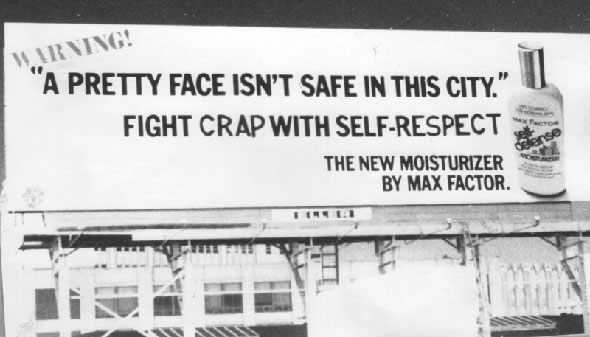
Before the Billboard Liberation Front spearheaded the modern artform of liberating billboards, it had its shadowy origins in the exploits of the ur-urban adventure group, The San Francisco Suicide Club. Personally, I never cared much about billboards, but keenly appreciated the daring involved, and remain in awe of the stone cold chutzpah of the late, great Irving Glick. Without Glick, I have doubts about how successful the movement would have been, and without the assurance of early successes, how long-lived and legendary it would be today.

But long-lived and legendary it is, witnessed most recently by the Taschen Press tribute, Trespass: A History of Uncommissioned Urban Art — with a book release party Thursday February 17, 7 p.m. in City Lights Books. On hand will be art critics and artists and guys really good at climbing signs, such as the BLF’s own Jack Napier — or some avatar or image cloaked in the name.

Spray-paint the date on your wall calendar, if interested, and check out another of Taschen’s spectacular histories of our culture.

Posted in Frisco, News, SFSC | Tagged , , , , |