Our pal Morgan “The Morgman” Holmes has a dictum — either the product of his own profound deliberations or picked up over shots of whiskey in a seedy bar held together with vines and rattan somewhere on the outskirts of the Pulp Jungle:
Any work of art is made better by the inclusion of cavemen and dinosaurs.
Yes, any.
On occasion I wonder if Hammett should have tossed a Cro-Magnon or a stegosaurus into The Maltese Falcon, and haven’t doped out how he might have spun it to the betterment of the plot — but either certainly could really jump up a forced read-through of Proust.
Some other San Francisco boys, however, did get in on the caveman action. Jack “Wolf” London and the poet George “Greek” Sterling. (No dinosaurs, unfortunately.)
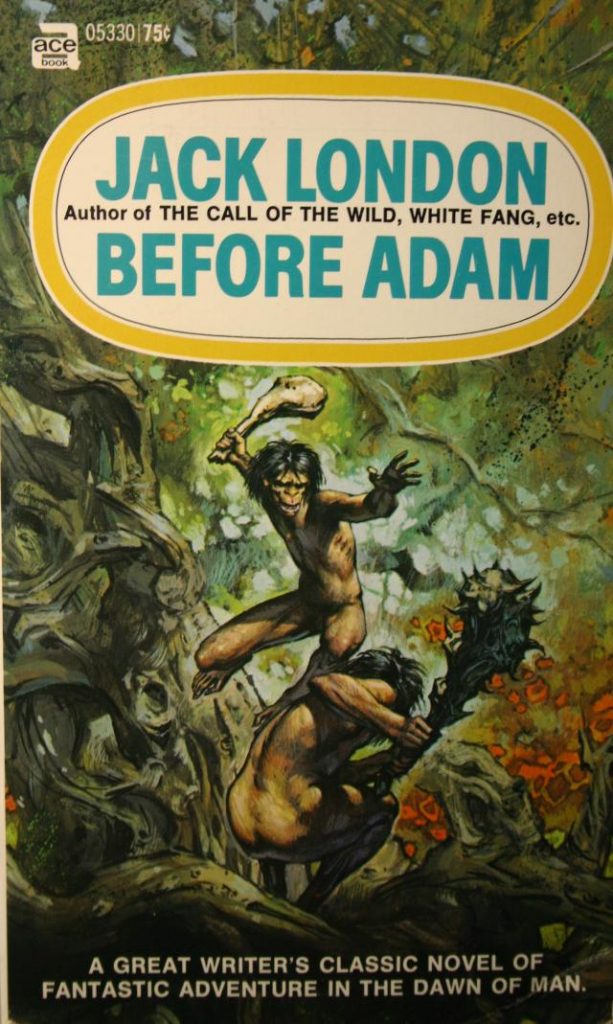
Recently Vince Emery sent along a copy of Sterling’s Babes in the Wood, first book publication of the poet’s sort-of sequel to Jack London’s Before Adam. In his years as a publisher Vince has knocked out a little bit of this, some of that, an eclectic mix anchored thus far by some intimate connection to the city of San Francisco.
I figured I should look into the original first, and as I poked through London’s primeval tale didn’t pick up any ghost memories of having read it years ago. The framing device was quite familiar, since it heavily influenced Robert E. Howard’s Sword-and-Sorcery yarns involving ancestral memories, such as “The Valley of the Worm.”
A modern man relives past lives in his dreams — in Before Adam specifically the life of a hominid facing a brutal and always dangerous world. The narrator only sees the life of this one time-lost ancestor, but in a touch that makes a writer a world-class figure while almost all his contemporaries are forgotten, in one vivid sequence he joins his ancestorin his dreams, and plunges back and back across life cycles toward the primordial mire. Lovecraftian pre-Lovecraft. A forerunner of what Clark Ashton Smith would do in “Ubbo-Sathla.”
Knowing the mechanics of yarn-spinning, London — while doing what he thought was a realistic portrait of the life of early man — threaded a love interest through the narrative, plus gave his hominid hero an antagonist within his tribe, the violent atavism Red-Eye. More primitive than the primitive.
Sterling stripped that template down to the bone, the love interest more casual, the past-haunted dreamer nowhere to be found. Episode follows episode, encounters with saber-tooth cats and cave bears and more, done well enough I occasionally thought that it was too bad Sterling didn’t try a Tarzan knock-off. He puts his toe into the grassy verge of the Pulp Jungle and swings his ape-men merrily through the trees.
Maybe it’s me, but I may as well note that both London and Sterling seem to be setting their tales in the landscapes of northern California, while using very early hominids as their foils — nothing as sophisticated as a Neanderthal appears. From what we know of the ever dynamic history of such tribes, I was keeping an eye out for anything that evoked Africa. For all I know they may have had abalone in Africa’s coastal waters, but all I could think about was Sterling during his famous stint in Carmel contributing to writing “The Abalone Song.”
The historical introduction by Vince Emery for many will prove the main attraction of this book. His recent research reveals much previously “lost” info on Sterling’s years in and around San Francisco, especially his jobs working for his uncle Frank C. Havens — they made the papers during a financial scandal. And it seems that Sterling used his office to set Jack London up with better homes in Oakland, as he began his career. Those early years in the Bay Area come up for major reevaluation, but the last fifteen years leading up to his suicide remain unchanged, Sterling as romantic poet and womanizer, one of the most famous San Franciscans of his day.
The coolest piece of info mentioned is that London interrupted writing Before Adam to cover the earthquake and fire of 1906, heading into the burning city of San Francisco for a few days. Gives that novel some extra smoky tang.
Vince did a pretty good job with the text, consulting three versions: Sterling’s holograph first draft in Bancroft Library; typed drafts (Sterling hated typing so someone else did those) with the author’s hand-corrections in the San Francisco Public Library; and the 1914 serial appearances of the episodes in Popular Magazine.
I only noticed roughly six typos, such as on p95 (last paragraph, line 2) no perched which obviously ought to be now perched. Or p150 (first paragraph), a women must be a woman. The textual detail that most intrigued me occurs on p120 (second line), in which mammoths assume the stage with “the enormous curved trunks of the males sometimes clicking together” — that’s got to be tusks clinking together. If I know anything about mammoths, and I do, it’s got to be tusks.
The most startling idea that struck me while reading these primordial episodes — and I’d never even considered the concept before — is that George Sterling was quite a sadist. He delights in describing the torture and death-agonies of one creature or primal man after another. If I noticed it — and I’m hardboiled and largely indifferent about such things — it’s pretty rough.
Just got word that Floyd Salas died Sunday the 17th at the age of 90. Tattoo the Wicked Cross, baby.
His companion of 38 years, Claire Ortalda, did the obit for Berkleyside — an excellent piece of writing, rounding up the major things you might need to know about Floyd. I don’t think you will find a better summation.
If you want something longer, try my piece “Collecting Floyd Salas” from Firsts: The Book Collectors Magazine — yes, I go through the history of his books but there’s lots of Floyd personality stuff in it, too.
Floyd had enough personality for any ten or twenty people.
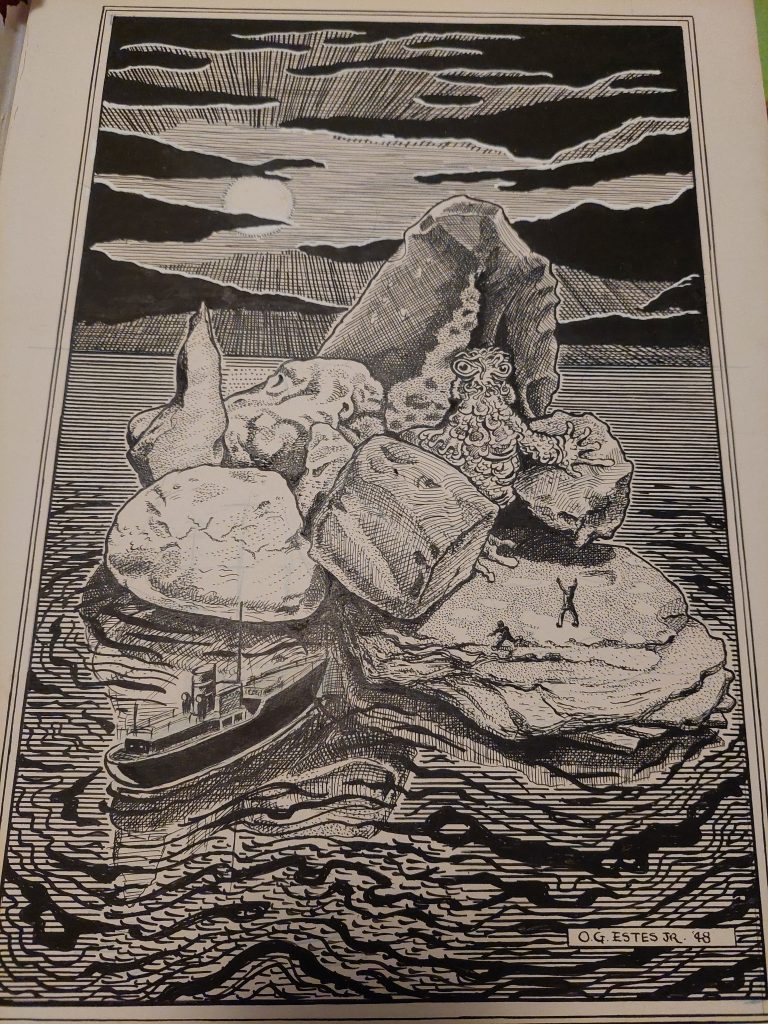
This morning Brian Leno hit me with a curiosity that could appeal to Lovecraft fans everywhere, an inimitable rendering of a pivotal moment in “The Call of Cthulhu” (at least, I’m fairly confident that’s the mise–en–scène for this tableau).
“Went through some more junk this morning,” Brian says, “and found this original O. (Oscar) G. Estes, Jr. drawing.
“I’m going to spend some time figuring out where it appeared, if it did appear.
“Nice artwork, looks like some guys are having trouble with a big chicken.
It’s been a few months since Jeopardy! dipped into the Hammett clew pile, a sprawling mass of info and allusion that might well go on forever.
On Monday October 11, they offered in the Double Jeopardy round a $400 clew, in the category National Literary Titles:
A detective is hired to track down the missing sister of the secretive Miss Wonderly at the beginning of this hard-boiled novel.
Contestant Jonathan Fisher buzzed in and said, “What is The Maltese Falcon?”
None other.
Now, did the sudden reappearance of Hammett on the Jeopardy! stage give Fisher just the edge he needed to unseat 38-day champion Matt Amodio? A little noir mojo?
That’s what happened, in any event. I held back on mentioning it because in my experience many of the Giant Killers only win for that one game, or sometimes carry a second. I wanted to see if Fisher would be a flash-in-the-pan, and so far he’s held down the champeenship for three games.
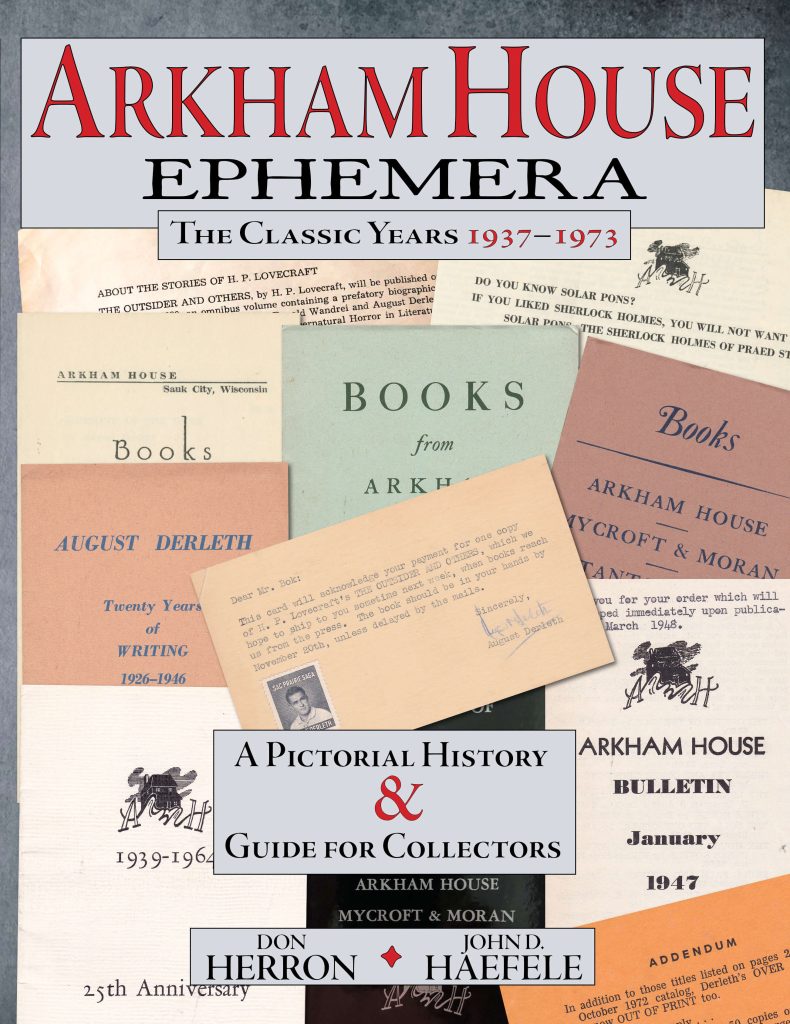
For you bibliophiles out there, John D. Haefele just put up a comprehensive yet compact history and survey of The Candlelight Press — one of the presses August Derleth of Arkham House had a couple of fingers in for a few years. Peter Ruber — one of the later short-lived editors at Arkham — acted as publisher, and Derleth’s work was a mainstay of that publishing firm in its heyday.
Ruber did other interesting books, as well. Out of all the titles he was involved with, the tribute to the great Chicago bookman Vincent Starrett, The Last Bookman, is my personal favorite. Plus, as often happens, Sherlock Holmes gets dragged in from over on Baker Street. Some pastiche. Some poetry.
Haefele — hot off publication of Lovecraft: The Great Tales— covers it all. And includes thorough checklists of all titles and ephemera.
Just got a note from crime writer Mark Coggins rounding up some stuff about the late Bill Arney on Twitter. One of the links offers Bill reading something by Mark on KQED. I bet there’s a lot of Bill’s voice work scattered around the web — remember that episode of The Fog Files on KFOG that profiled Bill? It was up online for years.
I think moreso than his role as the Voice of Noir, long term Bill will be remembered as the guy who championed the Hammett apartment and restored it to its historic glory. Put them together, though, and you’ve got a great legacy.
In any case, his half historical half pure promo stuff is fun to read — I’ve said before that Dannay’s books-about-books material ranks close to the magisterial Books About Books I collect from the great Chicago bookman Vincent Starrett.
Starrett ultimately had more book collections of such material see print, but given all the blurbs in EQMM I suppose Dannay may have done equal wordage or more — but then not all of Starrett’s many newspaper columns have been collected.
Thomas Burchfield just put up an article on the late great Bill Arney — especially useful because it first appeared in 2009 and contains lots of info on Bill’s movements in San Francisco. I’d almost forgotten the breakup with a girlfriend that spurred him to rent the Sam Spade apartment in 891 Post.
Also, some of the background enabled me to fact-check the outline of my hanging out drinking with Bill. I first met him in 1982 when he came out on the Hammett Tour, and I’m pretty sure he got in on a few meetings of The Maltese Falcon Society, which ended in 1986. However many he checked in on, and it wasn’t many, that period wasn’t the time that we really tied in.
No, we became the Hammett Cult in San Francisco a little over eleven years later, when Bill rented the Spade apartment in 1993. It took him another year or so to look out his windows and see a Hammett Tour group assembled in front of The House of Fans across Post Street. And the rest is history.
(In theory, Bill ought to have been able to track me down sooner, but in one of my classic lines delivered in the Twenty-Two-Eleven Club — when someone asked if Bill was also a detective because he lived in the Spade apartment: “Bill a detective? He doesn’t even understand what he’s been told.” The context for the remark is gone, but it ranked as one of Bill’s favorites. He quoted it for years.)
Drop over to the Burchfield piece and put some puzzle pieces together.
It’s always Autograph Hound Super-Sunday in The House of Leno.
Today Brian is keeping it light, showing off a couple of items related to the pulp hero The Avenger — The Avenger, not as big as Doc Savage or The Shadow, but typically some pulp mavens prefer his adventures to those of his bestselling compatriots.
Using his new smart phone, Leno gets a little fancy, catching his image in the mirror of the framed artwork — and even providing a shadowy glimpse of his famed library.
Here’s Brian:
Self portrait of an old grizzled bastard taking a picture of his signed Peter Caras print of The Avenger.
Ordered a few years back, Caras added a little drawing that can be seen, bottom right. Post office beat the hell out of it but I’ve gotten it straightened out a bit. Only five like it and mine is #5.
And also, the John Hancock of The Avenger writer, Paul Ernst. Of course he also wrote Dr. Satan for Weird Tales.
Welcome to a hard-boiled and not without noir blog with news and reviews, occasional outbursts of maniacal Autograph Hound activity, plus archival records from the forty-five year run of The Dashiell Hammett Tour.