If you like movies you’d like Pulps in the Movies, right?
But today is Tuesday and John hasn’t popped his latest installment in yet (!).
Kind of cutting it close. The time train rockets down the tracks.
The edge of that cliff seems tailor-made for a cliffhanger. . . .
Jeez, now I’m making myself nervous.
You’d think John would be content to coast along, pull a sample from the 250-plus he has on file. Yet he keeps ransacking the cinema of yesteryear! He just told me, “Saw Bureau of Missing Persons (1933) the other night. Great Pat O’Brien patter: ‘I’ve got five notches on my gun and another forty on my knuckles!'”
The problem, however, he summed up in two words: “No pulps.”
Tomorrow — another swell offering to the culture? The shocking silence of Nothing?
I met him through the mail in the 1980s, later in person.
Nice guy.
He lived about ten miles from John Gunnison. We occasionally caravaned from DC to Dayton for Pulpcon.
Once eBay caught fire, he dropped out of the convention scene and did all his buying online — and a lot of it. Ed had a deep Robert E. Howard collection, and rarities you never see.
His book room filled with pulps, then it started spilling into other places in the house.
Ed began to give stuff to Gunnison to sell, but not the good stuff.
For the twelfth exciting installment in his epic Pulps in the Movies series — On Sale Every Wednesday — John Locke goes way back to that transitional era when the talkies were muscling aside silent cinema, uncovering not only pulps but also movie magazines that capture the moment in periodical amber.
(If you are interested in the pulp Ghost Stories, you might begin your researches in either Volume One or perhaps Volume Two of John’s Ghost Stories: The Magazine and Its Makers — the guy brings some serious credentials into his role as our newest resident pulp expert.)
Here’s John Locke with the scoop for today:
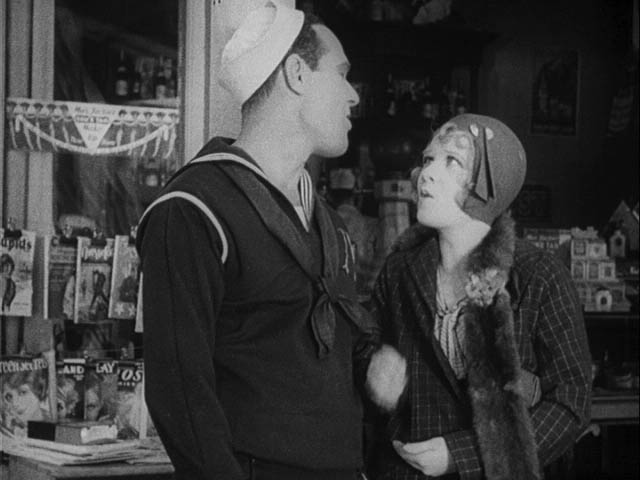
Pulps sighted in films tend to be the mainstream titles: Argosy, Detective Fiction Weekly, Western Story, etc. It’s a treat therefore to see a shop window like this one with short-run titles like Over the Top (21 issues, 1928-30) and Three Star Stories (34 issues, 1928-29) from the glory days of Great War pulp fiction.
The clipped magazines hanging in the top row are all pulps.
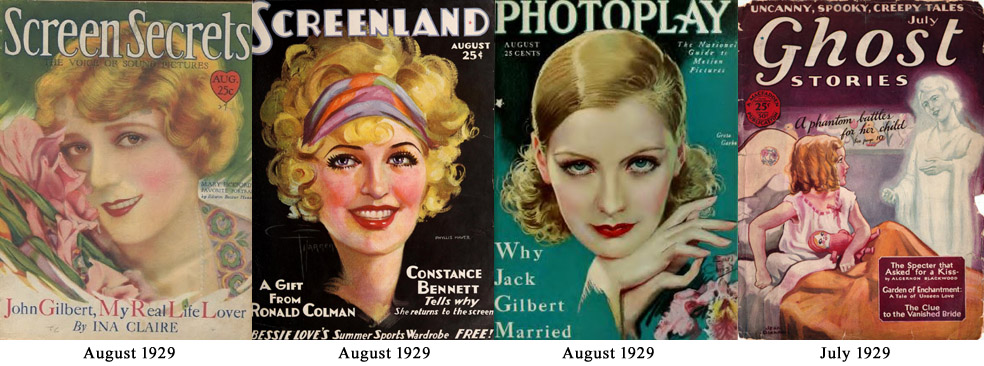
The larger movie mags, plus Macfadden’s Ghost Stories, are below.
Since the magazines in the window are date-matched, they may have shot the scene in front of an actual store. If not, it’s nice set-dressing.
The featured film is Navy Blues (1929). The actors are William Haines and Anita Page, in a story of shore-leave romance.
The director was Clarence Brown, who helmed a number of the Garbo classics (Flesh and the Devil, A Woman of Affairs) during her meteoric rise. Garbo, a fixture in the movie mags, gets yet another magazine cover here.
Navy Blues hit theaters in December 1929. Garbo’s first talkie, Anna Christie, another Brown classic and the acid test of Garbo’s stardom, was less than three months away.
Those eyes do all the talking on the Photoplay cover: “You vant to hear me speak? You have no idea what’s coming for you.”
Her first spoken words in Anna Christie — “Give me a whiskey, baby, and don’t be stingy” — brought the world to a screeching halt and pretty much cemented her name among the immortals of the screen and — what the hell — life itself.
One of the nicest guys I corresponded with in Robert E. Howard Fandom.
I treasure the Howard items he gave to me. When I found another copy of Gent I told him about it because I couldn’t afford it. Once he bought it, he sent me a finder’s fee of the Boardman edition of Conan the Conqueror. No dustjacket, but a very nice copy.
I was digging through all my crap during the lockdown and found Ed’s email exchange with me from years ago and that led me to this sad news.
Digging up the past leads to depressing things sometimes. I liked Ed.
If you want to surf over and check it out, I just had another review of a Cool and Lam novel pop to life. Roughly 80% accurate to what I turned in, so it passes my test for a personal link — and it passes the absolute acid test for my by-no-means-exhaustive writings on gumshoe Donald Lam, which involves describing how he gets beaten up.
Man, does the little guy eat the knuckle sandwiches.
A previous review had one of my favorite mini-blurbs on getting lambasted with flying fists. And I just realized that I covered all but one of the reissues by Hard Case Crime — on the back copy of the latest they call it “a fitting conclusion to Hard Case Crime’s revival of this classic (and long unavailable) detective series.”
They’ve done five and there are thirty total — kind of a Donald Lam-sized sampling, isn’t it?
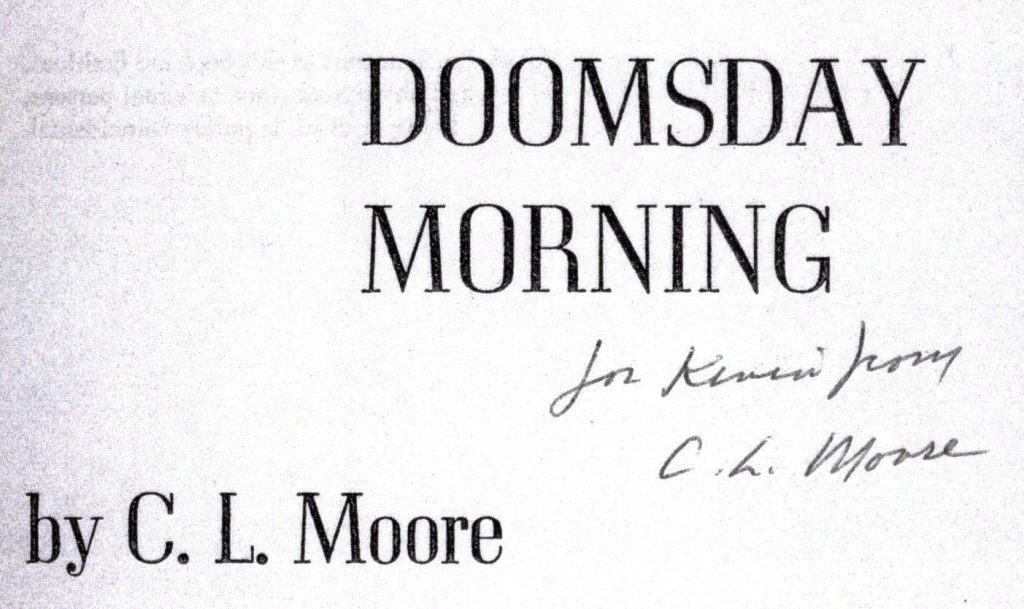
For this Autograph Hound Saturday the noted book and pulp collector Kevin Cook has chosen to spotlight C. L. Moore, who died on this date in 1987. His half-shelf of Moore hardcover titles appears above courtesy the intrepid Victoria Cook once again braving the labyrinth that is her husband’s library, camera in hand.
Moore co-wrote with her husband Henry Kuttner for 18 years, so some Moore contains some Kuttner, and vice versa — and they often used the pseudonym Lewis Padgett.
Here’s Kevin:
I met Catherine Lucille Moore at the Second World Fantasy Convention in New York City in 1976, where she shared Guest of Honor accolades with Michael Moorcock. After her speech a long signing line formed.
Doomsday Morning might seem an odd title to choose for an autograph, but I had just read it shortly before the convention and my copy of the brilliant collection Judgment Night had come with a signature already in it. Presto, instant choice!
The most interesting part of standing in the line and listening to Ms. Moore speak was that she explained how to pronounce Jirel.
I have never mastered writing phonetically, so anyone who wants to know should just approach me a convention sometime and ask.
Once again our resident adviser on all things woodpulp ransacks the archives of Hollywood for purposes of amusement and instruction. An education with a smile.
That adviser, of course, none other than John Locke, here to report:
You know those water-damaged pulps that no one wants in their collection?
This is one of the ill-advised methods by which those pulps got that way.
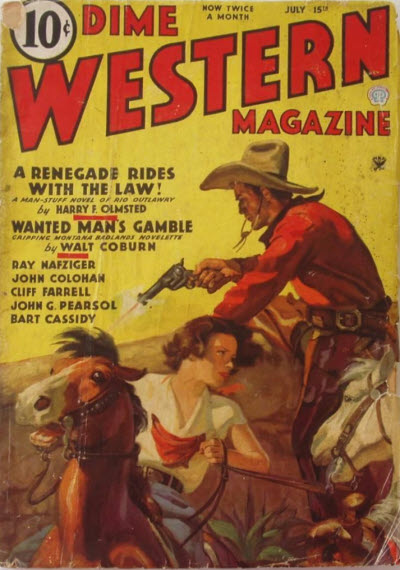
Hearts of the West (1975) is about an aspiring western novelist and avid pulp reader — played by Jeff Bridges, seen here — who falls into the stuntman business in 1930’s Hollywood.
He’s reading the July 15, 1935 Dime Western.
Note the stack of pulps on top of the toilet tank.
It’s mentioned before on These Mean Streets that Lawrence Block is an author whose work I admire and collect. Last year, I decided to compile a comprehensive bibliography of his works, just to document my own collection.
A Trawl Among the Shelves: Lawrence Block Bibliography, 1958-2020 has just been published in paperback and eBook, available on Amazon — and as an eBook on many other platforms.
When I completed the initial draft, I was struck by how much there was: novels, short stories, anthologies, and magazine appearances — the published book contains over 800 entries.
I thought other collectors might be interested in it. More than 25 years have passed since A.S.A.P. publishing brought out their bibliography of Larry’s work, which focused on his crime writing and — at Larry’s request — ignored his early pseudonymous sex-novels.
Since then, through a combination of avarice and the passage of time, Larry has embraced these early works, bringing many of them back into print via his own LB Productions and other avenues.
The time was ripe, I concluded, for an expansive update.
I sent Larry the rough draft and over the next few months he provided corrections, revisions, and information on long-forgotten works.
Of especial interest to me was The Strange Sisterhood of Mme Adista, his second published book (1958), a novella done quickly and printed on the cheap to be sold under the counter in Times Square bookstores.
Not even the most ardent of Block collectors are aware of this little item. Completely forgotten. Extremely obscure. I found no copies on the Internet. The only mention I could locate was to a NY court case on obscenity — it was entered into evidence.
Making it even more notable to collectors, it was illustrated by Gene Bilbrew, an African American artist well-known for his illustrations for fetish books and magazines. As far as I could determine, undocumented. (Larry’s “sequel” had nothing to do with the earlier volume, MadameAdista.)
Digging through his closets, he found his copy and sent it to me.
In addition to The Strange Sisterhood ofMme Adista, I was able to document many more works by Larry that are obscure or have not been previously identified or confirmed as his work — including more sex-novels, a sex-advice “non-fiction” book, ghost-written books, numerous articles on coin collecting, essays, book reviews, and introductions/afterwords for other authors’ books.
Some of these pieces were subsequently included in Larry’s recently published collection, Hunting Buffalo with Bent Nails, the contents of which kept expanding as I turned up items ripe for inclusion.
Best of all, A Trawl Among the Shelves contains a superb afterword — “The Man Who Wrote Too Much” — by Larry in which he discusses a sex-novel he wrote under a one-off pen-name that he’d completely forgotten until my work on the bibliography jogged his memory.
All he could remember was the pen-name he’d used — enough for me to track it down.
But, you’ll have to buy a copy of A Trawl Among the Shelves to find out the name and title.
In this Case of the Curious Lawyer, however, we’re easing over from actual movies into TV — though we’re sticking to moving images with pulps in them. Movies, TV, if you’re watching something on your phone, what’s the difference, right?
And now, John Locke with the argument for the defense:
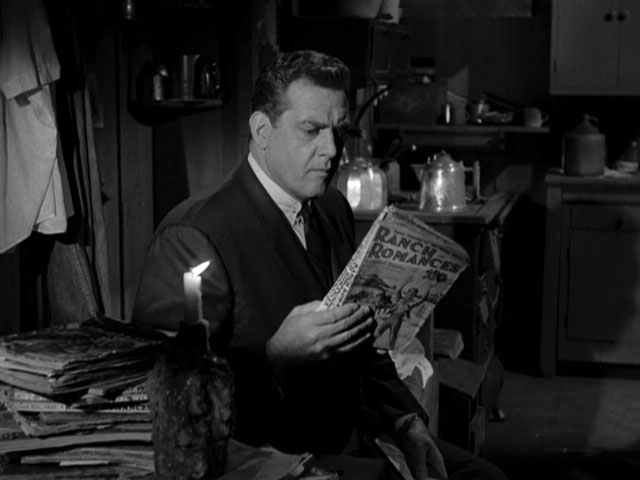
Here’s Raymond Burr as the immortal lawyer Perry Mason in the original TV series. The episode was “The Case of the Bigamous Spouse,” airdate November 14, 1963 — in those halcyon days before the JFK assassination when killers had tangible motives, and before the Beatles ruined popular music for the Pat Boones of the world.
Mason was the creation of Erle Stanley Gardner, who started selling to the pulps in 1921. He was a regular in Black Mask from 1924-43, with his stories of Ed Jenkins, the Phantom Crook, and numerous other characters. Mason never appeared in Black Mask, though. A higher-class character, his exploits were published in hardbound from 1933 into the Sixties. Occasionally, he was serialized in Liberty or the Saturday Evening Post.
In this scene from “Bigamous Spouse,” Mason explores an abandoned dwelling looking for clues and finds a large quantity of old western pulps. Being a highly inquisitive but generally unhip officer of the court, he naturally flips the mags over to marvel at the pocket-watch ad on a back cover.
The visible cover is the August 2 1942 issue of Ranch Romances. The issue dates from a brief period when the logo was red-on-white versus its more common white-on-red.
Welcome to a hard-boiled and not without noir blog with news and reviews, occasional outbursts of maniacal Autograph Hound activity, plus archival records from the forty-five year run of The Dashiell Hammett Tour.