Hammett: Two New Collections On the Way

Our peripatetic Guest Blogger Terry Zobeck roams the mean streets looking for news, when he’s not laired up pulling pure Hammett texts out of moldering pulp magazines. Here’s Terry:

Last month I was in St. Louis for Bouchercon — the World Mystery Convention. While going through the book room I ran into Otto Penzler, editor, publisher, and proprietor of the Mysterious Bookshop in New York City. I stopped to chat with him and thanked him for including the original serialized version of The Maltese Falcon in The Black Lizard Big Book of Black Mask Stories, which he edited last year. Hammett made substantial revisions to the serialized version of the story for its publication by Knopf, so it was nice to get the original version.

Otto then told me that he had just obtained the rights to publish two new collections of Hammett’s work. The first will be a collection of the (mostly) previously unpublished short stories archived among Hammett’s papers at the Harry Ransom Center at the University of
Texas, Austin. Otto previously published the story “Faith” in his 2007 anthology Pulp
Fiction: The Villains
, and The Strand Magazine published “So I Shot Him” earlier this year. This volume is tentatively scheduled to appear about a year from now.

The second volume is a collection of three screen stories Hammett wrote in the 1930s when he was working in Hollywood. A screen story is the plot line upon which the screenplay is based.

The first story is On the Make, originally written for and rejected by Warner Bros. but eventually filmed by Universal as Mr. Dynamite (1935). This story featured
prominently in Hammett’s legal tussles with Warner Bros. over the rights to the
character Sam Spade. Hammett, in his deposition, claimed he wrote a screen story (On the Make) in 1931 for Warner Bros. featuring Spade. In Warner Bros.’ deposition, they correctly note that the story does not include the character of Sam Spade. They further note that Hammett submitted two versions of the story, both of which were appended
to their deposition (my copy of the deposition does not include either version of the story). Several years ago, I bought a photocopy of On the Make; the version of the story I have appears to be the second draft based upon the page count (90 pages) noted in Warner’s deposition.

Hammett lost the first two rounds of the suit, but eventually won following the suit that Warner Bros. brought against CBS radio and Hammett over the broadcast of the radio serial The Adventures of Sam Spade. The decision became landmark copyright law, establishing an author’s rights to a serial character unless these rights are specifically transferred to another party.

The other two screen stories formed the basis for the second and third Thin Man movies. The first of these, After the Thin Man, was published in two parts in The New Black Mask (numbers 5 and 6, 1986), the paperback quarterly edited by Richard Layman and Matthew
Bruccoli. According to Layman’s introduction, it is Hammett’s second draft, following a 34-page summary that formed the basis of the first draft of the screenplay (by Albert Hackett and Frances Goodrich). Hammett then revised his story based upon that screenplay. The second screen story was for the film Another Thin Man. This story has never been previously published.

Thanks to Otto, Hammett fans will soon have two more volumes of Hammett’s writings to enjoy.


Posted in Dash, Film, Lit, News | Tagged , , , , , , , , , |

Two-Gun Bob: Lightin’ Al

I’m getting the distinct impression that good old Al Harron, over in the World of Robert E. Howard Studies, isn’t the fastest blade out of the scabbard. Back on February 11 I addressed some concerns he had raised about where I stood in the Howardian action, and I see that on October 17 he suddenly discovered that he had been answered.

If this had been a debate, people would have died of boredom in the interval.

But in answer to a couple of Al’s “points” — the idea that we couldn’t possibly be related in any way because our last names are spelled Herron vs. Harron indicates someone who isn’t familiar with names or how inconsistent they have been historically. While I don’t have the time or interest to explore the issue today, within my own family my father was one of eight siblings — half of those brothers and sisters spelled the last name “Herron” and the rest spelled it “Herren,” and I met some cousins once who spelled it “Herrin.” I have some Scots roots (Al is over in Scotland), so don’t regard his statement as in any way definitive. Al’s only 27 years of age at this point, so he hasn’t been around the block much as yet (though by that age I had written “Conan vs. Conantics” already and duked it out with L. Sprague de Camp in the letter column of Two-Gun Raconteur, so I probably expect more out of potential Howard critics than most people).

Then there’s the idea that Al doesn’t get that I get it. It might be the American vernacular throwing him, but who in Western Civilization doesn’t understand the concept of What Have You Done For Me Lately???

I guess we can put Al on that list. . . .

And somewhere in those long months I do recall Al taking the side of Professor Frank Coffman in a little dust-up I had with him — my only advice, Al, is that no one who really knows Howard Studies would ever side with Frank over me about anything. Honest.

But I must compliment Al on another recent post he did — very funny, and spot on — concerning the upcoming book of essays Conan Meets the Academy, where the initial blurb says flat-out that it is the first scholarly investigation of Conan. The only way you could suggest that it is “first” would be if you consider the idea that the essays are written by academics (including Professor Frank) and that only professors can do litcrit (some people apparently believe that — the poor saps, the poor deluded saps). To me, it just looks as if the profs are cribbing the pattern that L. Sprague de Camp used in books such as The Conan Reader, The Blade of Conan, and The Sword of Conan — sorry, academics, but it’s been done, decades ago.

Posted in News, REH | Tagged , , , , |

Hammett: “This King Business” News

Our frequent Guest Blogger Terry Zobeck pops back with some swell news — if you might wonder why you’d want to have the third edition of a book on your hard-boiled shelf over the first edition, read on.

I started my guest blogging career on Don’s site a few months ago with a piece on the edits
Frederic Dannay made to Hammett’s “This King Business” when he collected it in The Creeping Siamese. When the Library of America (LoA) published their Hammett collection, Crime Stories and Other Writings, they obtained the original magazine appearances of the stories so as to use Hammett’s pure texts — all but for “This King
Business.” At the time, no copy of the January 1928 issue of Mystery Stories, where
the story originally appeared, could be located.

After my post appeared, I got to thinking that it would be nice if the LoA would correct
Dannay’s edits to this story — after all, the primary draw of their collection is that it is based on the pure texts. It seemed a shame to have it marred by the edits to the one story, especially given their extent and negative impact on it.

So, a few Fridays ago I sent a “To Whom It May Concern” letter (the old fashioned way,
via snail mail) to the LoA detailing the differences between their version and the original — including the error they made in inadvertently deleting a whole page of text from Dannay’s version. I had little hope that my letter would get to the right person, let alone lead to anything. Therefore, I was pleasantly surprised (okay, stunned) to find an email reply waiting for me on the following Monday evening.

It was not a reply from just anyone at the LoA. It was from Max Rudin, the publisher, who wrote telling me that my “copy of the original pulp version of ‘This King Business’ is exciting news to us, and we’d very much like to use it as the basis for a revised printing of the volume.” He added that they had caught the deletion of the page of text and had corrected it in their second printing. A few days later I sent them photographs of the story — very carefully taken by me and my daughter to avoid damaging the fragile pulp.

In subsequent emails, Mr. Rudin and I discussed the possibility of the LoA revising their collection of Hammett stories to include all of the Continental Op stories — they’ve never been collected in a single volume — and another volume of the remainder of his stories, including the unpublished ones at the Harry Ransom Center, University of Texas, Austin.  This would fulfill my dream of seeing all of Hammett’s short stories in print in handsome uniform volumes. Given the difficulty of the marketing of such a revision — LoA has never done this to any of their previous volumes — I think it is unlikely it will happen, but one can dream.

As a fan and collector of Hammett’s work, it is a thrill for me to have played a roll — albeit a small one — in restoring Hammett’s original work to the marketplace. It wouldn’t have happened without Don’s gracious loan to me of his site, thereby providing me with the forum to document Dannay’s edits to the story.

Posted in Dash, News | Tagged , , , , , , , , |

Hammett: “Albert Pastor at Home” and “His Brother’s Keeper”

Our frequent Guest Blogger Tenderloin Terry Zobeck returns — finishing off his examination of the first set of pure text Hammett stories he had in his files, to see what sort of blue pencil Frederic Dannay put them to as he assembled ten paperback collections many moons ago. With this milestone achieved, Terry is now on the prowl for the rest of the short Hammett fiction in the original print appearances, to complete the job. Take it, Terry:

I began these posts to restore the pure texts of Hammett’s short stories a few months ago.

Now I’ve come to the end of the original 12 stories for which I own the pulps or slicks in which they first appeared. I can report that these last two stories — “Albert Pastor at Home” from the premier issue of Esquire (Autumn 1933) and “His Brother’s Keeper” from Collier’s (February 17, 1934) — were untouched editorially by Dannay when he included “Pastor” in Nightmare Town (1948) and “Keeper” in The Adventures of Sam Spade (1945).

However, we’ve not come to the end of the pursuit of the pure texts. This past week I acquired a copy of the November 1, 1923 issue of Black Mask, which contains the obscure Continental Op story “It,” one of two Op stories that haven’t been reprinted since Dannay collected them in his digest volumes of Hammett stories (the other one, if you recall, is “Death and Company”).  Dannay reprinted “It” in Woman in the Dark (1951) under the title “The Black Hat that Wasn’t There.”

Next time we look for pure texts, we’ll see if Dannay made changes to “It.”

Posted in Dash, Lit | Tagged , , , , , , , , , , |

Blog: Adios, Tenderloin Terry Zobeck

— Or; How the Tag Cloud Slowly Won Me Over. . . .

After the recent burst of posts about Musso & Frank, I noticed that the name of the oldest restaurant and bar in Hollywood muscled its way into my Tag Cloud — the clump of names hovering over in the sidebar area. Leo Grin, who has put on the feedbag in M&F every time I have, also popped up — and when I did the last of the posts about the residences where noir master Jim Thompson lived in Hollywood, suddenly Thompson’s name made the leap to the cloud.

Earlier I noticed the same thing happened with Dashiell Hammett Street. And Frederic Dannay, after an inundation of mentions. Even my pal John D. Squires made the cut awhile back — he said his name really should appear in the Tag Cloud in purple (that’s an M. P. Shiel joke, for those not in the know — Shiel fans get it, no one else will).

When the blog started, I wasn’t sure I wanted a Tag Cloud, because on other blogs I’ve seen they look pretty clunky — I find the ones where the Tags are listed in numerical order of hits especially mechanical — Dashiell Hammett Street (45), Dudley Do-Right (18), and so on. Just no organic rhythm. . . .

I barely know enough computer chops to do new posts. I didn’t know the Tag Cloud would form based on the first twenty-five or so names I tagged, or I might have juggled it differently. Or tried to. I thought those names would be it, I didn’t know some names would start to fall off and be replaced by others that were getting more action. Cool. Plus, I’ve noticed that the Tag Cloud wants names beginning with different letters, and searches for different angles — 891 Post got picked up because it starts with numbers (and is mentioned a lot), and at one point the title “Conan vs. Conantics” made the cut because its in quotes, but got dropped in favor of “Death and Company.”

I’m just an interested observer, at this point, I wouldn’t juggle the results even if I bothered to learn how. Tag Cloud Darwinism.

I guess I knew that the more hits a Tag got, the larger the name would appear, which has resulted in some nice idle reveries.

My favorite, and you can still see it, mostly, was when Valentine and Vince Emery floated in the cloud in the same font size, for months, side by side, and I started to think of Vince as Valentine Vince Emery. Like the names of the hoods who come into Frisco to rob the banks in Hammett’s The Big Knockover. Now I can’t think of Vince any other way.

And there was a great moment when I noticed that the name Tenderloin and Terry Zobeck were lined up, same size — I told Terry, hey, you can use the moniker Tenderloin Terry Zobeck!!! As a fan of The Big Knockover, Terry saw the appeal.

But as of a couple of days ago, Tenderloin Terry Zobeck is no more. Musso & Frank and the other new names muscling in had to push something aside, and Tenderloin was it. Now Terry is sitting in the cloud without a slang name, getting larger and larger with every appearance (he’s got three or four new posts ready to roll, so he well may be the largest name in the Tag Cloud in a couple of months).

And after this contemplative pause in the usual action, I’m not Tagging any name in this post — you can find most of them in the Tag Cloud and click away — every proper name dropped, except Dudley Do-Right.

Posted in Tour |

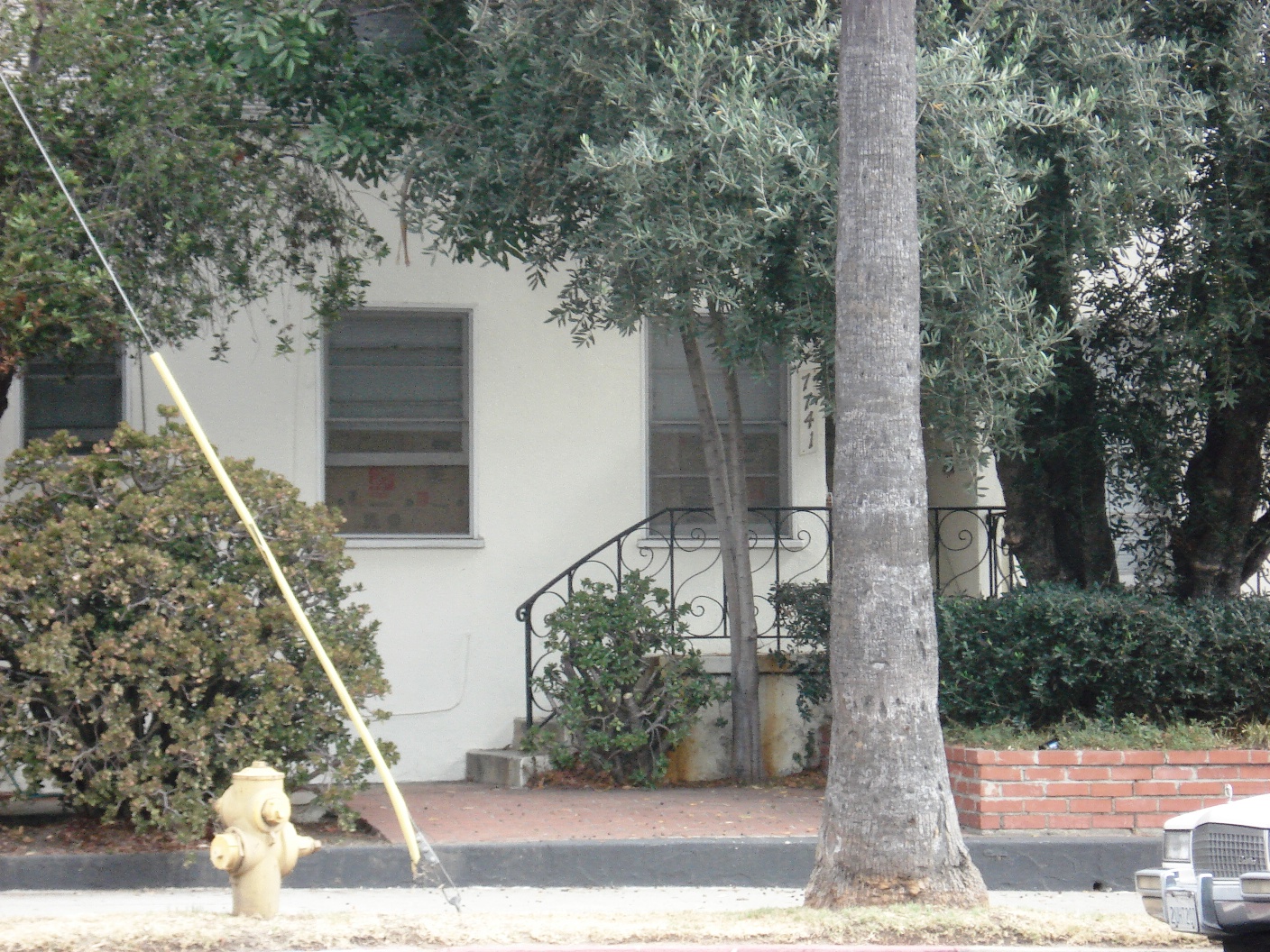
Hollywood Beat: 7741 Hollywood Blvd

Before the money from The Getaway allowed them to move closer to Musso & Frank, Jim Thompson and his family lived a little less than a mile away from the front doors, on the same street — far enough out to be in West Hollywood.

If Thompson was doing any drinking in M&F at this point, he could easily have hopped a bus back and forth — and the question comes to mind, If he was already familiar with M&F, did he use the loot from the Peckinpah film to allow him to move to Whitley, within easy walking distance? Or was it mere coincidence?

Of the residences in and around Hollywood, this is the one Thompson’s daughter didn’t like, remembering it as a dumpy little place — with the places on Whitley more upscale. That was almost forty years ago, though, and today the place and the neighborhood look nice enough. I was kind of hoping for one run-down shanty sort of place to evoke primo Thompson, but you don’t get anything like that with his Hollywood addresses.

Posted in Film, Lit | Tagged , , , |

Hollywood Beat: 1817 Hillcrest

The place Jim Thompson was living at the time of his death — check out a reputable source, but my understanding is that he died in this building — is roughly ten or twelve blocks from Musso & Frank. To get to 1817 Hillcrest from the front doors of M&F, go west to the major artery North Highland Avenue, north a few blocks to Franklin Place, left a block and right on Hillcrest. After a series of strokes Thompson stopped eating, and even lost interest in booze and cigarettes (and in this bleak noir universe, if you lose interest in booze and cigarettes, that’s it).

While you could walk from Hillcrest to M&F, my assumption is that Thompson wasn’t really up to it by the time his family moved to this address, and that it was the years spent on Whitley Street that made him a fixture in the grill, whether anyone there really knew who he was or not.

For me, Thompson is now the one writer, out of no doubt thousands of writers, I associate with M&F above all the others. What better ghost to haunt the bar?

Posted in Film, Lit | Tagged , |

Hollywood Beat: 1922 Whitley

When I got back to Hollywood to stop in Musso & Frank for the third time, I was really curious to check into what Dennis McMillan had told me — that Jim Thompson was a regular there, drinking at the bar almost every day, because he lived only about three blocks away.

Typically, I kind of waited till the last minute to look into it, and couldn’t find a copy of Robert Polito’s bio of Thompson, Savage Art, before I headed south — I’m confident Polito has every known address covered. However, Craig Graham solved that timing problem by calling up Thompson’s daughter and asking her.

We drove around, tracking down every place anywhere in the vicinity of M&F she told Craig about — I made a couple of notes, but most of the info here is from memory.

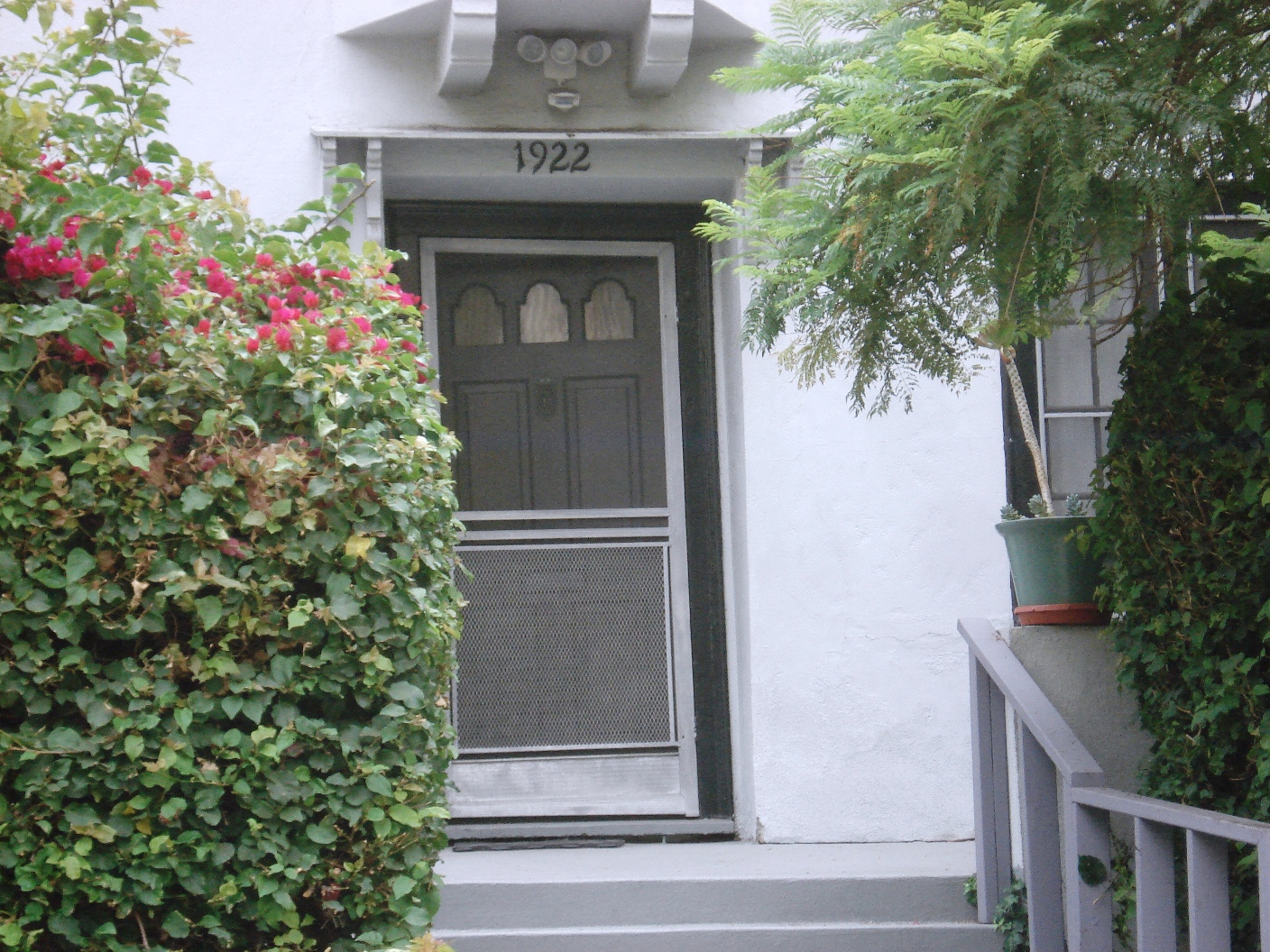
The closest address to M&F still standing is 1922 Whitley, roughly four blocks from the rear doors of the grill — you can duck around on some streets and cut across the back parking lot to shorten the distance, but Whitley T’s into Hollywood Boulevard about a block east of M&F’s front doors, then you head north three or four blocks — easy walking distance.

If I have the info right, the Thompson family made the move here after he got some film money from The Getaway, directed by Peckinpah, starring Steve McQueen, released in 1972. They had been living in an apartment the daughter didn’t like that much, further out Hollywood Boulevard, and at some point moved to her favorite place in this series — 1850 Whitley, south in the next block beyond Franklin — yes, one block closer to M&F! 1850 Whitley apparently was a three story building and they occupied the penthouse — today a large apartment house covers that section of real estate.

I guess that while they were living on Whitley, one or the other address, was when Thompson got to do his cameo as Judge Baxter Wilson Grayle in the 1975 Robert Mitchum version of Farewell, My Lovely  — if you’re a hard-boiled fan, it’s worth watching just for that.

And sometime before his death on April 7, 1977, the Thompsons moved about twice as far away from M&F — still not that far — where he died.


Posted in DMac, Film, Lit | Tagged , , , , , , , |

Hollywood Beat: More Musso

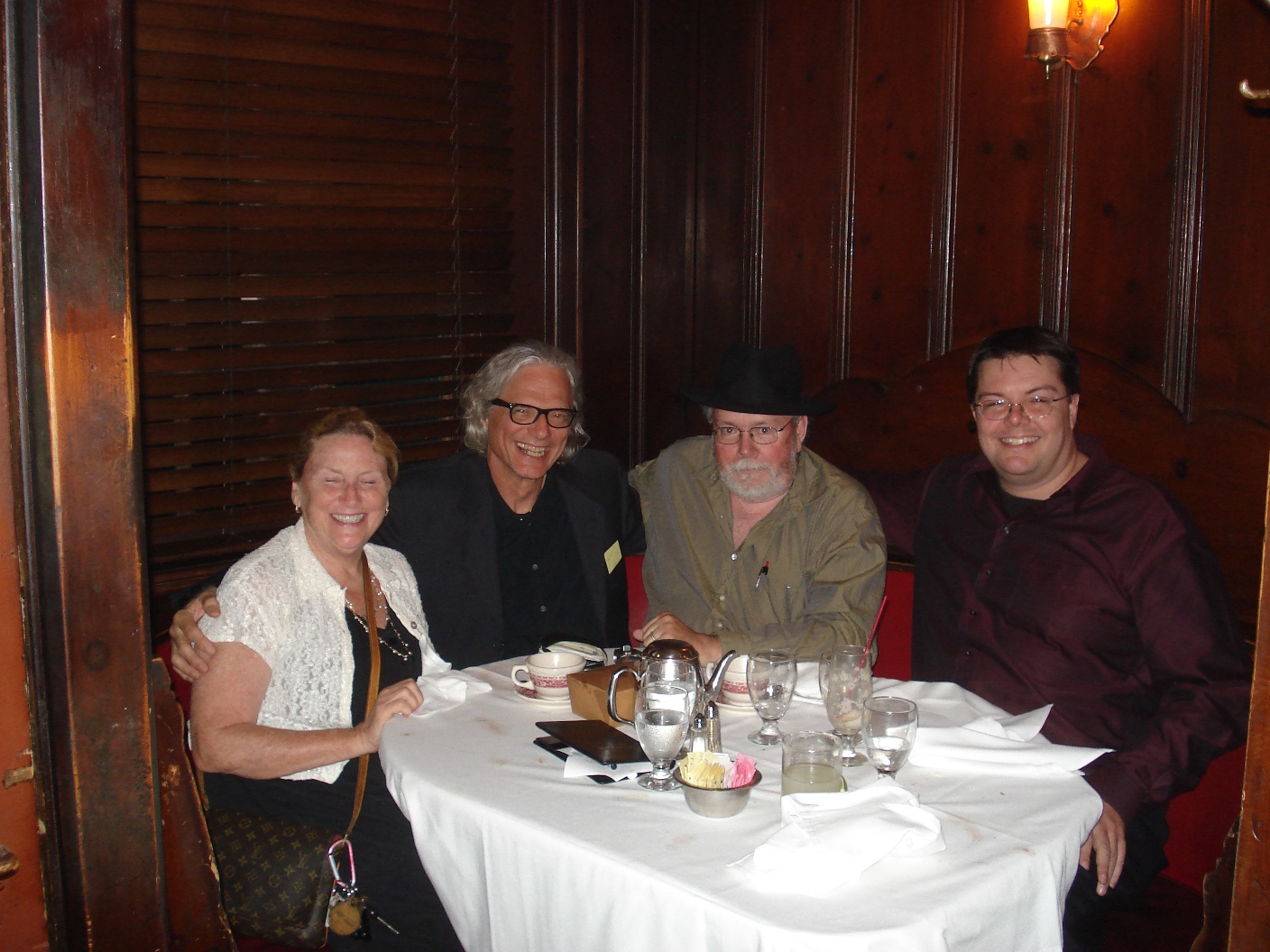
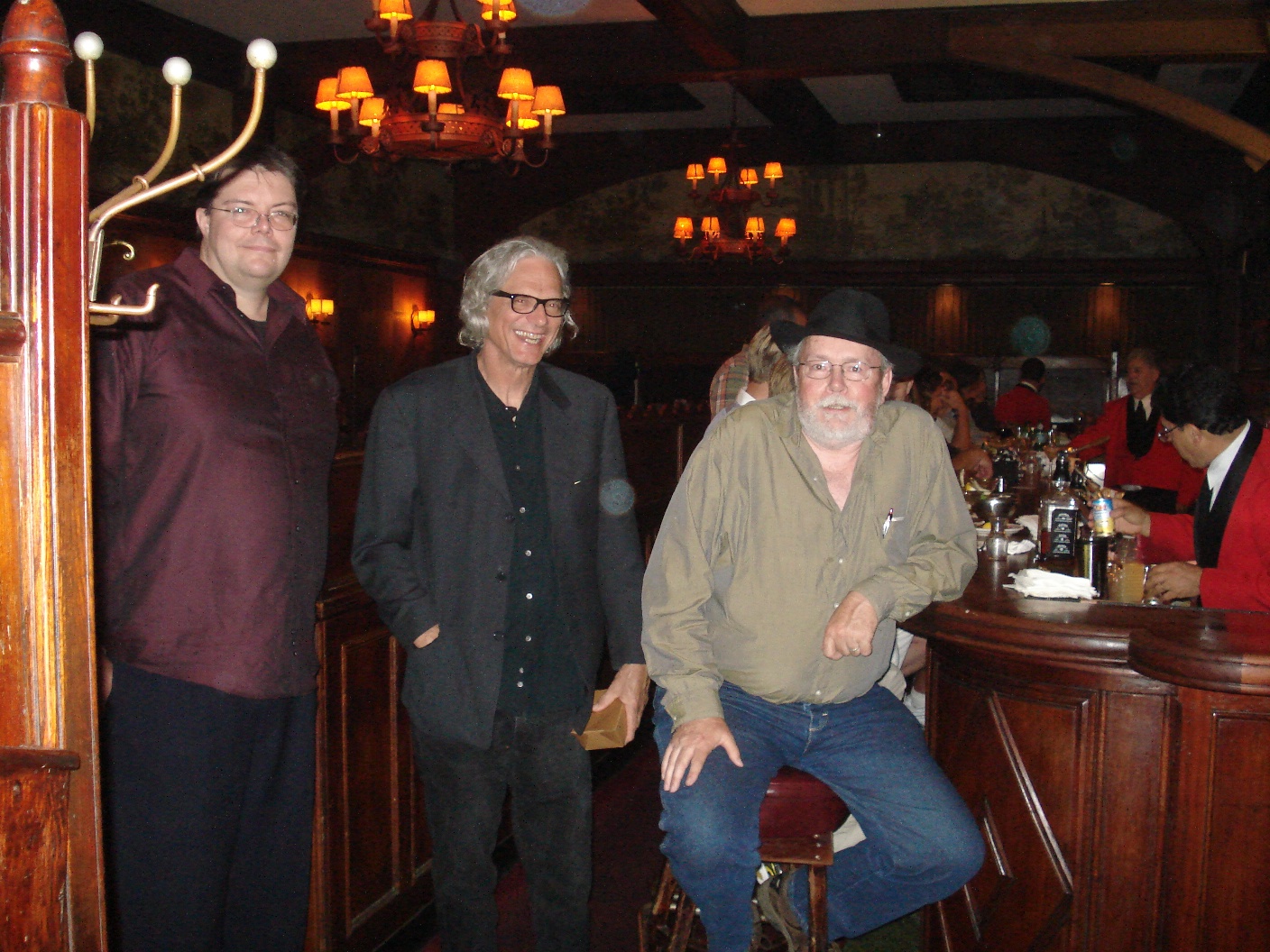
Finally, I got a date set-up — Saturday August 20, 2011 — where I could hit Musso & Frank with Craig Graham, the guy who first told me about the place. Craig reserved a table with a view of the bar. We were on.

I suppose I met the Grahams, Craig and Patti, and their Vagabond Books enterprise around 1994 or 95, when they operated a brick-and-mortar store in Brentwood, down the block from Mezzaluna where Ron Goldman worked — not long after Goldman and Nicole Brown Simpson were found murdered. Can’t remember what the exact reason for hauling down to LA was at the time, but it was something to do with Dennis McMillan.

They may not want it carved on their tombstones, but in the Posse McMillan Universe the Grahams have been most famed as the booksellers Dennis stopped in on (early 80s, I’m guessing) and his scrofolous old dog Skeezerinctum knocked up their dog. To become part and parcel of The Dennis Legend, it has to be something like that, you can’t just meet him at a booksigning somewhere. His dog has to knock up your dog. You have to hold a gun to his head. Something legendary. . . .

But in the real world Vagabond is quite respectable and handles lots of major antiquarian action — Patti mentioned that pretty recently they had acquired the Jimmy Durante library. I wouldn’t have thought that Durante would have had a library, but hey, I was glad to hear he did. The books just moved on recently, because although Durante died in 1980 he had married a much younger woman, a hat check girl in one of the New York clubs (something like that), who had kept the library intact.

So, we had the night lined up. Leo Grin was game for dinner, as usual, but Donald Sidney-Fryer wasn’t available. We parked in the back lot and moved in through the old room, where we paused to look at the Charlie Chaplin booth — up front, next to the doors, the only booth with a window looking out on Hollywood Boulevard — you want to be seen, a primo spot.

It was empty.

Our reserved table with a view of the bar was in the new room, but the host thought to ask if we wanted the Chaplin booth, since we were standing there, appreciating the history. Why not?

Found out that later on it became the favored booth of Steve McQueen. Cool.

This time we didn’t spot a single celebrity, at least that any of us recognised, but Craig mentioned that on one of his first stops in M&F in the next booth Lillian Hellman was dining. Yeah, everyone has set foot in M&F.

And before we hit the joint we made a whirlwind tour around to the various places Jim Thompson had lived in Hollywood. I figured they’d be mentioned in the bio Savage Art by Robert Polito, which I read the opening of once at somebody’s house — looked very detailed, thanks to Thompson’s widow having kept tons of material. But I never got that one. As I said before, I’m not that big a Thompson fan — which doesn’t mean I’m not interested in him.

I called Craig to see if he had a copy in stock I could get. He didn’t. But he said, “I’ll call Thompson’s daughter and see if she remembers the places.”

Suddenly we were going from a second-hand source to a first-hand source — very nice.

Posted in DMac, Film, Lit | Tagged , , , , , , , , , , |

Hollywood Beat: Musso & Frank

Since I missed out on Musso & Frank for years, I’ve been trying to catch up, stopping in every time I make the drive down to LA — I figure I won’t burn out, given that I only drop south once or twice a year. But its the kind of place where I wouldn’t object to being an habitué, staking a claim on a barstool or a booth. . . .

Craig Graham of Vagabond Books is the guy who sold me on the idea that I had to hit M&F next time I got to Chandlertown. I was hanging out in the Vagabond booth at the Antiquarian Book Fair in San Francisco, must have been in 2009, Craig was doing his raconteur thang and M&F came up — honest, I couldn’t believe I hadn’t been aware of it. Old Hollywood, everyone went there, and it was a survivor, unlike The Brown Derby and other legends that lay by the wayside.

I would have met Craig for drinks during my first visit, but happenstance took me south on a weekend when Vagabond was holding down another booth in a book fair in Frisco. I wasn’t going to skip M&F, so Craig got a raincheck. Saturday February 6 2010 was the date — I snagged four or five hours sleep, pointed the machine in the direction of Hollywood and Vine, punched it through hour after hour of raging thunderstorms. En route called up my LA pal Leo Grin so he’d be ready to tag along with us on the initial exploratory.

So, we’re seated in a booth with a view of the bar (the vantage point Craig insisted on, for maximum effect). In a place once frequented by Hammett, Chandler, Faulkner — even Bukowski. Charlie Chaplin had a favorite booth. Tom Mix. Doug Fairbanks. Valentino. All the actors for decade after decade came in — Leo pulled out his smartphone and found a Yelp-like site where someone reported they came in on a busy Saturday night and were told they’d have to wait. Hey, they said, can’t we sit in that empty booth right there? No, we’re sorry, but that booth is reserved for Mr. Johnny Depp and his family. Right, they thought — sure. . . . Then after a few minutes Mr. Johnny Depp and his family came in and sat in the booth. Well. Okay.

We hit the scene between lunch and dinner hours, the place was pretty quiet — the next two times, later in the evening, it was packed. I wasn’t thinking we’d spot Johnny Depp. I wasn’t thinking I’d spot anyone I’d recognise. Then a guy in a hat walked from the front over to the bar.

“The guy in the hat,” I said, “who just went to sit at the end of the bar — he’s in tons of stuff.”

“What’s his name?” Leo asked.

My brain was hamstrung by too little sleep. I couldn’t bring the name up.

“You’ve seen him, he’s in tons of stuff. He’s in several movies with Charles Bronson. . . . Breakheart Pass, he’s in Breakheart Pass.”

Leo activated the smartphone. We knew he wasn’t Bronson.

“Richard Crenna?”

“No.”

“Charles Durning?”

“No.”

“Ed Lauter?”

“Yeah. That’s him. Ed Lauter.”

“That’s not Ed Lauter,” Leo said, cranning to see to the end of the bar.

“I’m pretty sure it’s Ed Lauter. You know, he’s in The Longest Yard. Born on the Fourth of July. True Romance. . . . ”

Later, Leo got a better look. “Hey, that is Ed Lauter!”

I didn’t want to bother Ed Lauter, but figured some kind of confirmation was in order. I asked the guy manning the front, “The guy in the hat, seated at the end of the bar — is he Ed Lauter?”

The host nodded, though I wasn’t sure he knew the name.

“He always plays the tough guy,” he said, “always the tough guy.”

Okay, then. Ed Lauter sighting confirmed. For my tastes, I couldn’t have had a better celebrity sighting. Musso & Frank, your rep is deserved.

Now I talk up M&F all the time, and thought to ask Dennis McMillan if he’d ever been there the last time I talked with him on the phone. He had. And more:

Jim Thompson used to drink there at the bar every day. He only lived about three blocks away. Harlan Ellison wrote about talking to him there, he heard it was his hangout and found him — other people didn’t even know the guy at the bar was Jim Thompson.”

Hammett. Chandler. Bukowski. And Thompson. Hmmmm. . . .


Posted in Dash, DMac, Film, Lit | Tagged , , , , , , , , , , , , |