Tour: Two More in May

Only two more Sundays left in May, two more chances to put your gumshoes on the mean streets before I jump over to other things in the month of June, and maybe July, as well. . . .

For the tour on Sunday May 15 a guy showed up who has taken the walk a few times, plus another fellow from Danville who took it many years ago, although he couldn’t remember how long ago. Last year a guy came out who calculated that he had walked the walk an even thirty years before. Yeah, I’ve been around a long time. I get it.

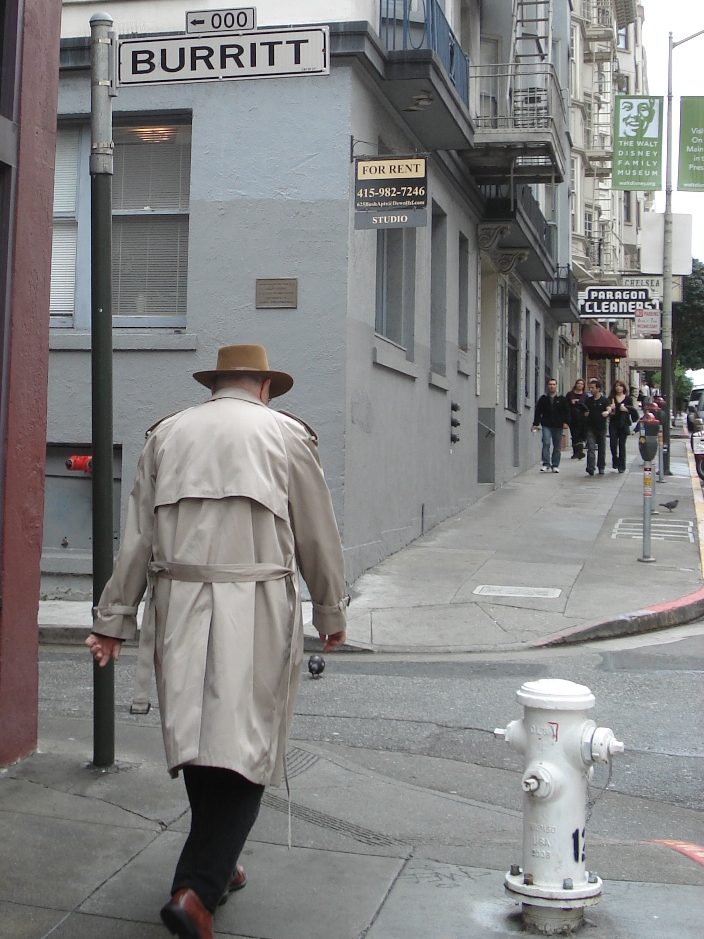
And as the May 15 tour reached the mouth of Burritt alley, we encountered a couple, both swathed in trenchcoats, standing under the plaque — and as it turned out, they were returning to the site for fun, having been out on the tour twenty-seven years ago.

Man. I’m thinking I should have tagged all the Hammett tour walkers like otters or something, so we could have tracked their movements in a Great Sociological Experiment.

Posted in News, Tour | Tagged , |

Two-Gun Bob: Keeping an Iron Hand In

As I was saying not long ago, I keep my hand in on things Robert E. Howard. A couple of items have been announced already, and I believe at least one more I contributed a tidbit to will be popped out as a surprise during Robert E. Howard Days in Cross Plains, Texas, next month.

The anthology Dreams in the Fire is available for pre-order, if interested — definitely the kind of book where if you like this kind of book you may like this book, but if you don’t like this kind of book, well, my bet is you really won’t like this book. If you know what I mean. Stories and poems by fans of REH, many of them with pro credits, all proceeds to benefit the Howard House and Museum.

A great cause. I contributed my 1980’s poem “The Blades of Hell,” originally placed with editor Steve Jones for Fantasy Tales in England, then tuned up a bit for a 2005 reprint in The Cimmerian, and now back again. That’s the cool thing about being a legendary battle-scarred gray wolf of Howard Studies, you can get by with a reprint of a poem, no less. Plus editor Mark Finn didn’t seem interested in a much more fascinating item I thought I mentioned as a possible contribution — maybe next time.

You can read an interview with Finn about this project on the Two-Gun Raconteur website — and for the next issue of Two-Gun Raconteur the print journal I knocked out a near-7000 word review concerning the three anthologies of Howardian litcrit promised for Howard’s centennial in 2006. Promised, but not delivered, or badly delivered, and that’s where the fun comes in. Yeah, it was time to pull out the broadsword and strew some viscera about, so Howard Fandom won’t forget I’m still guarding its borders.

Posted in Lit, News, REH | Tagged , , , |

Frisco Beat: Still Dashiel. . .

As of last night, the street sign at the bottom of Dashiell Hammett Street still reads “Dashiel Hammet.” The sign at the top of the street is the original, correctly spelled version.

And I did get a new theory about the sign from a resident of Hammett alley, who suspects the construction crew that has been ripping up Bush in recent weeks may have broken it off by accident, and replaced it with the new one — hey, construction guys trying to spell Dashiell Hammett, that would explain a lot. . . .

Meanwhile, Steven Meikle popped me a note, saying: “I had to laugh when I saw the new ‘Dashiel Hammet’ sign. I’m glad I got a photo with the old one.” Steven is a legend of the tour, of course, as the guy from Edinburgh who saved up for six years so that he could take the tour that fell closest to Hammett’s one hundredth birthday. He’s been back on the mean streets since then, and that’s when he took the shot shown above.

Posted in Dash, Frisco, News, Tour | Tagged , |

Death Lit: The Black (Mask) Bird

While I’m not doing a regular crime and mystery review column any more, and you’d have a very hard time talking me into the idea again, I still manage to knock out seven or eight standalone reviews every year in the old print medium — if I weren’t so lazy, I might do as many as ten or twelve.

The Big Book of Black Mask stories Otto Penzler put together is one of the best deals ever, and now that it has been out a few months, I’ve even seen copies reduced from stock in the Edward R. Hamilton remainder catalogs for around $16. A sweet bargain for anyone who wants to sample more fiction from the Mask than has ever before been assembled in one place. For my short, regular review I said this book deserves a Star, and it does, and I heard that the editors liked the review so much they even put it in a box. Ah, the shorthand signals to alert readers and booksellers that something great is about to hit the shelves! 

Although Otto is by no means the first with a collection from the Mask (his foreword neatly covers the earlier action), he certainly comes through with the mostest. Over one thousand pages, double columns, packed with wordage. If you’ve got any curiosity at all about the fiction that appeared alongside Hammett in the twenties and Chandler in the thirties, here you go. Although when push comes to shove, life is short — if you read Hammett and Chandler you’ve read the best from Black Mask, and you could go on to the next thing on your list if you’re in some kind of hurry.

This Big Book includes several things I especially like — for example, the original illustrations and headings for most of the stories, evoking a period feel. The episodic six-part novel Rainbow Diamonds by Raoul Whitfield, writing as Ramon Decolta, featuring the Filipino Private Eye Jo Gar, appears in a book for the first time since its original run in the Mask. In 2004 for Alfred Hitchcock’s Mystery Magazine I reviewed Jo Gar’s Casebook, which collects all the other stories in this series — everything except Diamonds. Yeah, it would have been better if every Jo Gar exploit had appeared in one book, but finally you get the chance to read them all — not as hot as Hammett’s Continental Op series, but solid second tier. Plus you get Erle Stanley Gardner’s first sale to Black Mask and a host of other stuff. Even some sociological import — fiction by the first Japanese-American crime writer, hard-boiled action by gay crime writers William Rollins Jr. and Cornell Woolrich, as well as a dame who managed to break into the almost exclusively male ranks of this premiere tough guy school of detective fiction.

But for purposes of this shadowy, blood-stained alley in a remote corner of a nighted city on the dark side of good old planet Blogosphere, there is one major reason why any big fan of Hammett desperately needs to have this book clutched tightly in his paws: it reprints in full The Maltese Falcon.

Yeah. I know what you’re thinking, because I was thinking the same thing.

The review copy was dropped on the doorstep just as I was heading out for the evening. I glanced over the contents quickly, and thought: it reprints The Maltese Falcon???!!! Jeez, everyone has read The Maltese Falcon. . . .

What a stupid waste of space. . . .

Yet, if Otto wanted to reprint Hammett’s most famous novel, honestly, how violently could I kick about it? No other single novel stands over the entire run of a magazine the way Falcon looms over Black Mask. The undisputed classic from a pulp that has achieved legendary stature, and a big chunk of that legend depends on Hammett creating Sam Spade.

Within five years of hitting print in those pulp pages, the Sam Spade adventure was the first contemporary detective novel picked up for inclusion in the prestigious reprint series from Modern Library — the 1934 publication of that edition hinted that Hammett had written an enduring work. Now over eighty years later Falcon stands alongside other novels that have made the grade as classics in the Big Read program from the National Endowment for the Arts.

Got it. A classic. Deserving a big chunk of pages in any Big Book of Black Mask.

But then I thought about it some more — would Otto actually be happy to just reprint a novel everyone has read?

Sudden excitement set in. There was another option. Maybe Otto had reprinted the original text of the novel from the yellowed wood pulp pages — a text that has never been reprinted before.

When Hammett prepared his novels for hardcover publication by Knopf, he worked them over — it is known that he made some 2000 textual changes from the version in the Mask for the 1930 hardback of The Maltese Falcon. For example, the chapter in the novel that appears under the title “The Levantine” in the pulp is called “Cairo’s Pockets.” Plus some 1999 other changes, as Hammett established the final text.

And all these years, most Hammett fans who may have wanted to see what changes he made haven’t been able to do so. Those issues of Black Mask aren’t all that common and they certainly are priced out of the budgets of most people. Only a year ago it would have cost you thousands of dollars to assemble those issues in order to read the pulp version of the Falcon.

Now, thanks to Otto Penzler, it’ll cost you less than twenty bucks.

I’ve been playing this edition up big time on the tour. The Black Mask Black Bird. The most exciting thing in Hammett studies in a longggggg time. Grab a copy for your complete collection of Hammett.

Posted in Dash, Lit, News, Tour | Tagged , , , , , , , , , , |

Hammett: Lost Stories, Found

After his first Guest Blogger spot, tracking down the pure text for Hammett’s Continental Op yarn “This King Business,” Terry Zobeck returns with another Adventure in Collecting. Here’s Terry:

Ever since I read Richard Layman’s 1981 Hammett biography Shadow Man, and learned there were four unlocated stories, I’ve been intrigued by their fate. He noted that two stories — “Another Perfect Crime” and “The Man Who Loved Ugly Women” — were published in Experience magazine sometime before May 1925. 

Layman eventually located a copy of “Another Perfect Crime” — it was published in the February 1925 issue of Experience. In 2002, Layman included the short story in his and Matthew Bruccoli’s Hardboiled Mystery Writers: Raymond Chandler, Dashiell Hammett, Ross Macdonald: A Literary Reference. Vince Emery reprinted it in Lost Stories in 2005. 

A few years later I found a copy. Thanks to my friends at FictionMags and Galactic Central, I’ve learned that Experience was a digest-sized magazine of humor and Hollywood gossip centered on the flapper lifestyle, published out of Chicago. It began life as Flapper magazine in May 1922. In October 1923, Flapper morphed into Experience, which lasted until sometime in 1925. 

“Another Perfect Crime” is minor Hammett, a humorous short-short (about 700 words) concerning a hapless criminal who thinks he commits the perfect crime by being such the obvious suspect that no one will actually suspect him.

To date, no copy of “The Man Who Loved Ugly Women” has come to light, but I have hopes of tracking it down some day. But given it was published in Experience, I have no great hopes as to its quality.

The remaining two stories, “First Aide to Murder” and “A Tale of Two Women” were published in Saturday Home Magazine, a newspaper supplement from the 1930s. Layman speculated that these stories might be re-titled reprints. I can confirm, with near certainty, that Layman’s guess was correct. 

Prior to giving Frederic Dannay permission to reprint his short fiction, it is known that Hammett licensed several of his stories to King Features Syndicate. These were published in the Saturday Home Magazine between at least 1936 and 1938. There are three copies of the Saturday Home Magazine with Hammett stories currently for sale by Internet dealers; these are “Death and Company” in the November 21, 1936 issue; “The Judge Laughed Last” in the February 27, 1937 issue; and “Pickup” — according to the dealer’s description, a re-title for “The Whosis Kid” — in the August 1, 1936 issue. The folks at the FictionMags Index indicate that “The Farewell Murder” was reprinted in an issue from 1937.

According to Mike Humbert’s The Dashiell Hammett Website, “First Aide to Murder” was published in the April 8, 1938 issue of Saturday Home Magazine. Unfortunately, the scan of the issue on his website is not of sufficient resolution to be able to read the text. Mike does not own the copy, but his recollection is that it is a re-titled reprint of “The Assistant Murderer.” 

I can be more definite about “A Tale of Two Women.” Last year, I purchased a copy of the March 3, 1987 issue of the San Francisco Examiner. As part of the paper’s centennial celebration it reprinted this story by one of its favorite sons. The copyright is given as “1938 King Features Syndicate.” The story is clearly a re-titled “Women, Politics and Murder.” I think the likelihood to be slim that the Examiner chose to re-title the story on its own initiative, using a title from one of the unlocated Hammett stories. The King Features Syndicate copyright notice also argues against this scenario.

So, that’s three down — three of the four previously unlocated stories located.

Posted in Dash, Frisco, Lit, News | Tagged , , , , , , , , , , , , , , , , , |

Tombstone: Willeford

The week before I watched The Pope of Greenwich Village on the anniversary of Charles Willeford’s death, my pal Leo Grin happened to be on a trip to Washington, D.C. Leo is known for the great Robert E. Howard magazine The Cimmerian, and he contributed an essay to my book of Howard criticism The Barbaric Triumph — back in the old days we were constantly planning out something that would outrage the boring Old Guard of Howard and fantasy litcrit and elevate the Texas writer to a higher rung on the ladder.

Lately Leo has been hanging his hat on the web as a blogger for Big Hollywood. I am the unnamed source for his interest in Chuck (which I knew he’d like, if only for the presence of his fellow Big Hollywood blogger Adam Baldwin) and Human Target.

In D.C. he did museums, met up with locals and so on, but did manage to squeak in a fast trip to Arlington National Cemetery — Leo didn’t have time to get to Hammett’s grave, but managed to pay his respects at the resting places of Lee Marvin and Joe Louis, as well as the mausoleum where Willeford’s ashes are interred.

He sends a couple of shots, noting that the letters on Willeford’s crypt are now washed out and hard to see — unlike nearby letters, which have a black stain which makes them stand out clearly. My guess is that Willeford’s marker has been visited by people doing gravestone rubbings — maybe even a lot of people doing gravestone rubbings. That’s not something I ever wanted to do — I am happy just moping around graveyards and looking — but I understand it is a popular hobby.

And Willeford is not without devoted fans. 

Posted in Dash, Film, REH, Willeford | Tagged , , , , , , , , , , , |

Sinister Cinema: A Couple of Popes

Breaking the pattern of recent years, this season I didn’t offer the usual Palm Sunday Tour in honor of Charles Willeford’s death, which fell on a Palm Sunday, March 27, 1988 — Willeford, who would be crowned posthumously by the Village Voice a year later “The Pope of Psychopulp.” Another walk by appointment nudged up against the date, so I let it go.

I did think about grabbing a Willeford book for rereading, but was caught up instead, on a sudden impulse, in a reread of Fritz Leiber’s Change War series.

No tour. No reread. But I did notice that The Pope of Greenwich Village was up free on On Demand.

Okay. I hadn’t seen that movie when I visited Willeford in April 1987 — and I still hadn’t caught it all these years later. In memoriam the late, great Charles Willeford, sure, it was time to sit down and watch Pope.

At some point when we were hanging around talking in his living room, Willeford mentioned The Pope of Greenwich Village and seemed surprised that I hadn’t seen it yet. He told me it was great. I believed him — I’d heard good things about it, and have continued to hear good things about it. And today I could watch it with the further careers of the three leads, Mickey Rourke, Daryl Hannah and Eric Roberts, in mind, something to brood over. I can’t help but appreciate career arcs, choices made, bad breaks — a large part of the appeal of Willeford as a writer is the way his career zigzagged around until he cracked the big time at the end of his life.

Now that I’ve seen it, I agree, Pope is a great little movie — reminds me in some ways of another favorite of mine, Palookaville.  Got to love the smalltime heist gone wrong scenario. And as I watched, I was impressed again and again by the dialogue. Yeah, as Willeford might put it, a minor masterpiece.

Then I got to the end, where Burt Young swallows the drink laced with lye — and I suddenly remembered after twenty-four years how Willeford specifically had pointed out how terrific a scene that was, then how he erupted with loud laughter. Yeah, it was a wild, unexpected development. And thank you Recovered Memory Department for bringing it back for me. 

Willeford did pretty much the same thing when he was telling me about Sid and Nancy, one of his favorite movies, and howled about the scene where Gary Oldman as Sid just walks right through a plate glass door.  Wild. Off-the-wall. In its way, totally Willefordian.

Posted in Film, Tour, Willeford | Tagged , , , , , , , , , , |

Hammett: The Real “Business”

I just hosted my first Guest Blogger, Brian Leno — how about another one?

Up this time is Terry Zobeck, whose name may ring a bell because he turned up the source for the quote where Hammett had called the British writer M. P. Shiel “A Magician.” Terry is a serious collector of Hammett in the original magazine appearances (you can thank Terry for the cover image of Mystery Stories above), and provides the best text to date as he covers restoring the Continental Op tale “This King Business.” Take it, Terry:

I like my Dashiell Hammett straight up, neat, with no editing. For years we have had to deal with the digest volumes edited by Frederic Dannay if we wanted to read many of the more obscure stories.  Sure, it was great to be able to read them, but Dannay, without any input from Hammett, often changed titles and edited the stories. I have never checked, but I suspect that Lillian Hellman with The Big Knockover and Steven Marcus with The Continental Op used the Dannay versions for their texts. In recent years, however, Marcus with the Library of America’s Crime Stories & Other Writings and Vince Emery with Lost Stories sought out the original magazine appearances — with one exception.

In the “Note on the Texts” in Crime Stories, Marcus states that “No copy is known to be extant of the issue of the pulp magazine Mystery Stories in which ‘This King Business’ initially appeared, in January 1928.” For this one story, the text of the Dannay edited volume — The Creeping Siamesewas used. It is especially unfortunate that the Dannay text had to be used since this is a terrific story featuring the Op.

A few years after Crime Stories was published I purchased a copy of the January 1928 issue of Mystery Stories. Recently I decided to check to just what extent Dannay edited this story.  Well, not only did he make several inexplicable edits — presumably for the sake of saving space — that detract from the story, but the damage was compounded by the copy editor at the Library of America. In transcribing the story from The Creeping Siamese page 116 was deleted!

Now this isn’t just any ordinary page of superfluous descriptive prose, this is the climatic scene between the Op and Colonel Einarson in which the Op pressures the colonel into accepting the deal to crown the Op’s client, Grantham, king of Muravia. If the Op cannot get Einarson to go along with his play, he could end up before a firing squad.

In the Crime Stories version the Op asks the colonel to step away from the others and talk with him.  He asks the Colonel, “Why not give Grantham his crown now?” The next sentence is “He thought it over.” We’re left to assume the Colonel, without any persuasion from the Op, thinks it over. The deleted scene is a terrific example of tough talk and pressure from the Op to convince the Colonel to follow his play.

For those interested, I have compiled the following list to indicate what edits were made by Dannay to the story and included the content from the deleted page (taken from the text of the story as it appears in Mystery Stories).  The list indicates the page number from Crime Stories where the edit occurs, the line number, whether it is from the top or the bottom of the page, and the affected text — the deleted text is underlined.

Page no.    Line #   Top/bottom    Text

659            1             top

Chapter I “Yes”—And “No”

660          4              top

three and a half or more

662            15           bottom

Before: “I found the Minister, should be: Chapter II Romaine

663            1             bottom

to the Minister of Police for help.

664            14           top

to speak to His Excellency first. He’ll wake presently.

664            17           top

A nice boy, delightfully naïve naif

665            4             top

floor didn’t creak nor the room tremble.

665            20           top

Should be a separate paragraph: The girl turned to me, smiling.

665            10           bottom

Before: ‘Back at the hotel’, should be: Chapter III Shadowing

667            9             bottom

I hunched huddled into that cavity

669            18           bottom

Before ‘White light poured over us’, should be: Chapter IV Introductions

669            10           bottom

Should be a separate paragraph: “British?” he asked.

672            6 & 7      top

Should be a separate paragraph: “This pig!”

672            10           top

Before “Leaning his left elbow’, should be: Chapter V A Flogging

675            9             top

I let the matter stand there,

675            10           top

Before ‘We returned to the city’ should be: Chapter VI Cards on the Table

675            16           bottom

Each was weighing the other in before

675            17           bottom

Should be a separate paragraph: I decided to put mine over first.

676            11           bottom

before you leave for the United States.

676            8             bottom

got into bed, and, not having anything to think about, went to sleep.

676            7             bottom

Before ‘I slept till late’, should be: Chapter VII Lionel’s Plans

677            16           bottom

You said you’d-ah-do-ah-help me

679            18           bottom

In between “if it wants” and “Muravia has stayed” should be: Even Albania, now that it is a protégé of Italy’s.

679            16           bottom

After “seaport” should be: “But with the balance shifting—with Greece, Italy, and Albania allied against Jugoslavia for control of the Balkans—it’s only a matter of  time before something will happen here, as it now stands.”

680          7           bottom

“Albania, shortly after the first World War [strike out “first World War” and replace with “war”]

681            7             top

“There’s a meeting tonight to-night

681            16           top

Before ‘At nine-thirty that night’, should be: Chapter VIII An Enlightening Interview

683            7             bottom

and everything went well enough.

684            11           top

as little about statesmanship today to-day

685            12           top

invest in this little farce?”

685            15           top

Before “How did the Minister of Police, should be: Chapter IX Conjectures

686            1             bottom

and fluffed her curls while saying almost absently:

687            20           top

Before ‘I got back to the hotel’, should be: Chapter X Einarson in Control

690            16           bottom

Should be a separate paragraph: I had a little excitement on the way.

690            3             bottom

Before ‘The servant Marya’, should be Chapter XI A Romantic Interlude

691            18           bottom

Should be a separate paragraph: “Tell me about the meeting,” she commanded.

691            11           bottom

she said, pushing my face away with a hand flat against my nose.

691            2             bottom

by your beauty and charm and one thing or another that I can’t refuse you anything

693            12           bottom

Before ‘I saw Einarson and Grantham’, should be: Chapter XII The Night Before

694            2             top

hardboiled hard-boiled

695            2             top

“a dozen languages. She made puns and jokes and goofy rhymes.”

695            14           bottom

Should be a new paragraph: He got into an overcoat, and we went downstairs.

695            12           bottom

Before ‘Rain drove into our faces’, should be: Chapter XIII Progress Goes “Betune”

696            6             top

into English for us:

697            8             top

occupying the Administration Building and the Executive Residence.

697            19           top

Before “The city is ours.” Should be: Chapter XIV Coronation

697            6             bottom

“I didn’t understand any of it.  I attended to my eating.”

698            10           top

hurriedly.  They looked at us with uneasy eyes.

699            2             top

following line 2:  walked to one of the rear corners of the platform should be this text:

Einarson followed me, frowning suspiciously.

“Why not give Grantham his crown now?” I asked when we were standing in the corner, my right shoulder touching his left, half facing each other, half facing the corner, our backs to the officers who sat on the platform, the nearest less than ten feet away. “Push it through. You can do it. There’ll be a howl, of course. Tomorrow, as a concession to that howl, you’ll make him abdicate. You’ll get credit for that. You’ll be fifty percent stronger with the people. Then you will be in a position to make it look as if the revolution was his party and that you were the patriot who kept this newcomer from grabbing the throne. Meanwhile you’ll be dictator, and whatever else you want to be when the time comes. See what I mean? Let him bear the brunt. You catch yours on the rebound.”

He liked the idea, but he didn’t like it to come from me. His little dark eyes pried into mine.

“Why should you suggest this?” he asked.

“What do you care? I promise you he’ll abdicate within twenty-four hours.”

He smiled under his mustache and raised his head. I knew a major in the A.E.F. who always raised his head like that when he was going to issue an unpleasant order. I spoke quickly:

“My raincoat — do you see it’s folded over my left arm?”

He said nothing, but his eyelids crept together.

“You can’t see my left hand,” I went on.

His eyes were slits, but he said nothing.

“There’s an automatic in it,” I wound up.

“Well?” he asked contemptuously.

“Nothing — only — get funny, and I’ll let your guts out.”

“Ach!” — he didn’t take me seriously —“and after that?”

“I don’t know. Think it over carefully, Einarson. I’ve deliberately put myself in a position where I’ve got to go ahead if you don’t give in. I can kill you before you do anything. I’m going to do it if you don’t give Grantham his crown now. Understand? I’ve got to. Maybe — most likely — your boys would get me afterward, but you’d be dead. If I back down now, you’ll certainly have me shot. So I can’t back down. If neither of us backs down, we’ll both take the leap. I’ve gone too far to weaken now. You’ll have to give in. Think it over. I can’t possibly be bluffing.”

699            8             top

hour of victory.  A little earlier, a little later, I might have had to gun him.  Now I had him.

699            20           bottom

Should be a separate paragraph: Einarson put a question and got a unanimous answer.

699            2             bottom

without meeting anyone any one who knew us [Dannay was correct]

699            16           bottom

I commanded. “Any kind of ceremony, so it’s short.”

700            2             top

herded him down the corridor to my room

700            7             top

Before ‘I prodded Einarson into the room’, should be: Chapter XV Bargain Hunters

700            15           top

Should be a separate paragraph: “Get over in the corner and sit down.”

700            20           bottom

to a chair in one corner of the room.

700            19           bottom

Should be a separate paragraph: “You’re a rowdy”

700            6             bottom

“or I’ll come over there and knock you double-jointed.”

701            5             top

finishing his morning nap, I suppose.”

701            19           bottom

“You and your king are a couple of brigands.

702            6             top

rid of him. I scowled at him and wondered what I should do next.

702            14           bottom

“Leave it to him. We’ll go upstairs.”

702            9             bottom

shoulders and turned her around.

702            1             bottom

my hands on her shoulders.

703            14           top

Before ‘I found my king in a wine’, should be: Chapter XVI Lionel Rex

704            4             top

I shall — ” He broke off and looked away from me.

704            13           top

Djudakovich will make a good dictator, and a good king later, if he wants to it.

704            20           top

Grantham looked at me and said: “No. You go.”

704            8             bottom

dinky lousy, country’s throne — that’s — —

705            4             top

He put his back to me and walked out of the room.

705            12           top

Before ‘Colonel Einarson sat very erect’, should be: Chapter XVII Mob Law

705            21           top

where he could be handled? Djudakovich looked sleepily at my scowl.

705            17           bottom

and came to where I stood, just inside the door.

705            1             bottom

grinning confidently under his flowing dark mustache.

706            2             top

come along and you’ll see,” she said. Her breath came and went quickly, and the gray of her eyes was almost as dark as the black.

706            15           top

Should be a separate paragraph: “Wait and see.”

706            17           top

except worry while I waited.

706            10           bottom

and stepped back, giving the blond giant the center of the stage.

707            5             top

heels. Angry voices raised cries.

707            13           bottom

stepped to one side, clicked his heels together,

708            6             top

on his monstrous arms than the other!

708            4             bottom

darkening streets. She sat as far from me as the width of the rear seat would let her.

708            3             bottom

Should be a separate paragraph: “And now you despise me?”

709            14           top

Before “Vasilije was right” should be: She shook her head and said:

Print it off, clip it and stick it in your copy of Crime Stories & Other Writings and you’ll have a restored copy of “This King Business.” It’ll be the next best thing until someone finally gets it right and publishes Dashiell Hammett: The Complete Stories based upon the original magazine appearances.
Posted in Dash, Lit, News | Tagged , , , , , , , , , , |

Hammett: The Ripper

On the tour I sometimes use the 1929 story “Fly Paper” for a quick introduction to the Continental Op stories, always getting into the Op’s showdown with the gangster Babe McCloor. I always mention the fact of arsenic poisoning being a key element of the story, but don’t always refer to how Hammett brings in Dumas and The Count of Monte Cristo as background for the idea of building up an immunity to poison — but whenever I think of the story, that’s the angle I remember.

Hammett had a lot more going on, of course, and his expertise in the arena of real crime was incredibly impressive — you simply cannot beat all those years he spent on the streets as a Pinkerton’s detective. Man, you want background, he had background.

As my first ever Guest Blogger I am pleased to feature Brian Leno, bringing our attention to some of that background knowledge and the ripple effects further out into the dark waters of murder and mayhem. I first encountered Brian in the pages of The Cimmerian some years ago, a fellow fan of the writings of Robert E. Howard — at this moment, Brian holds down a post as one of the regular bloggers on the Two-Gun Raconteur website devoted to REH. I have linked to his posts on boxing before this, one of his areas of interest. Howard, old school boxers, Lizzie Borden, the Old West — and also Ripperology. Take it away, Brian: 

Into the story “Fly Paper,” Dashiell Hammett drops this bit: “‘Ah, arsenical fly paper,’ the Old Man murmured. ‘The Maybrick-Seddons trick. Mashed in water, four to six grains of arsenic can be soaked out of a sheet — enough to kill two people.'” The Old Man runs the San Francisco branch of the Continental Detective Agency, and mentions this crude but very effective way of obtaining poison to the Op.

Frederick Seddon used this “trick” when he murdered Eliza Mary Barrow in 1911, and he would be hanged for it on April 18, 1912, seventeen years before Hammett’s story first saw print in Black Mask for August 1929.

Florence Maybrick, the other half of this act, was accused of poisoning her husband James in 1889.  After James Maybrick became ill and died, his wife quickly became a murder suspect, due in part to an incriminating letter written to Alfred Brierley, her lover, and the discovery of fly paper soaking in a wash basin — Mrs. Maybrick swore she used the arsenic taken from the paper for cosmetic purposes but it was believed she had administered the deadly toxin to her husband. Even though an examination of Maybrick’s body uncovered only a trace of the poison in his system, Florence was jailed and had to stand trial.   

During this trial it was proven that James, believing arsenic to be an aphrodisiac, ate the deadly substance quite often, which would have made it only natural for the poison to have appeared in his autopsy. Maybrick, no saint, was also shown to have been as unfaithful to his wife as she was to him — so all the ingredients were present for a sensational Victorian murder trial. Presiding over this circus-like affair was Justice James Fitzjames Stephen, an uncle to Virginia Woolf, and father to James Kenneth Stephen, author of Lapsus Calami and Other Verses. Interestingly, the son has achieved a small measure of immortality — not only was he an able poet and personal tutor to the Duke of Clarence, but his name has been thrown into the mix as a possible suspect for Jack the Ripper.

Ever since Jack carved up five prostitutes (the usually accepted number) in 1888, scores of books have been written with the various authors contributing their guesses as to who this London serial killer really was, and some interesting names have appeared. However, so many people have been accused of being the Ripper that, while some of these candidates are truly worthwhile and serious, most are just downright silly. An easy example: Lewis Carroll as Jack — I guess he’d be labeled “A Ripper in Wonderland.” Richard Mansfield, famous for his portrayal of Jekyll and Hyde on the stage, is another name not to be taken too seriously. It’s been written that poor Oscar Wilde, while not the killer himself, knew who Jack was and used him as the basis for his character Dorian Gray. Even the author of My Secret Life, a piece of Victorian pornography, has come under scrutiny and is the subject of a book which now claims he was Jack. Prince Eddy, the Duke of Clarence and heir to the English throne, is prominent on the list — as stated above, he was tutored by James Stephen, yet another contender in a crowded field for the Jack the Ripper crown.

But around 1992 another man’s name appeared on the radar and I think Dashiell Hammett would have been very surprised to learn that the supposed victim of Florence Maybrick’s fly paper trick, her unsuspecting husband, had apparently penned a diary in which he admitted to being the Whitechapel fiend.

This claim, made by Shirley Harrison in her book, The Diary of Jack the Ripper, has actually been taken very seriously by some Ripperologists. Amazingly, at about the same time that the Ripper diary was found, a watch was also discovered with the inside inscription reading “I am Jack,” signed “JMaybrick” — and to top all this off the watch also included the initials of the five ladies who were the Ripper’s victims. 

More than a hundred years after the crimes, suddenly two pieces of information appeared to damn Maybrick as the legendary knife-wielder — it does seem a little too coincidental, doesn’t it? Ripper historian and expert, Donald Rumbelow, author of The Complete Jack the Ripper and the tour-host of a Jack the Ripper walk, does not believe — along with many others — in the authenticity of the diary, and his opinion bears enough weight with me to sway my belief. All a little too perfect — Maybrick would almost seem to have been yelling his criminal identity from the London rooftops. It’s a wonder he didn’t sew a Jack the Ripper monogram on his shirts. 

I think this manuscript will go the way of the Howard Hughes memoirs and the Hitler diaries; time of course will tell, but the Ripper, while he will always remain a shadowy figure, will continue to have volumes written about him and his crimes, and I’m certain new suspects will step forth in the future.

The future, however, of Florence Maybrick appeared to be cut short when she was found guilty of killing her husband and was sentenced to be hanged shortly thereafter. One day before the execution was to be carried out Florence was told to prepare for death. 

However, with less than twelve hours remaining before the hanging, she was informed that the sentence had been commuted to life imprisonment. She spent fourteen years in Woking and Aylesbury prisons before she finally was granted freedom, and tells of this horrible period of confinement in her book, Mrs. Maybrick’s Own Story: My Fifteen Lost Years (1905).  Perhaps it’s to be expected that the book has some scenes of self-pity. If wrongly convicted— and I believe she was — Mrs. Maybrick had every right to feel that the world hadn’t given her a fair shake. She died in 1941, pretty much friendless except for a house full of cats, twelve years after first publication of Hammett’s story which drops her name.  

Many books have been written about Florence Maybrick — one boldly proclaims her the wife of Jack the Ripper in the title, The Last Victim: The Extraordinary Life of Florence Maybrick the Wife of Jack the Ripper. Along with My Fifteen Lost Years I personally can recommend The Girl with the Scarlet Brand (1954) by Charles Boswell and Lewis Thompson, which I found to be a very clear narrative of the Maybrick case. In 1952 the radio series The Black Museum, narrated by Orson Welles, retold the story under the title “Meat Juice.” The radio play takes place in 1892, and the Maybrick’s names were changed to Ruth and Robert Hammond — perhaps the names were changed to protect the innocent.

Posted in Dash, Tour | Tagged , , , , , , , , , , , , , , , |

Sinister Cinema: Jackie Cooper

I noticed that on May 3 Jackie Cooper passed on — thanks to the Hammett tour and dumb luck, I got to meet him one time.

The year was 1982. I was back on the Jim Eason program on KGO radio — think I appeared on Jim’s show three or four times in those years. If memory serves, my first radio interview ever was with Jim in the old KGO studios on Golden Gate Avenue, right off the thick of the Tenderloin. Good years.

So, we were chatting merrily along when Jackie Cooper came into the waiting area. He was on a book tour for his autobiography Please Don’t Shoot My Dog.  

Apparently Cooper was set for an interview with Jim the next day or the day after that, not today. Jim hadn’t had a chance to read the book. But he couldn’t refuse to do the interview — if I got it right, at the time Cooper was also a fairly prominent executive with ABC, owners of KGO. You know, if they had had some muscle come in on air and drag me off, and said, “Hey, listeners, have we got a surprise for you! — JACKIE COOPER!” — well, I would have figured that was pretty normal. Show business, you know.

As it was, I got to watch Cooper through the window in the Green Room as he waited patiently, watch as Jim across the table sweated out the rest of my segment, riffling through a copy of the autobio every chance he got. Jim has been my favorite Radio Guy all these years, and that moment is one of my two favorites.

When I exited the studio I got to meet Cooper, who was extremely cordial — aside from doing the book promo, he was in town to visit his son, who was connected with one of the big stores off Union Square. We chatted for a few minutes, he wished me luck with the tour. And that may have been the moment when I got fully behind the idea of Degrees of Separation.

Hey, I met and shook hands with Jackie Cooper. One degree of separation from Wallace Beery. One degree of separation from Superman. Cool.

And of course, I simply got to meet Jackie Cooper. Nominated for an Oscar at age nine. I don’t know about you, but I can’t remember distinctly a single thing I was doing when I was nine.

And as I was poking around the Internet as background for this post, what ho! I came across the idea that it was Wallace Beery with the gangster Pat DiCicco and DiCicco’s cousin Cubby Broccoli — yes, the same Cubby who later would produce the James Bond movies — who in 1937 in the parking lot of the Trocadero may have beaten to death Ted Healy — yes, the guy who who used the Three Stooges as his stooges.

You’ve got to love Hollywood, right?

Posted in Film, Frisco, News, Tour | Tagged , , , , , , , , , , , , |