Noted book and pulp collector Kevin Cook is back to show off another signed item from his shelves, to spotlight another of his favorite writers.
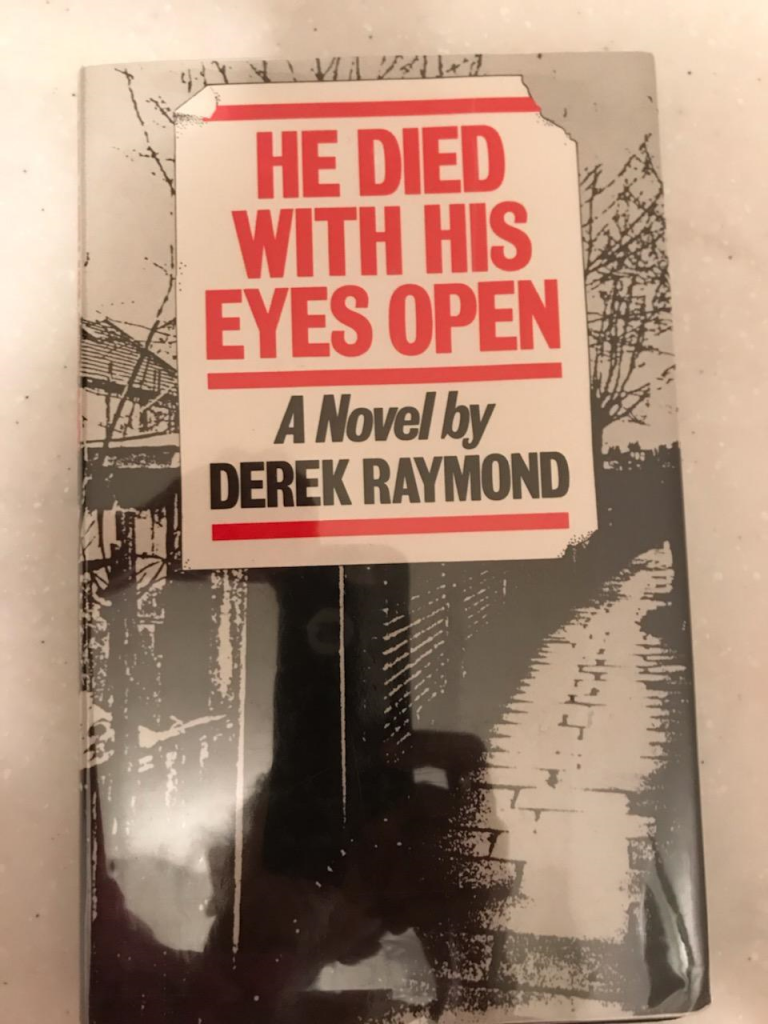
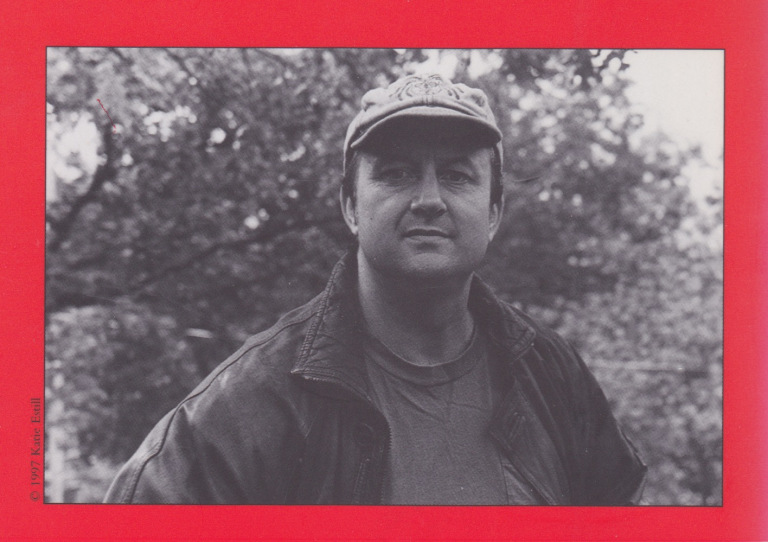
“Perhaps someone will be intrigued enough,” Kevin says, “to give Derek Raymond a try. It would certainly be worth their time. After Nisbet told me about Raymond at NoirCon I found a paperback edition of He Died with His Eyes Open and fairly inexpensive copies of the hardcover first editions of the next four novels in the series.
“Couldn’t locate any hardcover copies of that first book for a few years, though.
“Then one day scrolling through book listings on the internet I found a British dealer selling the book for ten pounds. It was a mint, unread, signed copy, and he obviously had no idea what the book was or who Raymond was. I bought it in a heartbeat of course.”
Jim Nisbet has pushed Raymond for years. My memory is that he knew him personally, which puts Nisbet one degree of separation from the notorious Kray Brothers — again, if memory serves, the Brit noir writer rubbed elbows with the Krays and lived in the same underworld.
Here’s Kevin with a formal statement:
Every time you read an essay, article or biography of Dashiell Hammett a paraphrase of the following statement will appear: Hammett had the perfect background for writing detective/crime fiction because he had previously been a Pinkerton’s Detective.
What about the polar opposite of being a detective? Could a man with a criminal background also be a perfect choice to write crime fiction?
Enter Derek Raymond.
Born on this date in 1931 as Robert William Arthur Cook and known to his friends as Robin, Raymond rebelled against his privileged birth as a member of the British upper class and became a con man. After one con too many he had to leave the UK and ended up living in France.
He had previously published books as Robin Cook, but now hid his identity behind the name Derek Raymond.
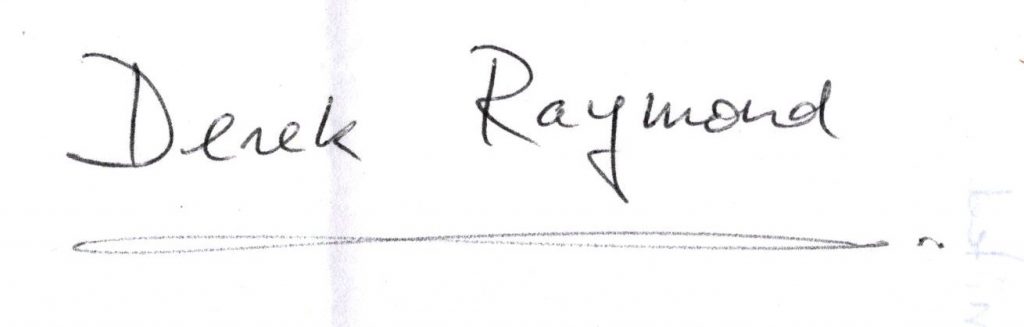
His autograph is from the first Raymond book, He Died with His Eyes Open (Martin Secker & Warburg Limited, 1984). That volume is also the first book of his acclaimed Factory Series where Raymond’s unnamed police officer works in the Bureau of Unexplained Deaths.
Jim Nisbet, a noted noir author himself, has stated that Raymond was the world’s finest noir writer. He was speaking about pure noir: misery, corruption, hopelessness and death.
The greatest critical acclaim goes to the fourth book of the Factory series, I Was Dora Suarez, It would be a simplified analysis to describe this book as the British equivalent of Laura, the police officer falling in love with the dead murder victim, because Raymond’s vision is much darker than Vera Caspery’s, and there is no happy ending.
Those last words are not really a spoiler because anyone who had already read the first three Factory novels would not expect the tone of black despair to change.
Eighty-four years ago today, at his final age of 30, pulp writer Robert E. Howard shot himself in the head outside his home in Cross Plains, Texas.
To commemorate the somber anniversary we bring in lifelong REH fan Brian Leno. Part convention report, part book report, part REH history and all Texas history, Brian’s got a tale to tell you. In honor of Two-Gun Bob.
Here’s Brian:
It was raining hard in Cisco during the Summer of 2009 when my three road companions and I booked rooms in one of the local motels. The rooms were only necessary for sleeping, because we were planning on spending most of our time 23 miles away in Cross Plains.
Festivities were in full swing honoring Robert E. Howard that weekend in Cross Plains — the weekend closest to the date he killed himself. I had been twice before to view Howard’s home, once in 1967, and the last time in 2007.
This one was special however. One of my traveling companions was Donald Sidney-Fryer, an expert on the poetry of Clark Ashton Smith, Howard, and many others.
A high point came when we rescued DSF from participating in a mind-numbing reading — by rank amateurs — of Howard’s verse. Known as the Poetry Throwdown, this sophomoric event sometimes even degenerated into these would-be poets reciting their own lackluster rhymes.
We hustled Donald back to the Cisco motel and the night was spent drinking beer and listening to an actual poet recite bits of Howard’s and Clark Ashton Smith’s poetry. An intellectual acrobat, DSF kept the interest alive with many excursions into the realms of writing, including comments on J. D. Salinger, pulp verse — he even dipped a toe into tales of a book he was writing on the history of ballet.
It was good times.
What wasn’t such good times, however, and something I didn’t know much about, was a bank robbery that had occurred in the little town of Cisco on December 23, 1927, over 80 years earlier.
The so-called Santa Claus Bank Robbery was a story I had heard about, of course, but the Kris Kringle business had conjured up images of a gang comprised of members of Monty Python’s Flying Circus and the Bowery Boys.
I couldn’t have been more wrong.
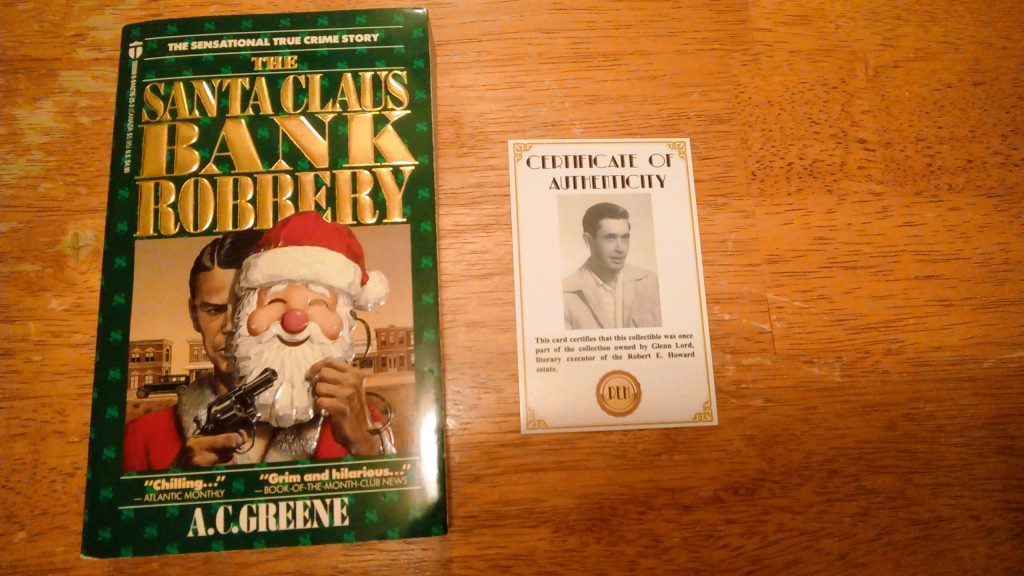
Recently I was fortunate enough to purchase The Santa Claus Bank Robbery (Tudor 1988), by A. C. Greene. This copy once belonged to the late Glenn Lord, for many years the literary agent for the Howard estate, so out of respect for this greatest Robert E. Howard scholar, I cracked it open and began to read.
It was a book that really was too good to put down, and that is a rarity. Once finished, hard to forget.
There were four bank robbers who stepped into the First National Bank in Cisco on December 23, 1927. Henry Helms, who ended up getting the electric chair. Louis Davis, who died during the intense manhunt following the robbery. Robert Hill, who was paroled eventually and lived the rest of his life under a different name.
The fourth member of the gang, Marshall Ratliff, was the only one of the robbers known by sight to the Cisco townspeople.
A woman named Midge Tellet, a friend to the robbers, was making a suit for her husband who was going to dress as Santa Claus for Christmas that year, and Marshall Ratliff borrowed it. Red coat, no pants, but she had a Santa hat and fake beard.
Ratliff apparently felt a jolly Santa getup would keep him from being recognized — and not draw too much attention.
Just not-thinking-it-through of the highest order.
Ratliff told his buddies to drop him off a few blocks before the bank.
By the time Ratliff got to the First National he had a mob of screeching kids tugging on his Santa coat, wanting to know if he had received their letters. Was he bringing them what they had asked for? Would he buy them some ice cream?
Ratliff probably figured taking the bank would be easier than getting the damn brats off his back.
He was wrong.
If you read the book, it appears that everything that could go haywire during the robbery did, including the fact that the crooks forgot to fill the getaway car with gas — and it was running on empty.
Anyway, Bad Santa Claus ended up in a jail cell in Eastland, just a few miles distant from Cisco. There Ratliff started acting like he was crazy, hoping to escape the electric chair.
But Ratliff soon found a chance for a jailbreak and ended up shooting Tom Jones, one of his jailers. The escape attempt failed.
A mob formed. After subduing the lone jailer left standing, they started climbing the stairway to Ratliff’s cell, laughing and yelling “Come on out, Santa Claus, we’re coming to get you!”
Greene’s writing, always decent throughout his book, takes on new life here, and it’s undoubtedly one of the most harrowing and terrifying passages I’ve read in many years. After showing Ratliff a knife and threatening to feed him his own testicles for lunch, they burst into his cell, tearing his clothes off and dragging him down the stairway, laughing as his nakedness on full display for the sizable group of ladies that made up part of the mob.
They beat the hell out of him.
The first attempt to hang Ratliff failed. His body hit the ground with an audible thud.
But the second try, with a group of people grabbing the rope to pull Ratliff off his feet into the air, succeeded. Ratliff’s strangling body gave up the ghost.
His corpse was left to sway in the breeze — like a ghastly made-to-order scarecrow, to frighten would-be robbers away.
All of this happened within a short drive of Robert E. Howard. In a famous July 13, 1932 letter to H. P. Lovecraft, Howard goes into hyperbolic overdrive and describes that after a wild night of drinking with his pals, he was asked to join the “man-hunt” but refused, stating “we were in no shape to even lift a gun to our shoulders, much less confront a band of desperate outlaws.”
I have trouble believing that Howard wouldn’t have joined a posse if asked.
But after reading Greene’s book I’m glad he didn’t.
I’m really happy that the Texas writer was not part of the mob that hanged Ratliff, because there is a bit of mob mentality in all of us, and we can sympathize — even if just a little — with Ratliff, because if times get desperate enough who knows what any of us might be capable of doing.
Some might fear to spot woodpulp fiction mags in one of the most beloved — and prestigious — movies of all time. Oscar winner for Best Picture. Best Director. Among others.
He spots a pulp, he reports a pulp — and he tells it like it is:
Godfather II (1974) featured extensive sequences showing how young Vito Corleone became the Don (the Mafia title, not the Herron, though the two may be closely related).
The year was 1917.
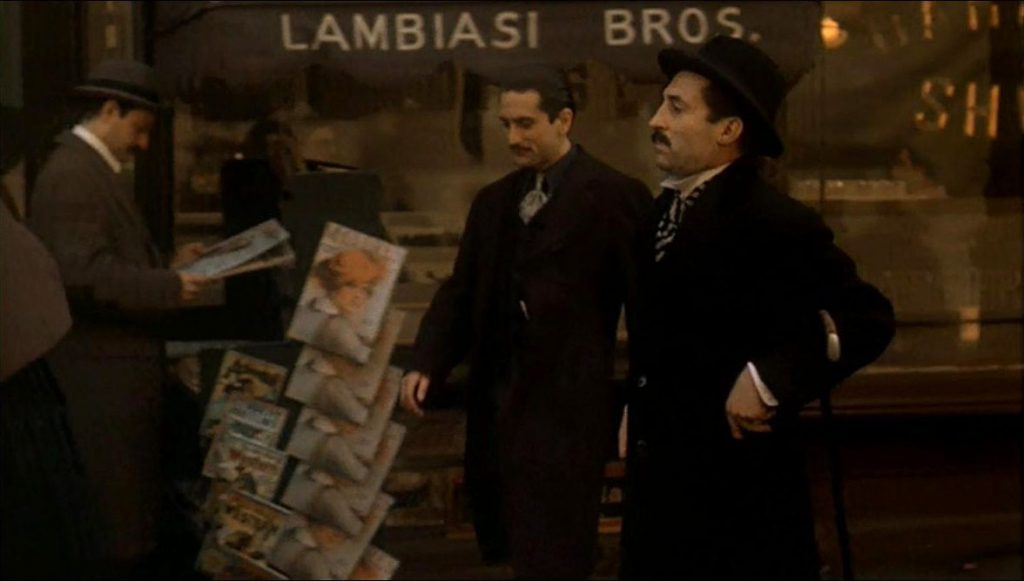
This shot follows Vito’s assassination of Don Fanucci, the Black Hand boss who was the reigning parasite of Little Italy. Note how smartly dressed Vito (Robert De Niro, middle) is now, a clear contrast to his shabby workman’s clothes of previous scenes. He’s cashing in on the power of fear.
Vito passes a newsstand with a sullen landlord who’s just wilted before the suggestion he cut the rent of a poor widowed tenant.
Well, this is embarrassing — not the landlord’s failure to withstand the polite pressure of the dangerous new Don, that is, but the contents of the newsstand.
Here at Pulps in the Movies, we’re enslaved to a high level of exactitude.
One of Godfather II’s six Oscars was for Best Art Direction–Set Decoration.
And now we must give this Oscar an asterisk it can’t refuse.
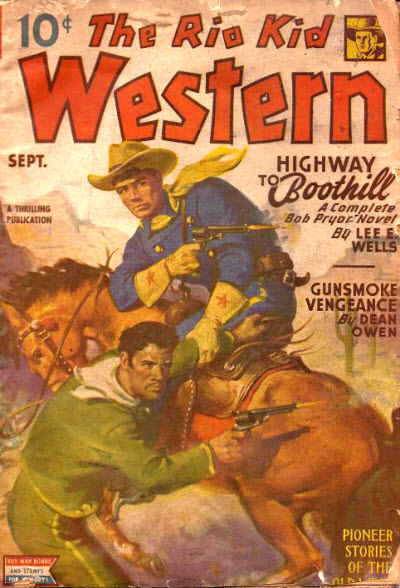
A column of pulps, the left row, adorns the newsstand. Adventure (top), began in 1910, but the issue on display is dated February 1945. The Rio Kid Western (middle) ran from 1939-53, but this issue is for September 1945. (We’re stumped on the western pulp closer to the bottom, though it looks like another 1940s issue. Can anyone help?)
These issues were on sale roughly when Michael Corleone returned from WWII, where The Godfather (1972) begins.
(There’s a second magazine below Adventure. I have no idea what it is. It could even be a dime novel. The fifth mag at the bottom of the stack — impossible to make out with what’s showing. As for the larger mag on the right, they seem to have obscured the logo. It may be a McClure’s, a woman’s mag at that time, but I couldn’t find a matching cover. Clearly mock-ups, given the multiple copies. If you look at the copy the reader is holding, it appears to have a stiffer cover than an actual magazine.)
No doubt, these particular pulps were chosen because their yellow backgrounds pop off the screen better than earlier pulps. Authentic 1917 covers were printed with muted, often dull, colors.
In 1977, Harry Steeger, founder of Popular Publications, who published the 1945 Adventure, was asked about pulp cover colors. His answer:
“There were certain colors and color combinations used on covers which attracted buyers more than other colors. I made a complete study in considerable depth of every color in the artist’s palette. I made all the various combinations possible and then studied them at various distances to note and study the eye appeal. In addition to this, I kept a newsstand in my office and arranged covers on the newsstand to see which ones stood out above the others. This study went on year after year. I became aware of the fact, for instance, that the hot colors like reds and yellows appealed to men, whereas the cooler colors like the greens and the blues and the pastel colors appealed more to women. The magazine covers were planned accordingly.”
Thus, Steeger created the other Yellow Peril in the pulps, a ridiculous proliferation of yellow-background pulp covers.
For me the most interesting moment was learning that Daniel Woodrell, author of Winter’s Bone (star turn vehicle for JLaw), was once a resident of Sam Spade’s burg.
Very light on the info, though. No address. No neighborhood. No year dates.
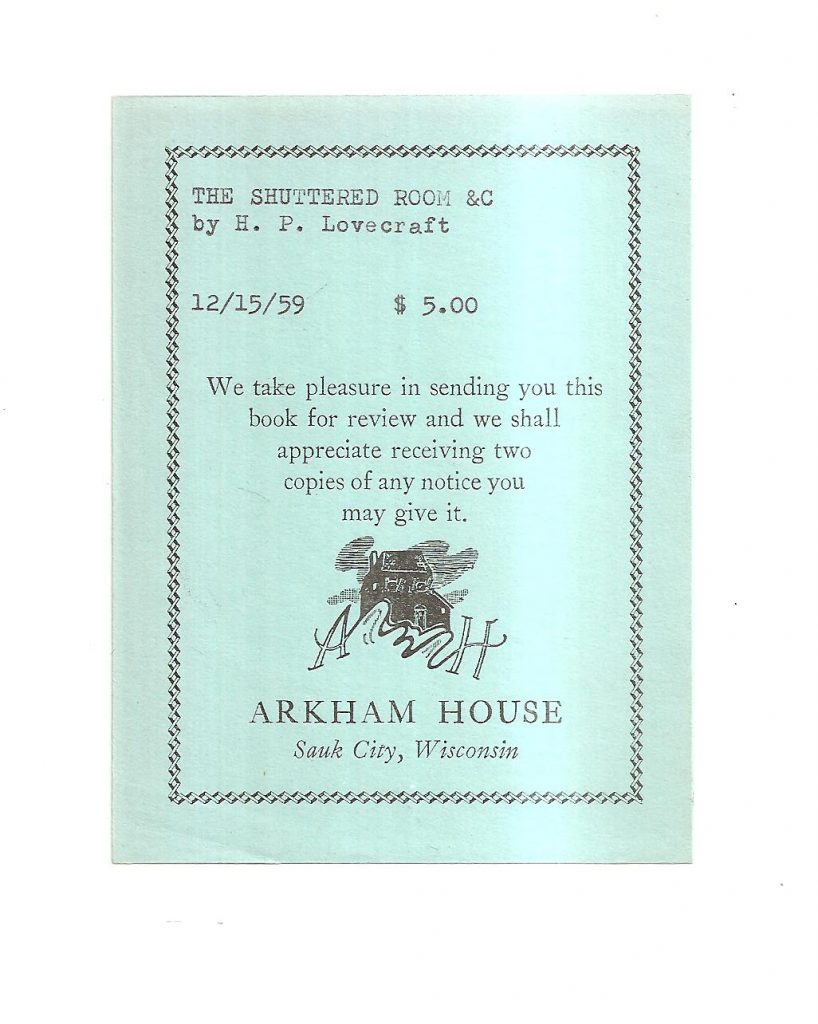
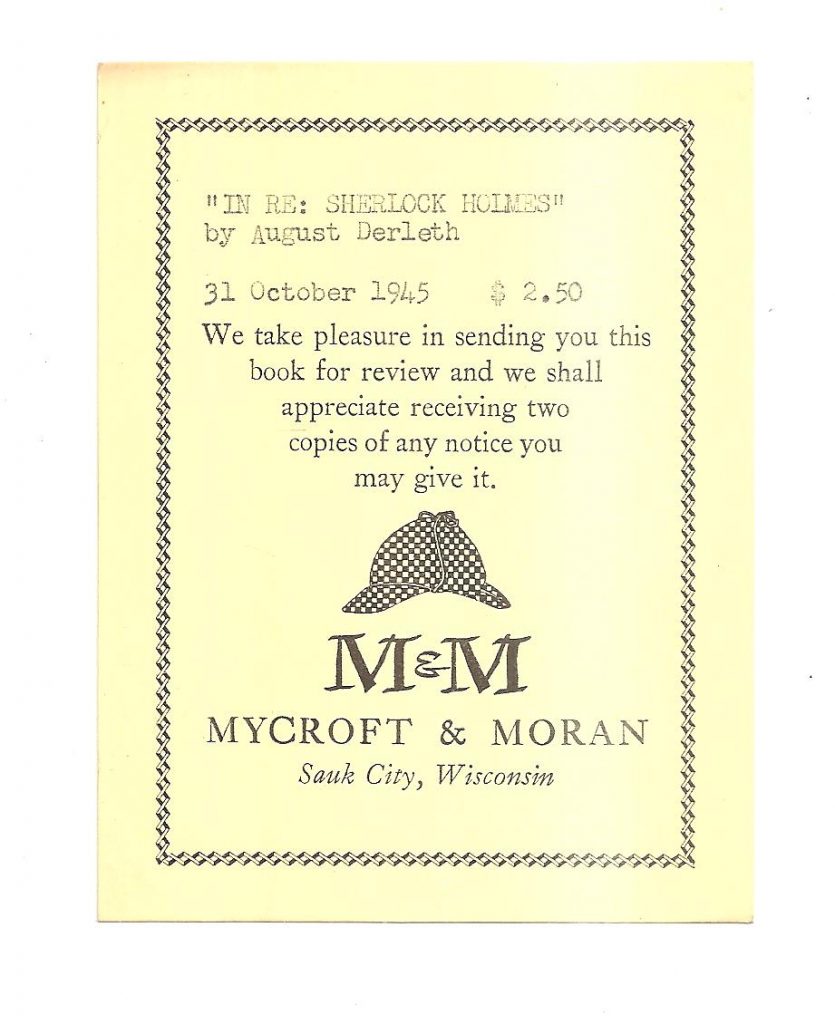
Inspired by looking over the Paul Dobish list of Arkham House review slips yesterday, Arkham and August Derleth savant John D. Haefele sent in an image of a related item for your instruction and amusement.
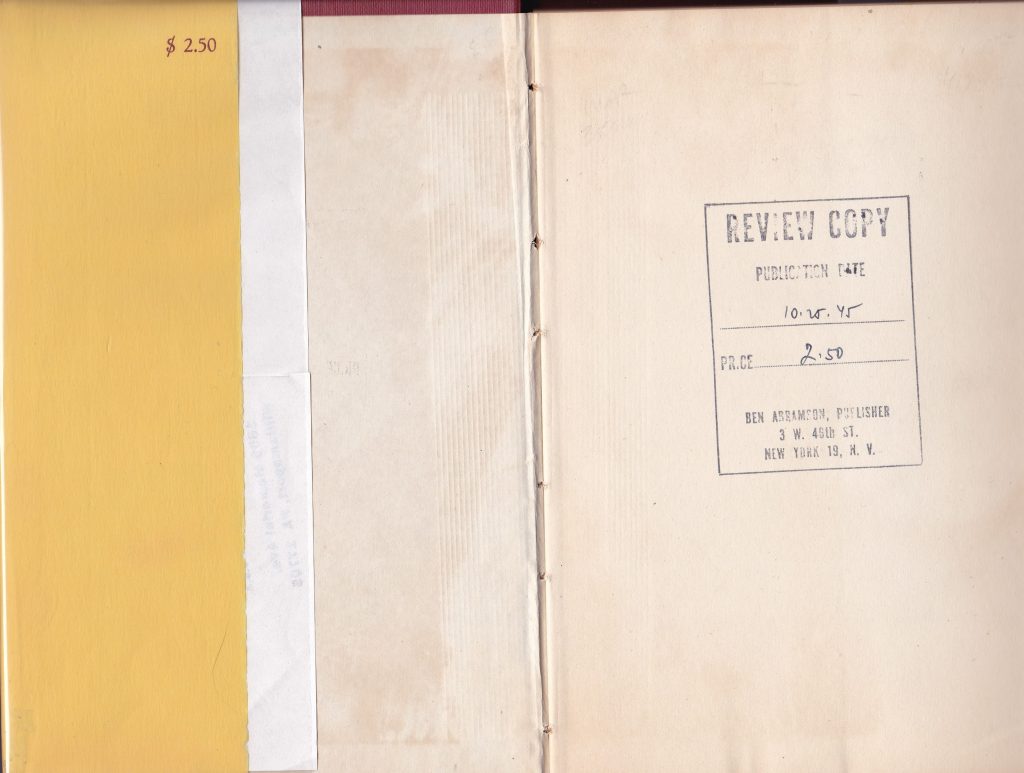
Check out the way the Ben Abramson company dealt out the info in a review copy of Derleth’s 1945 H. P. L.: A Memoir.
Not a review slip but a rubber stamp, with the pub date and price left blank to be filled in by hand.
No, not Arkham, but given the authorship of Derleth and the subject matter, pretty damn close.
I’d keep it with my Arkham stash.
“I imagine,” Haefele says, “that the Abramson edition of Lovecraft’s Supernatural Horror in Literature was done in similar fashion.”
If you recall my essay on Arkham House ephemera in Firsts: The Book Collector’s Magazine back in October 2002, I wrapped it up by mentioning that much other ephemera existed than just the stock lists and brochures I concentrated my attention on. August Derleth ordered Arkham House matchbooks to spread around — those must be more ephemeral than the ephemera!
And Paul Dobish Jr made a plea for recognition of the review slips that went out with review copies from Derleth’s various imprints. Yes, sure, those items are interesting, but I cut the Gordian Knot by saying that I would “regard the review slips as desirable extras in the actual review copies, parts of a book, like the dustjacket.”
I still think of the review slips that way, and Paul still wants collectors to know about them, so we cut a deal: I told him, Put together a list and I’ll put it up on the net. See if it stirs up any further info.
The main list below consists of items Paul has in his personal collection — like the legendary The Phil Mays Collection of Arkham House Ephemerae from 1985 consisted only of items Mays had assembled, and nothing more.
But I’m sure Paul would be interested in knowing of any items he doesn’t have to hand. I imagine, too, he’s open to buying any strays. I’ll forward the info.
Paul writes, “I suspect many others exist.”
And now, Paul Dobish Jr with an Intro:
I have been seeking the review slips/letters for a long time. I never found a significant “batch” of them. Nearly every example that I have is the result of a “one-off” purchase, usually accompanying a “regular” copy of the book, not one of the formal plastic comb-bound style advance/proof copies of the books, which often had a review slip affixed to them.
For regular trade copies of the books that went out for review purposes, the slips were typically laid in or sometimes tipped-in to the front free endpaper. This list includes those loose slips as well as slips that I only have affixed to proofs of the books.
I have not distinguished nor annotated which slips are entirely printed and which had the book specifics — title, author, publication date, price — typed on review “blanks” of the period.
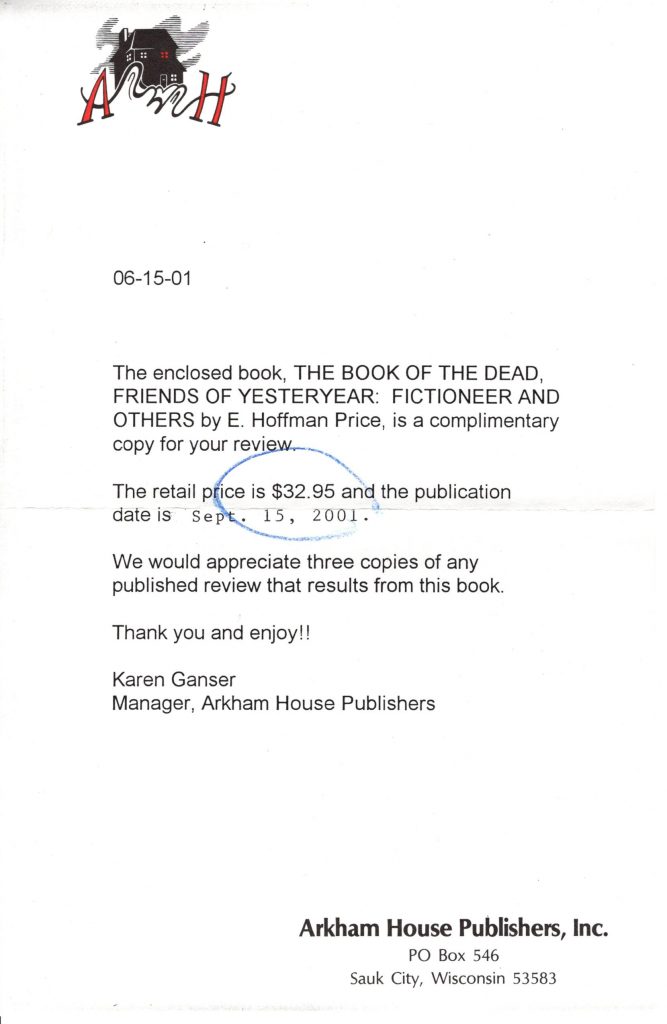
“Letter” means the generic type, pre-printed in multiples. Not individualized correspondence, done only as a single copy. An example shown here comes with E. Hoffmann Price’s The Book of the Dead.
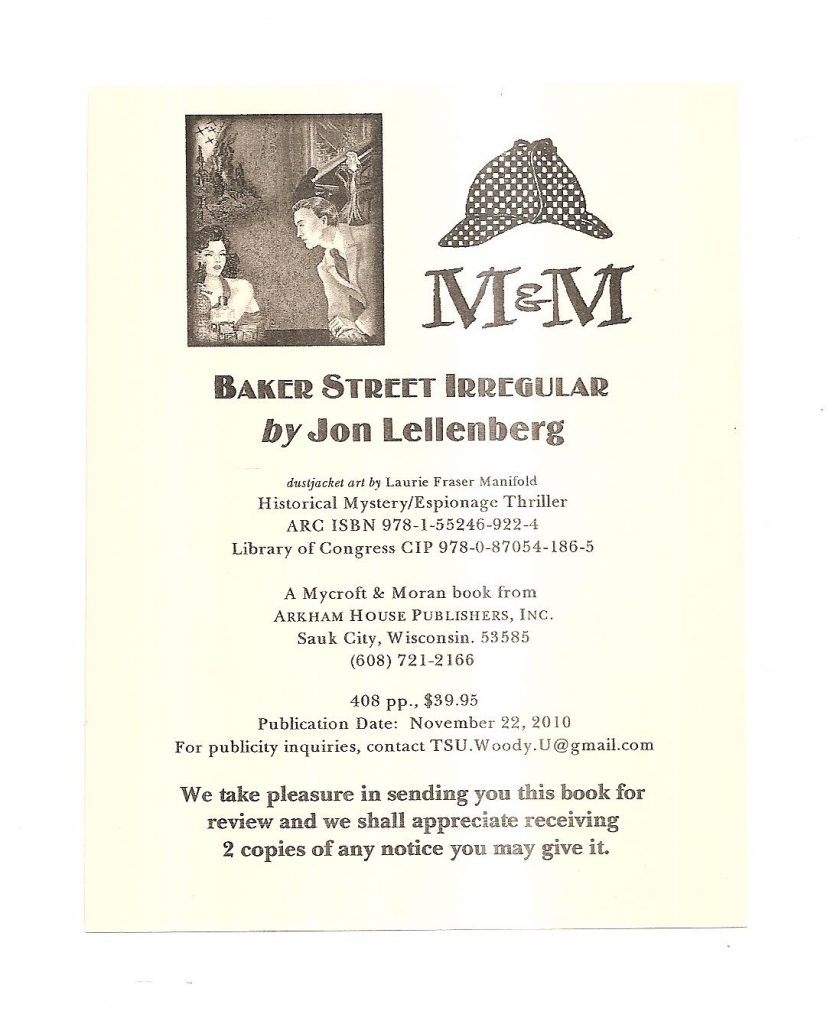
Sizes of the slips varied, but generally the slips were roughly from 3.5″ to 4″ wide x 4.5″ to 5″ tall — save that the Lellenberg, one of the last books to date released under the imprint of Arkham House, is a bit larger at roughly 4.25″ x 5.5″.
The later review slips and letters seem to have been done on white paper (again, the Lellenberg being an exception). As can be seen in the scans, at least some of the earlier slips were done on variously colored paper.
I do not know:
1. how many others exist
2. which was the first title to have one
3. which titles — if any — did not have one (although a few likely “suspects” come to mind).
As with advance/proof copies of the books themselves, generally speaking the slips from the 1970s/1980s seem to be the easiest to obtain.
But all examples are scarce/rare.
I once passed on an example of ALWAYS COMES EVENING paired with the book at $1500. (I asked, but the seller would not split up the pairing.)
And a collector once told me that he had a slip for HORNBOOK FOR WITCHES. (How I wish that I had that one!)
NB: SELECTED LETTERS OF CLARK ASHTON SMITH and CAVE OF A THOUSAND TALES share a single physical review letter, of which I only have one copy.
NB: The two printings of SELECTED LETTERS [III] 1929-1931 each have their own separate slip/letter.
No pretense of anything remotely like completeness is suggested.
I strongly suspect that most of the books published by Derleth “missing” from this list also had review slips/letters.
Arkham House / M&M review slips/letters:
Bear: THE WIND FROM A BURNING WOMAN [NB: slip only on a comb-bound proof]
Bishop: BLOODED ON ARACHNE [NB: slip only on a comb-bound proof]
Bishop: ONE WINTER IN EDEN [slip]
Bishop: WHO MADE STEVIE CRYE? [slip]
Blaylock: LORD KELVIN’S MACHINE [slip]
Bloch: FLOWERS FROM THE MOON AND OTHER LUNACIES [letter]
Bond: THE FAR SIDE OF NOWHERE [letter]
Bond: NIGHTMARES AND DAYDREAMS [slip]
Bowen: KECKSIES AND OTHER TWILIGHT TALES [slip]
Brennan: STORIES OF DARKNESS AND DREAD [slip]
Campbell: ALONE WITH THE HORRORS [slip]
Campbell: THE HEIGHT OF THE SCREAM [slip]
Campbell: NEW TALES OF THE CTHULHU [NB: slip only on a comb-bound proof]
Cannon: LOVECRAFT REMEMBERED [slip]
Carter: DREAMS FROM R’LYEH [slip]
Case: THE THIRD GRAVE [slip]
Coppard: FEARFUL PLEASURES [slip]
Copper: FROM EVIL’S PILLOW [slip]
Copper: NECROPOLIS [first printing] [slip]
Counselman: HALF IN SHADOW [slip]
Derleth: HARRIGAN’S FILE [slip]
Derleth: IN RE: SHERLOCK HOLMES [slip]
Derleth: NEW HORIZONS: YESTERDAY’S PORTRAITS OF TOMORROW [slip]
Derleth: THE SOLAR PONS OMNIBUS [slip]
Derleth: WISCONSIN MURDERS [slip]
Durbin: DRAGONFLY [letter]
Grant: TALES FROM THE NIGHTSIDE [slip]
Harvey: THE CLEANSING [letter]
[Joshi, as editor] see under: Lovecraft MISCELLANEOUS WRITINGS
Joshi: SIXTY YEARS OF ARKHAM HOUSE [letter]
Kessel: MEETING IN INFINITY [slip]
Kirk: WATCHERS AT THE STRAIT GATE [NB: slip only on a comb-bound proof]
Kress: THE ALIENS OF EARTH [slip]
Lawrence: NUMBER SEVEN QUEER STREET [slip]
Le Fanu: THE PURCELL PAPERS [slip]
Lellenberg: BAKER STREET IRREGULAR [slip]
Long: HOWARD PHILLIPS LOVECRAFT: DREAMER ON THE NIGHT SIDE [slip]
Long: IN MAYAN SPENDOR [slip]
Lovecraft: AT THE MOUNTAINS OF MADNESS [Corrected fifth printing] [slip]
Lovecraft: THE DUNWICH HORROR AND OTHERS [Corrected sixth printing] [NB: slip only on a comb-bound proof]
Lovecraft [edited by Joshi]: MISCELLANEOUS WRITINGS [slip]
Lovecraft: THE SHUTTERED ROOM & OTHER PIECES [slip]
Lovecraft: SOMETHING ABOUT CATS [slip]
Lovecraft / Derleth: THE SURVIVOR AND OTHERS [slip]
Lumley: BENEATH THE MOORS [slip]
Lupoff: LOVECRAFT’S BOOK [slip]
MacLeod: VOYAGES BY STARLIGHT [letter]
Malzberg: IN THE STONE HOUSE [letter]
Price: BOOK OF THE DEAD: FRIENDS OF YESERYEAR: FICTIONEERS & OTHERS [letter]
Ruber: ARKHAM’S MASTERS OF HORROR [letter]
Russ: THE ZANZIBAR CAT [slip]
Schultz/Conners: SELECTED LETTERS OF CLARK ASHTON SMITH [letter: NB: this title combined with Thomas’ CAVE OF A THOUSAND TALES: THE LIFE AND TIMES OF HUGH B. CAVE]
Shea: POLYPHEMUS [slip]
Shepard: THE JAGUAR HUNTER [first printing] [slip]
Smith: THE BLACK BOOK [slip]
Smith: POEMS IN PROSE [slip]
Smith: A RENDEZVOUS IN AVEROIGNE [first printing] [slip]
Smith: SELECTED LETTERS OF CLARK ASHTON SMITH [NB: listed above under: Schultz/Conners rather than under: Smith]
Smith: SELECTED POEMS [slip]
Smith: TALES OF SCIENCE AND SORCERY [slip]
Starrett: THE QUICK AND THE DEAD [slip]
Sterling: CRYSTAL EXPRESS [slip]
Swanwick: GRAVITY’S ANGELS [slip]
Thomas: CAVE OF A THOUSAND TALES: THE LIFE AND TIMES OF HUGH B. CAVE [letter: NB: this title combined with Schultz/Conners: SELECTED LETTERS OF CLARK ASHTON SMITH]
Tiptree: TALES OF THE QUINTANA ROO [NB: slip only on a comb-bound proof]
Turner: CTHULHU 2000 [slip]
Walter: IN THE MIST AND OTHER UNCANNY ENCOUNTERS [slip]
My review of the latest translation from French noir master Jean-Patrick Manchette — No Room at the Morgue — recently popped at PW.
Here’s the really good news — New York Review Books lined up another translator to work on the Manchette oeuvre. For years now it’s been either Donald Nicholson-Smith or James Brook, and I’m not complaining about their product — between them they made Manchette one of my all-time favorite noir writers. But with Alyson Waters added to the mix, it is possible they might translate the rest of Manchette’s novels in my lifetime — I honestly didn’t think it would happen. They might even be able to put his criticism and reviews, such as Chroniques, into my vernacular.
Manchette is legendary for writing ten crime novels and then quitting after he wrote his obvious masterpiece, The Prone Gunman.
But then he made a comeback to write a decades-spanning saga of assassins and spies, supposed to go on book after book. Manchette didn’t quite get the opening finished before his death. That novel-length fragment appeared under the title Ivory Pearl.
Of the previous ten novels, six now have seen American print.
Four left.
I’m hanging on. I can make it, I can make it.
Go, New York Review Books, go!
While the top half of my No Room at the Morgue review presents the info points I sketched in, the wordage is switched up to the point I normally wouldn’t link to it. However, the last couple of sentences are pretty good, and those are mine.
If you’re interested, you’ll find it in the list of Manchette reviews in PW that follows, presented in order of American publication. Surfing around their site, I could not find a review for Nada, so I’ll cover that one on These Mean Streets in the next day or two.
If PW reviewed it, it wasn’t me at the keys.
Of the other reviews, I did all but one — acknowledging whatever editorial input tweaked a few words here or there:
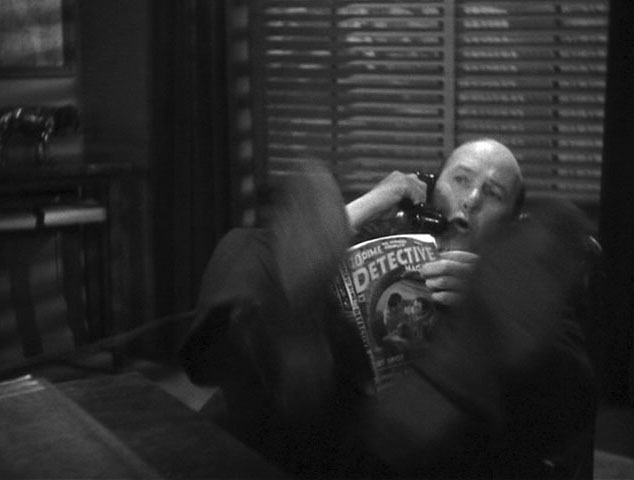
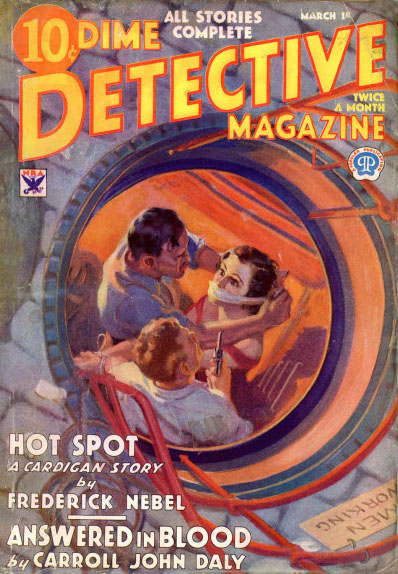
Here in 1934’s great comedy, Twentieth Century, a private investigator is forced to take a call while reading Dime Detective Magazine. He appears to be very near the end of Frederick Nebel’s latest Cardigan story, “Hot Spot.”
No wonder he looks annoyed.
The pulp is dated March 1, 1934, and the film premiered in New York City on May 3, so you know it was the latest issue when they filmed it.
John Newton Howitt’s great cover reveals the literal underworld — New York’s crime-infested sewers.
The main point I was disputing was that Derleth lived in a “log cabin” in Wisconsin, and that his custom-made castle dubbed Place of Hawks was not a log cabin — unless somehow in your brain you think it is.
John D. Haefele writes to let me know that “People are sharing your recent blog about Derleth on Facebook,” but that “they are posting inadequate photo-postcards they happen to have with Place of Hawks in the background to show the home Aug had built” — which is more or less what I did. I figured anyone ought to be able to determine from the sheer scale of the building in the image I used that it was not what anyone would think of as a “log cabin.”
A ski lodge, sure — maybe a hunting lodge from which you might head out to pursue the most dangerous game.
“Here is a much better snap you should post as a follow-up of your own,” Haefele adds, “and it even has a good view of the original roof. For some reason I note ‘1949’ on my postcard, but the photo itself looks to be earlier . . . .”
Haefele is the expert on Derleth and his publishing firm Arkham House. And Place of Hawks housed both Derleth and the press he massaged into myth.
Yeah, 126 years ago today Samuel Dashiell Hammett began life as a fat baby, and lived that life as a thin man. Pinkerton’s detective. Pulp writer in San Francisco. Hollywood. Ended up in New York.
You probably know the outline.
But if you don’t, Brian Wallace found an article in a 2002 issue of The New Yorkerthat goes over the ground, using the 2001 publication of Hammett’s Crime Stories from the Library of America as the excuse.
I’m loathe to link to it because of the instant barrage of banner ads, but if you’re willing to tough it out, then it’s your problem and not mine.
Brian specifically pointed out this little section:
The Library of America’s new Hammett collection, “Crime Stories and Other Writings,” contains a poignant textual note explaining that one of the stories could not be taken from Hammett’s original version because no copies of the magazine it appeared in still exist. Few are likely to mourn the January, 1928, issue of Mystery Stories, one of about seventy “pulps” then on the market — “pulp” as a category denoted the low quality of the paper, and presumably also of the contents and the readership — but the contrast of this rough extinction with the smooth, acid-free immortality of the volume at hand does point up the cultural irony of Hammett’s career. . . . But the contrast also points up the irony of the sweeping cultural mandate of the Library of America, for, as it turns out, the salvaged story — “This King Business,” printed from a later version — is hardly worth the effort of reading once.
Somehow when dealing with topics they’ve barely heard of — such as wood pulp fiction magazines — even the sophisticates come off like backwater rubes.
When the article writer typed
The current collection contains one perfect story — “The Scorched Face,” published in 1925 —which demonstrates how imaginative wit can transform even the crudest material into an exquisite whirring toy, a rococo clock with cops chasing crooks in circles and tumbling forth to chime the hour.
you can tell she has no idea whatsoever that Hammett stole the plot for that one from the Sherlock Holmes yarn “The Adventure of Charles Augustus Milverton” — still, sure, it is a hot Continental Op tale.
And not to be too mean to the venerable New Yorker. In 2013 they showed Hammett maintained his clout by using one of the “lost” stories later collected in The Hunter and Other Storiesin a “fiction” issue —and nothing in Hunter can touch the best of the Op series gathered in Crime Stories.
I’m thinking if another lost Hammett story turned up today, The New Yorker wouldn’t be loathe to publish it.
Welcome to a hard-boiled and not without noir blog with news and reviews, occasional outbursts of maniacal Autograph Hound activity, plus archival records from the forty-five year run of The Dashiell Hammett Tour.