Hammett: Dannay Does “Arson Plus,” per Nevins

Before his name came up again in connection with John Lawrence’s Marquis of Broadway stories, Mike Nevins got linked on this blog courtesy a bit he did about Frederic Dannay editing the Op tale “The Tenth Clew” — I put up the link in good part to show that Terry Zobeck and I aren’t the only people on earth concerned with stuff like that. Hell, there might be five or six. Ten. A couple of dozen. You know who you are.

Nevins has a nice angle on this stuff — he actually knew Dannay. So anytime I notice him doing something on Dannay vs. Hammett, I check it out.

Most recent bit concerned the first Op story, “Arson Plus,” which I noticed on Ed Gorman’s blog. And I see that in the comments Fred Blosser directs people over here to look over the Zobeck posts on Dannay vs. Hammett.

A little web surfing on my part found that the appearance on Gorman’s blog was a reprint — rerun? refreshing? — of a post Nevins had done elsewhere earlier. And Blosser piped in on those comments, too. Blosser’s tempted to investigate the textual differences between the pulp versions and the modern texts, but Zobeck plunged deep into that pool first. I suppose someone could always jump in from the other end, though, or belly-dive off the side.

But Blosser strikes a major cord when he notes that the 1925 yarn “Corkscrew” is “one of the very best Op stories.” I’m thinking that someday I should host a symposium on “Corkscrew” and how great it is — my standard for determining if someone “gets” Hammett is how they rate this satire of Western stories.

If you think it is off, or not very good, then you really don’t get Hammett. If you think it is topflight Op, like me and Terry Zobeck and now Blosser, you’re cool.

While I’ve got Blosser’s name punched into the blog, allow me to link to a couple of interesting pieces on Hammett he’s done, so you don’t miss out on them. First a bit about the town of Hopewell, Virginia, likely model for the crime town of Izzard in the story “Nightmare Town.” And a follow-up on that plus info on Hammett’s birthplace — and the usual regret of any Hammett fan that it looks as if any Pinkerton’s records for his P.I. years will never turn up.

Posted in Dash, Lit | Tagged , , , , , , , , , |

Hammett: “The Advertisement IS Literature”

Even as he packs his valise for PulpFest 2012, our frequent Guest Blogger Terry Zobeck finds a moment to comment on the local action:

“Nice post on Vidal. He’s one of my favorite writers. He got a little odd there the last decade or so. And of course there is the Hammett connection. Vidal was stationed in the Aleutians during the War, too. I met him at a couple of book signings and always wanted to ask him if he ever met Hammett at that time, or was even aware that he was there. But I was too intimidated.”

Terry did get his first edition of Vidal’s first book, Williwaw — titled after the violent wind storms they have in the Aleutians — signed.

And he’s got a new post for us. Terry apologises for not having the usual cover image for the magazine being discussed to show off with his coverage, but luckily I got a nice illo of Hammett in from Jim Tully biographer Mark Dawidziak — originally done for some play he was involved with, something like that. For purposes of the moment, let’s call it “Hammett Contemplates Literature.”

Here’s Terry:

When Don announced that August was LitCrit month here at the Mean Streets I wondered if there was anything I could contribute to the topic.

How about Hammett’s own LitCrit musings?

By March 1926, Hammett had been writing for the pulps for almost four years. His primary outlet was Black Mask, having placed more than two dozen stories with the pulp. However, around this time he had a falling out over money with Phil Cody, the Mask’s editor. Hammett believed he should be paid more; Cody didn’t agree, and so Hammett turned his back on the fiction game — he wouldn’t publish any fiction for eleven months. To make ends meet and support his family, Hammett took a job with Samuels Jewelers, writing advertising copy for the San Francisco jewelry store.

As a writer, Hammett was pretty much self-taught. It appears he taught himself the advertising game in pretty short order, too, applying what he knew about fiction writing to his new profession. He was sufficiently confident of his abilities that over a period of about a year-and-a-half he contributed a series of four articles on how to produce effective copy to Western Advertising, an industry journal headquartered in San Francisco. (In a previous post I covered Hammett’s omnibus review of the best advertising books of 1927, also published in Western Advertising).

The first of these articles was “The Advertisement IS Literature,” published in October 1926. Hammett starts with the premise that the common wisdom on advertising is it isn’t literature, it’s “selling talk” with no place for the usual tricks of literature. Advertising, so the common wisdom goes, “talks to the man in the streets in his own language.”

Hammett quickly argues that advertising is literature and that “nothing but harm can come from the attempt to separate it from its parent stock.” He explains the primary task of the writer in terms that he surely applied to his own writing:

He must set his idea on the paper in such form that it will have the effect he desires on those who read it. The more competent he is, the more stubbornly he will insist that the idea set down shall be his idea and not merely something like it, and that the effect on the reader shall be the effect the writer desires and not an approximation of that effect. The selection and arrangement of words to accomplish effectively these twin purposes is a literary problem, no matter whether the work be a poem, a novel, a love letter or an advertisement.

Hammett obviously gave great thought to the nature of writing and the struggles an author has with himself and his editor in getting his work right; in this short paragraph he nails it — he’s nearly Chandleresque.

He then turns to matters of style, noting that in advertising:

The disproportionately florid, the gaudy, have worse reputations in literature than ever they have had in advertising. There are few literary points on which there is general agreement, but I know of no first-rate writer or critic who does not call that style most perfect which clothes ideas in the most appropriate words.

Hammett boils his point down to clarity, explaining “that clarity is the first and greatest of literary virtues.” Returning to the common wisdom that advertising should speak to the man in the street in his language, Hammett states that “the language of the man in the street is seldom either clear or simple.” And that when this language is “divorced from gesture and facial expression, [it is] not only excessively complicated and repetitious, but almost purposeless in its lack of coherence.”

The bottom line for Hammett is that:

Simplicity and clarity are not to be got from the man in the street. They are the most elusive and difficult of literary accomplishments, and a high degree of skill is necessary to any writer who would win them. They are the most important qualities in securing the maximum desired effect on the reader. To secure that maximum desired effect is literature’s chief goal. Can the copy writer find a better one? Does he want another?

One of the disappointments — perhaps the only one — with Hammett’s letters is their lack of content regarding the writing life. Don’t get me wrong, there are some interesting examples — his letter to Blanche Knopf in which he lays out his desire to elevate the detective novel to literature is one — but they are scarce. With this article for Western Advertising and his piece on “Ber-Bulu” in The Editor, we have perhaps the most detailed and fascinating insights into Hammett’s thoughts on his profession. These long-forgotten articles have received scant attention from Hammett’s biographers.

“The Advertisement IS Literature” also is interesting for what we learn about the breadth and depth of Hammett’s reading. Over the course of the two-page article, Hammett references several writers, including Goethe, Thomas Carlyle, Benedetto Croce, Joel Elias Spingarn, H. L. Mencken, Joseph Conrad, John Galsworthy, Anatole France, Ring Lardner and Aristotle.

This weekend I’ll be traveling to Columbus, Ohio for Pulpfest 2012 and a rendezvous with Don and other like-minded folks. While in Columbus I’ll be paying a visit to the Ohio State University’s Rare Books & Manuscripts Library to photograph their copy of the January 1925 issue of Black Mask with Hammett’s Op story “Mike, Alec, or Rufus.” So be looking for my write-up of the Dannay edits to this story sometime later this month.

Posted in Dash, Frisco, Lit, News | Tagged , , , , , , , , , , , , , , , , , , , , , , , |

Rediscovered: The Lost World of Pulp!

In less than a week I’m off to PulpFest 2012 in Columbus, Ohio, with side trips to look up Jim Tully sites in St. Marys plus check out one of the world’s best privately held collections of M. P. Shiel — and when I’m gone, I’m gone. I don’t check email, don’t update the blog.

If you’ve got something really important to ask about, track me down at the convention.

Some on-the-side blog action should occur, though, since frequent Up and Down These Mean Street presences Brian Leno and John D. Squires are also set to appear with me on the panel on Saturday about Robert E. Howard’s Conan and the Cimmerian’s debut in wood pulp print 80 years ago.

And our most prolific Guest Blogger to date, Terry Zobeck, is planning on dropping in on the pulp-collecting scene. I haven’t met Terry before, so that should be fun — I am curious to see whether he or Leno hauls home the largest stack of crumbling magazines.

Me, I very much doubt I’ll buy a single pulp. I may get some of the new book collections assembling some pulp stories, at least a few Shadow novels against the next time an urge to read some Shadow sweeps over me.

Never got into collecting the original pulps, but nonetheless have somewhere around twenty. Mostly Weird Tales, some science fiction pulps with Clark Ashton Smith stories, a couple of random items. Plus an early issue of Esquire — for the Donald Wandrei tale, not the Hemingway and Fitzgerald — and one of the 1932 slicks with a Sam Spade story. Nothing compared to a real pulp collector.

Usually, I don’t feel I’m missing anything, since the writers I’m interested in mostly have been collected in book form long since — and in the case of someone such as Robert E. Howard, he’s even muscled his way into pure text editions. Yeah, I’m still waiting for the rest of the I. V. Frost stories by Don Wandrei to see reprint — the first collection, Frost, as I’ve said, contains some of the hottest pulp action ever. And I would really like to see a collection of the complete Pawang Ali stories by E. Hoffmann Price.

We seem to be entering a new Golden Age for pulp reprints, so I figure all I have to do is live long enough, and the problem will be solved.

But every now and then a pang of regret about my paltry pulp collection hits me hard. Happened at the last PulpFest I attended, at the talk Francis M. — Mike — Nevins was giving about various writers he knew or liked, many needing a rediscovery effort.

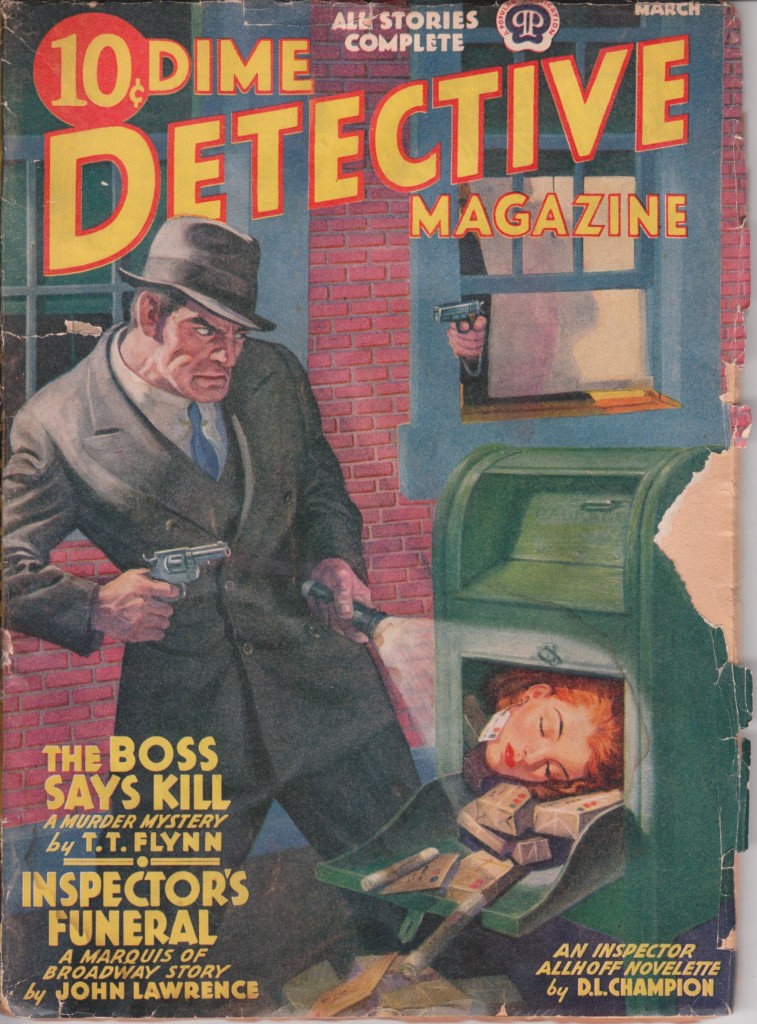
One he mentioned was John Lawrence, who wrote a long series of stories for Dime Detective about the “Marquis of Broadway.” Mike gave the series a good blurb. And while “Marquis” sounds kind of effete, a seasoned collector in the audience also threw in a word plugging them and said they were very hard-boiled, that the Marquis was like a 1940s Dirty Harry.

Okay. They had me hooked. I looked through the Dime Detectives in the dealers room for Marquis tales, and found a few — but each issue was priced around $200 a copy. I’m not quibbling or complaining about the price. Very nice condition, I don’t doubt that’s the current market value. But two hundred smackers was more than I was willing to spend to check out one story in a long series.

And I’m really picky about this stuff — while Mike and the other guy might think these stories were great, chances are that I would not agree.

Still, I was curious, and almost regretted that I didn’t get in on collecting Dime Detective a long time ago, when they may have been $10 or $15 the copy. . . .

A week or two after I got home, though, a random thought started to tug at my memory. Hey, you’ve got an old mystery pulp, you know — and I think it’s a Dime Detective.

Okay. Yeah. That’s right. Now, where did I put it?

A not too painful search turned it up. Dime Detective, March 1940. Bought it circa thirty years ago just for the cover. Cheap, maybe $4 tops. Edges chipped. Read the openings of some of the stories, but had never read a complete (in this issue!) story.

And what ho! — a Marquis of Broadway yarn headlined on the front.

I felt pretty good about my pathetic little pulp collection.

Started “Inspector’s Funeral,” got a few chapters in. Not up with the best Continental Ops, but what is?

Got distracted. Time passed. Started again. Got distracted.

Finally, less than a month ago, knowing PulpFest was coming up fast, decided I’d better sit down and read it all, so it wouldn’t be left hanging from my previous PulpFest adventure a couple of years ago.

Maybe this one wasn’t the top level the Marquis achieved. Tough guy police procedural stuff in the Broadway district of Manhattan. Nice descriptions of the period streets. The ending just didn’t do it, though some of the getting there was fun.

If the series ever gets collected, I can see buying at least one of the volumes, and reading at least half of the contents before something else pulls me away. But I am picky, and I can see other pulp fans thinking, this is better than Hammett, better than Chandler!

So much pulp, so little time.

Posted in Dash, Lit, News, REH | Tagged , , , , , , , , , , , , , , , , , , , , , , |

Mort: Gore Vidal

I wasn’t going to mention the passing of Gore Vidal the other day, since it seemed a little offtrail for this blog — hey, the guy was no H. P. Lovecraft.

Yeah, yeah, I’ve been aware of him most of my life, with the earliest encounters seen on TV when I was a kid, Vidal swapping repartee with William F. Buckley, Buckley’s tongue licking in and out like a lizard. So, he’s been there my whole life, but not to the point that a mention on Up and Down These Mean Streets was mandatory.

And then I remembered. . . .

Oh, yeah.

Vidal wrote one of my all-time favorite opening paragraphs for a mystery. . . .

He wrote three crime novels under the name Edgar Box, and I picked one up cheap once, an old paperback. Death Likes It Hot, first published in 1955. Loved the first paragraph, but stopped reading after another thirty or sixty pages when nothing was happening.

Still, that first paragraph. Here it is, in memoriam Gore Vidal:

The death of Peaches Sandoe the midget at the hands, or rather the feet, of a maddened elephant in the sideshow of the circus at Madison Square Garden was at first thought to be an accident, the sort of tragedy you’re bound to run into from time to time if you run a circus with both elephants and midgets in it. A few days later, though, there was talk of foul play.

Posted in Lit, News | Tagged , , , |

Rediscovered: The Underworld Years

Let’s ease gently from Biography Month into LitCrit Month. . . .

In the intro to their bio on Jim Tully, Bauer and Dawidziak have this statement:

Frank Scully, who knew Tully better than anyone, had a warning for any biographer so foolhardy as to attempt to capture Tully in print: “Obviously such a hammered-down Titan needs a Boswell as good as himself, and the pity of it is that there is none.”

Well, he may not have been quite ready when Scully offered that opinion, but by 1987 when I interviewed him, Charles Willeford was more than qualified — in my opinion, his body of work not only equals, in its way, what Tully wrote, but easily surpasses it. More modern, likely to last even longer.

Yeah, as I’ve said from the first encounter, I’ve got my money on Willeford lasting for the long haul.

If you’ve got the book I did on Willeford, you can find info on the Tully bio he wanted to write on pages 54-55 — he had the title The Underworld Years, but his agent discouraged him from spending any time on that project vs. writing the fourth Hoke Moseley novel. I agreed. Unlike most writers, who seem to sputter out as they reach the end of their lives, Willeford went out on a series of masterpieces — and I can’t see how a bio of Tully possibly could have equaled one of those novels.

Instead of being unshackled, free to do what he felt like, Willeford would have had to stick to the facts. He was better when he could let loose. You can check out a couple of small pieces he did on Tully that are collected in Writing and Other Blood Sports — good enough, but not primo Willeford. And the book probably wouldn’t have been equal to Willeford’s autobiographical books, either. If it had been, Scully would have had his Boswell for Tully.

But as he told me in a letter dated April 21, 1986, “I have given up the Tully project, at least for now. The UCLA Library has 37 linear feet of Tully material, and to do it right I should look through that stuff, and I’m not up to it now, plus the expense, for what would be a non-commercial project.”

When Bauer and Dawidziak tumbled to Tully in the early 90s, they soon learned of the UCLA holdings, dug into the boxes, and did what Willeford knew he would have had to do for a regulation biography.

In Willeford, I do a follow-up bit on the Tully bio on page 274, and a bit more on pages 390-91 when we’re discussing Waldo Frank, like Tully another major bestseller of the 20s and 30s, whose writing no one would expect you to have heard of today.

The unwritten Tully bio, though — Willeford genuinely admired Tully, and laughed loudly when he told me about how Tully wrote a piece for Mencken’s The American Mercury reporting that he had been turned away from Jack London’s Beauty Ranch when he went there for a handout. London stormed that no road kid had ever been turned away hungry, and Tully confessed, yeah, he’d just made it up.

Bauer and Dawidziak cover Tully finally meeting London in their book, but nothing on this specific incident — if the incident took place and wasn’t just something Willeford remembered incorrectly.

In his brief essay on Tully, Willeford writes:

It took a lot of guts to dodge the draft during World War II (remember Pearl Harbor?), but can you imagine what kind of guts it took to dodge the draft in World War I? Well, then, if you are a middle-class reader, as most readers are, ponder the indifference to public opinion of Jim Tully, examining chains during World War I, and that of his buddy, and fellow road kid, Jack Dempsey, working in the shipyards during the war that was supposed to end all wars. But Tully — and Dempsey — weren’t as stupid as Muhammad Ali; they found legitimate ways to avoid the draft.

Bauer and Dawidziak cover the same territory like this:

When World War I drove up demand for chain, Tully hired on as a government chain inspector. It beat joining the doughboys overseas, he later claimed, as German Americans had treated him well during his years on the road and he had misgivings about shooting their relatives.

The same circumstances, somewhat different perceptions. I wonder if it was because Willeford was older, and had more of a sense of what was going on it that era? Details that get lost as the years pass by — and while Boswell dug into the research and set up the template for modern biography, he also had the huge advantage of hanging out with Dr. Sam: Johnson in person.

A pity that none of the Tully biographers ever got to meet the man, and never will.

Posted in Lit, Willeford | Tagged , , , , , , , , , , , |

Mort: J. Dan Price

Just heard that J. Dan Price, the only begotten son of pulp fictioneer E. Hoffmann Price, passed away on June 1 — various circumstances delayed the spread of the news.

Great guy, he ranked as a raconteur right up there with his dad.

I first met Dan during a dinner hosted by Ed in a Chinese restaurant on the penisula, must have been around 1982 or 83, and every few years after that I’d bump into him. Somehow Dan got the idea that I liked Jack Daniels, not an inaccurate observation, so every time he would fill a carafe — a large carafe — with Jackblack and set up shot glasses.

Witnesses to those sessions exist, and I’d hope that any biography for me or for Dan would contain a mention.

If you have a shot glass, Salute!


Posted in News | Tagged , |

Rediscovered: The Life of Jim Tully

If you’ve got about an hour and twenty minutes free, the above video will give you a great crash course in Jim Tully. It features cover images of his various books, lots of still photos, even film clips of the legendary Louise Brooks in a movie version of Beggars of Life and Tully himself in an early talkie, if you want to hear what he sounded like.

However, let’s say you have no real interest in Tully — but you have a general interest in the art of biography. Why someone suddenly would decide to dive into research that lasts for years. How one discovery leads to another, and you tumble to stuff you’d never have expected. Mark Dawidziak and Paul Bauer bring the inspiration and act of biography to life in their presentation, and I think it’s worth watching just for that angle.

It’s kind of like reading a book while seeing the book being written, at the same time.

And then you could also read the book, which is what I did. I’ve been aware of Tully since the early 80s, and one of the things I discussed with Charles Willeford when I visited him in Miami in 1987 was the biography of Tully he wanted to write, but never did — Willeford even had a title for it: The Underworld Years. I think of reading the Bauer and Dawidziak bio of Tully as kind of like reading a lost Willeford. He really wanted to do a book on Tully.

Although I was conversant with Tully’s life riding the rails as a young hobo and becoming one of the bestselling writers in the 20s and 30s, lots of details got filled in. I was under the vague impression that the biography Tully wrote about Charlie Chaplin — he worked with Chaplin’s production company in the period they were prepping The Gold Rush — had seen print, not that Chaplin had sued and forced it into permanent limbo. Of course, Tully drew on his knowledge for one magazine article after another on Chaplin after that, as he became known as an expert on “old” Hollywood. As the biographers point out, a genuine little tramp — Tully was five foot three — and the Little Tramp. In a photo of them taken together, Chaplin appears to be a few inches taller than Tully.

Without thinking much about it, I figure Tully must have met Hammett when both were at a peak of fame in Hollywood in the 30s, but the only time their names meet in these pages is when both turn up on an October 1938 list of “suspected Communists.” And I’d have liked to read any anecdotes on Tully’s friendship with the senior Lon Chaney and Boris Karloff — but I know it’s quite likely nothing specific can be found today. A ton of other famous faces make more of an appearance. Wallace Beery. Dempsey. Barrymore. I hadn’t realized that the young James Cagney got his big break by playing a character based on Tully in a Broadway play, one redhead playing another.

From birth to death, this book covers every aspect of a writer’s life you’d expect. All the books, including the censored — and subjected to book-burning — Ladies in the Parlor. Early life. Marriages. Affairs. I also had no idea that Tully’s son turned out to be a serial rapist and finally committed suicide.

And I particularly enjoyed the rediscovery angles that keep popping up, as the authors ponder how someone so famous — Tully made national headlines by knocking out actor John Gilbert with one punch in the Brown Derby — could have disappeared so completely from the cultural scene for so long. I suppose my best guess is that it is because Tully, while observing the underbelly of the American scene firsthand, never became a crook, and so never had the allure of a life of crime to draw people to his writing, like fellow hobo writer Jack Black.

One of Tully’s pals did become a member in good standing of Dillinger’s bank-robbing crew, though.

All told, a completely satisfying biography — and written in a style meant to be read. Even though the publisher is Kent State University Press, Dawidziak tells me they wanted this book to be accessible, modern — not one of the ponderous doorstops of a biography of yesteryear, not bogged down in academic jargon. If you like their presentation in the video, that’s the way this book reads, too.

Finally, I must plug this biography purely as a physical item. Solid boards, Smythe-sewn signatures, great design. I was reading along, and I’d stop to admire the actual book — thinking, this is one nice-looking book. Finally, after years of neglect, Jim Tully gets some of his due.

Posted in Dash, Film, Lit, Willeford | Tagged , , , , , , , , , , , , , , , , |

Rediscovered: The Shiel Biographies

By this time last year I had poked my way through the first two of three projected volumes covering the life of M. P. Shiel, and happened to bump into Vince Emery while I was reading along.

“Give me one reason I would never have thought of before about why I’d want to read a biography of Shiel” — or something odd like that — Vince asked.

I have no idea where Vince comes up with his rhetorical gambits. But in this instance I thought I had a solid answer:

“Okay, you have a British writer of the same era as H. G. Wells, also known for early works of science fiction — who was raised as a black kid in the Caribbean.”

Even Vince nodded, okay, that’s good, that’s interesting. . . .

Arthur Machen, a fellow scrivener alongside Shiel in the London of the 1890s and after, once noted that they had a parlor game where people would try to guess what race Shiel may have been. A mix of Irish and African roots, born in Montserrat, for half a century Shiel has maintained his toehold on fame courtesy of his fantasy and science fiction writings, such as The Purple Cloud, but I think he also deserves some attention in Black Studies — neither area probably will ever carry him into an overall revival, but a couple of solid niche spots beats the typical slide into complete obscurity.

Harold Billings goes into depth on the ancestral mix in his volume covering the early life, but the idea is summed up quickly by a page of photos of Shiel’s boyhood chums. No white kids there. The photos throughout the project are a major asset, most never before seen — and most coming from the Harry Ransom Humanities Research Center in the University of Texas in Austin, where some of the Hammett archives, such as Including Murder, also are housed. If I have it right, Billings was director of the HRC for some years — or director of the whole library system of which the HRC is a part.

Apparently, Billings intended to write his Shiel biography circa the late 50s or early 60s, then got off into other things for a few decades. The delay at least allowed for one major biographical incident to come to light, which might not have turned up earlier: recently uncovered details of Shiel’s imprisonment doing hard labor for molesting a twelve-year-old stepdaughter.

Everyone with an interest in the author knew Shiel was a complete egomaniac, his various affairs and marriages, usually to younger women, part of the record — and covered by the photos in these books. But if you’re doing a biography, you cover the life that was lived, and that episode finishes off volume two on Shiel’s middle years.

Billings displays some nice writing in these books, but you can tell that he knows this project will be the only full biography of Shiel likely ever written. So you can bog down in details about family members in the Caribbean, and every piece of biographical info that can be found makes its way in, as in a storehouse for anyone interested in the writer later on.

In addition to the many photos, every letter gets quoted. Major contemporary articles on Shiel get quoted in full, which you wouldn’t do in most biographies — just sample quotes to get the gist across.

But this is the long-delayed chance to get the life out there, and Billings is going for it.

If you’re not familiar with the fiction, Billings doesn’t recap every plot — as much as he’s putting in, he understands that you can’t put everything into one set of books — and the writings mostly get left on the side for the critics.

And without question this project is aimed at Shiel readers, who should be familiar with the plots.

Would any kind of general reader come to a biography of M. P. Shiel?

Would Random House release such a book?

Billings and his publisher aren’t overestimating the market — I believe Early Years saw a print run of some 300 trade paperback copies, Middle Years fifty hardcovers and 100 in trade paper, something like that. Beautifully produced, solid bookmaking — enough copies going out into the world to preserve this dramatic and flawed life.

And now here I am a year later waiting for the Final Years, where Billings suggests that Shiel had much more to do with establishing the legend of the literary realm of Redonda than we suspected.

But Billings is now, what, age 82?

That’s brinksmanship.

I guess I won’t hold my breath until the third volume completes the set and the life, but if it does see print, yes, I’ll be in line to read it.


Posted in Dash, Lit | Tagged , , , , , , , |

Hammett: “Great Stuff”

Last Wednesday I got together for lunch with Nathan Ward, who was in Frisco doing research for his upcoming biography of Hammett — from birth up till around 1933, I think it is, with heavy concentration on the detective and pulp-writing eras.

Should be good. Nathan has dug deep and uncovered some cool stuff, and should have the most in-depth look into Hammett as a Pinkerton’s man — some of the other so-called biographies devote a paragraph or two to the topic, and most are really weak on the actual writing. Really weak.

I’ve got the sense that Nathan is going to hoist those bars a lot higher.

I asked him what he thought of Terry Zobeck’s discovery of the lost 1929 interview with Hammett — one of the hottest research moments of recent times, where Zobeck proves he’s earned his stripes. Master Sergeant in Opology, minimum.

Traveling into the burg, Nathan hadn’t seen it yet. My description rang no bells for him. But he just popped in an email titled “Great Stuff” and said, “That Eagle interview is a fabulous find. . . .” His thoughts on the bits lifted from Hammett’s 1923 article “From the Memoirs of a Private Detective” are that they are “almost like they finished the conversation by letter, however unlikely on a newspaper deadline.”

Yeah, the word-by-word, line-by-line follows so closely to the text in Smart Set — but I still bet Hammett just rattled them off as the interviewer took notes.

Nathan also offers some info on Terry’s recent post about the Hammett review “Outlaws of the Old West”:

Hammett was right that the Horan book is disappointing, considering the access he had. One archivist told me that when Horan died he still had dozens of Pinkerton files on loan in his garage. I don’t know if they were returned or donated as part of his papers somewhere else. But his various manuscripts for Desperate Men are part of the Pinkerton collection.

Who would have thought that at this point in time — over fifty years since Hammett’s death — so many intriguing documents wait to be unearthed?

Posted in Dash, Frisco, Lit, News | Tagged , , , , , |

Posse McMillan: DMac vs. Zombies

While I think the actual life of Dennis McMillan is interesting enough, especially if you’ve got your noir or absurd on, I realised awhile back that a shadow life of Dennis in fiction was developing — don’t know for certain if it was the first, but the booklet Trips by Charles Fischer keyed me in.

Pitch perfect Dennis in a set of stories, maybe more real than real life.

By the time Dennis assembled his twentieth anniversary anthology Measures of Poison in 2002, obviously his writing crew had figured it out. Michael Connelly begins his story in the book with “McMillan has the deal.” Others, but not all, made the nod. (I thought my major reference was slick and subtle, obliquely invoking Dennis while bouncing off a line in the Op story “The Whosis Kid” — plus major plot moments were in tribute to his life. Why write a story for that book otherwise?)

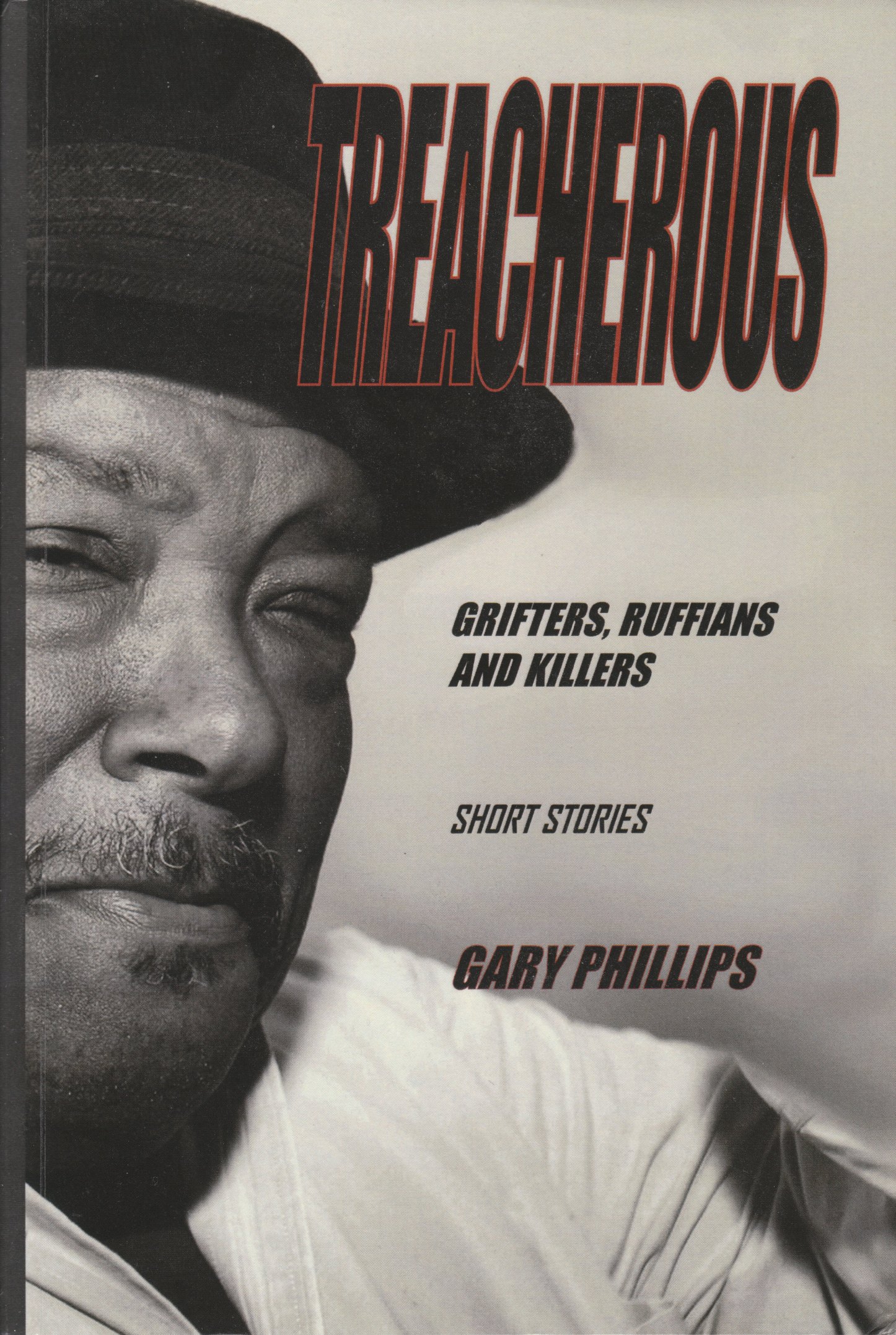
And I just found another installment in this life in Gary Phillips’ new collection Treacherous, where “McMillan flopped onto his stomach in his vintage Hawaiian shirt atop the ratty shag carpet.”

The story is “Disco Zombies” — I missed it when it originally appeared in 2005 in the theme anthology The Cocaine Chronicles. Like I was saying in my review column a few years ago, theme anthologies are taking over from magazines as the main source for new short fiction — true for almost everything Gary offers here.

A solid collection, lots of variety. “Disco Zombies” isn’t my favorite story in the book, but if you’re collecting This Life of Dennis, you’ve got to read it — Dennis and a Gary surrogate see their coke deal gone wrong and end up battling to the death against zombies. It could happen, right? Old Dennis definitely deserves this chance to battle some zombies.

Looking up potential links to the book, I was surprised to see each and every image showing a generic “suspense” cover, a shadowy woman in a lit doorway deal, while on the proof copy I have Gary himself makes the cover.

He should be on the covers of all his books.

And if you’re looking for other lives of Dennis to explore, his career as a publisher is good, too, and folds back into this book. For a complete Dennis collection you’ll want to get the dustjacket he did for his limited deluxe edition of Soul Circus by George Pelecanos, featuring Gary as a gangsta — but his edition never happened. Instead, 500 copies of the Gary dustjacket, signed by everybody involved, the only proof that edition was ever in the pipeline.

Now I’m wondering if the proof copies of this collection are going to be equally scarce.

Or, the Life of a Collector.

Posted in DMac, Lit | Tagged , , , , , , |