The newspaper reprint phenomenon has more elements than we have touched on.
For instance, newspapers seem to have had a habit of picking reprints from certain pulps.
Edgar Rice Burroughs and Dashiell Hammett we already know about, but I can attest that other authors from the Munsey group were also reprinted in newspapers; among them H. Bedford-Jones (John Solomon), Ray Cummings and Homer Eon Flint.
I own a reprint of Flint’s “The Missing Mondays,” a Munsey serial, reprinted complete in the Sunday March 3, 1940 issue of the Akron Beacon Journal in their “The Sunday Novel” feature, 17 years after it’s serialization in Argosy All-Story Weekly — and well after Flint’s death.
Who would have been marketing Flint’s old stories at that point in time, if anyone?
Perhaps Munsey. But my thought has been that some parent newspaper company to the Akron paper bought the rights years back and was just recirculating the story.
Think of the number of Hammett reprints there could be if parent companies bought story rights and then reprinted them in all their different papers over a period of years? Hearst, for instance?
I mean, who would have thought to check the Akron Beacon Journal for pulp magazine reprints?
Does the newspaper even exist today? Are their files on microfilm somewhere?
Edgar Rice Burroughs’ “The Man Eater” was only located decades later by going through records of every issue of the New York Evening World that was reprinting tons of his stuff.
That’s why I think that it would be impossible to locate every Hammett reprint, when you know that pulp reprints were appearing in totally obscure newspapers.
It reprints “The Creeping Siamese” — with the confusing cover teaser “New Complete ‘Thin Man’ Story by Dashiell Hammett Inside”.
Light editing removes any reference that dates the story to the 1920s, with a few other random touches, including a couple of unfortunate edits to Hammett’s dialogue.
However, it does not use the Dannay version. Most likely because it slipped into print before Dannay (editing as Ellery Queen) began his ambitious reprint program.
I’d like to know how much Hammett was making off these syndicated reprints.
And Woz offers this tip:
When it flashes up, download page 1, then 6 and 7.
If this link works, let me know and I’ll send you another (6-page) Antipodean installment — “First Aide” (i.e., “The Assistant Murderer”). Good Luck.
After the project with Ladd fell apart, some hopeful type tried to keep it going with the actor Bruce Cabot set for the lead.
I wonder how far that one got before it did a nosedive.
Cabot would have made a more authentic tough guy than Ladd in the role, but at over 6’1″ he wasn’t short and he wasn’t fat — not that I would expect Hollywood to cast some short fat actor in the gumshoes of the Continental Op. Even today.
His IMDb page is interesting. Best known (if known at all) as the manly swab Jack Driscoll opposite Fay Wray in the 1933 King Kong — but what a toehold on cinematic history. Apparently auditioned for the role of Ringo Kid in Stagecoach, but lost it to John Wayne. Right there, one hit the road to superstardom and the other faded into the background. Last film role, a backup character in Diamonds Are Forever (1971) — a canonical Bond/Connery-as-Bond flick.
Now I’m wondering whether or not our resident Autograph Hound Brian Leno has Cabot’s John Hancock. He might — he’s got Fay Wray.
But does Brian have a signature under Cabot’s full birth name Etienne Pelissier Jacques de Bujac?
Get on it, Brian.
Never in a million years would I have pulled that name out of the hat for Bruce Cabot.
In November I got an enthusiastic yet somewhat startled note from my academic pal Tom Krabacher, who said: “Here’s a Kickstarter that actually delivered!
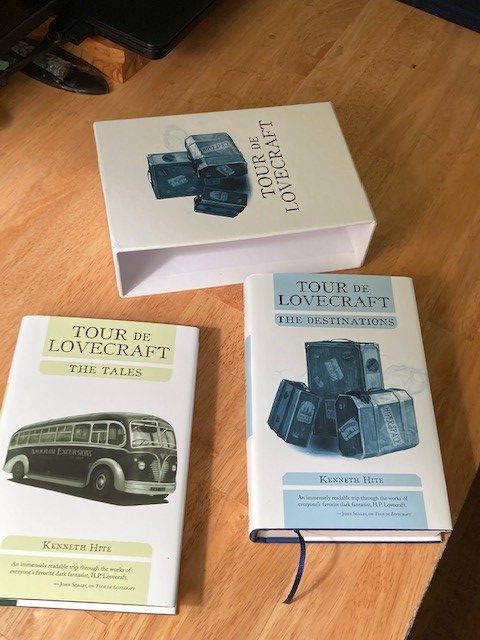
“The second volume of Ken Hite’s Tour de Lovecraft arrived a couple days ago. This one, The Destinations, looks at HPL’s use of locales, both real and imaginary.
“It comes with a updated and expanded edition of the earlier Tales volume in a nice slipcase. There’s a sewn-in bookmark ribbon and, for those of us who need them to decorate our Jr. High trapper keepers, some stickers as well.
“All at a very reasonable $35 price.
“The process wasn’t without glitches; the original delivery date was Halloween 1919, but delays with their Romanian printer and the pandemic got in the way. Still, there were regular updates and it came through in the end.
“No Chicken-Fried Cthulhu here!”
Krabacher is a big booster of the original Hite book — he loanered it to me awhile back — but I think he’s been burned on Kickstarter too many times for his own good. He likes to toss in money on potentially worthy causes, he really does, but resisted on Chicken-Fried Cthulhu because it was being done by some of the same people who put forth the magazine Skelos.
As I recall, the vague proposed plan was that Skelos would appear quarterly and so you’d Kickstart in for four issues, get them all in a year, then resub. I think the first three issues may have dribbled out over the course of three or four years, with a two or three year wait before issue four was pronounced as available.
Of course, Krabacher — who paid the full freight up front — has yet to receive his copy of that fourth issue. Makes you lose faith in humanity and its endeavors.
He’s lucky Hite can deliver.
And the guy knows a great book on Lovecraft when he sees one.
I did a quick Dashiell Hammett Tour by appointment on Saturday the 18th. Initially the guy had Monday the 13th in mind — you know, the day one of those atmospheric rivers unloaded the agua on the mean streets all day and night.
I told him he probably didn’t want to drown his parents on the walk, and we lucked out on a different day they were still in town on a visit.
The easy backstory is that his parents named him Dashiell, and he figured they might enjoy the tour. He’d been on the walk before himself, back in 2013, so it wasn’t just a shot in the dark.
I got to ask them about how they came to pull the name Dashiell out of all the names in all the cultures in all the world, and much of it was what I consider the usual. They like the stories — but they also respect Hammett standing up to McCarthy back in the blacklist days.
An even more specific detail helped nail down the name selection for them.
The mom noticed that Harry “The Hat” Anderson was naming his newborn Dashiell Anderson — born January 26, 1986 in the midst of Harry’s run as Judge Stone on Night Court, 1984-1992.
Dashiell — yeah, why not?
And so one new Dashiell quickly followed up another in that mid-80s boom.
Incidentally, on Wikipedia it notes that in 2002, Anderson and his second wife, Elizabeth, whom he met in New Orleans, opened a small shop in the French Quarter named “Spade & Archer Curiosities by Appointment” selling various “magic, curiosities, and apocrypha.”
The noted book and pulp collector Kevin Cook sent in some additional thoughts and info on the idea of writers such as Hammett getting a ton of newspaper action with reprints — lots of reprints — from their backlog. Kevin approaches the subject via Tarzan scribe Edgar Rice Burroughs.
“With the newspaper reprints the most interesting things the Burroughs fans found was additionally unknown illustrations by major artists like J. Allen St. John — the same may happen as enough different Hammett newspaper reprints are discovered, although illustrations for Hammett have never been a major focus for his collectors.
“Plus” Kevin continues, “some textual differences.
“For instance, additional text for Burroughs’ Beyond Thirty was found in newspaper printings that was not included in the All Around Magazine printing — and the newspapers were provided with their text from Burroughs’ manuscript rather than magazine tear sheets.
“Therefore, the missing text was written by ERB and edited out by Street and Smith editor A.L. Searles.
It may well be that the entire perception of the history of pulp fiction — or at least some of the major writers to emerge from the pulps — must be redone, taking all these newspaper appearances into the account.
Too bad figures such as H. P. Lovecraft or Robert E. Howard never got in on the newsprint. But newsprint could be a deciding factor alongside book publication that made some of the pulpsters famous more quickly.
“I watched Two Sharp Knives this afternoon,” Terry reports in, “and then re-read the story, which I hadn’t read in several years.
“It wasn’t bad for 1940s TV.
“They actually kept to the skeleton of the story and even used some of Hammett’s dialogue.
“I got a chuckle at how they tried to justify the title.
“There’s a brief scene where Scotty, the Police Chief, is shown drawing two sharp knives on a sheet of paper.
“No explanation.
“Two sharp knives don’t enter into the teleplay in any other way.
“Since they had Hammett right there they could have asked him about it and he could have told them that the editor at Colliers screwed up and the title should have been ‘To a Sharp Knife.’
“They could have added that bit of dialogue about ‘to a sharp knife comes a tough steak’ to the end — since they did include that final scene of Scotty and Wally just like in the story.”
Got a note in from Brian Leno immediately after he read Tom Krabacher’s report on the Windy City pulp convention, where the issue of Weird Tales with Margaret Brundage’s “Batgirl” cover went at auction for $11,000 plus 10% buyer’s premium.
“Just read Krabacher’s report,” Brian said, “and it made me wish I had been there with a fistful of cash.
“I was amazed at the price for the Weird Tales batgirl.
“Like Krabacher I don’t find the cover that remarkable — in fact, I’m really not a big Brundage fan.”
But it reminded him of an incident during one of his last years dealing cards in a lowlife gambling den, an authentic noir occupation.
“About 5 years ago I was sitting at work on a slow night with my Kindle and I saw that Weird Tales issue offered for $250.
“I snatched it up immediately.
“All those years of shuffling cards gave me fast fingers.”
Holy cow — suddenly it is Audio Hound Super-Sunday! And longtime Mean Streets maven Terry Zobeck just heard some sound he’s been waiting to hear for many, many long years.
Here’s Terry with the scoop:
In 2001, at the Washington, DC Bouchercon, Hammett’s daughter, Josephine Hammett Marshall, and granddaughter, Julie Rivett, along with Hammett biographer, Richard Layman, were in attendance to promote Jo’s memoir Dashiell Hammett: A Daughter Remembers. I had the pleasure of meeting them and spending a memorable and leisurely lunch with them.
Among the many questions I had for Jo was, since there were no recordings, what did Hammett’s voice sound like? She said it was a bit high-pitched but that was the best she could describe it.
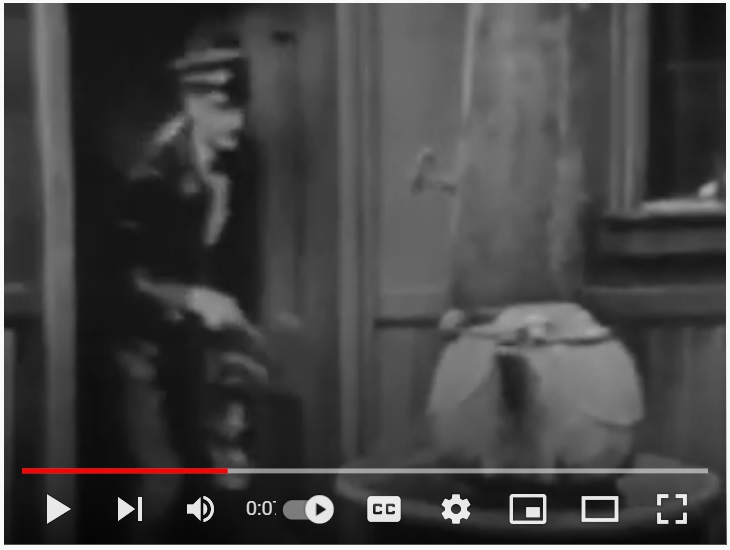
But it wasn’t until three years ago that a sharp-eyed Hammett aficionado named Thomas Fasano recognized Hammett in a brief scene. He posted it to YouTube on December 31, 2018. He notes that it is the only film footage of Hammett he’s been able to find, but he’s sure there must be more.
As regular visitors to the Mean Streets will know, Don has documented two previous bits of footage of Hammett — both are silent. But with the teleplay Two Sharp Knives, we have him speaking a couple of lines.
Hammett plays Skip, the ticket agent at the railroad station. The police have come to the station on a case and rouse him from reading Dick Tracy to ask about the arrival of a train.
Hammett’s scene comes at around the 9-minute mark. The episode also is available on DVD, paired another Studio One episode, There Was a Crooked Man. Several websites document this episode of Studio One but none of them note Hammett’s cameo.
I came upon this remarkable footage quite by accident. I’ve been researching the non-fiction articles of John Le Carré the past few weeks. I posted my initial findings to the FictionMags listserv. A fellow FMer, Bill Mullins, sent me the details of an online search he did that contained several dozen more articles of which I was completely unaware. Bill knew from earlier posts on FictionMags that Hammett was my favorite author. He sent me a search of another online service that contained hundreds of references to Hammett from newspapers.
I spent several hours scrolling through the search results. Most of the articles were book and film reviews and gossip column notices. The latter are of interest and deserving of a future post.
But a few of them discussed Studio One television productions of The Glass Key and Two Sharp Knives. These were unfamiliar to me so I clicked on the link to read about them.
The Glass Key was broadcast on May 11, 1949.
Two Sharp Knives aired during the program’s second season on November 14, 1949.
I then thought to see if they were available on YouTube and lo and behold, they were. But it was the second post for Two Sharp Knives — titled “Dashiell Hammett — Cameo in ‘Two Sharp Knives’” — that set my heart racing.
I contacted Richard Layman and asked if he were aware of this bit of history. Turns out Julie Rivett happened upon it a few weeks ago. She wasn’t sure it was her grandfather and wanted Rick to take a look and see if he could confirm it. He was able to quickly assure her it was indeed him.
We have Thomas Fasano’s sharp eye to thank for identifying this Hammett rarity — and Bill Mullins for sending me all those Hammett search results.
Welcome to a hard-boiled and not without noir blog with news and reviews, occasional outbursts of maniacal Autograph Hound activity, plus archival records from the forty-five year run of The Dashiell Hammett Tour.